
Which Freeze-Dried Mango Format Fits Your Product: Slices, Cubes, Bites or Powder?
Choose the format for what your line does to the fruit, not for how it looks in a sample pouch. Slices (6–7 mm) suit snack pouches and toppings. Cubes (5–10 mm) survive cereal mixers and bars. Bites (10–15 mm) suit snack mixes. Granules (2–5 mm) go into dough, tea and coatings. Powder (60–80 mesh) disappears into drinks, creams and chocolate. Every format is the same 100% mango at 3–5% moisture and water activity ≤0.30; what changes is breakage in your mixer and how fast moisture from the product around it reaches the fruit. Get those two right and a few grams of mango carry colour, a bright sweet-tart bite and a one-word ingredient line onto the front of your pack.
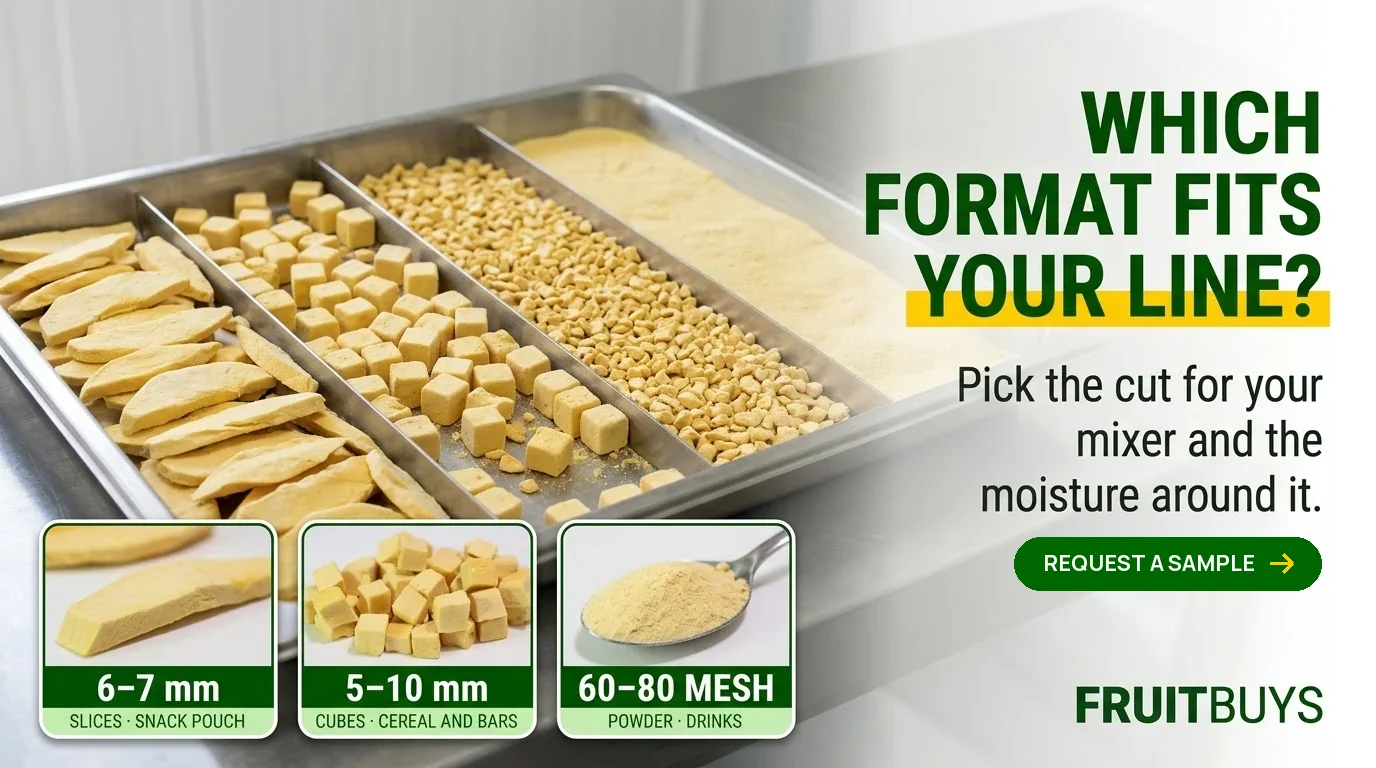
What are the five formats, and what is each one for?
Five cuts from the same fruit, each built for a different job.
Slices: 6–7 mm, for the snack pouch
Slices are the “mango chip” format: a full golden piece that snaps and then melts. At 6–7 mm thick (±0.5 mm) they are strong enough to survive the pouch and the voyage, with whole slices at ≥90% at release and ≥85% on arrival. Thinner slices look elegant but break heavily in handling: below 5 mm, mixer breakage can run above 25%. Grading at the facility already turns about 8–10% of slices into smaller pieces, which go into cubes, granules or powder rather than your pouch.
Best for: retail snack pouches, single-ingredient snacks, dessert garnish and post-bake toppings.
Cubes: 5–10 mm, for cereal, bars and chocolate
Cubes are the workhorse inclusion. A cube spreads load across its faces, so tumbling and conveying losses stay around 3–5%. 8–10 mm cubes suit granola and cereal; 6–8 mm cubes suit bars and chocolate. Keo mango is the standard cultivar for cubes because its firm flesh keeps sharp, uniform edges; softer Cát Chu frays when diced small.
Best for: breakfast cereal, granola and muesli, snack bars, chocolate tablets and inclusions, porridge cups. Doses and line handling for chocolate are in freeze-dried mango in chocolate.
Bites: 10–15 mm, for snack mixes
Bites are larger, chunkier pieces that read as “real fruit” in a trail mix or snack bag and hold their own next to nuts. They carry more visible colour per piece than cubes.
Best for: trail mix, snack mixes, larger-piece retail packs, ice cream toppings.
Granules: 2–5 mm, for dough, tea and coatings
Granules disperse evenly and rehydrate in about 30–60 seconds. They go inside dough where a cube would create wet pockets, and into tea blends and dry drink mixes where a visible fleck of fruit is wanted. They also flow without caking, which makes them a practical alternative to powder on lines that cannot keep powder dry.
Best for: bakery doughs and extruded snacks, tea blends, dry drink mixes, chocolate coatings with visible specks.
Powder: 60–80 mesh, for drinks, creams and colour
Powder is milled from the same freeze-dried mango, with no carrier. It colours and flavours without a visible piece and disperses in 30–60 seconds. It is the right format whenever the fruit is blended, whipped or melted. Doses, mesh choice and recipes are in the freeze-dried mango powder buyer’s guide and freeze-dried mango powder recipes.
Best for: smoothie and beverage mixes, yogurt and ice cream bases, white chocolate, frostings, baby puffs.
Need a different size? Custom cube and dice sizes are set on project orders and confirmed on a trial run before the container.
Which format fits your application?
Match the cut to the mixing your line applies and the water activity of the product around it.
| Application | Main risk | Recommended format | Key specification |
|---|---|---|---|
| Dry cereal, granola, trail mix | Breakage in drums and conveyors | Cubes 8–10 mm or bites 10–12 mm | Fines <2 mm ≤3% at release, ≤5% on arrival; 10–15% of the mix |
| Bars with a moist binder | Moisture moving from binder into fruit | Cubes 6–8 mm or granules 3–5 mm | Up to 15–20% inclusion; binder water activity ≤0.45; added last, pressed cold |
| Chocolate and confectionery | Humidity before coating | Cubes 5–10 mm or slices 6–7 mm; powder for colour | Coat promptly in a room below 35% RH; 5–12% fruit in chocolate |
| Yogurt and chilled desserts | Free water soaks the fruit in minutes | Bare cubes 6–8 mm in a separate dry compartment, or fat-coated cubes about 5 mm | Split cup or dome lid; direct contact only with a fat barrier |
| Bakery and extruded snacks | Heat and dough moisture | Granules 2–4 mm in the dough; slices only on top after baking | Long, hot bakes collapse the porous structure without fat protection |
| Retail snack pouch | Breakage in transit | Slices 6–7 mm | Whole slices ≥90% at release, ≥85% on arrival |
| Tea blends and dry drink mixes | Uneven dispersion | Granules 2–4 mm or powder 60–80 mesh | Disperse in about 30–60 seconds |
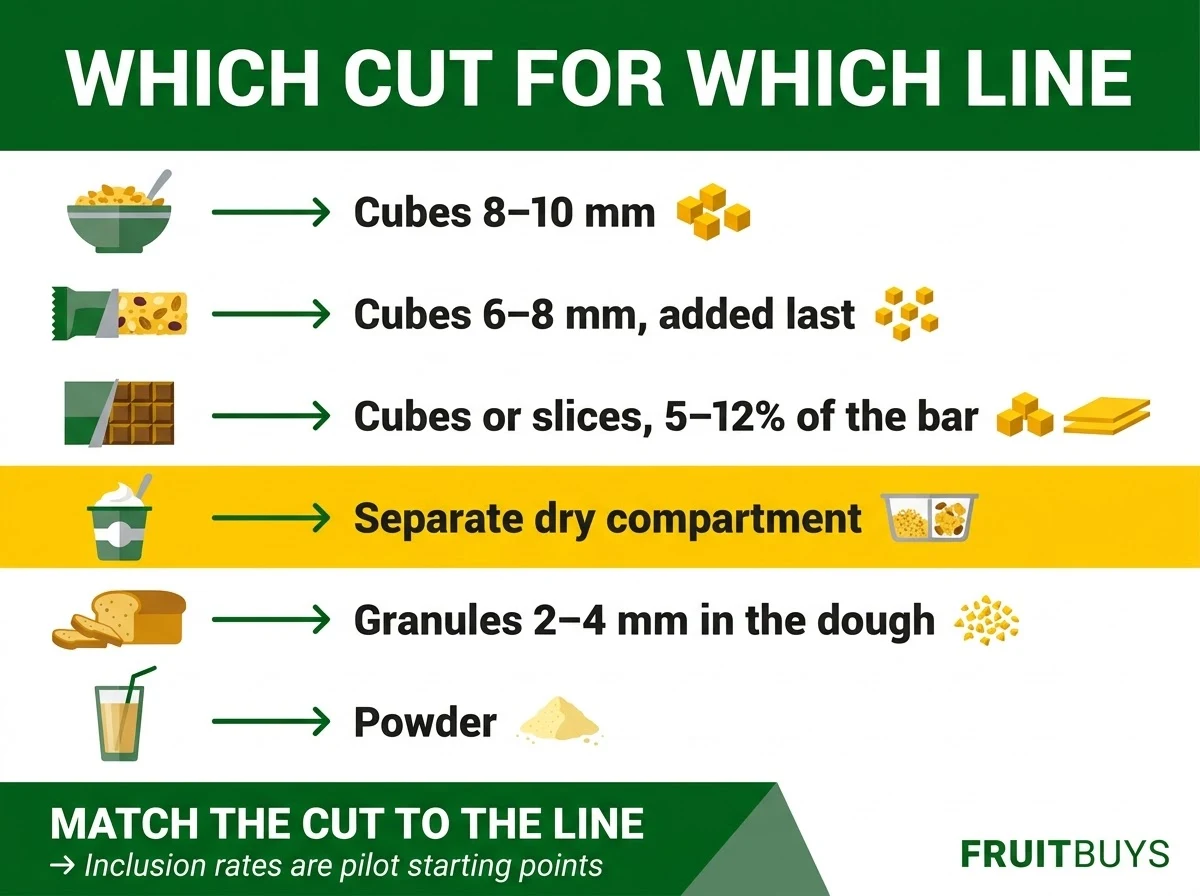
Inclusion rates are pilot starting points; your line trial fixes the final figure against appearance and cost.
How far does a kilogram of mango go?
Further than the price per kilogram suggests. At pilot starting rates:
| Product | Mango per unit | Units per kg of mango |
|---|---|---|
| Granola, 40 g serving at 10–15% | 4–6 g | about 170–250 |
| Chocolate bar, 100 g at 5–12% | 5–12 g | about 85–200 |
| Yogurt cup topping, 150 g at 6–10% | 9–15 g | about 65–110 |
| Snack pouch, 28 g | 28 g | about 36 |
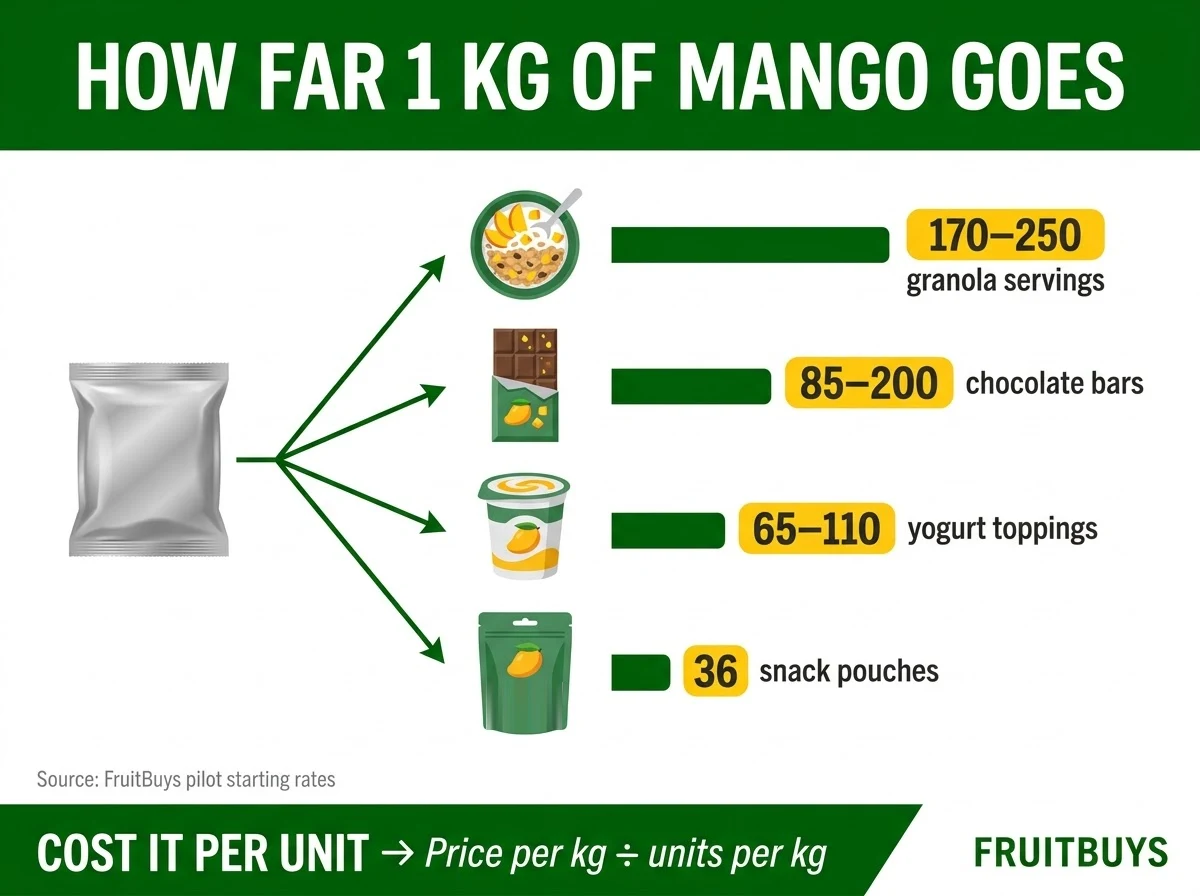
Cost per unit = your price per kg ÷ units per kg. A few grams of real fruit is what puts mango on the front of the pack. Cost it next to packaging and freight, not against the price of the cereal base. The full cost build-up from orchard to carton is in why freeze-dried mango costs what it does.
What does mango add that your customer notices?
Colour on the shelf, a bright acid note in the mouth and a “real fruit” ingredient line.
- Colour: straw-yellow to orange-yellow, matched to signed colour tiles, so every batch looks the same in pack photography and in store.
- Flavour: sweet and tart together. The acidity lifts white chocolate, yogurt and honey-bound bars that would otherwise taste flat.
- Texture: a light crunch that dissolves on the tongue, which reads as fresh fruit rather than fruit leather.
- Label: one word, “mango”, with no added sugar, supporting a “100% fruit” or “no added sugar” claim.
Why does freeze-dried mango break in commercial mixers?
Because the open, honeycomb structure that makes it crisp also makes it brittle, and thin flat pieces take the most damage. Slices thinner than 5 mm can lose more than a quarter of their weight to breakage in ribbon or paddle mixers; cubes lose around 3–5%. Cultivar matters too: Keo’s firmer flesh holds cube edges through handling, while Cát Chu produces more fines when diced small and is better used for slices or powder. Cultivar choice is covered in mango varieties for freeze-drying.
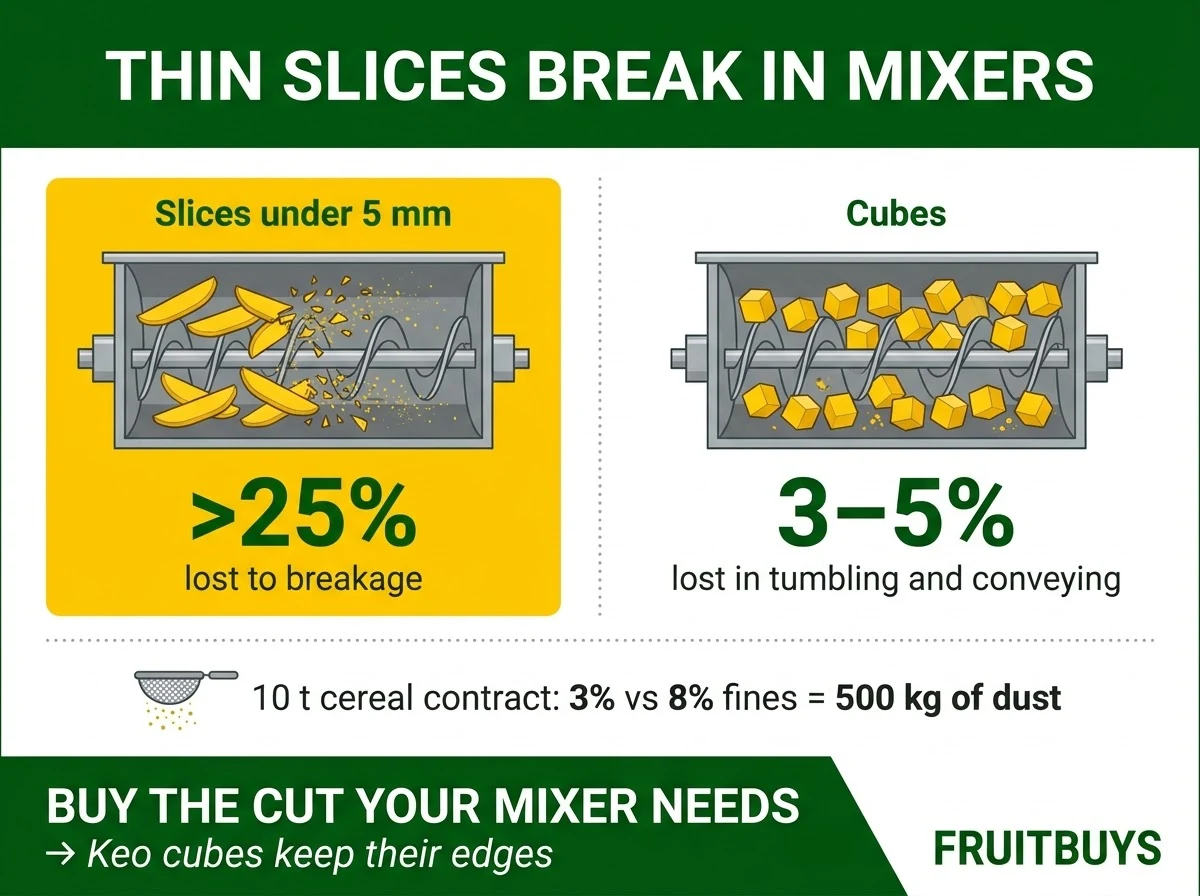
What fines cost you. On a 10-tonne cereal contract, the gap between 3% and 8% fines is 500 kg of dust in the bottom of the carton, raising your cost per usable kilogram. Put the fines limit in the contract and check it with a 2 mm sieve at receiving.
Why does freeze-dried mango go soggy in yogurt and bars?
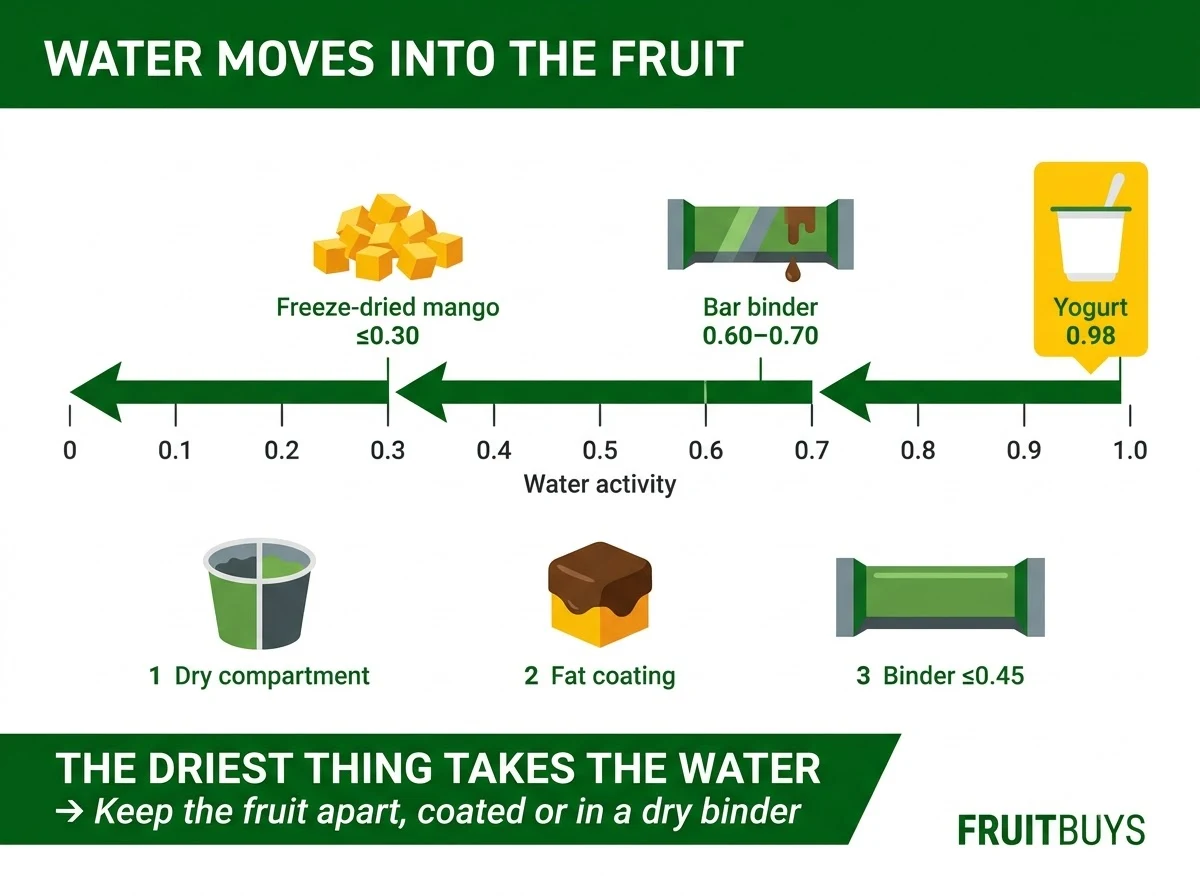
Because water always moves from higher water activity to lower, and the fruit is the driest thing in the product. Freeze-dried mango leaves at water activity ≤0.30. Yogurt sits near 0.98; chewy bar binders such as glucose syrup and honey run at 0.60–0.70. Once the fruit climbs to about 0.35–0.40 at room temperature, its sugars turn from glassy to rubbery and the piece goes leathery and sticky. In a bar with a binder above 0.6, uncoated pieces soften within a few weeks.
Three ways R&D teams keep it crisp:
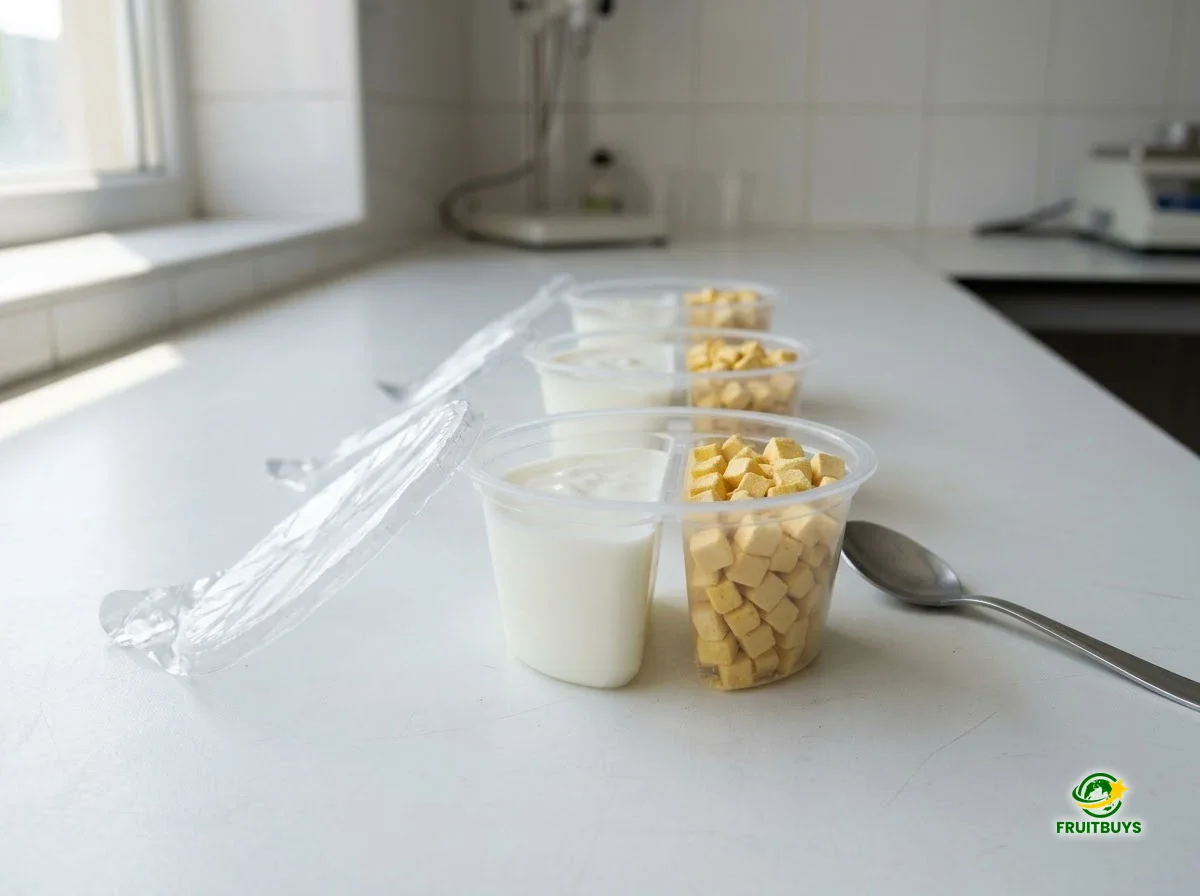
- Keep it apart in yogurt. Pack bare cubes in a sealed dry compartment, a split cup or dome lid, so the consumer adds them just before eating.
- Put a fat barrier around it. For direct contact with dairy or frozen desserts, coat diced mango in compound chocolate or a refined vegetable fat. The fat slows water uptake from minutes to days.
- Dry the binder, not just the fruit. For uncoated cubes in a bar with a long shelf life, bring binder water activity to 0.45 or below with glycerin, sorbitol or high-solids syrups, add the fruit last and press cold.
How do you run a format pilot that passes first time?
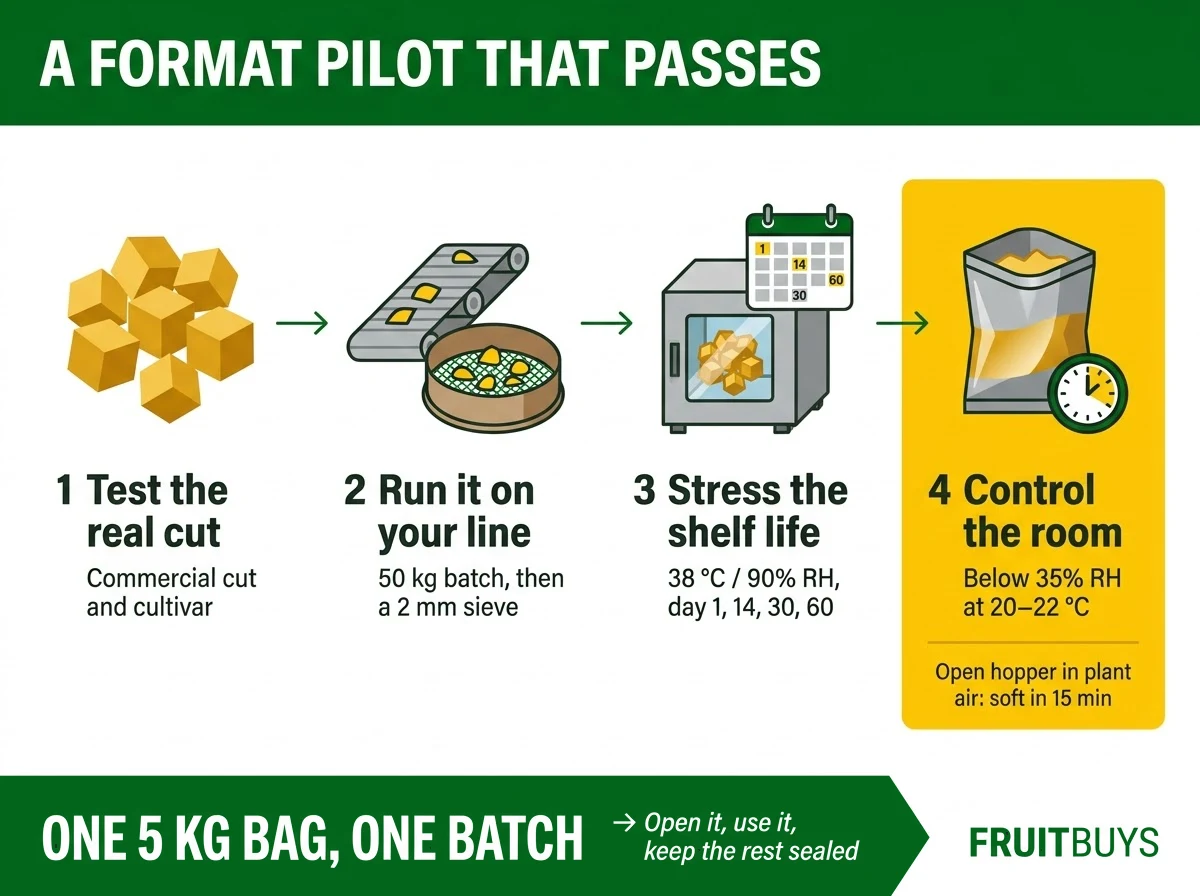
- Test the cut you will buy. Do not approve a cube programme on hand-cut slices; trial the commercial cut and cultivar.
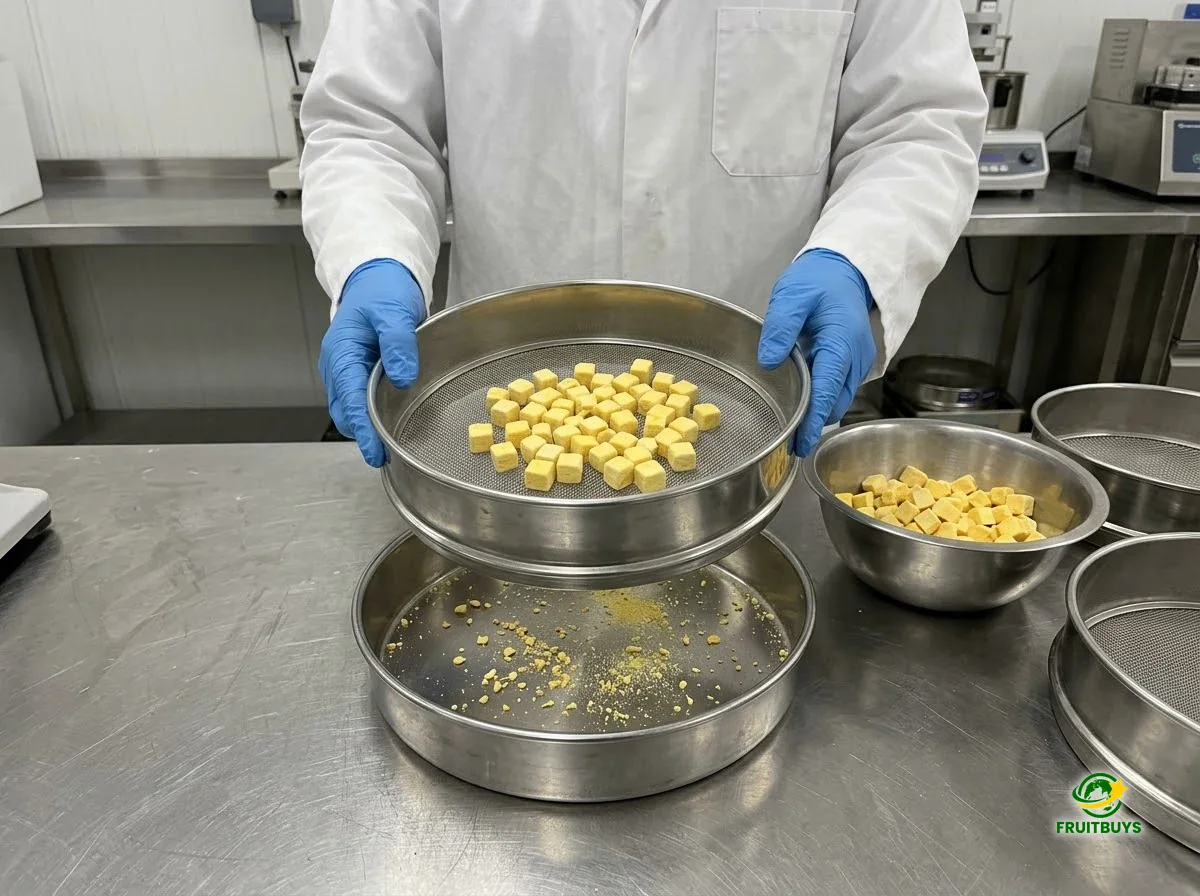
- Run it on your line. Put a 50 kg batch through your real conveyors, drums and weighers, then sieve over a 2 mm screen to measure the fines your line adds.
- Stress the shelf life. Store finished packs at 20–25 °C and at 38 °C / 90% RH; check texture, water activity and colour at day 1, 14, 30 and 60.
- Control the room. Open bulk bags only where the air is below 35% RH at 20–22 °C. In typical plant air at 60–70% RH, mango in an open hopper starts to soften within about 15 minutes. Each 5 kg bag is one batch: open it, use it, keep the rest sealed.
What goes into a format specification?
- Cut and tolerance: for example dice 8 × 8 × 8 mm, or slices 6–7 mm, ±0.5 mm
- Whole pieces: ≥90% at release, ≥85% on arrival
- Fines below 2 mm: ≤3% at release, ≤5% on arrival, measured by sieve
- Moisture and water activity: 3–5% and ≤0.30 on the same sample, as in the moisture and QA guide
- Packaging: 5 kg foil bags, gentle vacuum and desiccant, in 58 × 28 × 34 cm cartons, as in the packaging and shelf-life guide
- Approved sample: the reference for colour, cut and fines, as in the RFQ and sample approval checklist
Decision rule
- Snack pouch → slices 6–7 mm.
- Dry cereal, granola, trail mix → Keo cubes 8–10 mm or bites, fines ≤3% at release, mix cold.
- Bars → binder water activity ≤0.45, cubes 6–8 mm or granules, added last.
- Yogurt and ice cream → separate dry compartment, or fat-coated cubes.
- Bakery → granules 2–4 mm inside, slices only on top after baking.
- Drinks, creams, white chocolate colour → powder 60–80 mesh.
When is a freeze-dried format not the answer?
When your process cooks the fruit into a purée, jam or sauce, the crisp structure is not what your customer pays for: freeze-dried mango powder gives the colour and taste in one step, and frozen mango may do the job for less. For muffins, cookies and long bakes where shoppers expect a chewy piece, soft-dried mango holds its bite; FruitBuys supplies a low-sugar line at about 5% added sugar on request, compared in freeze-dried or soft-dried mango.
Get cut-specific samples
Send FruitBuys your process, mixer type and target inclusion rate. We send samples of the cuts you need from stock in 3–5 working days and recommend the specification for your line. Formats, cartons and container plans are on the freeze-dried mango product page; the wider programme is in the freeze-dried mango supplier guide.
support@fruitbuys.com · WhatsApp Export +84 919 739 589
FAQ
What sizes does freeze-dried mango come in?
Slices 6–7 mm thick, cubes 5–10 mm, bites 10–15 mm, granules 2–5 mm and powder at 60–80 mesh. Custom sizes are set on project orders.
Which freeze-dried mango format is best for cereal?
Keo cubes of 8–10 mm or bites of 10–12 mm, at 10–15% of the mix, with fines at or below 3% at release.
Why does freeze-dried mango go soft in yogurt?
Yogurt’s water moves into the dry fruit within minutes. Use a separate dry compartment or fat-coated cubes.
How much water do freeze-dried mango cubes take up?
About 2.5–2.8 times their dry weight in room-temperature water within 5–10 minutes, keeping around 80–85% of their shape, which suits instant oatmeal and porridge cups.
Can broken pieces and fines be used?
Yes. They carry the same flavour and colour; use them in truffle fillings, seasoning dusts or drink blends.