

What Packaging Keeps Freeze-Dried Mango Crisp, and Why Are You Paying Freight for Air?
Freeze-dried mango is single-ingredient mango (Mangifera indica L.) from the freeze-dried fruit range: a crisp, porous product that is shelf-stable at ambient temperature for as long as its packaging keeps moisture and oxygen out.
The two questions in the title have the same root. The open, porous structure that makes freeze-dried mango crisp is also what makes it pull moisture from the air and what makes a full container so light. Packaging is the only thing standing between the product and a soft, sticky bag, and the date you print on a private-label pack is only as good as the pouch, the seal and the gas inside it. Freight, meanwhile, is paid on space, not weight: a 20-foot container of freeze-dried mango slices holds about 1.35 to 2.1 tonnes, not the 20-plus tonnes it could carry.
Which pouch keeps freeze-dried mango crisp until the date on the label?
An aluminium-foil laminate with a nitrogen flush and a tested seal; metallised film is a step down, and ordinary snack film will not last. Freeze-dried mango leaves the factory below water activity 0.30 (the release limits are set out in our freeze-dried mango specification guide). From that moment, the pouch decides how fast it climbs back towards softness.
| Element | What FruitBuys specifies | Why it matters to you |
|---|---|---|
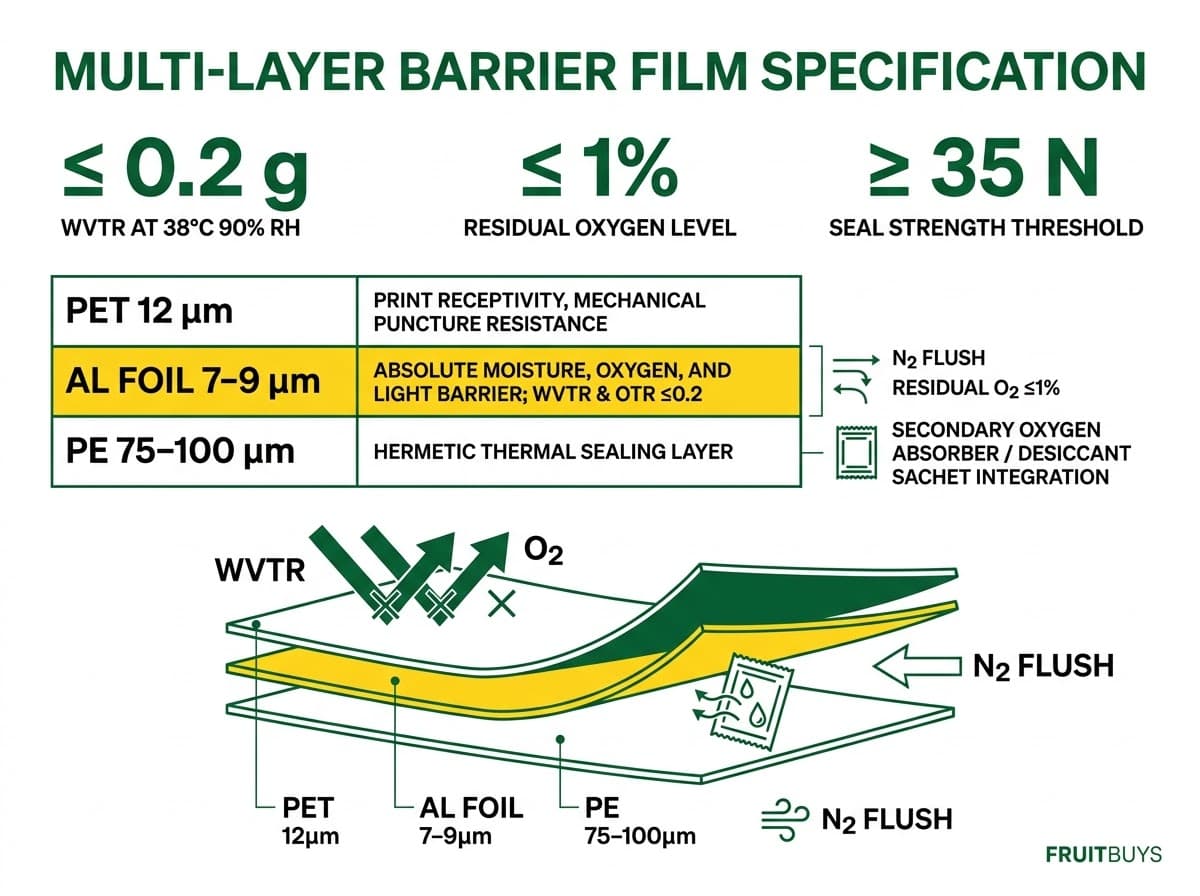
| Film structure | PET 12 µm/aluminium 7–9 µm / PE 75–100 µm | The foil layer is what blocks moisture, oxygen and light |
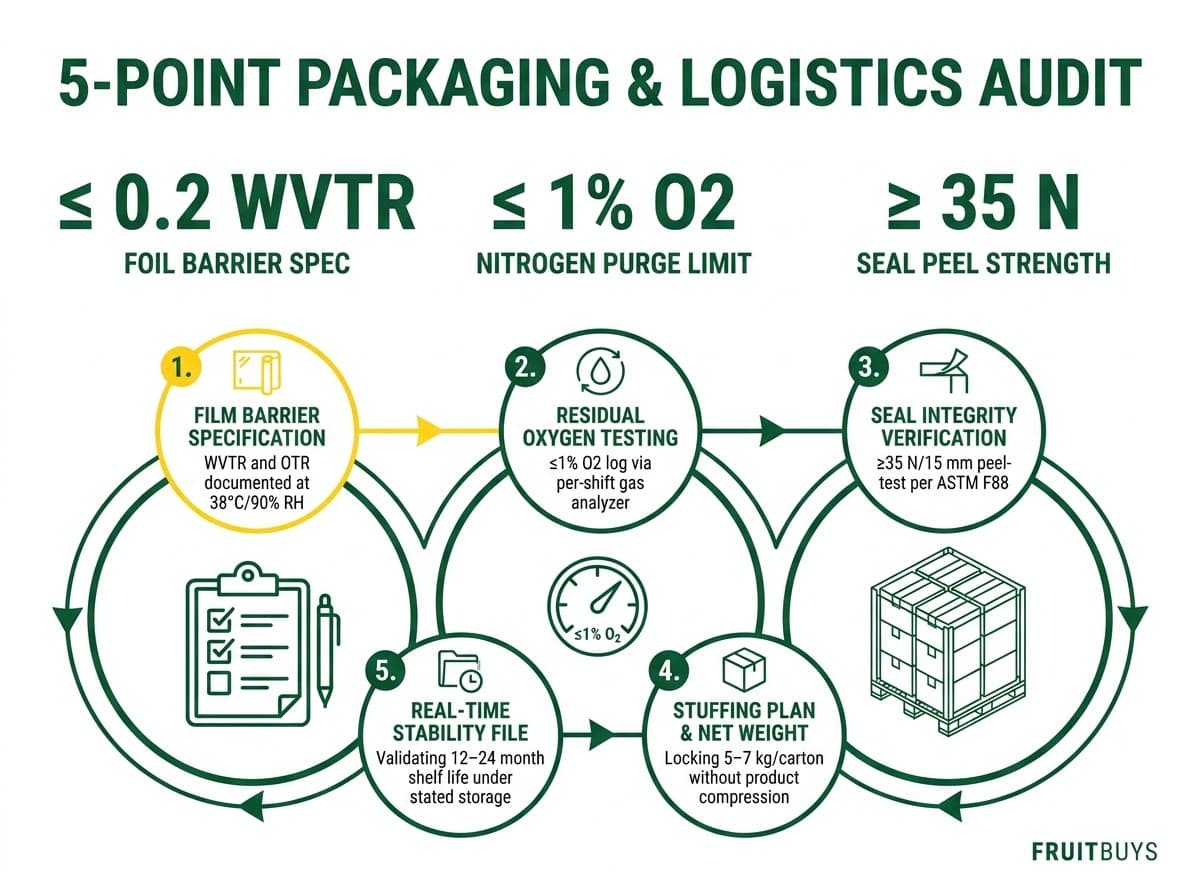
| Moisture barrier (WVTR) | ≤0.2 g/m²/day, measured at 38 °C, 90% RH | Water getting through the film is what turns crisp to leathery |
| Oxygen barrier (OTR) | ≤0.2 cc/m²/day | Oxygen drives off-flavors and color loss |
| Residual oxygen after nitrogen flush | ≤1% | Measured per lot with an oxygen analyzer |
| Seal strength | ≥35 N/15 mm, peel-tested each shift | A leaking seal defeats the best film |
| Retail pouch extras | Oxygen absorber (about 50–100 cc for a 50 g pouch) or food-grade desiccant (about 1 g per 100 g, not touching the product) | Buys margin for pouches that will be opened and resealed |
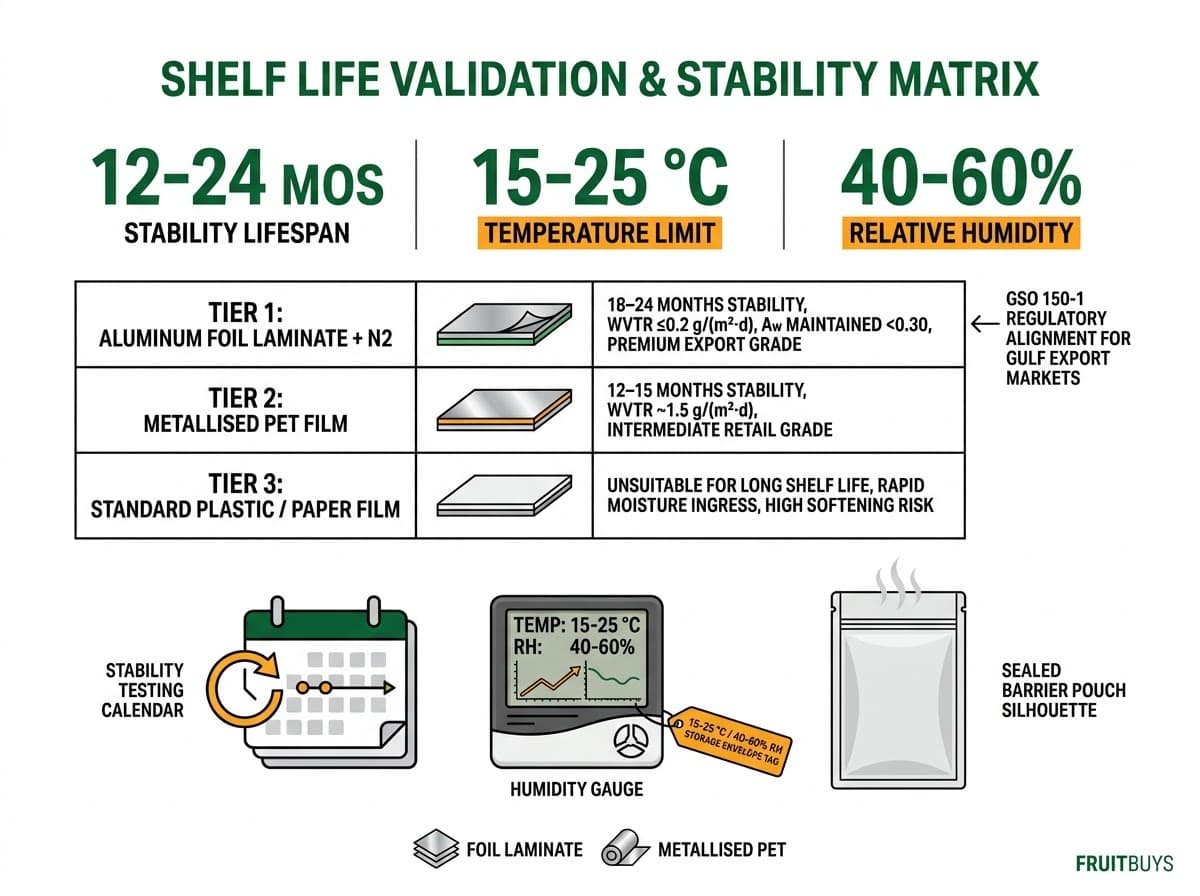
Metallised PET instead of foil can work for shorter shelf lives, with barrier figures typically around 1.5 rather than below 1. It is a legitimate cost choice if your printed date is shorter; it is not a like-for-like substitute.
How long a shelf life can I print on the pack?
FruitBuys works to 12–24 months for freeze-dried mango, and where you land in that range depends on the format, the barrier, the seal, the storage conditions and the stability evidence behind it. A foil pouch with nitrogen flush sits at the top of that range; metallised film at the bottom.
What turns a target into a date you can defend:
- Real-time evidence. Samples stored at your intended storage conditions and tested at intervals for water activity, texture and flavor. Accelerated tests at high temperature and humidity are useful for comparing pouches; converting them into a printed date is an assumption, not a proof.
- Storage conditions on the label. The reference is 15–25 °C and 40–60% relative humidity. A date validated at 20 °C does not hold in a 35 °C warehouse.
- Market rules. Gulf markets set shelf-life expectations through GSO 150-1, check the entry for your product before printing.
If a supplier offers a longer date than their pouch and data can support, the private-label brand carries the risk: stock that softens before its date is marked down or withdrawn under your name, not theirs.
Why do packs go soft before the printed date?
Almost always because one of four things was not specified: the film, the test conditions, the seal or the oxygen scavenging.
- The wrong film. Kraft paper with a thin compostable liner, or standard PET/PE snack film, lets moisture through far faster than foil. Some films quote an excellent oxygen barrier while the moisture barrier, the one that matters for crispness, is orders of magnitude worse.
- Barrier figures without test conditions. The same film can let through many times more moisture at 38 °C and 90% RH than at mild conditions. A WVTR figure without its test temperature and humidity cannot be compared.
- No seal record. A small channel in a seal lets humid air in continuously. Without a peel-test log per shift, you cannot tell a film failure from a sealing failure.
- No oxygen control. Without nitrogen flush or an absorber, residual oxygen oxidizes flavor and color, and the product tastes stale even when it is still crisp.
Does freeze-dried mango need a refrigerated container?
No. At water activity below 0.30 in sealed barrier packaging it ships in a standard dry container. Heat is not the main enemy; humidity and condensation are. On long routes, especially to the Gulf, containers can reach about 50 °C inside, and temperature swings cause “container rain” on cartons. Protect the load with desiccant strips in the container, sound cartons and intact inner bags. Refrigerated shipping is needed for some soft-dried mango lines, which sit at much higher moisture; do not carry that requirement over to freeze-dried.
Why does a full container weigh so little?
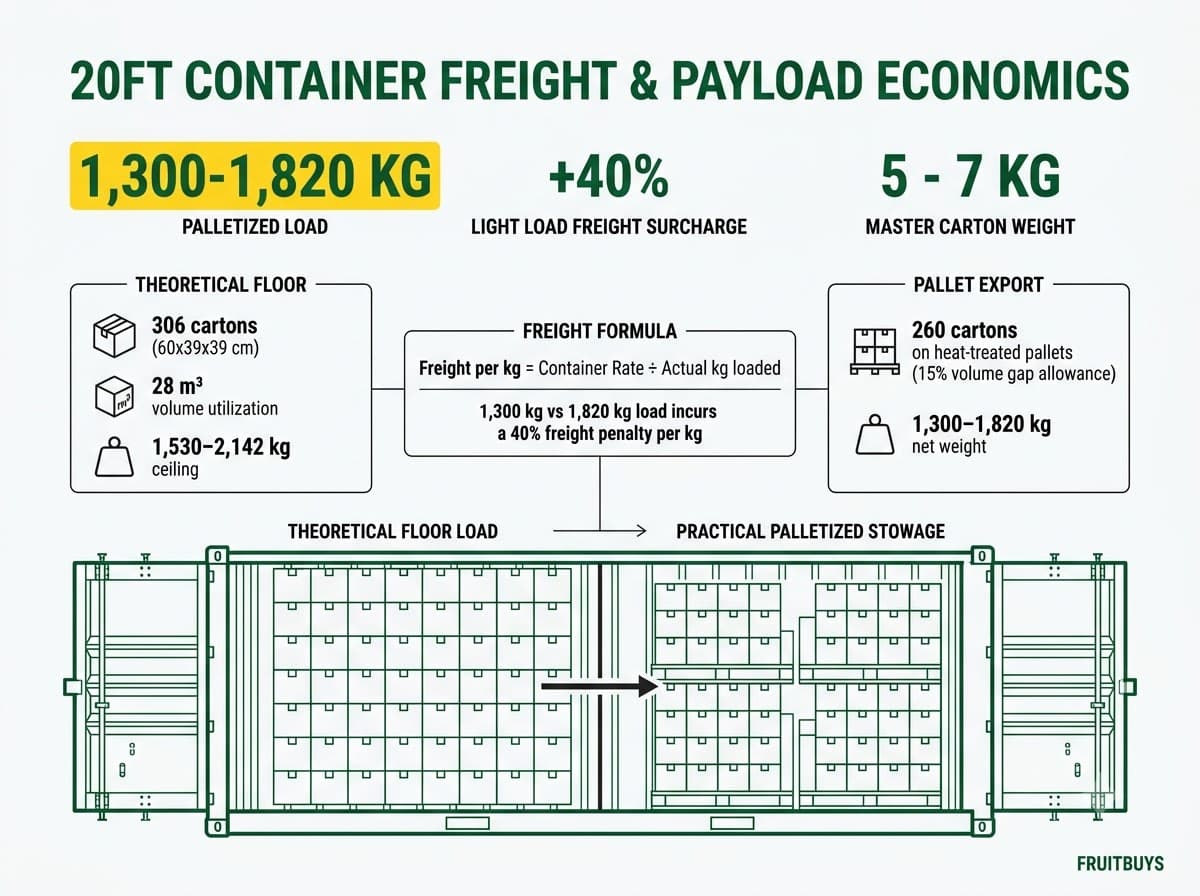
Because freeze-dried mango fills space long before it reaches any weight limit, so you pay freight per cubic metre, not per kilogram. A standard export carton of 60 × 39 × 39 cm holds about 5–7 kg of freeze-dried mango slices, depending on slice thickness. That is roughly 55–77 kg per cubic metre of carton. The container itself would accept well over 20 tonnes.
For a 20-foot container, the conservative planning range is 270–300 cartons, or about 1.35–2.10 tonnes of slices. The full geometric layout, clearance assumptions and 40-foot figures are owned by our Freeze-Dried Mango Container Planning Guide; use its stuffing ranges when you budget freight.
What this means for your costs:
Freight per kg = container freight ÷ kg loaded. At the same container rate, a load of 1,350 kg costs about 56% more per kilogram than a load of 2,100 kg, which feeds straight into your landed cost per usable kilogram. Carton weight is therefore a freight lever. But there is a limit: pack the cartons heavier by compressing the product and the porous slices break, and you pay for that in fines and downgraded product instead of freight.
How do I plan freight without surprises?
- Budget freight per cubic metre, then divide by the kilograms actually loaded, not by the container’s weight limit.
- Ask for a stuffing plan with carton count, net weight per carton and total net weight before booking.
- Consider denser formats for ingredient use. Dice and granules pack more kilograms per carton than whole slices; slices are worth their freight only where the shape matters. Our freeze-dried mango formats guide shows which cut each application needs.
- Consolidate. Mixed loads with other products can fill the weight capacity that freeze-dried mango leaves unused.
- Do not trade freight for breakage. Ask what net weight per carton the supplier can load without crushing the product.
Packaging and loading checklist for the contract
- Film structure with WVTR and OTR stated, including test temperature and humidity, backed by the film supplier’s data sheet
- Nitrogen flush with residual oxygen ≤1%, recorded per lot
- Seal strength ≥35 N/15 mm, with peel-test records per shift
- Oxygen absorber or desiccant for retail pouches, food-grade, not in contact with the product
- Water activity measured at packing, on the lot COA
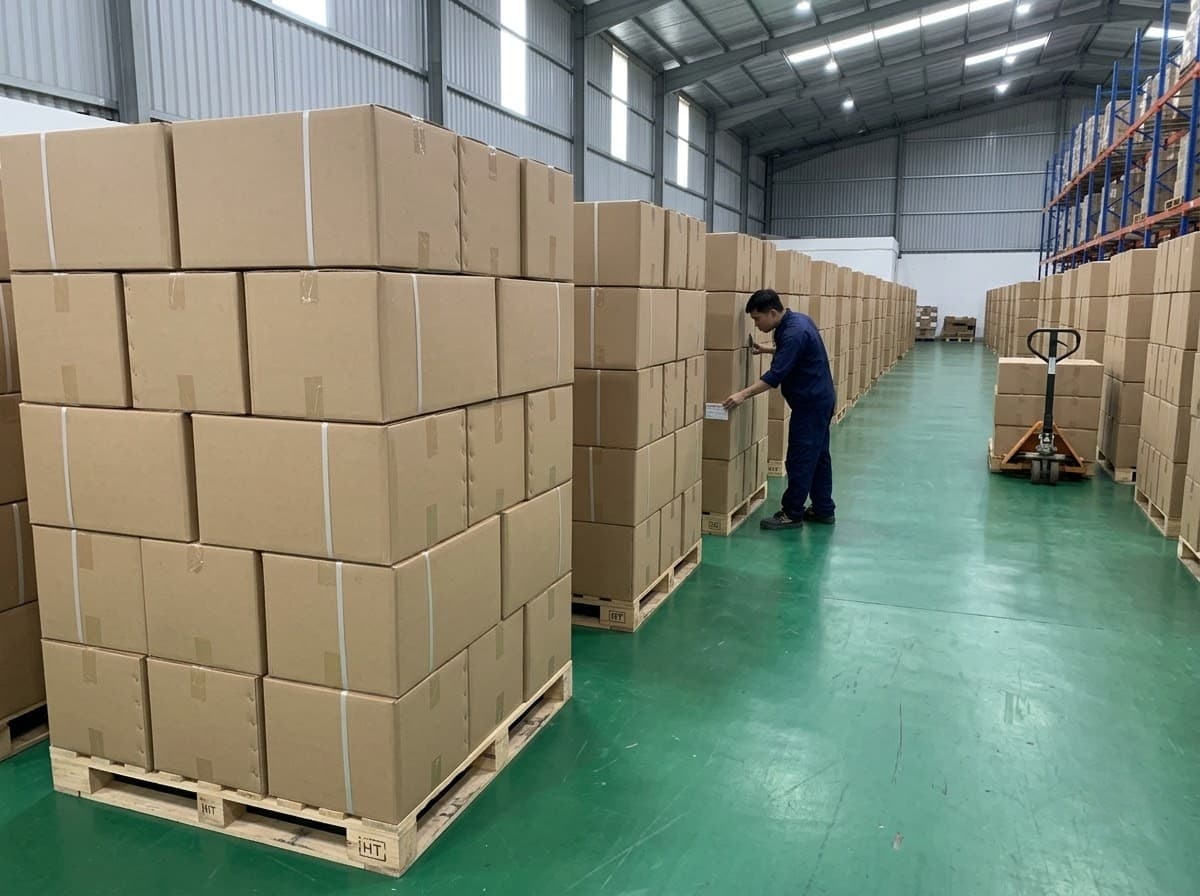
- Carton size, net weight per carton and inner-bag configuration written into the specification
- Stuffing plan with carton count and total net weight before booking
- Shelf-life claim supported by real-time stability data at stated storage conditions
Where freeze-dried mango does not fit
If your channel cannot hold stock below about 25 °C and 60% humidity, or your packaging budget allows only standard snack film, a long printed shelf life is not realistic. Shorten the date, move to foil, or consider a product that tolerates weaker packaging. And if freight per kilogram decides your margin, freeze-dried mango will always look expensive next to denser dried fruit; buy it where the crisp texture earns that freight back. Hold us to the same packaging checks as any other supplier. If a cheaper drying method may suit your channel better, compare the options in freeze-dried or dried mango.
FAQ
Can I use recyclable or compostable packaging?
Yes, but check the moisture barrier at 38 °C and 90% RH first. Most current compostable films cannot match foil, so expect a shorter shelf life.
How many kilograms fit in a 40-foot container?
It depends on the carton plan for that container. Ask for a stuffing plan rather than scaling up the 20-foot figure. Our Freeze-Dried Mango Container Planning Guide publishes the 40-foot layout and conservative ranges.
Talk to us about your packaging and shipping plan
Planning a private-label launch or booking your first container? Send us your pouch size, target shelf life, storage conditions and destination port. FruitBuys will propose a barrier specification and a stuffing plan built for freight per kilogram, so you can see the loaded weight before you book. Reach our team from the freeze-dried mango product page.
Sources & Technical References
- FruitBuys Vietnam: “Premium Freeze Dried Mango”: release targets of 3–5% moisture and water activity below 0.30; shelf life of 12–24 months subject to format, packaging barrier, seal integrity, storage conditions and shelf-life validation. (https://fruitbuys.com/product/freeze-dried-mango)
- ASTM International: “ASTM F88/F88M Standard Test Method for Seal Strength of Flexible Barrier Materials”. (https://www.astm.org/f0088_f0088m-21.html)
- GCC Standardization Organization: “GSO 150-1:2013 Expiry periods for food products – Part 1”. (https://www.gso.org.sa/store/standards/GSO:615086/GSO%20150-1:2013?lang=en)
- European Union: “Regulation (EC) No 1935/2004 on materials and articles intended to come into contact with food”: food-contact compliance for packaging films. (https://eur-lex.europa.eu/eli/reg/2004/1935/oj/eng)
Basis note: film structure, barrier limits, residual oxygen, seal strength, absorber and desiccant quantities and 5–7 kg per carton are FruitBuys working specifications and field guidance. Metallised film figures, storage conditions and the 50 °C container temperature are industry benchmarks. Container loads and the 56% freight difference are calculations; confirm every shipment against a stuffing