Freeze-Dried Mango Powder or Spray-Dried: Which One Is Your Formula Actually Buying?
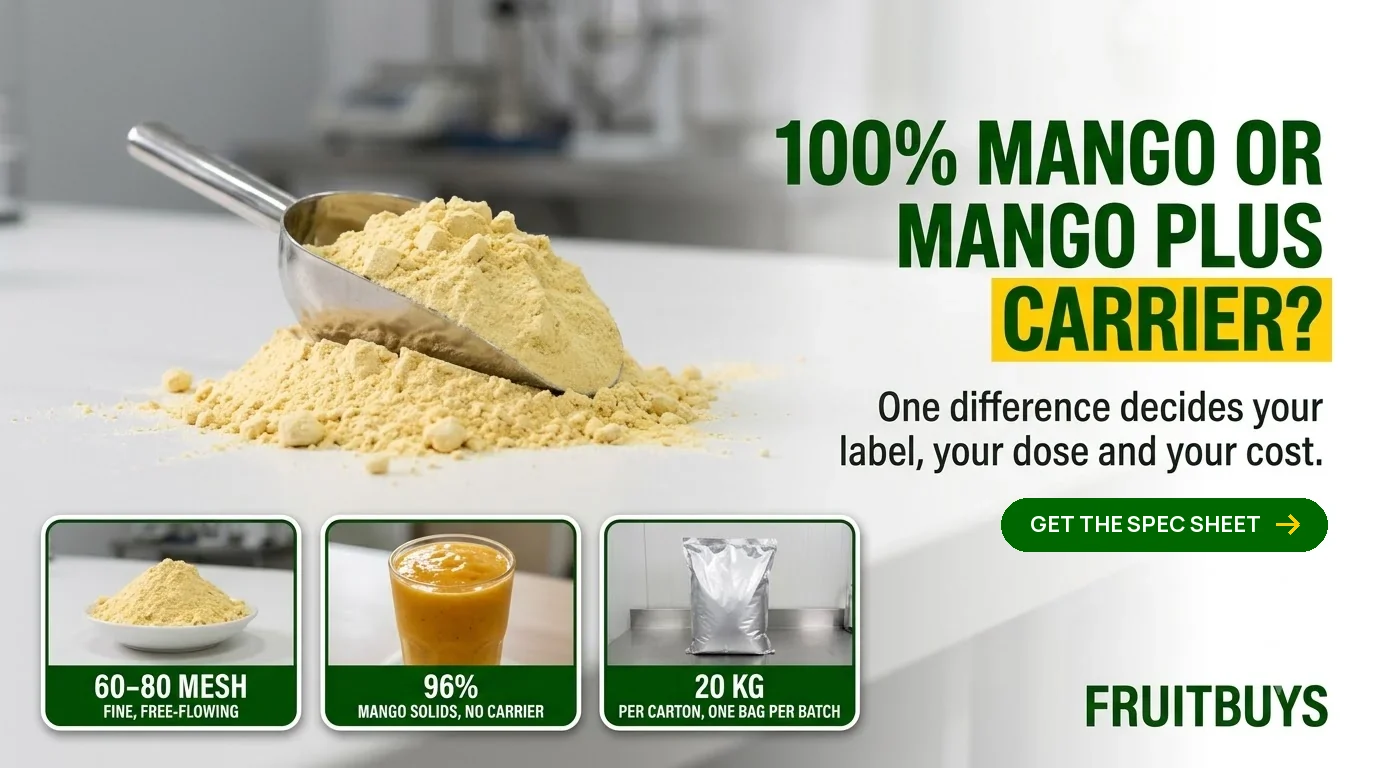
Freeze-dried mango powder is 100% mango; most spray-dried mango powder is mango plus 15–30% maltodextrin. That one difference decides your ingredient line, how much real fruit each kilogram carries and how much powder you need per serving. Choose freeze-dried when mango is the hero of the label, the colour or the mouthfeel. Choose a carrier-based powder only when price per kilogram leads and the mango sits behind other flavours. FruitBuys supplies freeze-dried mango powder at 3–5% moisture, water activity ≤0.30 and 60–80 mesh, in 20 kg cartons, with samples in 3–5 working days.
Open a bag and the difference is visible: a bright golden-yellow powder that smells of ripe mango rather than of a flavouring. Stirred into milk or a smoothie it turns orange-gold and gives a thick, pulpy body, because the fruit’s own fibre is still there.
What is the real difference between freeze-dried and spray-dried mango powder?
Freeze-dried powder is milled from dried fruit; spray-dried powder is liquid mango sprayed into hot air, and it needs a carrier to dry. Mango sugars turn sticky in a hot chamber. To stop the powder coating the dryer walls, spray-drying typically blends in 15–30% maltodextrin, which keeps the particles dry. That carrier is part of every kilogram you buy.
| What you care about | Freeze-dried powder | Spray-dried powder |
|---|---|---|
| What is in the bag | 100% mango | Mango plus typically 15–30% maltodextrin |
| Ingredient line | “Mango” | “Mango, maltodextrin” |
| Mango solids per kg | about 96% | about 65–82% |
| Flavour and colour | Close to ripe fruit, no heat step | Lighter, diluted by the carrier |
| Body in drinks | Pulpy, from the fruit’s fibre | Thinner |
| Flowability | Needs dry handling or a free-flow agent | Flows easily thanks to the carrier |
| HS direction | 1106.30, powder of Chapter 8 fruit | Often outside 1106 once a carrier is added |
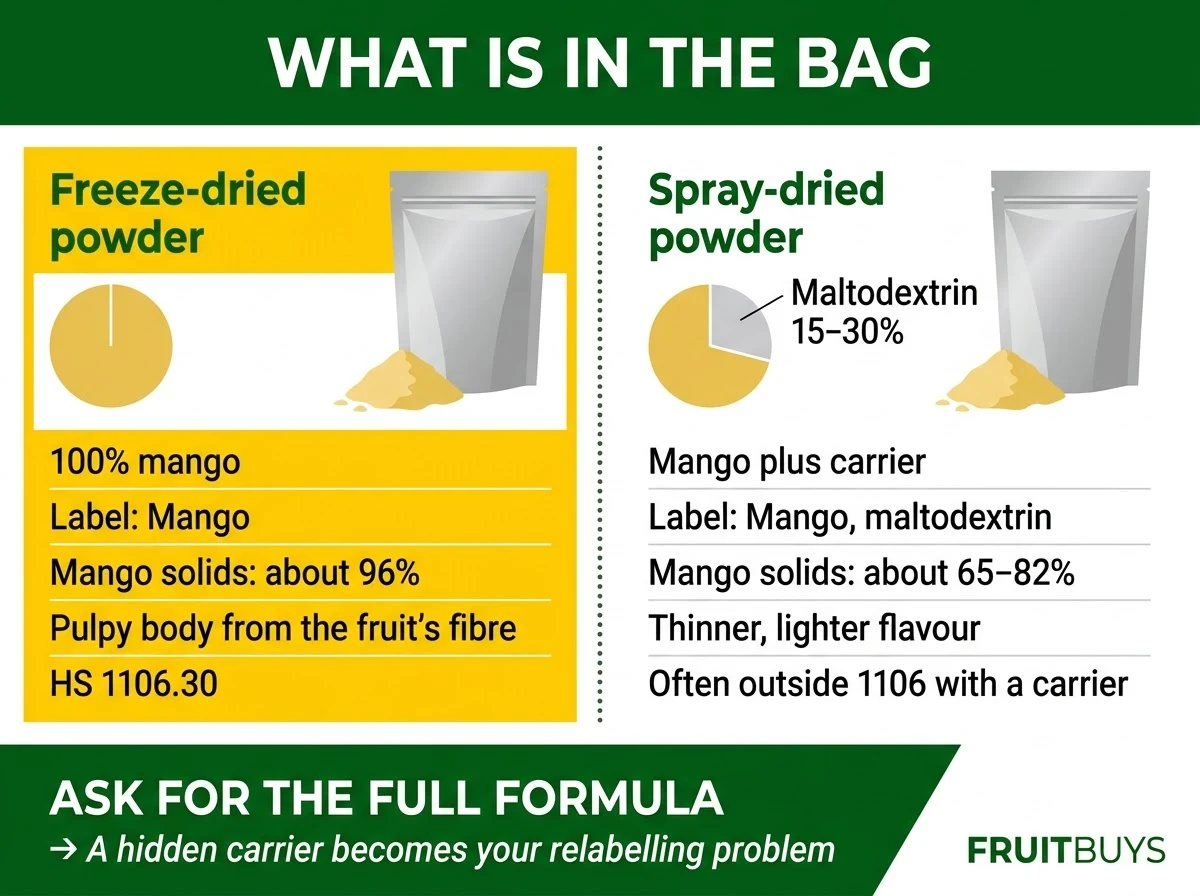
A “100% fruit” or “no additives” claim needs a carrier-free powder. A spray-dried powder whose label lists only mango deserves a request for the full formula with percentages before you approve it, because a carrier missing from the label becomes your relabelling problem at launch.
How much real mango does each kilogram give you?
About 96% in freeze-dried powder, about 65–82% in a carrier-based powder. Freeze-dried powder is mango with 3–5% water left in it. A spray-dried powder at 15–30% carrier, plus its own moisture, delivers roughly two-thirds to four-fifths mango.
That gap shows up in your dose. To match the colour and flavour of a freeze-dried powder, a carrier-based powder usually needs a higher inclusion, and every extra gram adds maltodextrin to the formula. Compare quotes on the same basis:
Cost per kg of mango solids = price per kg ÷ mango solids fraction
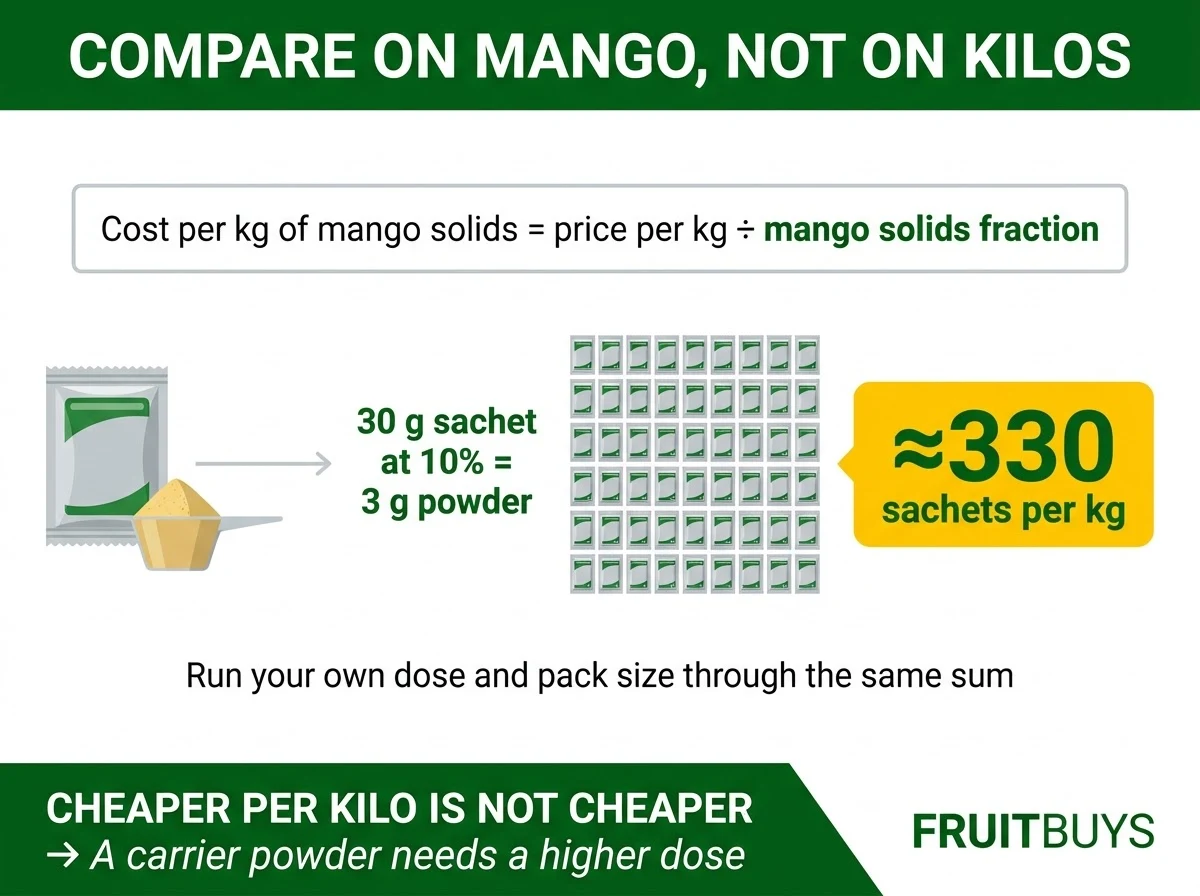
Then compare cost per serving: a 30 g smoothie sachet dosed at 10% uses 3 g of freeze-dried powder, so one kilogram covers about 330 sachets. Run your own dose and pack size through the same sum before you decide which powder is “cheaper”.
How does Vietnamese mango powder taste next to Alphonso or Kesar?
Brighter and more sweet-tart. Powder carries the flavour profile of its cultivar, so choose the fruit before the drying method.
- Keo (FruitBuys standard): a clean sweet-tart mango note with a light, fresh finish. It sits well in yogurt, smoothies and white chocolate, where a little acidity cuts richness.
- Cát Chu (on request): sweeter and more aromatic, with a fuller tropical nose, for drinks and desserts where mango is the headline flavour.
- Alphonso and Kesar (India): rich, deep-orange, intensely aromatic profiles with a creamy, almost saffron-like character, long associated with mango lassi and dessert bases.
If your brand is built on the Alphonso or Kesar taste, source that cultivar from its home origin. If your brief is a fresh, bright mango note with a clean label and container-scale supply across most of the year, Vietnamese Keo and Cát Chu powder is the efficient choice. Cultivar and season are covered in sourcing freeze-dried mango from Vietnam.
Which particle size should you specify?
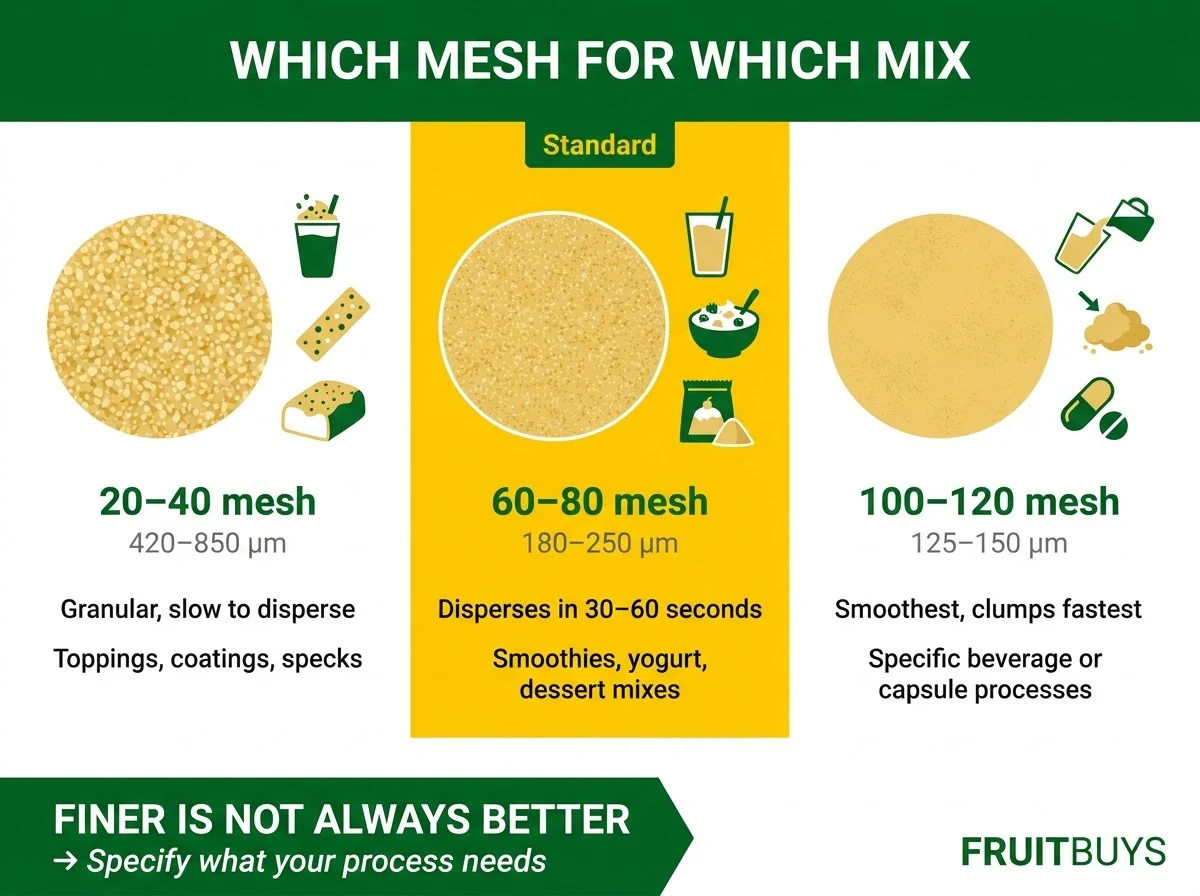
60–80 mesh for most drink and dessert mixes; finer only if your process needs it.
- 20–40 mesh (about 420–850 µm): granular and slow to disperse, for toppings, coatings and visible specks.
- 60–80 mesh (about 180–250 µm, FruitBuys standard): disperses in 30–60 seconds and resists clumping, for smoothie and beverage mixes, yogurt and dessert powders, bakery creams.
- 100–120 mesh (about 125–150 µm): very fine and smooth, but it clumps fastest when wetted or exposed to humid air; on request for specific beverage or capsule processes.
How does it behave in drinks?
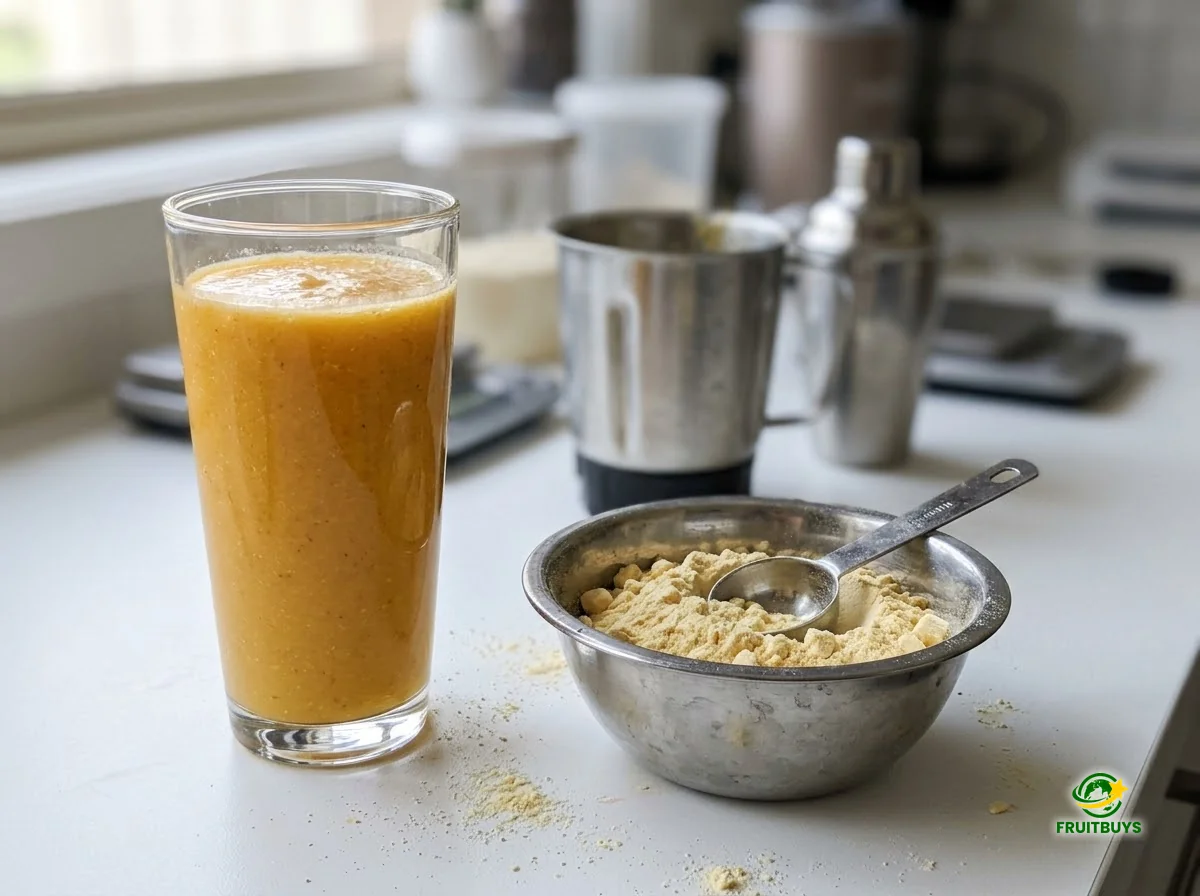
It disperses rather than dissolving clear, and that is the point. The fruit’s fibre stays in suspension, which gives smoothies, shakes and lassi-style drinks real body and a natural orange-gold colour. For ready-to-mix sachets, blend the powder into the dry base last, and add it to cold liquid with a few seconds of shaking or blending. For a clear drink, a juice concentrate is the better ingredient; FruitBuys will say so on the first call.
Why does mango powder cake, and how do you stop it?
Because it is pure fruit. With no carrier to dilute the sugars and far more surface than pieces, it pulls moisture from the air fast. Opened in a room above 60% RH, it starts to clump within about 20–30 minutes. Two clean choices:
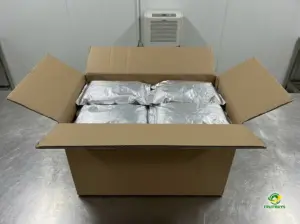
- Clean label. Keep the powder 100% mango. FruitBuys packs it in 5 kg foil inner bags, four to a 20 kg carton, so each bag is one mixing batch: open it in a dry room, use it through the shift, and the rest stays sealed.
- Free-flowing. Add 1–2% silicon dioxide on request. It flows through dosing equipment without bridging, but it goes on your label and can change the HS classification, so decide before you order.
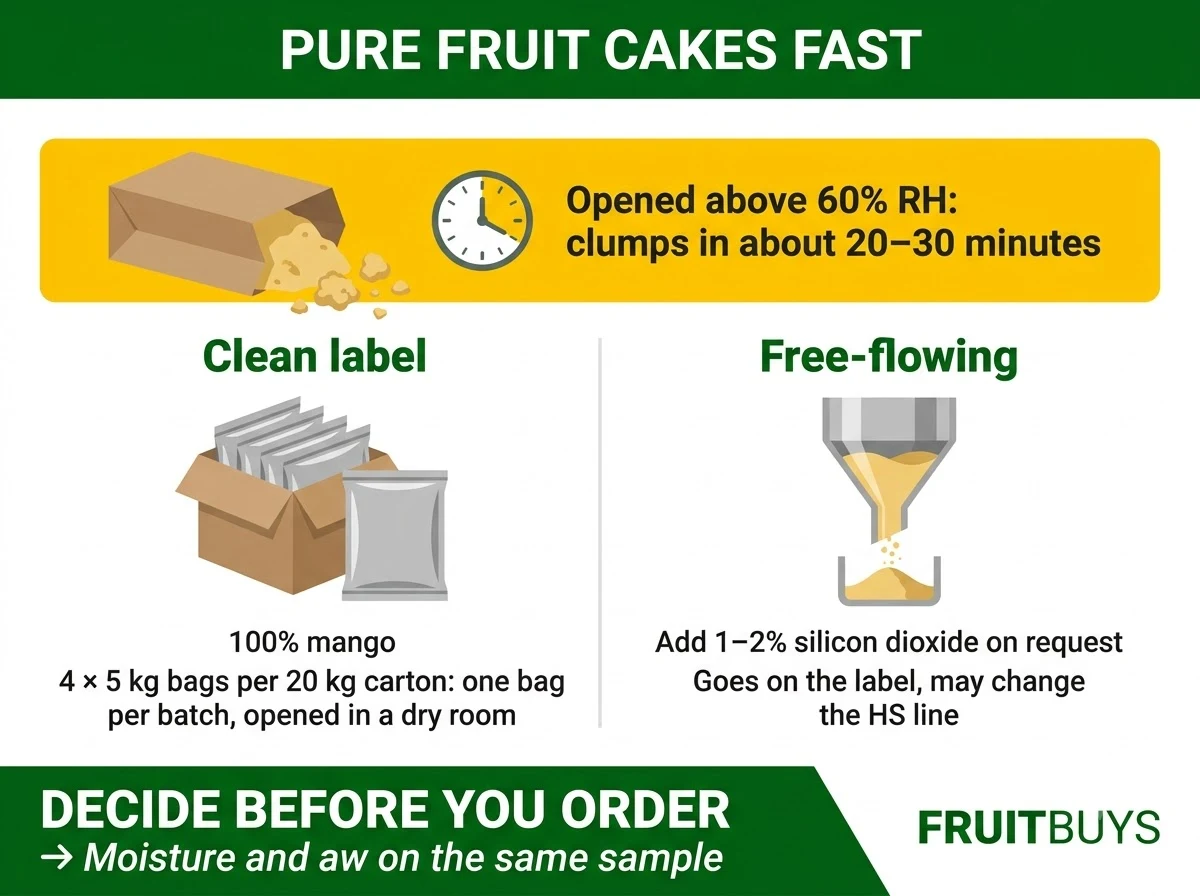
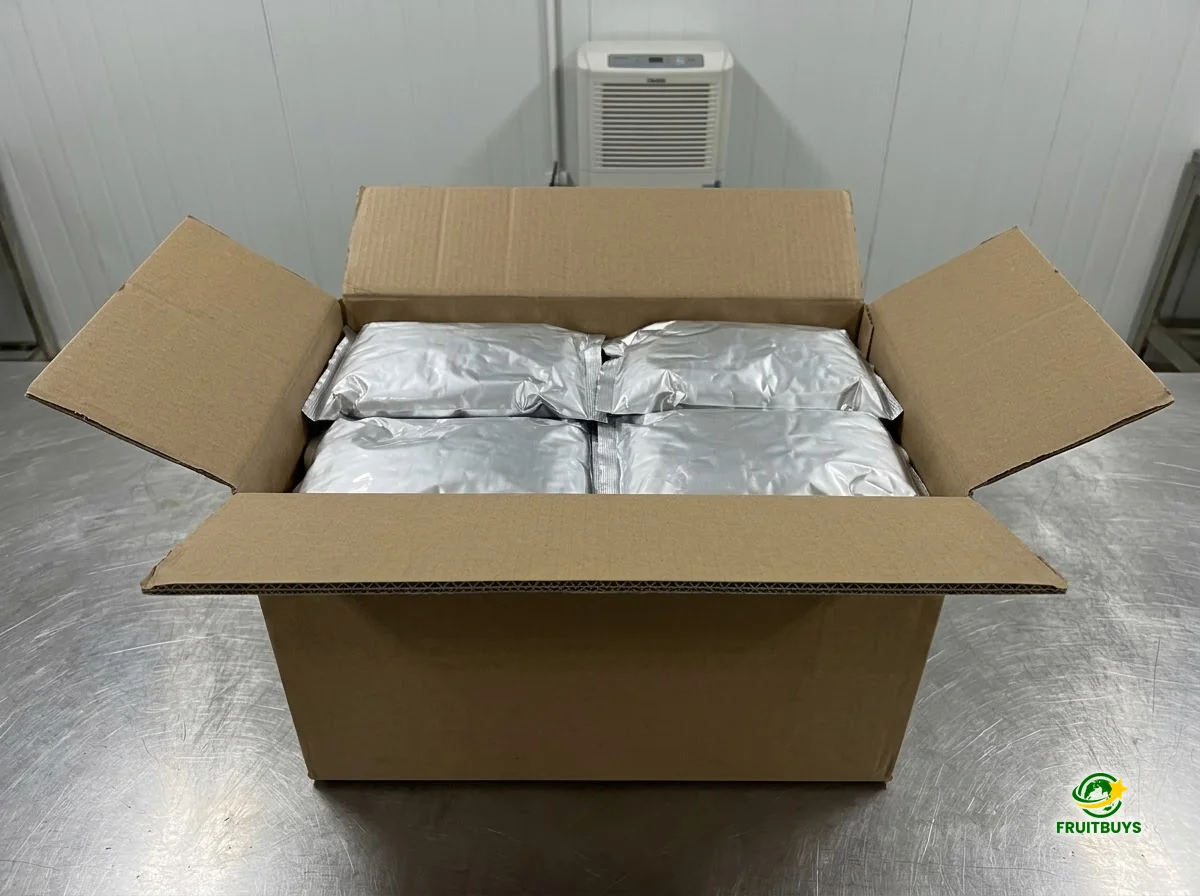
Specify moisture and water activity on the same sample at packing. Pouch and seal choices are in the packaging and shelf-life guide.
Where does freeze-dried mango powder earn its cost?
Where the mango is the labelled hero of the product. Pilot starting doses:
- Smoothie, juice and beverage mixes: 5–12%. Natural colour and pulpy body that carrier-based powders lose to dilution.
- Yogurt, ice cream and dessert powders: 5–12%. A fresh-fruit tartness that cuts dairy richness.
- White chocolate and compound coatings: 3–8%. At under 5% moisture it colours and flavours without thickening the mass.
- Bakery creams and fillings: 4–10%. Colour and flavour from one ingredient, with no added sugar to rebalance.
- Baby and toddler puffs and melts: 5–15%. A one-word ingredient line, “mango”, which is what these briefs ask for first.
FruitBuys adjusts the dose with your R&D team on a sample. Recipe starting points are in freeze-dried mango powder recipes; where visible pieces matter, compare cuts in the formats guide.
What does powder change in freight and import?
More product per container, and a different tariff line. Powder packs four times denser than pieces: about 11,000 kg floor-loaded in a 20 ft container against about 2,750 kg of pieces. At an example rate of USD 2,500 per container, freight works out at about USD 0.23/kg for powder.
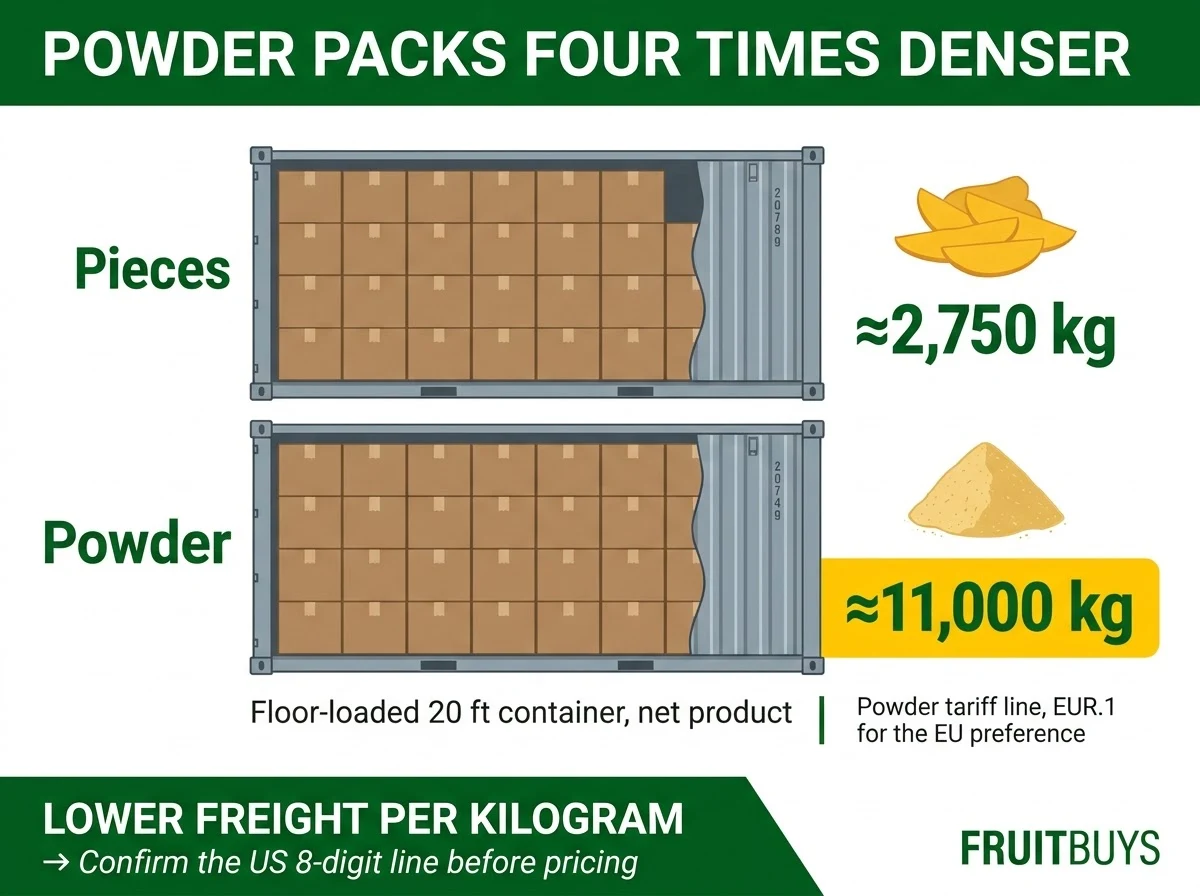
At the border, 100% mango powder enters under HS 1106.30. Vietnamese origin with a C/O Form EUR.1 qualifies for the EU–Vietnam preferential rate, and FruitBuys includes a phytosanitary certificate and lot COA with every shipment. US duty depends on the exact 8-digit 1106.30 line, so confirm it before you price a US programme; the import documentation guide covers each market.
Specification checklist
- Ingredients: 100% mango, or mango plus a named free-flow agent with its percentage
- Cultivar and origin: Keo standard, Cát Chu on request; Mekong Delta, Vietnam
- Moisture and water activity: 3–5% and ≤0.30, on the same sample at packing
- Particle size: 60–80 mesh standard
- Microbiology: TPC ≤10,000 CFU/g, yeasts and moulds ≤100 CFU/g, E. coli <10 CFU/g, Salmonella not detected in 25 g
- Contaminants: lead, arsenic and aflatoxins through periodic baseline testing; pesticide panel for your market on request
- Packaging: 4 × 5 kg foil bags in a 58 × 28 × 34 cm carton, 20 kg net
- Shelf life: 18–24 months in the sealed 5 kg bag in cool storage at ≤18 °C, RH ≤50%; 12 months at ≤25 °C, RH ≤60% or once repacked into retail pouches
- Nutrition: from analysis of the product; see the nutrition label guide
Which powder fits a price-led brief?
If mango sits behind other flavours, or your plant cannot keep powder dry once opened, start freeze-dried powder at the low end of the dose range, where a few percent already carries colour and flavour, or use 2–5 mm freeze-dried granules, which flow without caking. FruitBuys sets the dose with your R&D team on a sample, so you pay for the fruit your formula needs and no more. Choosing between pieces and soft-dried mango instead? Start with freeze-dried or soft-dried mango.
Test it in your base
Tell FruitBuys your application, label promise, mesh size and destination market. We send freeze-dried mango powder in 3–5 working days with a suggested starting dose, so your team can run it against your current powder side by side. Specifications and container plans are on the freeze-dried mango powder product page; the wider mango programme is in the freeze-dried mango supplier guide.
[email protected] · WhatsApp Export +84 919 739 589
FAQ
Is freeze-dried mango powder just ground freeze-dried mango?
Yes. Freeze-dried mango milled to 60–80 mesh, with nothing added unless your specification asks for a free-flow agent.
Does freeze-dried mango powder contain maltodextrin?
No. Freeze-drying needs no carrier, so the powder is 100% mango.
Does it dissolve in water?
It disperses in about 30–60 seconds at 60–80 mesh; the fruit fibre stays in suspension rather than dissolving clear.
How much powder goes into a smoothie?
Start at 5–12% of the dry mix; a 30 g sachet at 10% uses 3 g.
Can it be packed under our brand?
Yes. Private label starts at 500 kg per SKU, in retail pouches filled and sealed in a dry packing room.