
How Do You Use Freeze-Dried Mango in Chocolate Without Seizing or Softening?
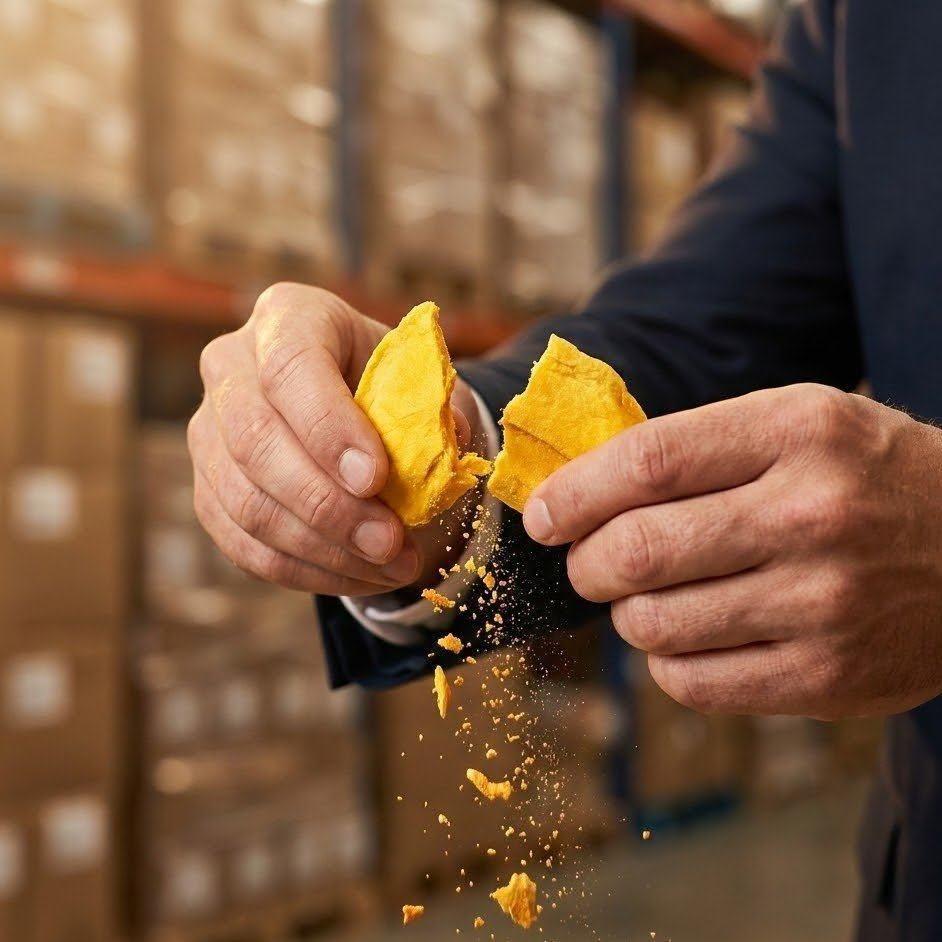
Freeze-dried mango works in chocolate because it brings fruit without bringing water. Released at 3–5% moisture and water activity ≤0.30, it can go straight into melted chocolate at 5–12% of the bar without making it thicken or seize, and once the pieces are coated in cocoa butter they hold their crunch far longer than bare fruit. Choose the cut for the product: slices 6–7 mm on top of a dark bar, cubes 6–8 mm inside white or milk chocolate, granules for visible specks, and powder at 3–8% to colour a white chocolate or compound coating. The two things that go wrong, seizing and softening, both come from moisture picked up on your line, and both are controlled with a dry room and a sealed bag.
Which format suits which chocolate product?
Match the cut to how the shopper sees and bites the fruit.
| Chocolate product | Format | Starting dose | What it gives the product |
|---|---|---|---|
| Dark chocolate bar, topped | Slices 6–7 mm or bites 10–15 mm pressed on the back | 5–8% | Gold on dark: the fruit is the pack photograph |
| White or milk chocolate bar, inclusion | Cubes 6–8 mm | 6–12% | A bright, tart bite that cuts the sweetness |
| Chocolate with visible flecks | Granules 2–5 mm | 5–8% | Even yellow specks through the bar |
| Coloured white chocolate or compound coating | Powder 60–80 mesh | 3–8% | Natural yellow colour and mango flavour, no visible pieces |
| Enrobed or panned mango bites | Cubes 8–10 mm or bites 10–15 mm | Mango as the centre | A crisp fruit centre under a chocolate shell |
| Truffle and praline centres | Powder or granules in ganache | 6–8% | Real fruit acidity in a sweet centre |
Doses are pilot starting points. At 5–12% in a 100 g bar, one kilogram of freeze-dried mango covers about 85–200 bars, so the fruit cost per bar is small next to the chocolate and the packaging. The same kilogram carries “real mango” onto the front of the wrapper.
Why doesn’t freeze-dried mango make chocolate seize?
Because it adds almost no free water. Chocolate seizes when a small amount of water meets its sugar: the sugar particles clump, and the smooth melt turns thick and grainy. Fresh, frozen or soft-dried fruit carries enough water to trigger that. Freeze-dried mango at water activity ≤0.30 holds its remaining water tightly, so it behaves like a dry ingredient in the melt. Powder at under 5% moisture colours white chocolate without thickening the mass, which is why it is used in place of fruit purées and pastes.
The risk comes back only if the mango picks up moisture before it reaches the chocolate. In plant air at 60–70% RH, freeze-dried mango in an open hopper starts to soften within about 15 minutes, and a softened piece carries enough surface moisture to cause trouble in tempered chocolate.
How do you keep the mango crisp inside the bar?
The chocolate does most of the work, as long as the mango goes in dry. Once a piece is fully coated in cocoa butter, the fat slows moisture uptake sharply, and in a sealed bar wrapper the fruit stays crisp under the shell. Three line rules keep it that way:
- Warm cartons sealed. Cartons coming out of cool storage should reach room temperature before the bag is opened, or condensation forms on the cold pieces.
- Open one bag per batch, in a dry room. Weigh and add the mango in a room held as close as possible to the packing standard of below 35% RH. Each 5 kg bag is one batch: open it, use it, keep the rest sealed.
- Coat fully. Pieces sticking out of a bar back are exposed to air for the life of the product. Press toppings into the chocolate, or seal the bar in a moisture barrier wrapper.
Freeze-dried mango is released at ≤0.30 water activity; if your incoming check finds a higher reading, quarantine the lot before it goes near chocolate. Why a lot can arrive soft, and the clauses that prevent it, are in freeze-dried mango gone soft.
Which mango and which colour for which chocolate?
Keo for clean cubes, Cát Chu for aroma. Keo’s firm flesh keeps sharp cube edges through mixing and depositing, which matters when the cube is the visible bite. Cát Chu is sweeter and more aromatic and suits slices on top or powder in a coating, where flavour leads and cut definition matters less.
Colour runs straw yellow to orange-yellow, matched to signed colour tiles so every batch looks the same in your pack photography. On dark chocolate the gold reads strongly; in white chocolate the mango’s tartness is what customers notice first, because it cuts the sweetness of the bar. Cultivar choice is covered in mango varieties for freeze-drying.
How do fines and breakage affect a chocolate line?
They change the look of the bar, not its taste. Cubes lose around 3–5% to breakage in handling; thin slices break far more in a mixer. Fines below 2 mm are held to ≤3% at release and ≤5% on arrival. In chocolate, fines are not waste: they colour a coating or a ganache with the same flavour as whole pieces. Sieve them out at receiving and route them to the coating line rather than letting them dust the surface of a bar sold on its looks. Format choices across all applications are in the formats guide.
What should the specification for chocolate use say?
- Format and size: cubes 6–8 mm, slices 6–7 mm or granules 2–5 mm, ±0.5 mm
- Moisture and water activity: 3–5% and ≤0.30, on the same sample at release
- Fines: ≤3% at release, ≤5% on arrival
- Colour: matched to the signed colour tiles
- Packaging: 5 kg foil bags, gently vacuumed with a desiccant sachet, in 58 × 28 × 34 cm cartons
- Labelling: ingredient line “mango”, no added sugar, no sulphite (released at SO₂ <10 ppm)
Each full container carries a lot COA; how to read it is in what a freeze-dried mango COA covers.
When is freeze-dried mango not the right choice for chocolate?
When the product is a soft centre or a filling that will sit in moisture for months, such as a fruit cream or a jelly layer, freeze-dried pieces will soften by design. There, freeze-dried mango powder gives the flavour and colour without a piece to protect, and for a chewy mango centre in a baked or enrobed product, soft-dried mango holds its bite; FruitBuys supplies a low-sugar line at about 5% added sugar on request, compared in freeze-dried or soft-dried mango.
Run a pilot with your chocolate
Tell FruitBuys your product, chocolate type and target inclusion. We send cubes, slices, granules or powder from stock in 3–5 working days, so your R&D team can run a pilot bar the same week. Specifications are on the freeze-dried mango product page and the freeze-dried mango powder product page; how FruitBuys runs the chain is in the freeze-dried mango supplier guide.
[email protected] · WhatsApp Export +84 919 739 589
FAQ
Can you put freeze-dried mango in chocolate?
Yes. At 3–5% moisture and water activity ≤0.30, it goes into melted chocolate at 5–12% without seizing it.
How much freeze-dried mango goes in a chocolate bar?
Start at 5–12% of bar weight for pieces, or 3–8% for powder in white chocolate and coatings.
Will freeze-dried mango go soft in chocolate?
Not once it is fully coated. The cocoa butter keeps moisture out; pieces left exposed on the surface are the ones that soften.
Which cut is best for white chocolate?
Cubes of 6–8 mm for a visible tart bite, or powder at 3–8% to colour the chocolate itself.
Can freeze-dried mango be enrobed?
Yes. Cubes of 8–10 mm or bites of 10–15 mm make a crisp fruit centre under a chocolate shell.



