Will your freeze-dried papaya container match the sample you approved?
It will if four things are fixed in writing before the first container: the specification, the approved pre-shipment sample, the partner facility that makes your lots, and the way each lot is released. The sample becomes the quality reference, the facility is locked for the length of the contract, every lot is released against its COA, and a retained sample of each lot stays on file for its full shelf life. The path from first enquiry to first container runs in four steps, and the papaya you approve at step two is the papaya that arrives at step four.
Which 10 RFQ fields get you an accurate quote?
A complete RFQ gets you a quote and a loading plan within 24–48 hours. These ten lines are enough:
- Destination country and port
- Application: cereal or granola, trail mix, chocolate, bakery, yogurt topping, retail snack, drink mix
- Form and cut: dice 5 or 10 mm, slices, granules or powder
- Microbiology grade: standard or inclusion grade
- Lot tests your market or customer needs
- First-order volume: trial, LCL, 20 ft or 40 ft HC; floor-loaded or palletised
- Annual volume and call-off rhythm
- Packaging: bulk bag size, or retail pouch size and artwork status
- Mixed container with other FruitBuys freeze-dried fruits, if any
- Incoterm (FOB Cat Lai, CIF or DDP), payment term and target delivery date
A quote built on these lines states the moisture, ingredient line, fines limit, micro grade and Incoterm, so you can set it beside any other on the same basis.
What arrives in the pre-shipment sample, and what should you test?
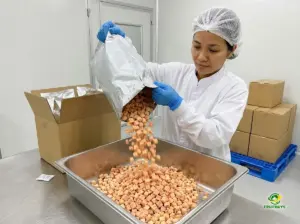
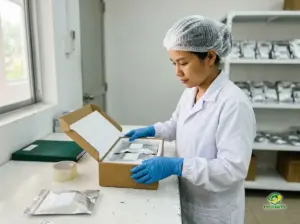
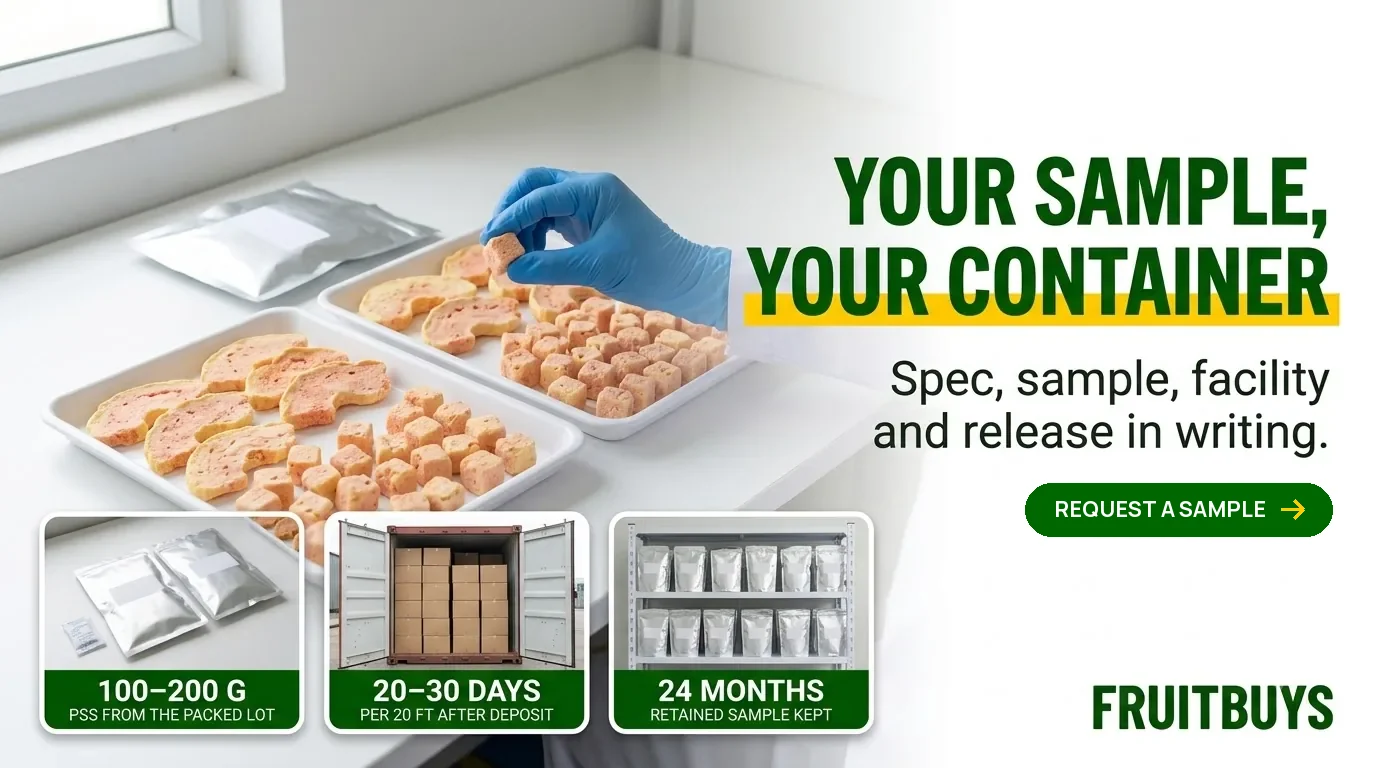
The pre-shipment sample is 100–200 g drawn from the packed lot, split into two sealed foil pouches with desiccant: one for your sensory and application tests, one kept sealed for your own lab. It is dispatched within 24–48 hours of the lot being packed. Because it comes from the cartons that will load, it shows you the container before it leaves.
Five checks take an afternoon:
| Check | How | Pass |
|---|---|---|
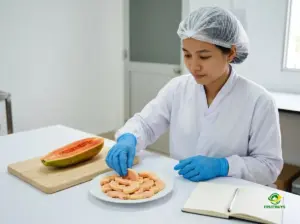
| Colour and cross-section | Cut a piece in half | Even orange to orange-red, porous, no sugar crystals or brown core |
| Texture | Snap a dice or slice | Clean crunch, no bending |
| Water activity | Seal pieces in the meter cup within 60 seconds of opening | ≤0.30 |
| Cut and fines | Sieve 100 g through a 2 mm screen | ≥90% within cut; fines ≤5 g |
| Application | Run your recipe at target dose | Flavour, colour and softening time as briefed |
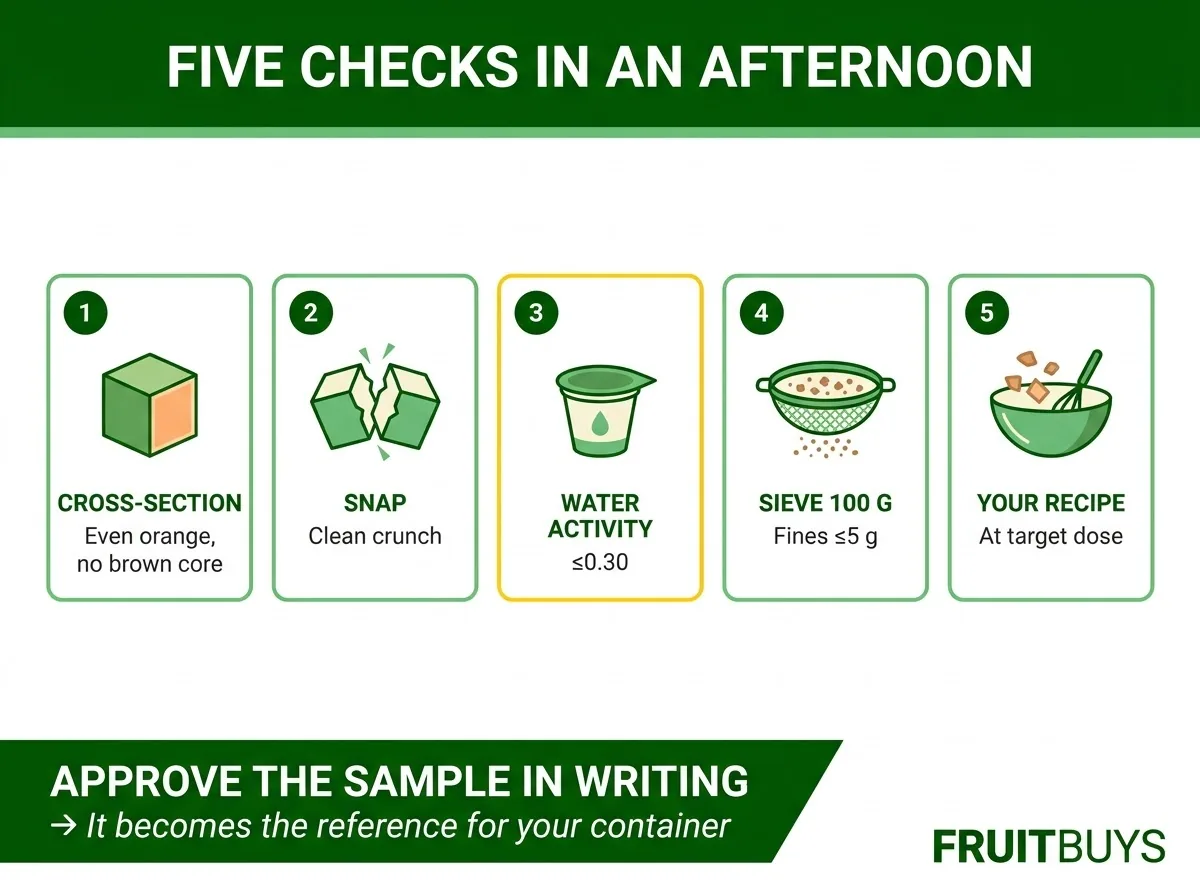
Approve the sample in writing. From that moment it is the reference for the container: the contract limits, the COA and any claim are read against it. The full limits and the arrival check are in what moisture, water activity and microbiology limits a freeze-dried papaya contract should set.
How does a trial order work, and what QC record comes with it?
Trial orders start at 50–100 kg, by air or LCL, or loaded into a container shared with other FruitBuys freeze-dried fruits. Each trial batch ships with an in-house QC log of moisture, water activity and sensory, and third-party testing of the trial lot is available on request. Bulk orders start from 300–500 kg, and private label from 500 kg per SKU.
A trial is the right size for a production run on your own line: enough papaya to fill the hopper, run a shift and see how the pieces dose, mix and pack. If your monthly volume will stay below a container, plan the program as a consolidated container from the start; it costs about 15–20% less in logistics per kilogram than LCL, and the papaya ships in the same foil-and-desiccant pack as a full load.
How does FruitBuys keep bulk lots matched to the approved sample?
By controlling the same points on every lot, from the truck at the gate to the sealed container.
| Control point | What happens | Why it keeps lots alike |
|---|---|---|
| Fruit intake | Our QC cuts 3–5 fruits from every truckload and reads them on a refractometer; only loads at 11–13 °Brix are signed in | Same ripeness, sweetness and colour in every lot |
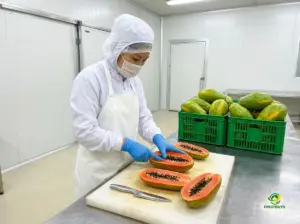
| Deseeding | Seeds and membrane scooped out by hand with stainless-steel spoons, fruit by fruit | No bitter membrane, clean cut faces |
| Facility | One qualified partner facility locked for the length of your contract | Same process, same people, same equipment |
| Change-control | Any change of facility needs written notice to you and re-approval of the pre-shipment sample | No silent switch between lots |
| Release | Each lot released at moisture ≤4.0% and aw ≤0.25, against its COA | Every lot leaves with margin to the contract limit |
| Retained sample | Kept from every container lot for its full shelf life, up to 24 months | Any later question is answered against the same lot |
| Audit access | Once under contract, you can audit the partner facility | You see the process, not only the paperwork |
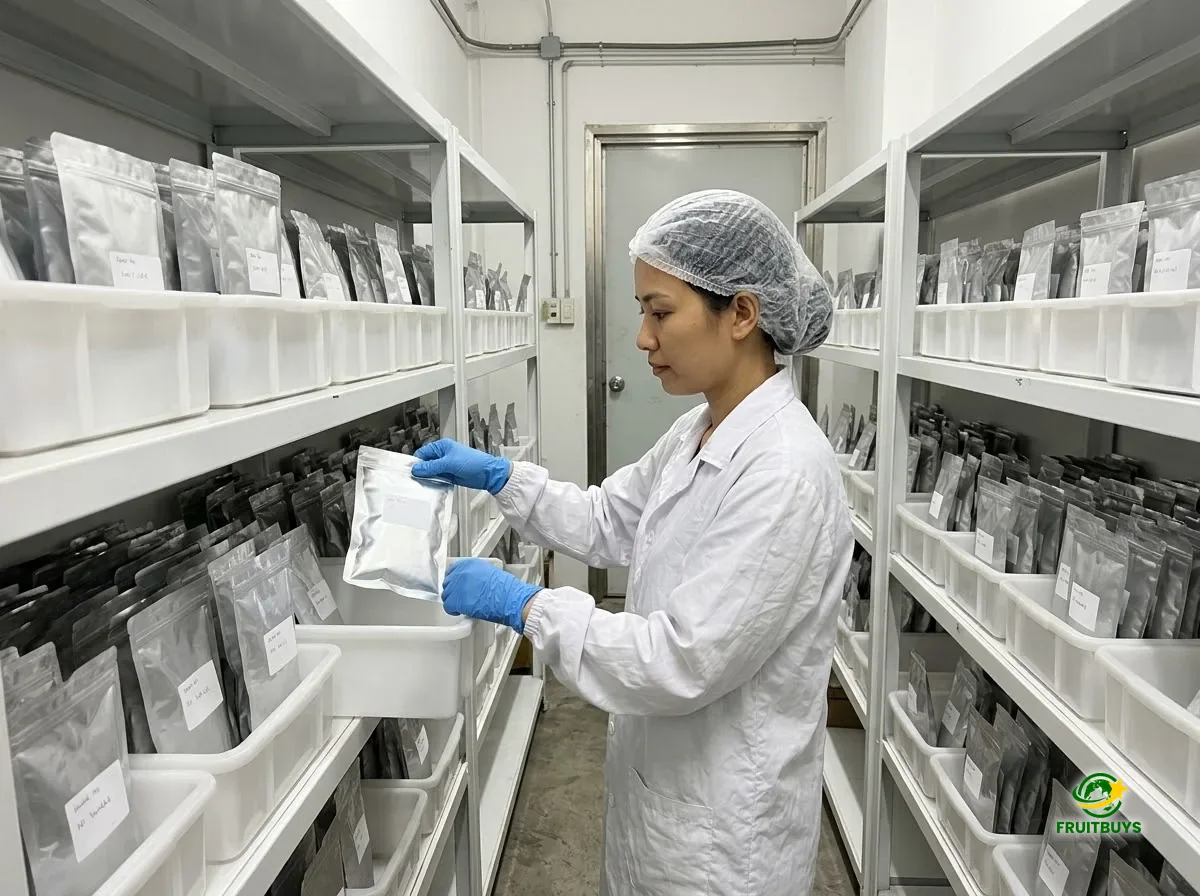
Season still moves the fruit. Dry-season lots from December to April carry the deepest orange-red; if your pack photo depends on it, we reserve dry-season lots for your SKU. Claims on packaging, appearance, breakage or water activity are accepted within 14 days of unloading, and lab results within 30 days, measured against the approved sample and the contract.
These are the questions every buyer should put to any supplier, including us: who makes the lots, can that change without notice, what is the lot released against, and what is kept on file when a question comes up three months later.
How long does a private-label launch take?
From approved artwork to a packed, ready-to-ship lot of digital-print pouches takes about 30–45 days.
| Step | Time |
|---|---|
| Quote and loading plan after a complete RFQ | 24–48 hours |
| Sample dispatch | 24–48 hours, plus courier time |
| Digital pouch print, from 3,000–5,000 pouches per SKU, no cylinder fee | 7–10 working days |
| Rotogravure pouch print, from 500 kg per SKU | 15–20 working days |
| Production of a 20 ft container after deposit | 20–30 days |
| Approved artwork to packed digital-print lot | about 30–45 days |
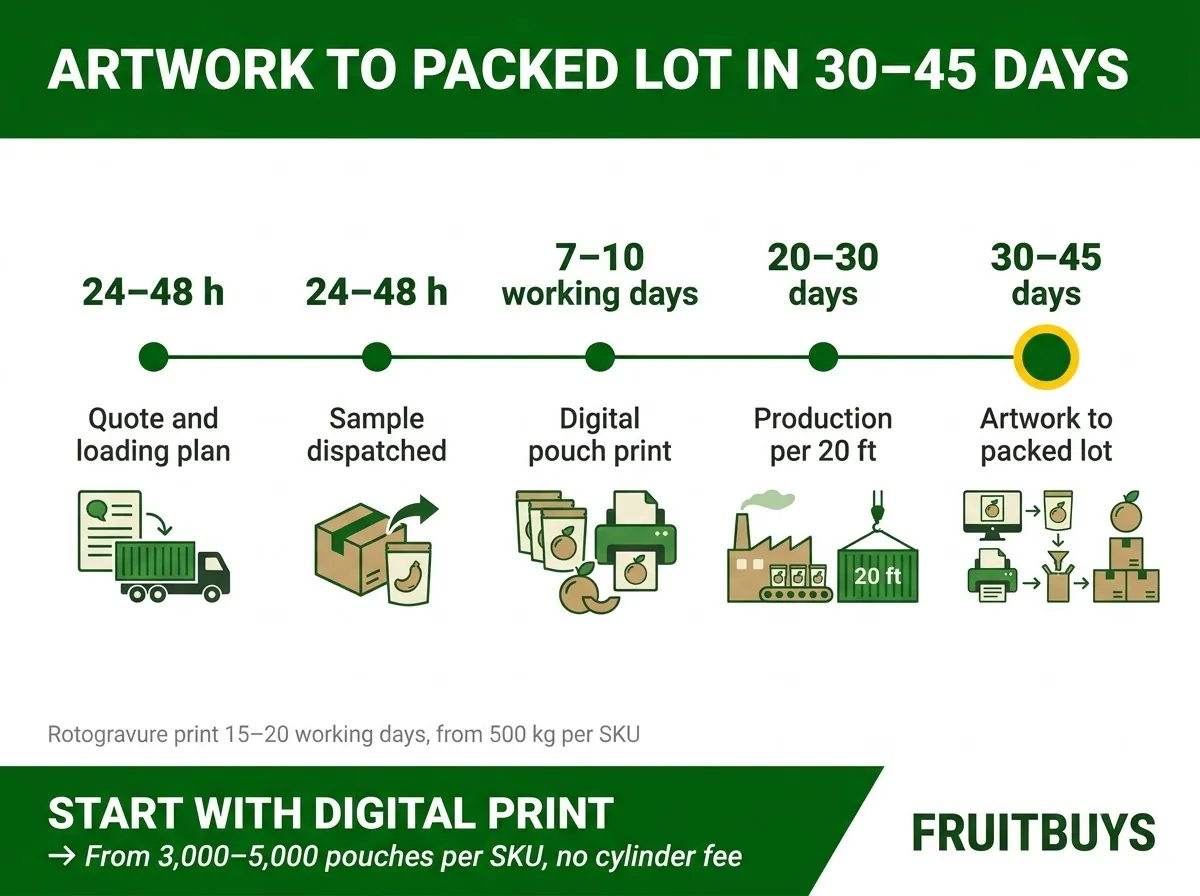
Start with digital print for a test market. Digital pouches need no cylinders and start at a few thousand per SKU, so a new flavour or a seasonal line goes to market without committing to a large print run. Move to rotogravure once the SKU repeats; it gives the lowest pack cost per pouch. Pouches are filled and sealed at source in the dehumidified packing room, carton and pallet labels follow your FBA instructions, and for EU programs we build the pack to the requirements of the EU Packaging and Packaging Waste Regulation that you specify. Packing options are on our OEM and private label page, and cuts and formats on the freeze-dried papaya product page and the powder page.
Request your sample
Send the ten RFQ lines above and we return the specification, the quote and a sample plan in one reply.
FAQ
How much is in a freeze-dried papaya sample?
100–200 g, split into two sealed foil pouches with desiccant: one to test, one kept sealed for your lab.
How fast is a sample sent?
Within 24–48 hours, plus courier time.
What is the minimum order for freeze-dried papaya?
Trial orders from 50–100 kg; bulk from 300–500 kg; 500 kg per SKU for OEM and private label.
Does a trial order come with a COA?
Trial batches ship with an in-house QC log of moisture, water activity and sensory; third-party testing is available on request. Full-container lots ship with a COA from an ISO/IEC 17025 accredited laboratory.
Can the supplier change the processing facility during my contract?
Not without written notice to you and re-approval of the pre-shipment sample. One qualified partner facility is locked per contract.
How long are retained samples kept?
For the full shelf life of each container lot, up to 24 months.
How long does a private-label launch take?
About 30–45 days from approved artwork to a packed lot of digital-print pouches.