Freeze-Dried Mango
A freeze-dried mango supplier decision should not begin with a glossy sample. The real decision starts with what that sample proves, what it does not prove and whether the bulk lot can repeat it under a documented release file. Importers, distributors, QA managers, R&D developers and private label buyers need more than a product name. They need format control, raw material governance, moisture and Aw targets, COA scope, packaging protection, label data, market documentation and sample-to-bulk discipline.

A buyer does not need “nice mango”, the buyer needs one export-ready mango product with one locked specification and one accountable release route. FruitBuys supplies freeze-dried mango through an Integrated Product Supply Model covering raw material direction, production partners, QC, packaging, documentation and export logistics coordination under single-point commercial accountability.
What B2B Buyers Mean by Freeze-Dried Mango Supply
Freeze-dried mango supply means delivering a defined product format, not just dried fruit in a pouch.
The buyer must lock format, moisture, Aw, packaging, COA and destination documents before bulk release.
FruitBuys supplies the configured product under one specification and one release file.
Freeze-dried mango supply begins with product identity. Codex’s General Standard for Dried Fruits recognizes naming options such as “dried,” “dehydrated” and “freeze dried,” and it expects dried fruits to retain characteristic color, flavor, odor and texture while remaining practically free from visible foreign matter and moldy fruit. That gives buyers a broad quality frame, but it does not define the buyer’s exact format, size tolerance, breakage limit, fines level, pouch structure or laboratory panel. Use Codex as a product-category reference, not as a substitute for a buyer specification. (FAOHome)
FruitBuys positions freeze-dried mango as a supplied B2B product, not a loose sourcing exercise. The buyer should receive a configured product file: product name, format, size or mesh, moisture target, Aw target, sensory criteria, packaging, COA scope, lot code, market documents and bulk-release criteria. This is the foundation of the B2B freeze-dried mango guide.
A useful first definition is simple:
| Buyer Question | Required Answer |
|---|---|
| What is the product? | Freeze-Dried Mango |
| What is the format? | Slices, Cubes, Bites, Granules or Powder |
| What is the application? | Snack, inclusion, topping, beverage, bakery, private label or bulk ingredient |
| What must the COA show? | Lot-specific values tied to the shipped goods |
| What protects the product? | Moisture-barrier packaging and carton configuration |
| What proves repeatability? | Approved sample plus sample-to-bulk release criteria |
The buyer should not ask only for availability. The buyer should ask what FruitBuys supplies, verifies, approves and releases for the actual SKU.
Why Vietnam Is Relevant for Freeze-Dried Mango Buyers
Vietnam gives B2B buyers access to mango-growing regions, processing capacity and export logistics routes. That does not automatically prove one supplier’s product quality. A country name never replaces raw material control, facility scope, laboratory results, packaging file or lot documents. The practical value of Vietnam comes from how the supply route can connect fruit selection, processing partners, QC, packaging and export handover into one product file. FruitBuys uses that structure to supply export-ready Vietnamese freeze-dried mango through one commercial relationship. The buyer should still validate each product lot through specification, sample record, COA, packaging and documentation.

A buyer evaluating Vietnam should ask:
- Which mango type or variety direction applies?
- What maturity and intake criteria guide raw fruit acceptance?
- What format will the final product use?
- What values define moisture and Aw release?
- What packaging protects the product after drying?
- What documents match the shipped lot?
- What market route will receive the goods?
This logic links Vietnam sourcing to mango variety and maturity controls, not to vague origin language.
Raw Material Governance: Variety, Maturity and Intake Control
Freeze-dried mango quality starts before freeze-drying. Raw mango decides aroma, color, dry matter, cutting behavior, fiber perception, defect risk and finished format recovery. A buyer who approves only “Keo,” “Cát Chu” or another mango name has not approved a controllable product.
UC Davis lists mango maturity and quality factors such as fruit shape, skin and flesh color, firmness, and freedom from decay and defects, while noting that red skin color in some cultivars is not a dependable maturity index. This supports a strict procurement point: variety name helps sourcing direction, but measurable intake criteria drive consistency. (UC Postharvest Center)
FruitBuys uses Raw Material Sourcing Governance to align:
| Raw Material Control | Why It Matters |
|---|---|
| Variety direction | Guides flavor, color and processing route |
| Growing area | Supports traceability and seasonal planning |
| Maturity window | Controls aroma, color, firmness and cutting behavior |
| Brix or dry matter | Supports sweetness and yield review |
| Defect tolerance | Reduces off-color pieces, trimming loss and rejection |
| Edible flesh recovery | Supports conversion-ratio review |
| Raw lot link | Connects incoming fruit to finished lot documents |
The buyer should read mango variety and maturity controls [FD-MNG-05] before approving samples. If raw material changes, sample-to-bulk consistency can change. If maturity changes, texture and flavor can shift. If dry matter changes, conversion ratio and finished product concentration can shift.
Conversion Ratio: What “Fresh to Freeze-Dried” Really Means
A freeze-dried mango conversion ratio has no meaning until the starting basis is defined.
Whole fruit, peeled flesh, tray-loaded flesh and approved finished grade all produce different ratios.
FruitBuys should verify conversion by batch records, not by generic yield language.
Buyers often ask, “How many kg of fresh mango make 1 kg freeze-dried mango?” That question needs a second question: fresh mango at which stage? Whole fruit includes peel, seed, trimming and rejects. Peeled flesh removes peel and seed. Tray-loaded flesh starts after cutting. Approved finished grade counts only the product that passes sorting and release criteria.

Use fresh-to-freeze-dried mango conversion ratio to separate these bases.
| Ratio Basis | What It Measures | Buyer Use |
|---|---|---|
| Whole fruit to packed finished product | Peel, seed, trimming, drying and sorting loss | Raw material planning |
| Peeled flesh to finished product | Edible input plus process and grade loss | Technical yield review |
| Tray-loaded flesh to dried output | Cut fruit entering freeze-drying | Process review |
| Dried output to approved grade | Sorting, breakage and fines | Commercial-grade planning |
| Approved grade to packed goods | Final pack route | Release and shipment review |
The current working claim that 9–11 kg of peeled and seeded mango flesh produces 1 kg freeze-dried mango requires batch proof before publication as a fixed FruitBuys range. It may reflect a strict grade, a specific variety route, a lower dry-matter batch, a higher sorting loss or a different measurement basis. Without batch records, the buyer should treat it as a claim under review. A buyer should request a batch-yield record showing raw input, approved flesh, dry matter, final moisture, dried output, approved grade, fines, rejects and lot code. The ratio should sit inside the product file, not float as a standalone sales line.
How the Mango Freeze-Drying Process Creates the Product
Freeze-drying, or lyophilization, normally includes freezing, primary drying and secondary drying. A food-industry freeze-drying review describes optimization across pretreatment, freezing, primary drying, secondary drying and storage, showing that process control extends beyond the drying chamber alone. (PMC)
For mango, the practical process route is:
Raw mango selection
→ washing and preparation
→ peeling and seed removal
→ trimming
→ cutting
→ tray loading
→ freezing
→ primary drying
→ secondary drying
→ unloading
→ sorting and grading
→ packaging
→ COA and release
The buyer should connect this to how mango freeze-drying works. The process can create a light, porous, crisp product, but it does not automatically prove lot quality. A dry-looking sample may still lack defined moisture, Aw, microbiology, format tolerance or packaging support.
Process control affects:
- Texture
- Color
- Breakage
- Fines
- Moisture endpoint
- Aw value
- Format recovery
- Packing behavior
- Sample-to-bulk consistency
FruitBuys does not ask buyers to accept the word “freeze-dried” as proof. FruitBuys aligns the process with QC values, sample criteria, packaging and release documentation.
Moisture and Aw: The Technical Gate
Moisture and Aw answer different questions in freeze-dried mango.
Moisture measures total water, while Aw relates to water available for microbial growth and stability review.
A lot should meet both the moisture target and Aw target before release.
The current FruitBuys working technical controls for freeze-dried mango are 3–5% moisture and Aw <0.30, subject to lot COA. These values should not sit in a product page as decorative specifications. They must appear in the release file for the actual lot. FDA explains that water activity relates to the water available for microbial growth and differs from moisture content. That makes Aw a critical dry-food stability measure, while moisture remains a mass-based dryness measure. (U.S. Food and Drug Administration) ISO 18787:2017 establishes basic principles and requirements for determining water activity in food and feed across the 0 to 1 measurement range, so buyers should expect method clarity behind Aw values (ISO).

Use freeze-dried mango moisture and Aw for the full technical review.
| Control | What It Answers | Buyer Requirement |
|---|---|---|
| Moisture | How much water remains by mass | Target and lot result |
| Aw | How much water is available for microbial growth and stability behavior | Target, method and lot result |
| Packaging | Whether the lot can keep its dry condition | Structure, seal and storage basis |
| COA | Whether the shipped lot meets release limits | Lot code and actual result |
Low Aw does not prove pathogen absence. FDA guidance on low-water-activity food systems states that Salmonella can survive and may become more heat resistant as Aw decreases in certain low-water-activity foods, which supports the buyer’s need for microbiology controls rather than dry texture alone (U.S. Food and Drug Administration).
Product Formats: Slices, Cubes, Bites, Granules and Powder
A format name can mislead the buyer if it lacks measurable criteria. “Slices” can mean clean retail pieces or mixed broken strips. “Bites” can mean controlled snack pieces or irregular product with visible fines. “Powder” can mean a controlled mesh ingredient or ground material with caking risk.
Use mango slices, cubes, bites and powder before approving any sample.
| Format | Typical Use | Required Controls |
|---|---|---|
| Slices | Retail snack, garnish, visual topping | Length, width, thickness, intact-piece level, breakage |
| Cubes | Cereal, granola, toppings | Cube size, tolerance, fines |
| Bites | Snack pouch, snack mix, ingredient use | Minimum piece size, maximum piece size, fines |
| Granules | Cereal, chocolate, bakery decoration | Sieve range, dust, particle distribution |
| Powder | Beverage, bakery, seasoning, filling | Mesh, bulk density, carrier status, caking review |
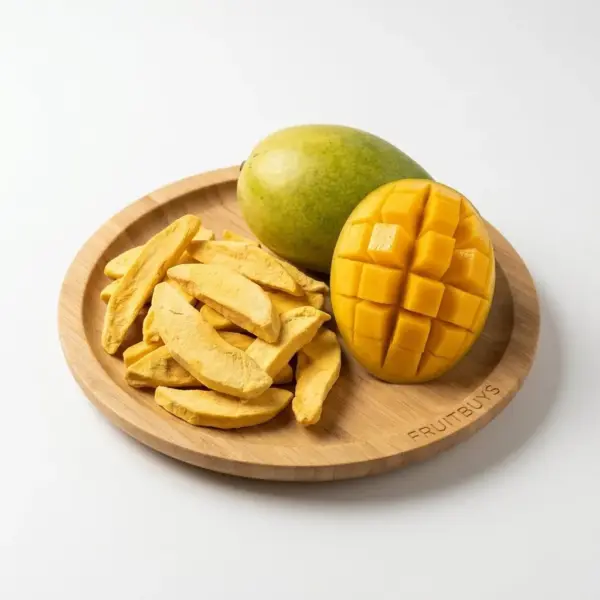
The uploaded product images show irregular mango pieces and visible fines. That visual profile may fit Bites or Irregular Pieces, but it should not represent uniform Slices unless the buyer approves dimensions and intact-piece criteria. A supplier file should name the format honestly because the format controls packaging, application and release proof.
COA and Laboratory Testing
A COA is not a brochure. It is a lot-specific release document. It should identify the product, lot code, test date, method, specification limit, actual result and release status. Use freeze-dried mango COA requirements before accepting a bulk lot.

A useful COA and laboratory package may include:
| Proof Area | Buyer Review |
|---|---|
| Moisture | Actual result against target |
| Aw | Actual result, method and lot code |
| Microbiology | Buyer and market-required panel |
| Pesticide residues | Destination-dependent panel |
| Contaminants | Destination-dependent panel |
| Sensory or visual grade | Color, odor, texture, breakage and fines |
| Packaging | Pouch structure and seal support where required |
| Nutrition | Product-specific label basis where required |
Certificate scope cannot replace lot testing. A HACCP, ISO, BRCGS, Halal or facility registration document may support supplier qualification when scope applies, but it does not prove the current lot’s moisture, Aw, microbiology, residue status or label values. Buyers should keep system documents and lot documents in separate proof lanes. FruitBuys uses Documentation and Quality Control to connect COA, laboratory reports, sample records, packaging files and lot identity. The buyer should receive a document set that matches the product in the cartons.
Packaging and Shelf-Life Control
Freeze-dried mango can pass moisture and Aw at release, then soften or cake when packaging fails. Packaging must protect the product after drying, not only carry the pack design. Use moisture-barrier packaging for freeze-dried mango before approving any retail pouch, bulk bag or private label configuration.
A packaging file should define:
| Packaging Control | Why It Matters |
|---|---|
| Pouch or inner bag structure | Controls moisture exposure |
| Food-contact support | Supports destination review |
| Seal method | Controls leakage and humidity risk |
| Seal inspection | Supports release decision |
| Carton size | Controls loading and handling |
| Carton strength | Reduces crush and breakage risk |
| Storage instruction | Connects to shelf-life basis |
| Shelf-life validation basis | Supports label and buyer review |
Shelf life should apply to the exact product, format, package, seal condition and storage condition. A general “12–24 months” statement should remain a target unless the package and validation basis support it. The buyer should not approve shelf life as a generic fruit category claim.
OEM and Private Label Freeze-Dried Mango
OEM and private label work should begin with product specification, not pouch artwork. Artwork cannot prove format, moisture, Aw, ingredient statement, Nutrition Facts, packaging barrier or COA scope. Use OEM freeze-dried mango packaging when the buyer needs a retail SKU or brand-ready product. A private label file should include:
- Approved product format
- Piece size or mesh
- Ingredient statement
- Formula where relevant
- Moisture and Aw targets
- COA scope
- Packaging structure
- Food-contact support
- Serving-size basis
- Nutrition Facts or nutrition declaration basis
- Storage statement
- Lot code plan
- Carton configuration
- Artwork revision control
FDA states that serving size and servings per container appear prominently on the Nutrition Facts label, and nutrition information usually applies per serving, which means private label pack size and serving basis must be reviewed before artwork approval. (U.S. Food and Drug Administration). FruitBuys treats OEM/Private Label Delivery as a controlled product route. The buyer should not receive an attractive pouch wrapped around an unfinished technical file.

Food and Beverage Applications
Freeze-dried mango behaves differently across food systems. A snack pouch needs crispness and visual grade. Cereal needs size distribution and low dust. Chocolate needs particle control and Aw review. Beverage powder needs mesh, bulk density, dispersibility and caking review. Yogurt toppings need rehydration behavior. Use freeze-dried mango food applications to match format to use.
| Application | Better Starting Format | Main Risk |
|---|---|---|
| Retail snack | Slices or Bites | Breakage, fines and texture loss |
| Snack mix | Bites or Granules | Dust and uneven distribution |
| Cereal | Cubes or Granules | Settling and breakage |
| Chocolate | Small Cubes or Granules | Dust, Aw mismatch and coating issues |
| Bakery | Granules or Powder | Heat behavior and flavor balance |
| Beverage | Powder | Mesh, sediment, caking and carrier status |
| Yogurt topping | Bites or Granules | Rehydration and texture change |
The buyer should test the product inside the final application. Table tasting cannot predict mixing, baking, hydration, coating or storage behavior. Application testing turns a sample from a pleasant nibble into an actual qualification step.
Sample-to-Bulk Consistency
Sample approval does not release a commercial lot.
The buyer must define the measurable criteria that decide whether bulk matches the approved sample.
FruitBuys connects approved sample, specification, COA, packaging and lot identity before bulk release.
A sample can look correct while leaving key questions unanswered. What is the allowed breakage? What counts as fines? What moisture and Aw values apply? What packaging protects the product? What document proves the lot? Use sample-to-bulk consistency controls before approving bulk release.

A sample approval file should record:
| Sample Field | Required Detail |
|---|---|
| Sample code | Traceability reference |
| Product format | Slices, Cubes, Bites, Granules or Powder |
| Application | Intended buyer use |
| Size or mesh | Dimensional standard |
| Breakage | Allowed limit |
| Fines | Definition and limit |
| Sensory | Color, aroma, texture |
| Moisture and Aw | Target and result where available |
| Packaging | Sample pack and commercial pack difference |
| COA scope | Required lot tests |
| Bulk match rule | How the bulk lot will be judged |
“Same as sample” is not a release standard unless the sample has measurable criteria. FruitBuys uses the approved sample as the start of the release file, not the end of qualification.
Container and Shipment Planning
Freeze-dried mango is often volume-sensitive because the product is light and porous. Container planning must start with carton size, pack type, format, loading method and document match, not only a theoretical carton count. Use freeze-dried mango container planning before confirming a shipment plan.
The current working carton input is:
| Carton Field | Working Input |
|---|---|
| Carton size | 600 × 390 × 390 mm |
| Net product range | 5–7 kg/carton |
| Carton volume | 0.09126 CBM |
For this carton, previous planning logic produced a theoretical tight-fit ceiling of 324 cartons in a 20ft dry container and 720 cartons in a 40ft High Cube. Those figures should stay as geometric planning ceilings until carton strength, clearance, loading method, receiver requirement and product format are validated.
Export Logistics Coordination should connect:
- Carton count
- Net and gross weight
- Lot code
- Packing list
- COA
- Market document file
- Loading method
- Container number
- Seal number
- Loading photos where required
A shipment that loads well but carries mismatched documents still fails the buyer.
Nutrition Facts and Label Data
Nutrition data should match the exact product, format, formula, serving size, pack size and destination market. The uploaded label gives a useful reference: serving size 28.35 g, 110 calories, 27 g carbohydrate, 2 g fiber, 17 g total sugars and less than 1 g protein per serving. It does not prove every FruitBuys commercial lot. Use freeze-dried mango Nutrition Facts before approving private label artwork.
The uploaded label calculates to the following reference per 100 g values:
| Nutrient | Calculated Per 100 g From Uploaded Label |
|---|---|
| Calories | 388 kcal |
| Total Carbohydrate | 95.24 g |
| Dietary Fiber | 7.05 g |
| Total Sugars | 59.96 g |
| Protein | Less than 3.53 g |
| Potassium | 635 mg |
These calculations are reference only. Label rounding can create false precision when values are multiplied from a serving panel. A declared zero may reflect labeling rules rather than analytical absence, and “less than 1 g” cannot become an exact value. The buyer should request product-specific nutrition support when the product enters private label, retail, nutrition claim, powder, formulation or destination-label review.
Market Documentation: US, EU and UAE
Market documentation should match the destination, not a generic export folder. Use market documentation for freeze-dried mango [FD-MNG-15] before approving retail or importer files. For the United States, FDA’s FSVP rule requires importers to verify that foreign suppliers produce food in a manner that provides the required level of public health protection and that imported food is not adulterated or misbranded with respect to allergen labeling. (U.S. Food and Drug Administration) This puts the importer file, supplier verification and lot evidence inside the buyer’s decision process.

For the European Union, Regulation (EU) No 1169/2011 establishes general principles and requirements for food information to consumers, and the European Commission identifies mandatory particulars for prepacked foods. (Food Safety) EU review may also require pesticide MRL review under Regulation (EC) No 396/2005 and contaminant review under Commission Regulation (EU) 2023/915, depending on the product and destination file. (Publications Office of the EU) Food-contact packaging placed on the EU market must comply with Regulation (EC) No 1935/2004. (Food Safety)
For UAE routes, the UAE Government portal states that imported, locally produced or modified food must be registered in the ZAD electronic system before being handled in UAE markets. (u.ae) GSO 9:2022 applies to labeling of prepackaged foods offered to consumers or catering purposes in Gulf contexts (GSO Sims Preview Documentation). FruitBuys can align documents, but the buyer must define destination, importer route, product format, pack type, label needs and laboratory scope.
RFQ Checklist: What Buyers Should Send FruitBuys
A strong RFQ prevents weak samples. Use the freeze-dried mango RFQ checklist before requesting sample or commercial review.
The RFQ should include:
| RFQ Section | Required Input |
|---|---|
| Buyer role | Importer, distributor, R&D, QA, private label or food manufacturer |
| Destination market | US, EU, UAE or another market |
| Application | Snack, cereal, bakery, beverage, dairy, ingredient or private label |
| Format | Slices, Cubes, Bites, Granules or Powder |
| Physical spec | Size, mesh, breakage, fines and sensory |
| Technical spec | Moisture, Aw, microbiology and required panels |
| Packaging | Pouch, inner bag, carton, storage and shelf-life basis |
| Documentation | COA, lab reports, certificate scope, label data and market files |
| Sample criteria | Sample purpose, code, test method and bulk match rule |
| Logistics | Carton, loading method, lot code and receiving requirement |
A weak RFQ says, “Need freeze-dried mango.” A useful RFQ says exactly what the product must do, how it must test and how the lot must release.
Application Mapping
| Buyer Type | Application | Required Format | Proof Needed | FruitBuys Delivery |
|---|---|---|---|---|
| Importer | Bulk distribution | Slices, Bites, Granules or Powder | Specification, COA, packaging file, packing list and market documents | Documentation and Export Logistics Coordination |
| Distributor | SKU portfolio | Bites, Slices or Powder | Case configuration, shelf-life basis, lot code and product file | Single-point commercial accountability |
| R&D developer | Product testing | Cubes, Granules, Bites or Powder | Application sample, size or mesh, moisture, Aw and trial notes | MOQ Flexibility/Market Trial Support |
| QA manager | Supplier and lot approval | All formats | COA, lab reports, method, certificate scope, traceability and release status | Quality Control and Documentation |
| Private label brand | Retail pouch | Slices, Bites or Powder | Product spec, pouch file, Nutrition Facts basis, artwork inputs and sample match | OEM/Private Label Delivery |
| Food manufacturer | Ingredient use | Cubes, Granules or Powder | Particle control, microbiology, moisture, Aw and application proof | Application-specific product configuration |
| Logistics manager | Shipment planning | All formats | Carton size, loading method, packing list, lot code and seal record | Export Logistics Coordination |
Why FruitBuys Delivers This
FruitBuys supplies freeze-dried mango through an Integrated Product Supply Model. The buyer works through one product route covering growers, production partners, QC, packaging, documentation and export logistics coordination. The buyer receives one configured product under one commercial relationship, not scattered claims that must be stitched together after sample approval.
The Raw Material Sourcing Governance pillar controls variety direction, maturity, intake criteria and traceability. The MOQ Flexibility/Market Trial Support pillar supports application-matched sampling and route validation when operationally feasible. The OEM/Private Label Delivery pillar connects product format, pouch, label inputs, coding and case configuration. The Quality Control pillar controls size, breakage, fines, moisture, Aw, sensory and release review. The Documentation pillar connects specification, COA, laboratory reports, certificate scope, packaging file, nutrition basis and market documents. The Export Logistics Coordination pillar aligns carton plan, packing list, lot code, container handover and document release.
FruitBuys supplies one locked, documented, quality-controlled product under one relationship. That is the control point buyers should qualify.
Buyer Checklist
Before approving a freeze-dried mango supplier route, confirm:
- Product identity
- Target market
- Buyer application
- Required format
- Size, mesh or sieve range
- Breakage and fines limits
- Variety direction and maturity criteria
- Conversion-ratio basis
- Moisture target
- Aw target
- COA scope
- Microbiology and laboratory panel
- Packaging structure
- Food-contact support
- Storage condition
- Shelf-life basis
- Sample code and approval criteria
- Sample-to-bulk comparison method
- Nutrition Facts or nutrition basis where required
- Private label artwork inputs where required
- Market document file
- Carton and container planning
- Lot code and release decision
Do not approve bulk supply from sample appearance alone. The product file must carry the order.
Freeze-Dried Mango Supplier Vietnam
Freeze-dried mango supply from Vietnam should be qualified through product format, raw material governance, moisture, Aw, COA, packaging, label data, sample-to-bulk criteria and destination documents. Vietnam origin may support a practical supply route, but origin alone does not prove lot quality. Buyers should define Slices, Cubes, Bites, Granules or Powder before sample approval. FruitBuys supplies export-ready freeze-dried mango through an Integrated Product Supply Model connecting raw material, QC, packaging, documentation and export logistics coordination under one accountable relationship.
FAQ
What should buyers check first when sourcing freeze-dried mango from Vietnam?
Start with application and format. Then verify size, breakage, fines, moisture, Aw, packaging, COA, sample criteria and market documentation.
What formats can FruitBuys supply?
FruitBuys can configure freeze-dried mango as Slices, Cubes, Bites, Granules or Powder, subject to specification, sample approval and production route.
What moisture and Aw targets matter?
The working targets are 3–5% moisture and Aw <0.30, subject to lot COA confirmation and method review.
Does freeze-drying prove food safety?
No. Freeze-drying removes water, but buyers still need hazard review, microbiology testing, sanitation control and lot documentation.
Can buyers use one Nutrition Facts label for every SKU?
No. Nutrition Facts must match product format, formula, pack size, serving basis and destination market.
What makes OEM freeze-dried mango ready?
OEM readiness requires format, ingredient statement, packaging, label inputs, COA, nutrition basis, sample-to-bulk criteria and market documents.
What should buyers send in an RFQ?
Send application, format, size, moisture, Aw, COA scope, sample criteria, packaging, label needs, destination market and logistics inputs.
Conclusion
Freeze-dried mango supplier qualification is not a sample contest. The buyer needs one product file: raw material route, conversion basis, format, moisture, Aw, COA, packaging, label data, sample-to-bulk criteria, market documents and logistics plan. FruitBuys supplies that product through an Integrated Product Supply Model with single-point commercial accountability.
Submit the RFQ checklist after confirming format, application, packaging route and document scope.
References
- Codex Alimentarius Commission. General Standard for Dried Fruits, CXS 360-2020. Codex dried fruits standard. (FAOHome)
- UC Davis Postharvest Research and Extension Center. Mango Produce Fact Sheet. UC Davis mango maturity and quality indices. (UC Postharvest Center)
- Liu, Y. et al. Application of Freeze-Drying Technology in the Food Industry: A Review. 2026. Freeze-drying process review. (PMC)
- U.S. Food and Drug Administration. Water Activity (aw) in Foods. FDA water activity guide. (U.S. Food and Drug Administration)
- International Organization for Standardization. ISO 18787:2017, Foodstuffs: Determination of Water Activity. ISO 18787 water activity method. (ISO)
- U.S. Food and Drug Administration. FSMA Final Rule on Foreign Supplier Verification Programs for Importers of Food for Humans and Animals, Key Requirements. FDA FSVP requirements. (U.S. Food and Drug Administration)
- U.S. Food and Drug Administration. Serving Size on the Nutrition Facts Label. FDA serving size guidance. (U.S. Food and Drug Administration)
- European Commission. Mandatory Food Information. EU food information rules. (Food Safety)
- European Union. Regulation (EC) No 396/2005 on Maximum Residue Levels of Pesticides. EU pesticide MRL regulation. (Publications Office of the EU)
- European Union. Commission Regulation (EU) 2023/915 on Maximum Levels for Certain Contaminants in Food. EU contaminants regulation. (Eur-Lex)
- European Commission. Food Contact Materials. EU food-contact material guidance. (Food Safety)
- The Official Portal of the UAE Government. National Food Accreditation and Registration System. UAE ZAD food registration system. (u.ae)
- Gulf Standardization Organization. GSO 9:2022, Labeling of Prepackaged Food Stuffs. GSO prepackaged food labeling regulation. (GSO Sims Preview Documentation)
Specifications
Freeze Dried Mango Nutrition Facts
Specifications of Freeze-Dried Mango
| Product Name | Freeze-Dried Mango |
| HS Code | HS 2022: 0804.50, Guavas, mangoes and mangosteens, fresh or dried. The WCO HS 2028 edition introduces 0804.53 specifically for dried mango. Confirm the destination country’s current 8-digit or 10-digit tariff line before shipment. WCO HS 2022 Chapter 8 and WCO HS 2028 correlation table. (wcoomd.org) |
| Main Ingredient: | Mango flesh (Mangifera indica L.). Intended single-ingredient formulation. Any “no added sugar” or “no preservatives” statement requires confirmation through the approved recipe and ingredient declaration. |
| Origin / Harvest Season | Vietnam, with the final growing area identified by lot. Working main-crop window: March to June; Đồng Tháp commonly records April to May as its main harvest period. Off-season availability depends on variety, growing area and crop schedule. Vietnam mango production research and Đồng Tháp mango harvest information. (research.aciar.gov.au) |
| Physical & Technical Specifications | Processing method: freeze-drying / lyophilization. Working targets: Moisture 3-5%; Aw <0.30. Available formats: Slices, Cubes, Bites, Granules and Powder. Characteristic mango color, aroma and flavor; crisp, porous texture for piece formats; practically free from visible foreign matter. Final values and format tolerances must appear in the approved specification and lot COA. The Codex General Standard for Dried Fruits recognizes “freeze dried” naming and requires the style to be identified. Aw testing should follow a defined method such as ISO 18787:2017. (FAOHome) |
| Certifications & Market Compliance | Subject to current facility, process and product scope: HACCP / ISO 22000 / BRCGS / Halal. Shipment and lot documents may include Certificate of Origin, lot-specific COA and phytosanitary documentation where the destination authority requires it. FDA food-facility registration applies where required, but it is not a product certificate or FDA approval. FDA food-facility registration guidance. (U.S. Food and Drug Administration) |
| Features | Low-moisture, low-Aw product format; crisp and porous structure for pieces; concentrated mango solids after water removal; available as Slices, Cubes, Bites, Granules or Powder; single-ingredient route available subject to approved formulation. |
| Benefits | Suitable for direct snacking and dry-food applications; flexible sizing for dosing and product development; can be stored without refrigeration when sealed in validated moisture-barrier packaging under the specified conditions; contains carbohydrate, dietary fiber and potassium according to the reference nutrition data. |
| Upselling/Cross-Selling | Freeze-Dried Fruit: banana, dragon fruit, durian, jackfruit, pineapple, strawberry and passion fruit cubes. Dried Fruit Snacks: mango, passion fruit, dragon fruit, pineapple and jackfruit. Dried Fruit Powder: freeze-dried mango, banana, dragon fruit, durian and jackfruit powders. Crispy Veggie Chips: mango, banana, jackfruit, lotus root, taro and sweet potato chips. Healthy Indulgence Snacks: brown rice bars, almond boat cakes and nut-based snack products. |
| R&D Application Guide | Slices/Bites: retail snacks, snack mixes and toppings. Cubes/Granules: cereal, granola, chocolate, confectionery and yogurt applications. Powder: bakery, beverage premixes, fillings and dry flavor systems. Validate particle size, fines, moisture migration, Aw interaction, rehydration, dispersibility, caking and packaging in the buyer’s final food matrix before bulk approval. |
| Production Capacity | 100 metric tons/year, subject to format, packaging route, raw-material scheduling and approved production plan. |
| Export Carton Size | 60 × 39 × 39 cm / 10 kg net |
| Container Capacity, Floor-Loaded | 20 ft: up to 324 cartons / 40 ft: up to 720 cartons. These are theoretical tight-fit ceilings based on carton dimensions. Confirm practical loading through an actual stuffing plan, carton-compression review and container inspection. |
| Testing | Lot-based panel as required by the buyer and destination market: moisture, Aw, sensory condition, foreign matter, total plate count, yeast and mold, E. coli, Salmonella, pesticide residues, heavy metals and applicable contaminants. Results must appear in a lot-specific COA or supporting laboratory report. |
| Shelf Life | 12-24 months, subject to the exact product format, packaging barrier, seal integrity, storage conditions and shelf-life validation file. |
| Storage Instructions | Keep unopened in the original sealed moisture-barrier packaging. Store in a cool, dry place away from direct sunlight, heat, humidity and strong odors. Reseal promptly after opening. Final temperature and relative-humidity limits must match the approved packaging and shelf-life specification. |
| MOQ | Flexible. No fixed MOQ for available bulk formats. OEM/private label projects generally start from 500 kg per SKU or recipe, subject to format, packaging and production feasibility. |
| Sample Lead Time | 3-5 working days after the product format, sample criteria and required documents are confirmed. |
| Retail Packaging | 50 g / 100 g / 500 g / 1 kg in resealable aluminum-laminate pouches, or according to the approved packaging specification. |
| Bulk Packaging | 1-5 kg in sealed PE/aluminum-laminate inner bags packed in 5-layer export cartons, or according to the approved packaging specification. |
| Payment Terms | Excluded from this technical specification. Confirmed separately in the approved order documentation. |
| Port / Airport of Loading | Cat Lai Port or Tan Son Nhat International Airport, subject to the approved shipment route. |
| Transportation Method | Sea-freight or air-freight coordination according to the product format, packaging configuration, receiving requirements and shipment plan. |
| Production Lead Time | Approximately 20-30 days for a 20 ft container production cycle after specification, packaging, document scope, raw-material availability and production scheduling are confirmed. |
| Additional Services | OEM / ODM / A&D support. Applicable projects generally start from 500 kg per SKU or recipe, subject to product, packaging and production feasibility. |