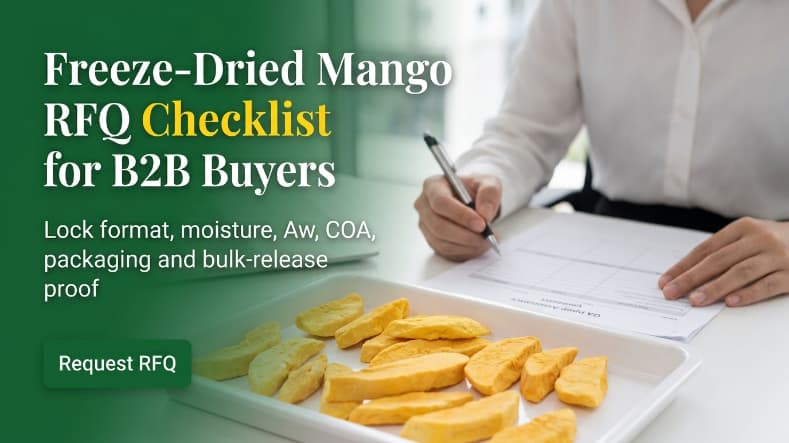
Freeze-Dried Mango RFQ Checklist for B2B Buyers
A freeze-dried mango RFQ can fail before the first sample ships. The buyer asks for “mango slices,” “mango bites” or “mango powder,” but leaves out size tolerance, moisture, Aw, fines, packaging, COA, Nutrition Facts, market documents and bulk-release criteria. The supplier then fills the gaps with assumptions.
That is where procurement risk breeds: not inside the mango, but inside the missing fields. Importers, QA managers, R&D developers and private label buyers need an RFQ that tells the supply chain what must be supplied, verified, packed and documented.
A strong RFQ is not a request for a product name, it is a release standard written before the sample is approved. FruitBuys uses the RFQ as the first control file for export-ready freeze-dried mango.
Start the RFQ with Buyer Use, Not Product Name
A freeze-dried mango RFQ should start with application, buyer role and target format.
The same product category can become a retail snack, cereal inclusion, beverage powder, bakery ingredient or private label pouch.
Buyers should define the use case before asking for samples or documents.
The first RFQ question is not “Can you supply freeze-dried mango?” The first question is “What must this mango do after delivery?” The answer changes the required format, packaging, COA scope, label basis and sample evaluation method.
Codex’s General Standard for Dried Fruits recognizes “freeze dried” as a naming option and sets general quality expectations for dried fruits, including characteristic color, flavor, odor and texture. That standard supports broad product identity, but it does not define the buyer’s application-specific requirements for size, fines, mesh, packaging or COA scope. (Codex General Standard for Dried Fruits, CXS 360-2020) (FAOHome)
This article sits inside the broader freeze-dried mango supplier Vietnam cluster. Buyers should use it as the action document after reviewing product format, moisture, Aw, packaging and market documentation.
| Buyer Role | RFQ Starting Point |
|---|---|
| Importer | Product format, carton plan, COA and market document scope |
| Distributor | SKU mix, pack size, shelf-life basis and receiving requirement |
| R&D developer | Application, particle size, moisture behavior and test sample |
| QA manager | Specification, COA, laboratory scope and release criteria |
| Private label buyer | Format, pouch, label data, Nutrition Facts and artwork route |
| Food manufacturer | Ingredient function, particle behavior, microbiology and traceability |
The buyer should define the product’s job before requesting the product.

Section 1: Product Identity
The RFQ must first identify the product in a way that connects commercial language to technical review.
Include:
| RFQ Field | Required Buyer Input |
|---|---|
| Product name | Freeze-Dried Mango |
| Processing method | Freeze-drying/lyophilization |
| Ingredient statement | 100% mango or formula-based product |
| Mango type | Variety direction or commercial type, if required |
| Origin basis | Vietnam or specific sourcing area where required |
| Product role | Snack, ingredient, powder, topping or private label SKU |
| Target market | US, EU, UAE or another destination |
| Pack type | Bulk, retail pouch, ingredient pack or private label |
Do not request a variety name without technical criteria. Keo, Cát Chu or another commercial type can guide raw material direction, but the RFQ still needs maturity, dry matter, color, firmness, defect tolerance and traceability where those controls matter. Use mango variety and maturity controls before locking raw material language.
A clean RFQ sentence can read:
Product: Freeze-Dried Mango Bites for retail snack pouch, Vietnam origin, single-ingredient mango, final specification subject to approved sample, COA and packaging file.That sentence gives FruitBuys a product route. “Send mango price list” does not.
Section 2: Format and Physical Specification
Format names are not specifications.
Slices, Cubes, Bites, Granules and Powder each require size, tolerance, breakage, fines and application criteria.
Buyers should define the physical format before asking for COA or packaging approval.
The RFQ should state the required format before requesting samples. Use mango slices, cubes, bites and powder to choose the correct product form.
| Format | RFQ Must Define |
|---|---|
| Slices | Length, width, thickness, intact-piece level, breakage limit |
| Cubes | Cube size, tolerance, minimum cube percentage, fines limit |
| Bites | Minimum and maximum piece size, visible grade, fines limit |
| Granules | Sieve range, dust limit, distribution requirement |
| Powder | Mesh, bulk density, caking review, carrier status |
The uploaded mango images show irregular pieces and visible fines. That visual grade may fit Bites or Irregular Pieces if the buyer approves that format. It should not become “Slices” unless the RFQ defines slice dimensions and intact-piece criteria.

Physical specification should include:
- Size or mesh
- Tolerance
- Maximum broken pieces
- Fines definition
- Color range
- Aroma
- Texture
- Foreign matter requirement
- Sample reference code
- Bulk-release comparison method
If the buyer needs a food manufacturing ingredient, also include the required processing behavior: mixing, coating, baking, hydration, grinding, dosing or filling.
Section 3: Technical Release Values
The RFQ must state technical release values, not only sensory preferences. For FruitBuys freeze-dried mango, the current working targets are:
| Technical Item | Target |
|---|---|
| Moisture | 3–5% |
| Aw | <0.30 |
| COA | Lot-specific |
| Microbiology | Buyer and market dependent |
| Residues/contaminants | Destination dependent |
| Sensory | Characteristic mango, no foreign odor |
FDA explains that water activity relates to water available for microbial growth, while moisture content alone does not define that available water. (FDA Water Activity in Foods) (U.S. Food and Drug Administration) ISO 18787:2017 specifies requirements for methods used to determine water activity in food and feed within a 0 to 1 measurement range. (ISO 18787:2017) (ISO)
The buyer should request both moisture and Aw because they answer different questions. Use freeze-dried mango moisture and Aw before finalizing the technical section.
A better RFQ line:
Technical target: Moisture 3–5%, Aw <0.30, lot-specific COA required with method, result, lot code and test date.Avoid weak lines such as:
Need dry and crispy mango.That line has no release force.
Section 4: COA and Laboratory Scope
The RFQ should define the COA before the order begins. A buyer who asks for COA after production creates document risk at the end of the chain. Use freeze-dried mango COA requirements to structure this section.
Request:
| COA Field | Requirement |
|---|---|
| Product name | Must match specification |
| Product format | Slices, Cubes, Bites, Granules or Powder |
| Lot code | Must match packing list and carton labels |
| Test date | Current lot or approved sample |
| Specification limit | Must show buyer-approved target |
| Actual result | Must show measured value |
| Method | Must state method or laboratory basis |
| Release status | Accept, hold or review |
| Laboratory | Name and scope where applicable |
Typical test categories may include:
- Moisture
- Aw
- Microbiology
- Foreign matter
- Pesticide residues where required
- Heavy metals or contaminants where required
- Nutrition testing where required
- Packaging-related tests where required
FDA guidance on low-water-activity foods shows why dry products still require control for hazards such as Salmonella, rather than relying only on low Aw or dry texture. (FDA guidance on Salmonella risk in low-water-activity ingredients) (U.S. Food and Drug Administration). Low Aw supports stability review. It does not replace microbiology requirements.

Section 5: Sample Request and Approval Criteria
Sample approval should create a measurable release reference.
The buyer should approve the sample code, format, size, texture, moisture, Aw, packaging and document scope.
“Same as sample” is not enough unless the sample is tied to written bulk criteria.
The RFQ should state what the sample must prove. It should not only ask for “available sample.”
Sample request fields:
| Sample Field | Required Detail |
|---|---|
| Sample purpose | Snack test, R&D test, label review, buyer approval |
| Required format | Slices, Cubes, Bites, Granules or Powder |
| Sample code | Needed for traceability |
| Quantity | Trial quantity by format and application |
| Packaging | Temporary sample pack or commercial pack |
| Tests required | Moisture, Aw, microbiology or other panel |
| Application test | Final food system or retail review |
| Approval criteria | Size, color, aroma, texture, fines, breakage |
| Bulk match rule | How bulk lot will be compared |
Use sample-to-bulk consistency controls before approving any sample. A beautiful sample without release criteria can become a procurement trap.
The buyer should record:
- Approved sample photo
- Sample code
- Sample date
- Format
- Size range
- Fines
- Sensory result
- Packaging condition
- COA values
- Required bulk match
A sample is not the end of RFQ. It is the first locked reference.
Section 6: Packaging and Shelf-Life Inputs
The RFQ must define packaging because freeze-dried mango can lose texture when moisture enters the pack. A passing COA cannot protect the product if the pouch or seal fails later. Use moisture-barrier packaging for freeze-dried mango before sending final packaging language.
Request:
| Packaging Field | Required Detail |
|---|---|
| Pack type | Retail pouch, bulk bag or ingredient pack |
| Pack size | Net content |
| Inner material | Pouch or bag structure |
| Food-contact support | Destination-market support where required |
| Seal method | Heat seal, zipper, inner bag closure or other |
| Seal inspection | Method or release review |
| Carton size | Export carton dimensions |
| Carton strength | Compression or handling basis where required |
| Storage condition | Temperature and humidity assumptions |
| Shelf-life basis | Real-time, accelerated or historical product basis where available |
Do not write “12–24 months shelf life” as an unconditional RFQ demand. Write it as a target requiring packaging, storage and validation support.
A better RFQ line:
Target shelf life: 12–24 months subject to approved package structure, seal control, storage condition and shelf-life support file.Packaging protects the technical result. It does not create the technical result.

Section 7: OEM and Private Label Inputs
Private label RFQs need extra discipline. Artwork should follow product data, not lead it. Use OEM freeze-dried mango packaging when the buyer wants a retail-ready SKU.
The private label section should include:
| Private Label Field | Required Detail |
|---|---|
| Brand owner | Buyer or authorized private label party |
| Pack size | Net weight and pouch type |
| Product format | Slices, Bites, Powder or another approved format |
| Label language | Destination market |
| Ingredient statement | Must match formula |
| Nutrition basis | Product-specific or validated basis |
| Barcode and coding | Buyer-provided or coordinated file |
| Artwork stage | Draft, final, or pending technical data |
| Storage statement | Must match packaging and shelf-life basis |
| Document scope | COA, lab reports, packaging file and market review |
FDA explains that Nutrition Facts information usually appears based on one serving, while some containers may also need per-package information. (FDA Serving Size on the Nutrition Facts Label) (U.S. Food and Drug Administration) That makes pack size and serving-size logic part of the RFQ, not a late design choice.
Use freeze-dried mango Nutrition Facts before approving private label artwork. The uploaded sample label can support discussion. It should not release a new private label SKU unless the product, pack, formula and destination requirements match.
Section 8: Market Documentation
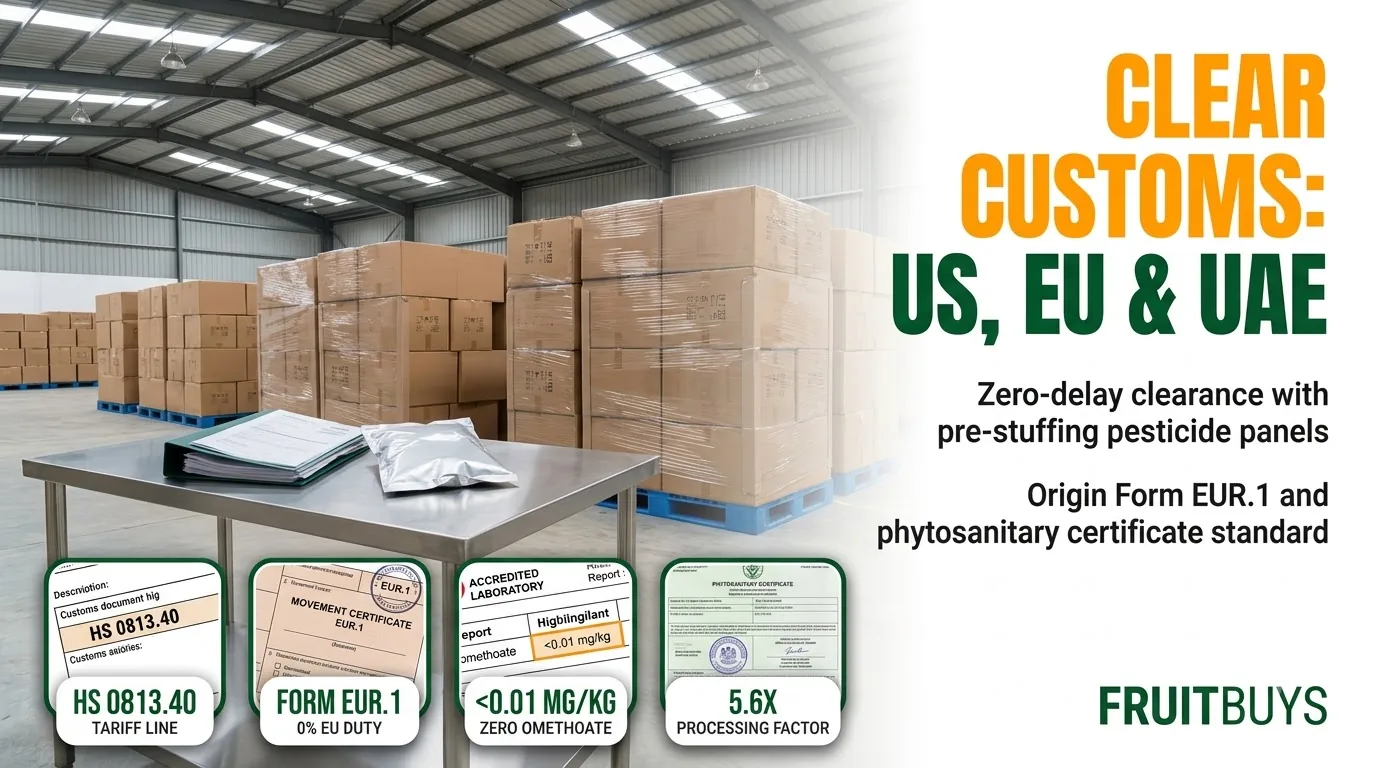
Market documentation depends on destination and importer role. Do not ask for one generic file set for every destination.
For US importers, FDA’s FSVP rule requires importers to establish and follow written procedures to ensure they import food from foreign suppliers approved based on risk and supplier-performance evaluation, or from unapproved suppliers under adequate verification activities when appropriate. (FDA FSVP Final Rule) (U.S. Food and Drug Administration)
That means the RFQ should support the importer’s verification file. It should not only ask for a branded pack. Use market documentation for freeze-dried mango before final market approval.
Request:
- Destination market
- Importer role
- Required facility or supplier documents
- COA scope
- Laboratory reports
- Certificate scope
- Ingredient statement
- Nutrition Facts or nutrition declaration basis
- Packaging food-contact support
- Label language
- Lot code plan
- Packing list requirements
- Traceability file
- Product registration route where applicable

A document request without destination context creates noise. Destination context turns documents into a release file.
Section 9: Container and Logistics Inputs
The RFQ should include logistics inputs when the buyer plans bulk supply, distributor inventory or private label shipment. Container planning should not start after the product is packed. Use freeze-dried mango container planning before confirming carton count.
Request:
| Logistics Field | Required Detail |
|---|---|
| Carton size | Length × width × height |
| Net weight per carton | Product weight |
| Gross weight per carton | Product plus packaging |
| Loading method | Floor-loaded or palletized |
| Pallet requirement | Size, height and wrapping if applicable |
| Container type | 20ft, 40ft HC or other route |
| Lot segregation | Single or multiple lot shipment |
| Case label | Required label fields |
| Loading photos | Required or not |
| Seal number | Required in shipment file |
| Receiving condition | Warehouse, manual unload or pallet unload |

The working carton input for current planning is 600 × 390 × 390 mm, with 5–7 kg net product per carton. Treat this as a planning input until pack format, carton strength, loading method and receiver requirement are confirmed. Logistics does not only move cartons. It protects the product’s approved condition.
Complete RFQ Checklist
Use this checklist before sending the RFQ.
| Section | Checklist Item |
|---|---|
| Buyer profile | Buyer role, destination, channel, application |
| Product identity | Freeze-Dried Mango, processing method, ingredient statement |
| Raw material | Variety direction, maturity, dry matter or Brix if required |
| Format | Slices, Cubes, Bites, Granules or Powder |
| Size | Dimension, sieve range or mesh |
| Physical limits | Breakage, fines, color, aroma, texture |
| Technical limits | Moisture, Aw, microbiology and required panels |
| COA | Lot-specific COA with method, result, date and lot code |
| Sample | Sample code, purpose, criteria and bulk match rule |
| Packaging | Pouch, inner bag, carton, seal and storage condition |
| Shelf life | Target range plus packaging and validation basis |
| Nutrition | Product-specific data basis where label use requires it |
| Private label | Pouch, label language, artwork, coding and SKU file |
| Market documents | Destination, importer role, certificates, lab reports |
| Logistics | Carton size, net weight, loading method and packing file |
| Release criteria | Accept, hold, conditional review, rework or reject |
This is the RFQ spine. It keeps the buyer away from vague procurement fog.

RFQ Template Buyers Can Send
Product:
Freeze-Dried Mango

Application:
[Retail snack / cereal inclusion / chocolate inclusion / bakery / beverage powder / yogurt topping / private label / bulk ingredient]

Format:
[Slices / Cubes / Bites / Granules / Powder]

Physical specification:
Size or mesh:
Breakage limit:
Fines limit:
Color and sensory target:

Technical targets:
Moisture:
Aw:
Microbiology panel:
Residue or contaminant panel, if required:

Sample requirement:
Sample purpose:
Sample quantity:
Sample pack:
Application test:
Approval criteria:

Packaging:
Pack type:
Pack size:
Pouch or inner bag structure:
Carton size:
Storage condition:
Shelf-life target and validation basis:

Documentation:
COA:
Laboratory reports:
Certificate scope:
Ingredient statement:
Nutrition basis:
Food-contact packaging support:
Market-specific documents:

Private label, if applicable:
Artwork stage:
Label language:
Serving-size basis:
Lot code placement:
Case configuration:

Logistics:
Net weight per carton:
Gross weight per carton:
Loading method:
Container type:
Receiving requirement:

Release decision:
Approved sample reference:
Bulk-release criteria:
Document match requirement:
This template does not ask FruitBuys to guess. It tells FruitBuys what to configure, verify, approve and release.
Application Mapping
| Buyer Type | Application | Required Format | Proof Needed | FruitBuys Delivery |
|---|---|---|---|---|
| Importer | Bulk distribution | Slices, Bites, Granules or Powder | Product spec, COA, lab reports, carton plan and market file | Documentation and Export Logistics Coordination |
| Procurement manager | Supplier qualification | All formats | RFQ checklist, approved sample, technical limits and document scope | Single-point commercial accountability |
| QA manager | Lot approval | All formats | Moisture, Aw, microbiology, COA, method and lot code match | Quality Control and lot-based Documentation |
| R&D developer | Application test | Cubes, Granules, Bites or Powder | Sample code, particle size, application result and bulk match rule | Market Trial Support |
| Private label buyer | Retail SKU | Slices, Bites or Powder | Pouch file, Nutrition Facts basis, label input and release file | OEM /Private Label Delivery |
| Distributor | Multi-SKU supply | Bites, Slices or Powder | Case configuration, lot segregation, shelf-life basis and shipment file | Export Logistics Coordination |
Why FruitBuys Delivers This
FruitBuys uses the RFQ as the first control document in the Integrated Product Supply Model. The buyer does not need to chase separate answers for raw material, process, sample, packaging, COA, label data and logistics. FruitBuys aligns those inputs into one supplied product route.
The Raw Material Sourcing Governance pillar controls variety direction, maturity, intake and traceability. The Quality Control pillar controls format, size, breakage, fines, moisture, Aw and sensory release. The Documentation pillar controls COA, laboratory reports, certificate scope, packaging file, label basis and lot identity. The OEM/Private Label Delivery pillar connects product data to pouch, label, coding and case configuration. The MOQ Flexibility/Market Trial Support pillar supports sample validation when the route allows it. The Export Logistics Coordination pillar aligns carton, loading method, packing list and document handover. FruitBuys does not treat the RFQ as paperwork. FruitBuys treats it as the first release filter.
Buyer Checklist
Before sending a freeze-dried mango RFQ, confirm:
- Buyer role and destination market
- Final application
- Required format
- Size, mesh or sieve range
- Breakage and fines limits
- Moisture and Aw targets
- COA and laboratory scope
- Sample approval criteria
- Packaging structure
- Shelf-life basis
- Ingredient statement
- Nutrition Facts or nutrition basis when required
- Private label artwork stage
- Market documentation needs
- Carton size and logistics route
- Bulk-release criteria
Do not send the RFQ until the product’s job is clear.
Freeze-Dried Mango RFQ Checklist
A freeze-dried mango RFQ should define application, format, size, breakage, fines, moisture, Aw, sample criteria, packaging, COA, laboratory scope, private label inputs, market documents and logistics requirements. Slices, Cubes, Bites, Granules and Powder need different proof.
Buyers should not ask for a generic product quote before locking the release standard. FruitBuys uses the RFQ to align raw material governance, Quality Control, Documentation, OEM/private label delivery and export logistics coordination.
FAQ
What should a freeze-dried mango RFQ include first?
Start with buyer role, destination market, application and required format. Those fields decide the technical, packaging and documentation route.
Should buyers request samples before writing specifications?
No. Buyers should define sample purpose, format, size, fines, moisture, Aw and approval criteria before sample dispatch.
What technical values matter most?
Moisture, Aw, microbiology, physical grade, breakage, fines and any market-required residue or contaminant testing matter most.
Does the RFQ need packaging details?
Yes. Packaging controls moisture protection, breakage, shelf-life basis, label execution and carton planning.
Should private label buyers include Nutrition Facts requirements?
Yes. Private label buyers should state pack size, serving basis, nutrition data source, label language and artwork stage.
Can one RFQ cover every market?
Only if the buyer separates destination-specific requirements. US, EU, UAE and other markets may need different document review.
What makes an RFQ ready for FruitBuys review?
It is ready when application, format, technical limits, sample criteria, packaging, documents and logistics inputs are clear.
Conclusion
A freeze-dried mango RFQ should not ask FruitBuys to guess the product. It should define the application, format, physical criteria, technical limits, packaging, COA, label basis, market documentation and logistics route. A strong RFQ reduces sample drift, document gaps and bulk-release disputes before they begin.
Submit the RFQ checklist after confirming the target application, format, packaging route and required document scope.
References
- Codex Alimentarius Commission. General Standard for Dried Fruits, CXS 360-2020. (Codex General Standard for Dried Fruits, CXS 360-2020)
- U.S. Food and Drug Administration. Water Activity (aw) in Foods. (FDA Water Activity in Foods)
- International Organization for Standardization. ISO 18787:2017, Foodstuffs: Determination of Water Activity. (ISO 18787:2017)
- U.S. Food and Drug Administration. Guidance for Industry: Measures to Address the Risk for Contamination by Salmonella Species in Food Containing a Peanut-Derived Product as an Ingredient. (FDA guidance on Salmonella risk in low-water-activity ingredients)
- U.S. Food and Drug Administration. Serving Size on the Nutrition Facts Label. (FDA Serving Size on the Nutrition Facts Label)
- U.S. Food and Drug Administration. FSMA Final Rule on Foreign Supplier Verification Programs for Importers of Food for Humans and Animals. (FDA FSVP Final Rule)