Freeze-Dried Mango COA and Laboratory Testing Requirements
A freeze-dried mango sample can pass a visual review and still fail a buyer’s documentation standard. The sample may look crisp. The color may look acceptable. The pouch may carry a certificate logo. None of that proves the shipped lot meets the approved specification. Importers, QA managers and private label buyers need a COA that matches the product, lot, format, test method and shipment file.
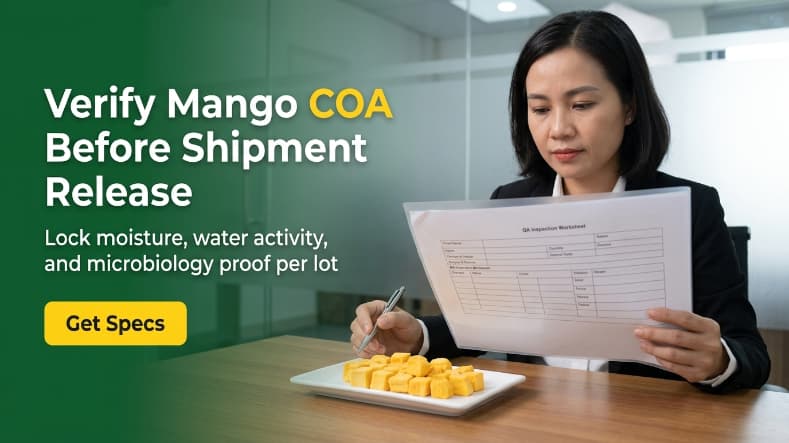
A COA does not decorate the order, it decides whether the lot can move forward. FruitBuys treats COA review as part of controlled product release, not as an afterthought sent when the cargo is already packed. The buyer should request the laboratory scope, certificate scope and lot identity before approving bulk freeze-dried mango.
What a Freeze-Dried Mango COA Should Prove
A freeze-dried mango COA should prove that one named lot was tested against one approved specification.
It should show the product identity, lot code, test items, methods, limits, results, date and release status.
Buyers should reject any COA that cannot connect clearly to the packed goods.

A useful COA starts with identity. It must identify the product as freeze-dried mango, not only “dried fruit” or “mango snack.” It must name the format because Slices, Cubes, Bites and Powder carry different physical risks. It must show a lot code that matches the packing list, carton labels and shipment file.
The COA should not make the buyer guess which sample the laboratory tested. A report without lot identity becomes a floating document. It may describe a past sample, a different format or a different production run. That kind of file cannot support bulk release.
For buyers still qualifying supply, this article sits under the broader freeze-dried mango supplier Vietnam path. Supplier qualification should move from product definition to test evidence, then to sample-to-bulk release.
A COA should answer six questions:
| Buyer Question | COA Requirement |
|---|---|
| What product was tested? | Product name and format |
| Which lot does it represent? | Lot code and sample identity |
| What limits apply? | Approved specification |
| What was tested? | Test panel |
| How was it tested? | Method or laboratory procedure |
| Can the lot move? | Release status or QA approval |
COA, Laboratory Report and Certificate Are Different Files
Buyers should separate three documents before approving freeze-dried mango. A COA summarizes test results and lot-release data against an approved specification. A laboratory report provides test detail, such as method, sample information, results, reporting limit and laboratory identity. A certificate describes a management system, site, process or standard scope. These files can support each other, but they do not replace each other.
ISO/IEC 17025 is the international standard covering competence requirements for testing and calibration laboratories. When a buyer relies on third-party test results, the buyer should review whether the laboratory’s accreditation scope covers the exact test methods used for the mango lot. (ISO)
A certificate also has limits. ISO 22000 describes food safety management system requirements and can be certified, but a management-system certificate does not prove the microbiology, Aw or pesticide residue result of one freeze-dried mango lot. (ISO)
The buyer should read these documents in this order:
- Approved specification.
- COA for the exact lot.
- Laboratory report behind critical results.
- Certificate scope and validity.
- Packing and shipment file.
- Sample-to-bulk comparison record.
Skipping this order creates document theatre. The order may look complete, but the buyer still does not know whether the delivered product passed.
Core Physical and Chemical Results
Physical and chemical tests show whether the lot meets the product specification.
For freeze-dried mango, moisture and Aw should sit beside format, breakage, fines and sensory review.
Buyers should not approve one number while ignoring the physical condition of the goods.

Freeze-dried mango requires more than a moisture value. A commercial lot should show enough technical data to match the approved sample and intended application. If the buyer orders retail slices, breakage matters. If the buyer orders powder, mesh and caking risk matter.
If the buyer orders bites for snack mix, minimum piece size and fines matter. The current FruitBuys target range for freeze-dried mango is 3–5% moisture and Aw <0.30. The actual lot must confirm those values through COA review. Moisture measures total water. Aw measures available water.
FDA’s water activity guidance links Aw to moisture available for microbial growth, which makes it a stability and safety-related control point, not a cosmetic data field. (U.S. Food and Drug Administration). For deeper QA context, buyers should read freeze-dried mango moisture and Aw before reviewing the COA.
A practical COA should include these physical and chemical controls:
| Test Item | Why It Matters | Document Needed |
|---|---|---|
| Moisture | Texture, mass balance and storage behavior | COA with method |
| Aw | Stability and microbial growth potential | COA with method |
| Format | Application fit | Specification and sample record |
| Dimensions | Retail appearance or dosing control | QC inspection sheet |
| Breakage | Pack appearance and application performance | Sorting or inspection record |
| Fines | Powdering, pack fill and ingredient behavior | Sieve or visual standard |
| Sensory | Color, aroma, texture and foreign odor | Approved sensory criteria |
Format proof belongs beside technical proof. Buyers should link physical review to mango slices, cubes, bites and powder before approving the final specification.
Microbiological Testing for Freeze-Dried Mango
Low moisture does not make a product sterile. Aw below a target can limit microbial growth, but it does not prove pathogens are absent. Growth and survival are different technical questions. A dry product can still carry contamination from raw material, handling, sorting, post-drying exposure or packaging contact.
FDA guidance on Salmonella risk in low-water-activity ingredients notes that process effectiveness may depend on how a low-Aw ingredient is used later, including whether it gets rehydrated in another food system. (U.S. Food and Drug Administration) FDA’s BAM Chapter 5 covers Salmonella analytical methods and was updated with screening content in 2024, which reinforces the need to state method and matrix when relying on a laboratory result. (U.S. Food and Drug Administration)

A buyer should request a microbiology panel based on destination, customer standard and product use. FruitBuys should not publish a universal panel as if it covers every market and buyer. Still, a practical panel for freeze-dried mango may include:
| Microbiology Item | Buyer Reason |
|---|---|
| Total plate count | General hygiene and process indicator |
| Yeast and mold | Dry-fruit stability and spoilage indicator |
| Coliforms | Hygiene indicator |
| E. coli | Process and hygiene concern |
| Salmonella | Pathogen control concern |
| Listeria monocytogenes | Relevant when buyer or destination scope requires it |
“Not detected” does not mean absolute zero. It means the organism was not detected under the stated method, sample size and reporting condition. Buyers must read the method, matrix, laboratory scope and sample identity.
Pesticide Residues and Heavy Metals
Freeze-dried mango starts with agricultural raw material. Raw material governance therefore affects the laboratory panel. Buyers should not treat drying technology as a shield against field-originated residue risk. Drying removes water. It does not erase pesticide residues or heavy metals.
For EU buyers, pesticide residue review must refer to the applicable MRL framework under Regulation (EC) No 396/2005. The European Commission explains MRLs as legally permitted maximum levels of pesticide residue in or on food or feed. (Food Safety) Contaminant review should also consider the applicable categories and limits under Commission Regulation (EU) 2023/915. (EUR-Lex)

Do not overstate this. A general EU regulation does not prove a FruitBuys lot complies. Only a product-specific laboratory report can support that claim for the lot under review.
A buyer should define:
- Destination market
- Product format
- Test panel
- Reporting limits
- Laboratory accreditation scope
- Sample identity
- Lot code
- Acceptance criteria
- Document validity window
FruitBuys aligns this through Raw Material Sourcing Governance and Documentation. The raw-material lot, production lot and laboratory sample must connect clearly. A buyer who accepts a residue report from a different season or product form has not approved the lot. The buyer has only approved a PDF.
Certificate Scope Verification
A certificate can support supplier qualification, but it does not replace lot testing.
The buyer must verify site, scope, process, product category, validity and issuer before relying on it.
Certificate logos without scope create false confidence and weak release decisions.

Buyers often ask for HACCP, ISO 22000, BRCGS, Halal or FDA-related files. The request makes sense. The risk starts when the buyer treats a certificate name as proof of the product lot. A certificate can show that a site or system operates under a defined scope. It does not automatically prove one lot’s moisture, Aw, Salmonella result, pesticide panel or heavy-metal result.
FDA food facility registration gives another example. FDA states that domestic and foreign facilities that manufacture, process, pack or hold food for U.S. consumption must register unless exempt, but FDA also states that it does not issue a certificate of registration or product status and does not recognize private certificates of registration. (U.S. Food and Drug Administration)
For U.S. buyers, FDA’s FSVP rule requires importers to establish and follow written procedures so they import food only from approved foreign suppliers based on risk and supplier-performance evaluation, or from unapproved suppliers under adequate verification activity. (U.S. Food and Drug Administration) That means the importer needs supplier evaluation and verification evidence. A certificate alone cannot carry the whole file.
Certificate review should confirm:
| Certificate Item | Buyer Check |
|---|---|
| Legal site name | Matches the production or packing site |
| Address | Matches the actual facility involved |
| Scope | Covers relevant process and product category |
| Standard version | Current and applicable |
| Validity | Not expired |
| Issuer | Recognized certification body |
| Exclusions | No exclusion that affects the supplied product |
| Product link | Clear enough for buyer qualification |
FruitBuys should release only claims supported by exact certificate copies, site scope and validity. Without that, the public article should avoid certification claims.
Lot-Based Documentation Control
Lot control creates the bridge between laboratory proof and the actual goods. The buyer should be able to trace the finished product from raw mango intake to production batch, sorting grade, packed unit, carton and shipment document. If that bridge breaks, the COA becomes weak.
A lot file for freeze-dried mango should include:
- Product specification.
- Raw material intake record.
- Production lot code.
- Approved format and grade.
- Moisture and Aw results.
- Microbiology results.
- Residue and contaminant testing where required.
- Certificate scope copies where relevant.
- Packaging specification.
- Packing list.
- Carton label record.
- Release approval.
Codex’s general standard for dried fruits covers dried fruits, including products identified as freeze dried, and it addresses general quality conditions such as characteristic colour, flavour, odour and texture, while requiring products to remain practically free from visible foreign matter and moldy fruit. (FAOHome) The buyer should treat those general quality expectations as a starting point, not as the complete lot-release file.
The release file must connect to sample-to-bulk consistency controls. A beautiful sample proves nothing if the bulk lot uses a different grade, format, package or laboratory file.
Documentation Package Before Shipment Release
A shipment should not move on a half-built document set. If the buyer receives the COA after packing, problems become harder to correct. If the test panel lacks destination relevance, the buyer may face review delays. If the certificate scope does not match the product route, the supplier approval file remains exposed.
Before release, the buyer should receive or approve:
| Document | Purpose |
|---|---|
| Product specification | Defines the product and acceptance criteria |
| Approved sample record | Defines the buyer reference |
| COA | Summarizes lot results |
| Laboratory reports | Support critical test data |
| Certificate copies | Support site or system qualification |
| Ingredient statement | Supports label and importer review |
| Packaging specification | Confirms pack structure and protection |
| Packing list | Confirms carton and lot details |
| Lot coding record | Links pack to production and COA |
| Destination documents | Supports importer and market review |
For procurement preparation, buyers should connect this article to the freeze-dried mango RFQ checklist. For market-specific review, connect it to market documentation for freeze-dried mango.
Application Mapping
| Buyer Type | Application | Required Format | Proof Needed | FruitBuys Delivery |
|---|---|---|---|---|
| Importer | Bulk distribution | Slices, Bites or Powder | COA, lab reports, certificate scope and lot file | Documentation alignment and export logistics coordination |
| QA manager | Supplier approval | All formats | Specification, methods, laboratory scope and release status | Quality Control plus lot-based documentation |
| Retail buyer | Consumer pouch | Slices or controlled Bites | Moisture, Aw, microbiology, breakage and packaging file | OEM/private label delivery with release control |
| Ingredient distributor | Multi-application supply | Powder, Granules or Bites | Mesh, fines, microbiology, residues and contaminants | Format-specific specification and document handover |
| Food manufacturer | Inclusion in cereal, chocolate or dairy | Cubes, Granules or Bites | Aw, microbiology, residue panel and sample comparison | Application-matched product configuration |
| Private label brand | Retail SKU | Bites, Slices or Powder | Ingredient statement, COA, label data and certificate scope | One finished private label product under one supplier relationship |
Why FruitBuys Delivers This
FruitBuys supplies freeze-dried mango as one configured product with one accountable documentation path. The buyer does not need scattered files from unrelated parties. FruitBuys aligns the specification, sample record, lot COA, laboratory reports, packaging file and shipment documents behind the supplied product.
The Quality Control pillar covers moisture, Aw, physical inspection, breakage, fines, sensory review and lot-release criteria. The Documentation pillar covers COA, laboratory report, certificate scope, lot code, ingredient file and packing documents. The Raw Material Sourcing Governance pillar connects raw mango intake to production and laboratory sampling. The OEM/Private Label Delivery pillar links technical proof to pouch, artwork inputs, coding and buyer approval. The Export Logistics Coordination pillar keeps the packing file and shipment file aligned before dispatch.
A COA works only when it matches the product in the carton. FruitBuys treats that match as a release condition.
Buyer Checklist
Before approving freeze-dried mango, request:
- Final product specification
- Product format and grade
- Approved sample record
- Lot-specific COA
- Moisture result and method
- Aw result and method
- Microbiology panel and laboratory report
- Pesticide residue report when required
- Heavy-metal or contaminant report when required
- Laboratory accreditation scope where relevant
- Certificate copies with site, scope and validity
- Ingredient statement
- Packaging specification
- Packing list and carton coding
- Sample-to-bulk comparison record
- Destination-specific documentation review
Do not approve a bulk lot from certificate logos, photos or old reports. That shortcut creates a documentation gap the buyer will have to explain later.
Freeze-Dried Mango COA and Testing
A freeze-dried mango COA should connect one product lot to one approved specification. Key items include moisture, Aw, microbiology, format, breakage, fines and any destination-required residue or contaminant testing.
Laboratory reports should identify the sample, method, result, reporting condition and laboratory scope. Certificate files support supplier qualification, but they do not replace lot testing. Buyers should review COA, laboratory reports, certificate scope, packaging file and sample-to-bulk comparison before approving commercial release.
FAQ
What should a freeze-dried mango COA include?
It should include product name, format, lot code, test items, specification limits, actual results, methods, test date and release status.
Can one laboratory report cover all future lots?
No. A historical report can support supplier review, but it does not release a future lot unless it matches the goods being shipped.
Does a certificate replace a COA?
No. A certificate supports system or site qualification. A COA supports lot-level release against the approved product specification.
Is Aw below 0.30 enough for release?
No. Aw supports stability review, but buyers still need moisture, microbiology, packaging and lot documentation.
Which microbiology tests should buyers request?
The panel depends on buyer standard and destination. Common items include total plate count, yeast and mold, E. coli and Salmonella.
Why must certificate scope be checked?
Scope confirms whether the certificate covers the relevant site, process and product category. A logo without scope proves nothing useful.
What should private label buyers add?
Private label buyers should add ingredient statement, label basis, pack format, coding, artwork inputs and destination-specific documentation.
Conclusion
A COA controls the release decision only when it connects to the actual freeze-dried mango lot. The buyer needs the product specification, laboratory methods, certificate scope, packaging file and sample-to-bulk comparison before bulk approval. Old reports, vague certificates and visual samples do not carry the risk.
Request the lot-document checklist after defining the destination market, product format and required laboratory panel.
References
- U.S. Food and Drug Administration. Water Activity (aw) in Foods. Inspection Technical Guides. (U.S. Food and Drug Administration)
- U.S. Food and Drug Administration. Guidance for Industry: Measures to Address the Risk for Contamination by Salmonella Species in Food Containing a Peanut-Derived Product as an Ingredient. March 2009. (U.S. Food and Drug Administration)
- U.S. Food and Drug Administration. BAM Chapter 5: Salmonella. Updated May 2024. (U.S. Food and Drug Administration)
- International Organization for Standardization. ISO/IEC 17025:2017, General Requirements for the Competence of Testing and Calibration Laboratories. (ISO)
- International Organization for Standardization. ISO 22000 Food Safety Management. (ISO)
- U.S. Food and Drug Administration. FSMA Final Rule on Foreign Supplier Verification Programs for Importers of Food for Humans and Animals. (U.S. Food and Drug Administration)
- European Union. Commission Regulation (EU) 2023/915 on Maximum Levels for Certain Contaminants in Food. (EUR-Lex)
- European Commission. Q&As: Regulation of Pesticide Residues in the EU. (Food Safety)
- Codex Alimentarius Commission. General Standard for Dried Fruits, CXS 360-2020. (FAOHome)