
Freeze-Dried Mango Supplier in Vietnam: A Buyer’s Guide to Bulk and Private-Label Supply
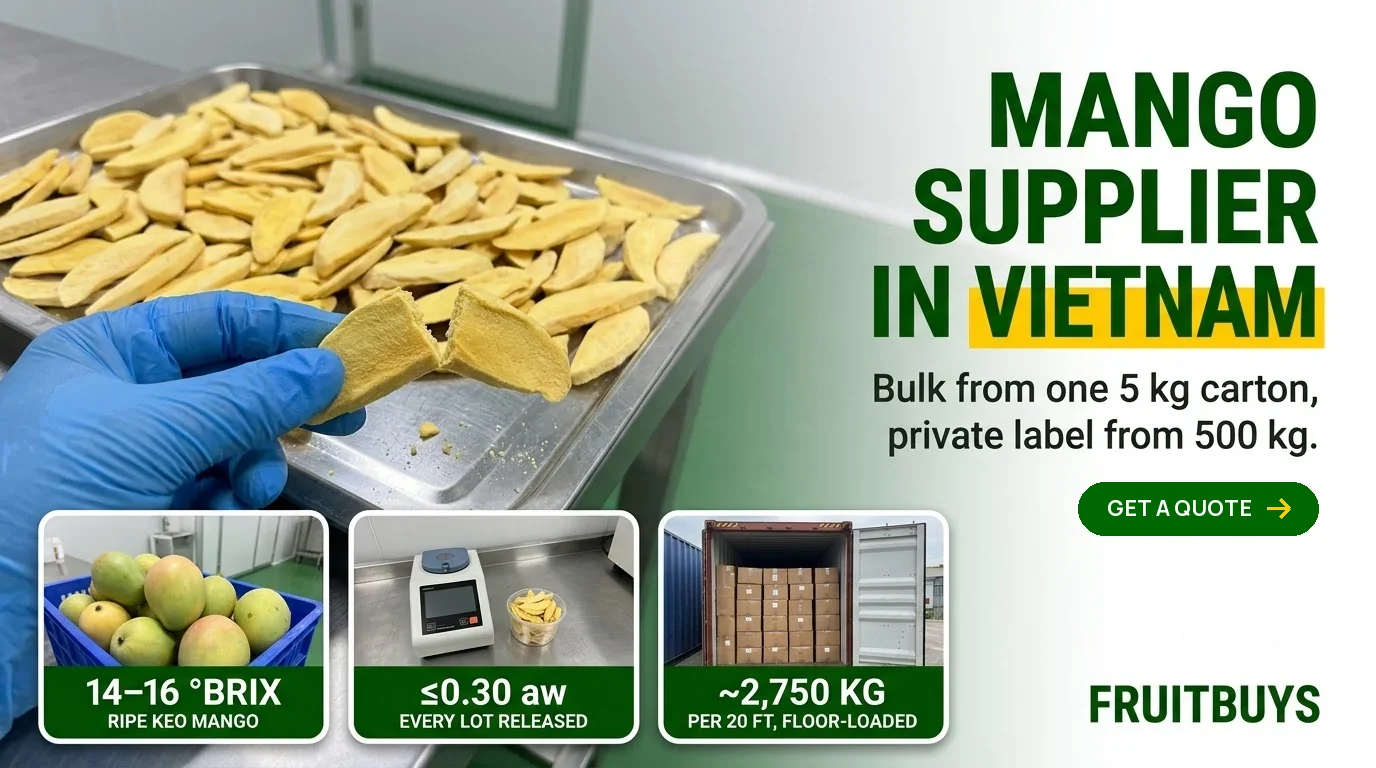
FruitBuys supplies bulk and private-label freeze-dried mango from Vietnam’s Mekong Delta, released at 3–5% moisture and water activity ≤0.30, in slices, cubes, bites, granules and powder. Bulk starts at one 5 kg carton, private label at 500 kg per SKU, and a 20 ft container carries about 2,750 kg floor-loaded.
This guide is the starting point for buying freeze-dried mango from Vietnam. Each section answers one buying question in a few lines and links to the detailed guide behind it. If you already know what you need, go straight to the freeze-dried mango product page or the freeze-dried mango powder page.
Key numbers
| Freeze-dried mango pieces | Freeze-dried mango powder | |
|---|---|---|
| Ingredient | 100% mango, 0 g added sugar, no sulphite | 100% mango, no carrier |
| Moisture / water activity | 3–5% / ≤0.30 | 3–5% / ≤0.30 |
| Sizes | Slices 6–7 mm, cubes 5–10 mm, bites 10–15 mm, granules 2–5 mm | 60–80 mesh (finer on request) |
| Bulk carton | 5 kg, 58 × 28 × 34 cm | 20 kg (4 × 5 kg bags) |
| 20 ft container | about 550 cartons, 2,750 kg floor-loaded | about 11,000 kg |
| Minimum order | Bulk from one carton; private label 500 kg/SKU | Bulk from one carton; private label 500 kg/SKU |
| Lead time | Samples 3–5 working days by courier; production 20–30 days per 20 ft after deposit | Same |
| Shelf life | 12 months at ≤25 °C, RH ≤60%; 18–24 months in cool storage at ≤18 °C, RH ≤50% | Same |
Who is FruitBuys, and who makes the mango?
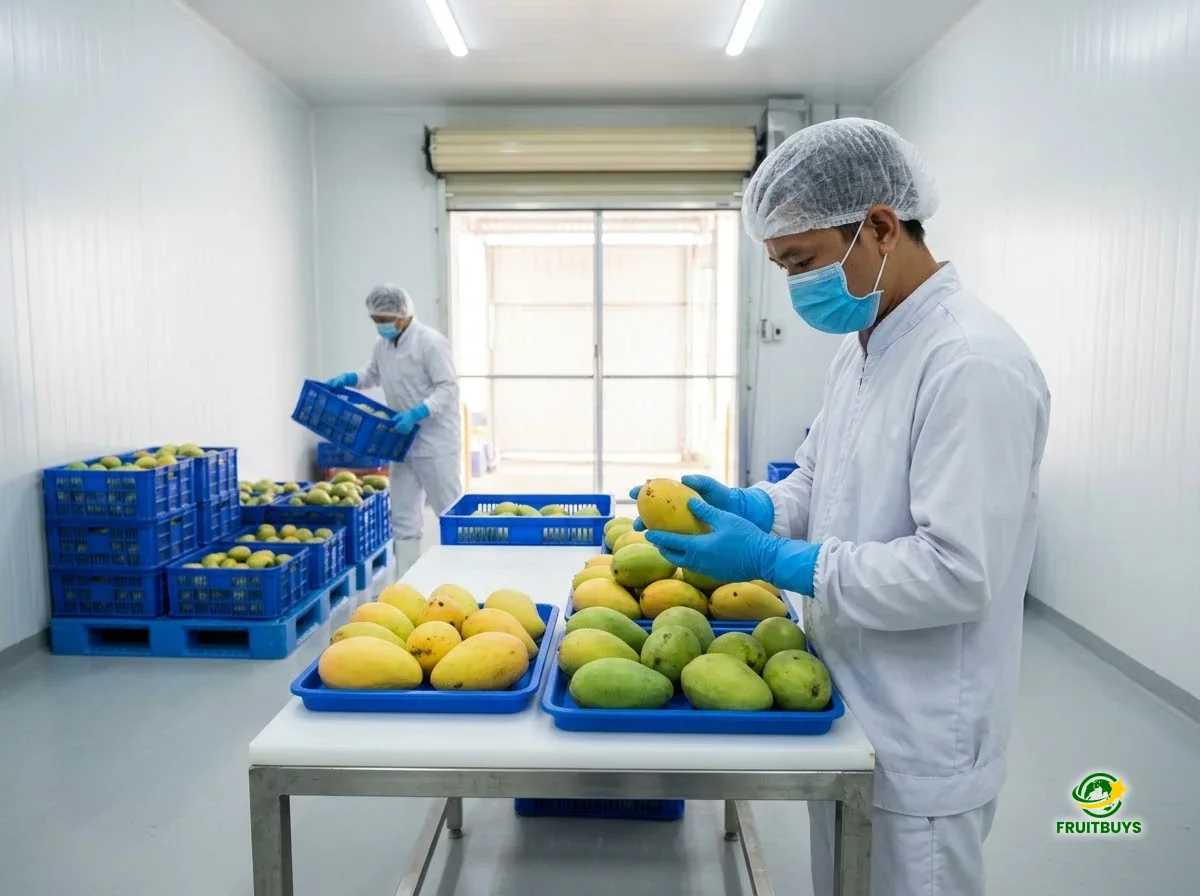
FruitBuys runs the supply chain end to end and dries on qualified partner facilities, one facility locked to each contract. We source the fruit in the Mekong Delta, set the process standard, release every lot against the same specification and prepare the export file. You deal with one commercial contact in Ho Chi Minh City from fruit intake to bill of lading.
The partner facility that dries your approved sample is the one that dries your tenth container. If it ever had to change, you would hear it in writing first and approve a new pre-shipment sample before a single carton moved. Once you sign, your QA team has audit access to that facility; its certificates sit in your technical file before you sign: HACCP, ISO 22000, US FDA Facility Registration and BRC (qualified processing facility), with Halal certification available on request. Each step from fruit intake to sealed bag, with the quality check at each one, is shown in how freeze-dried mango is made.
Which Vietnamese mango goes into the bag?
Keo is the standard; Cát Chu is available on request; Hòa Lộc is a limited gift-grade option. Keo has firm flesh that cuts into sharp, even cubes and holds its shape through mixing, with a ripe °Brix of 14–16. Cát Chu, grown mainly around Cao Lãnh in Đồng Tháp, is sweeter and more aromatic (14–18 °Brix) and is the pick for snack pouches eaten straight from the bag.
Open a carton of Keo cubes and the edges are still sharp; open a pouch of Cát Chu slices and the room smells of ripe mango. Name the cultivar in your contract and every reorder tastes like the first one. Cultivars, ripeness and how Vietnam compares with other origins are covered in why source freeze-dried mango from Vietnam.
When is mango season, and can you buy all year?
Yes: the main harvest runs March to July, an off-season crop follows September to November, and stock packed in the main season covers the months between. Main-season fruit is the sweetest and lowest-cost fruit of the year, so most annual programmes lock base volume before March. Off-season fruit grows through the rains and tastes a little sharper; a contract either agrees that sensory band or fills those months from main-season stock.
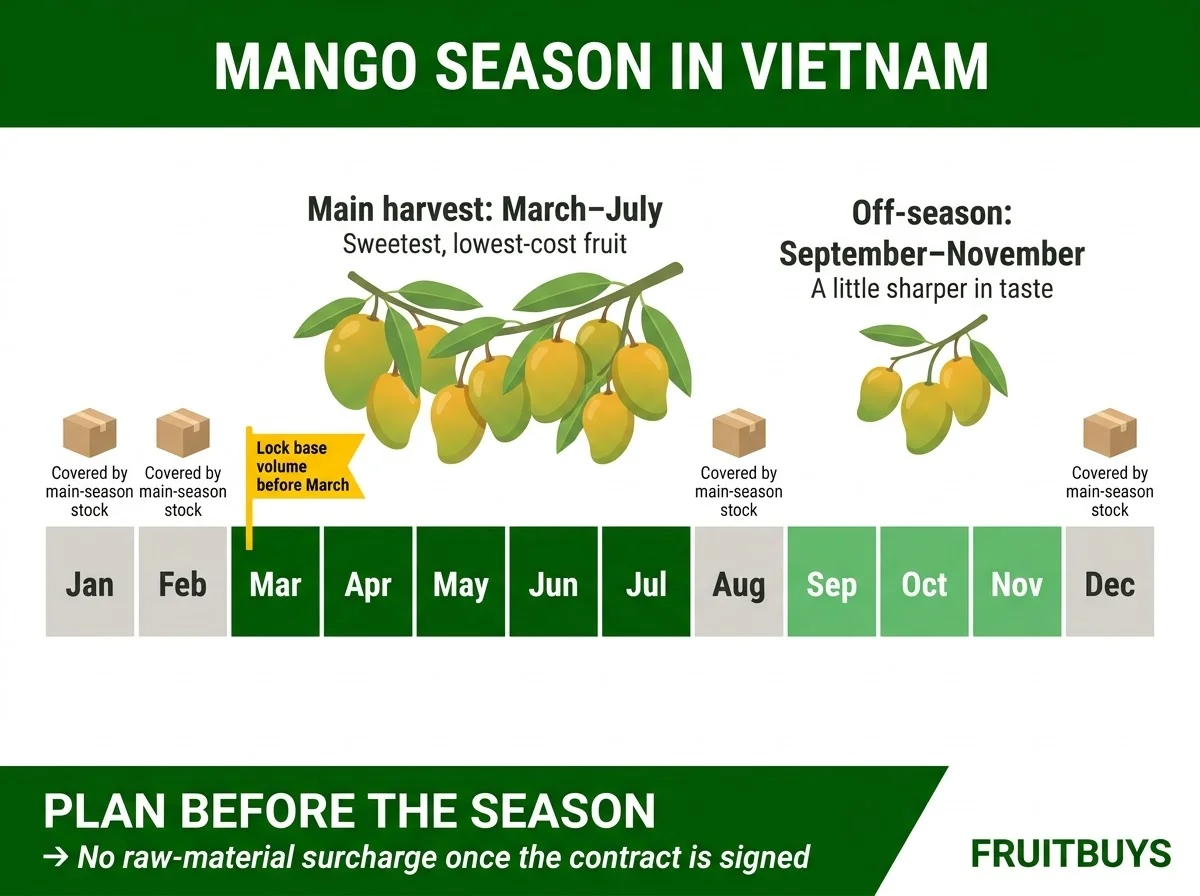
Once signed, a FruitBuys contract is not reopened for a raw-material surcharge when the harvest begins. That is the reason to plan early: you fix the fruit, the drying slots and the price before the season starts.
What formats can you buy, and which suits your product?
Slices for snack pouches, cubes for cereal and bars, bites for mixes, granules for bakery and drinks, powder for anything that must dissolve.
| Format | Size | Typical use |
|---|---|---|
| Slices | 6–7 mm thick | Retail snack pouch, chocolate pieces, toppings |
| Cubes | 5–10 mm | Cereal, granola, bars, yogurt cups |
| Bites | 10–15 mm | Trail and snack mixes |
| Granules | 2–5 mm | Bakery doughs, tea and drink blends |
| Powder | 60–80 mesh | Smoothie and beverage mixes, coatings, fillings, baby foods |
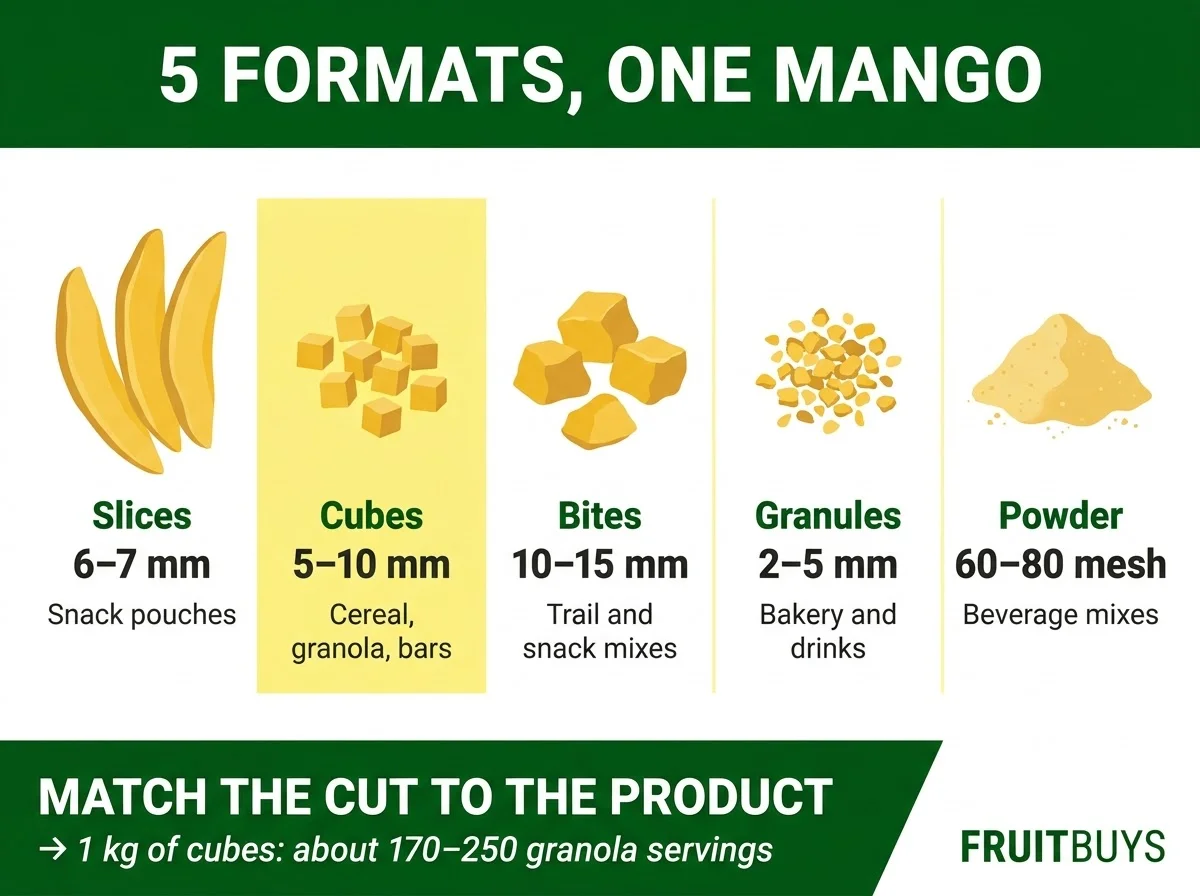
A little goes a long way: at a 10–15% inclusion, one kilogram of cubes carries real mango through about 170–250 granola servings of 40 g. Cut-by-cut guidance, inclusion rates and how to keep the crunch in yogurt or bars are in freeze-dried mango formats and applications. For powder, start with freeze-dried or spray-dried mango powder.
What specification does every lot meet?
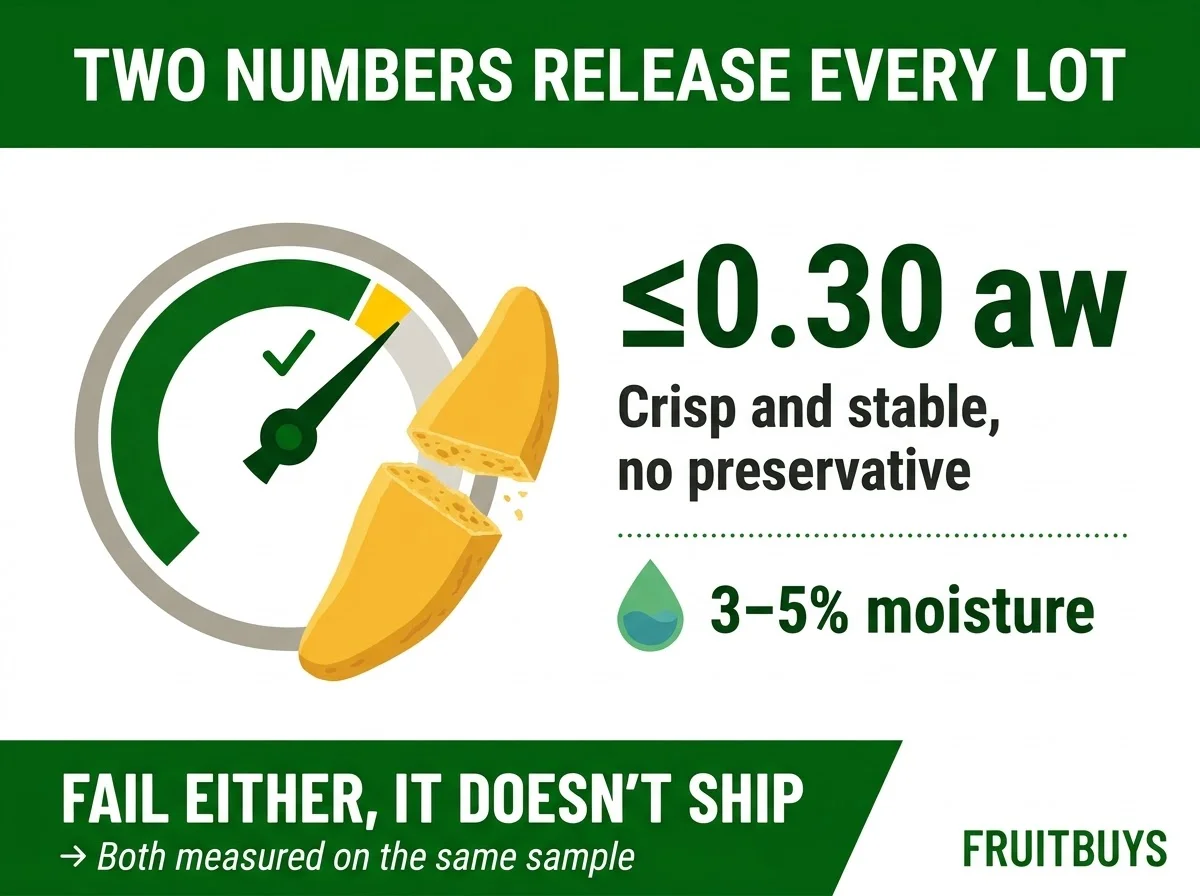
Every lot is released on moisture and water activity measured on the same sample; a lot that fails either does not ship. Water activity is the number that keeps the snap: at ≤0.30 the slice stays crisp and microbiologically stable without any preservative.
| Parameter | Release limit |
|---|---|
| Moisture | 3–5% |
| Water activity | ≤0.30 at 25 °C |
| Total plate count | ≤10,000 CFU/g |
| Yeasts and moulds | ≤100 CFU/g |
| E. coli | <10 CFU/g |
| Salmonella | Not detected in 25 g |
| Sulphite (SO₂) | <10 ppm, never added |
| Added sugar | 0 g |
| Fines below 2 mm | ≤3% at release, ≤5% on arrival |
| Metal detection | Fe 1.5 mm, non-Fe 2.0 mm, stainless steel 2.5 mm |
What the limits mean for your contract, and why a lot can still open soft when a moisture-only COA passed, is covered in why freeze-dried mango turns soft. Test methods and how to read a lot COA are in our testing and COA guide.
How much fresh mango is in a kilogram, and why does that set the price?
About 10.5–12 kg of whole Keo mango, or about 9.7 kg of Cát Chu, goes into one kilogram of freeze-dried mango. Peel, seed and trim take 35–42% of the fruit, and the flesh is mostly water. Every kilogram you buy is ripe mango with only the water taken out: no sugar fills the bag, so the crunch, the golden colour and the aroma are all fruit.
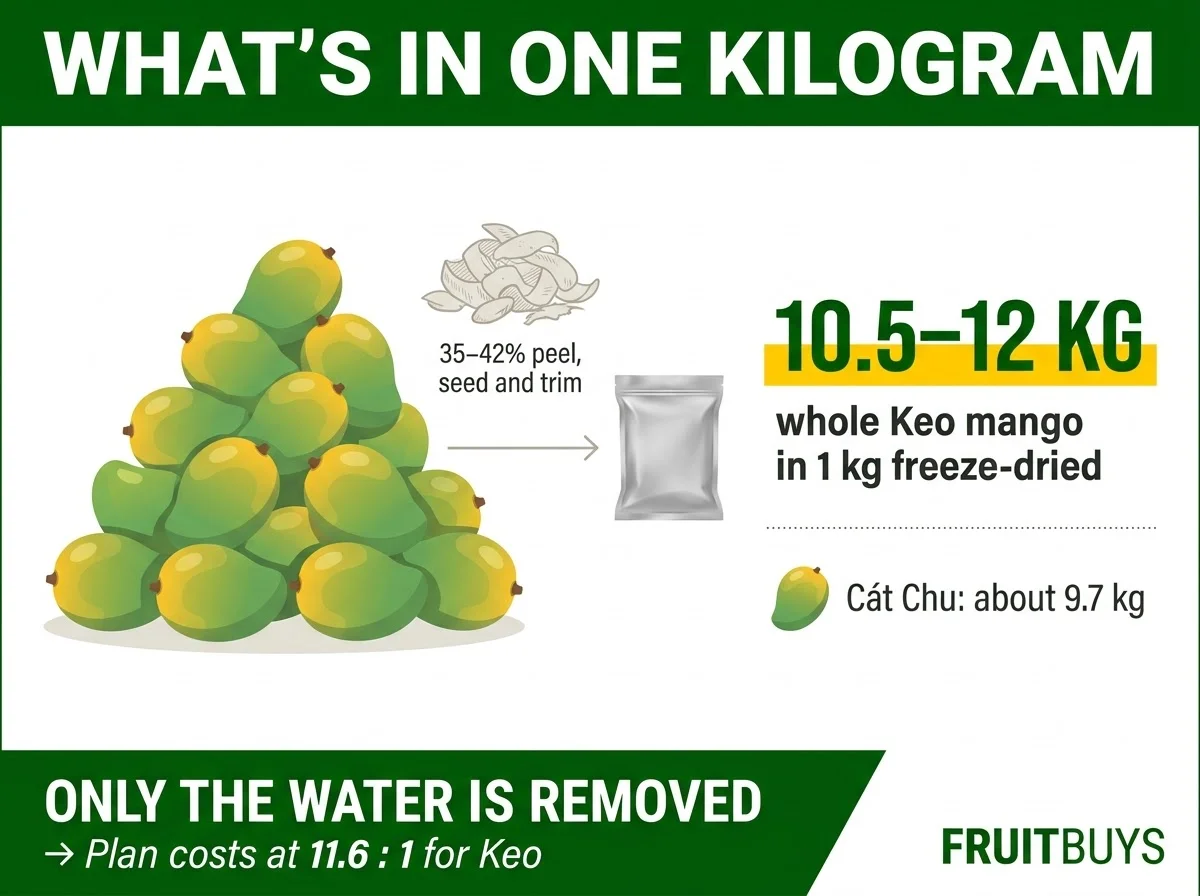
For costing, take 11.6 : 1 for Keo as your planning anchor. The rainy season pushes the real figure toward the top of the range; the dry season brings it down. Quotes stated on peeled flesh (around 6 : 1) look cheaper but under-budget the fruit. The full mass balance and a landed-cost formula are in why freeze-dried mango costs what it does.
How is it packed, and how much fits in a container?
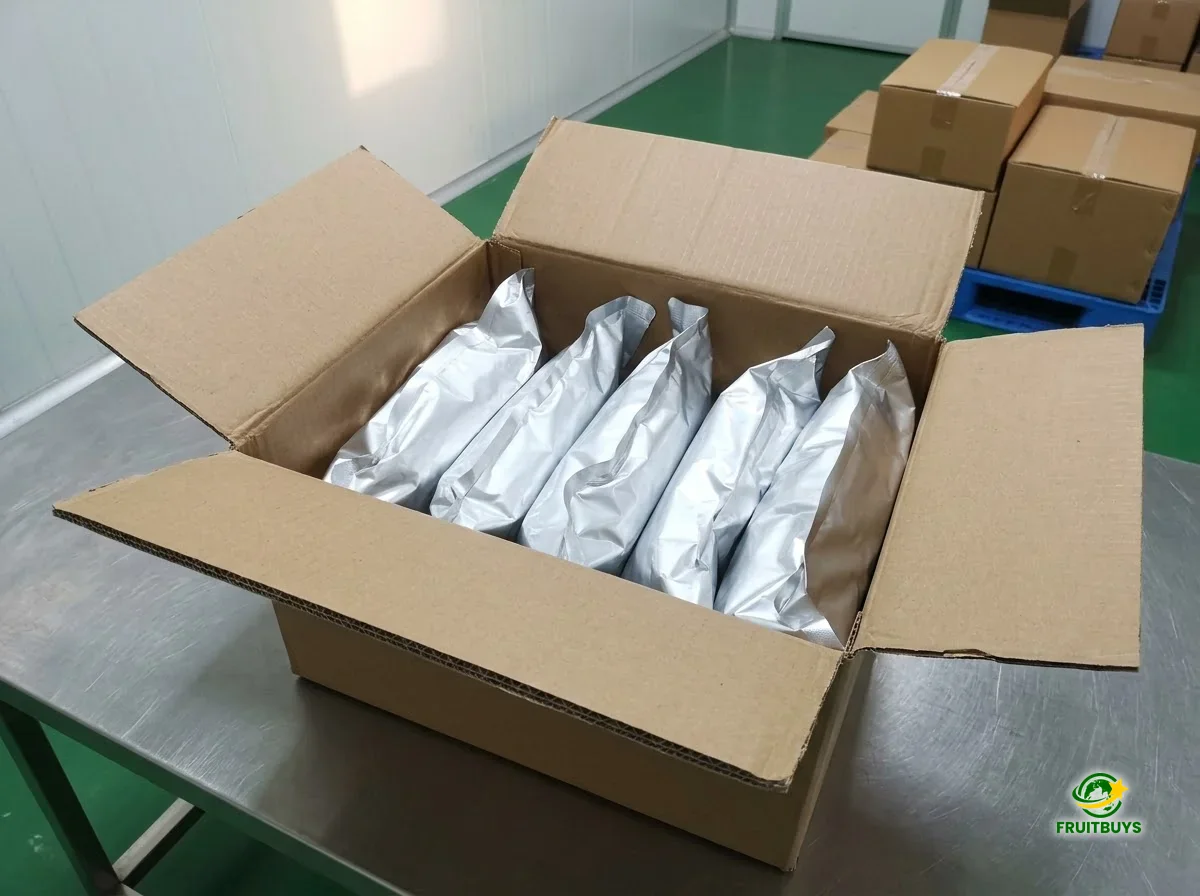
Every bag is foil laminate, gently vacuumed with a food-grade desiccant sachet inside, filled and sealed in a packing room held below 35% RH. Southern Vietnam’s air is humid most of the year, and a freeze-dried slice on an open table pulls water within minutes; the dry room is what lets a one-ingredient pack keep its date. Bags lie flat, with no nitrogen inflation, so cartons fill completely.
Freeze-dried mango fills a container by volume long before it reaches any weight limit. With the FruitBuys 5 kg carton:
| Loading | 20 ft | 40 ft |
|---|---|---|
| Floor-loaded | about 550 cartons, 2,750 kg | about 1,100 cartons, 5,500 kg |
| On pallets | about 1,400–1,800 kg | Stuffing plan per pallet type |
Floor loading cuts ocean freight per kilogram by 35–49% against pallets, about USD 1,800 per 20 ft container at an example freight of USD 2,500. Standard cartons are 5 kg for pieces and 20 kg for powder; other carton sizes are packed on project orders, confirmed by a trial pack. Film specifications, container protection against condensation and the shelf-life details are in packaging, shelf life and shipping.
Which documents come with each shipment?
Commercial invoice, packing list, bill of lading, certificate of origin (C/O Form EUR.1 for the EU and UK), a phytosanitary certificate and a lot COA travel with every shipment. Every document carries the same product description, HS line and lot code, so nothing on the exporter side holds your container.
- Full-container orders: a third-party lot COA from an independent ISO/IEC 17025 accredited laboratory covering moisture, water activity, total plate count, yeasts and moulds, E. coli and Salmonella.
- Trial and LCL orders: the release report per batch with our periodic baseline reports; third-party testing on a small lot is charged at lab cost and credited in full against your first container order.
- Periodic baseline: lead, arsenic and aflatoxins, reports available on request.
Freeze-dried mango pieces declare under HS 0804.50 and enter the EU at 0% duty; powder declares under 1106.30. Codes and filings for each market are in the freeze-dried mango HS code and import guide.
How does ordering work, from RFQ to bulk?
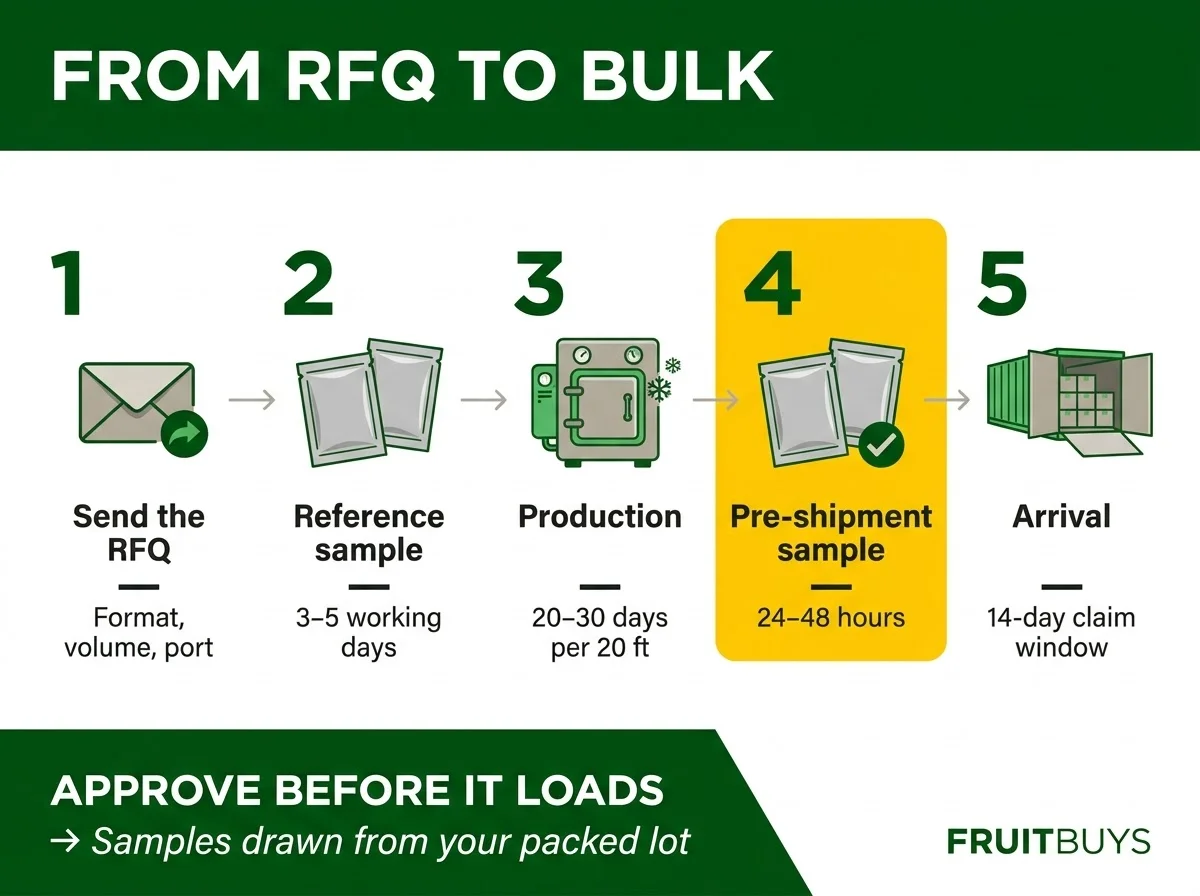
RFQ, reference sample, contract, production, pre-shipment sample, loading.
- Send the RFQ. Application, format and size, cultivar, monthly volume, packaging and destination port. A complete RFQ gets a like-for-like quote in one round; our RFQ and sample approval checklist lists every field.
- Approve a reference sample. Couriered in 3–5 working days; two signed retained pouches become the contract reference.
- Production. 20–30 days per 20 ft container after deposit.
- Pre-shipment sample. 200–300 g in two sealed pouches drawn from your packed lot, couriered within 24–48 hours. You approve before loading and before the balance payment.
- Arrival. Claims follow a standard window: 14 days from unloading for packaging, appearance, fines and water activity; 30 days for laboratory results. Each container lot keeps a retained sample for the life of its shelf life.
Can FruitBuys pack under your brand?
Yes, from 500 kg per SKU, which is about 10,000 pouches of 50 g. That is a launch you can test in a few markets or channels without tying up capital in a warehouse of stock, then scale once it sells through. Pouches are filled and sealed in the same dry packing room, printed digitally in 7–10 working days for first runs (one 500 kg run can split across several designs) or by rotogravure in 15–20 working days for repeat volume. UPC and FNSKU print on the pouch, and FBA carton and pallet labels go on before the carton is sealed. Sea-salt and chilli-lime seasoned versions are developed as ODM from 500 kg per SKU.
For US labels, 100% freeze-dried mango is fruit with nothing added, the category FDA’s updated rule lets carry a “healthy” claim automatically, alongside “0 g added sugars” and a one-word ingredient line. Pouch sizes, print timing and who supplies what on the label are in the private label freeze-dried mango guide; the nutrition panel (401 kcal and 59 g naturally occurring sugars per 100 g) and label claims are in freeze-dried mango nutrition facts.
Shipping to the US, EU and UAE: what changes?
The product and the release standard stay the same; the filings change.
- United States: US FDA facility registration of the partner facility, FDA Prior Notice before arrival and an FSVP file held by the importer.
- European Union and United Kingdom: C/O Form EUR.1 for preferential origin; pesticide residues are judged against fresh-fruit limits, converted with the drying factor.
- United Arab Emirates: bilingual Arabic-English label, Halal certification and product registration with the municipality of import.
Market by market details are in the import documentation guide. If you are still weighing Vietnam against other origins or against conventional dried mango, Vietnam’s dried mango exports and the freeze-dried shift and the best dried mango from Vietnam set out the options.
Request a sample and specification
Send your application, format, monthly volume and destination port. FruitBuys returns the specification sheet, coded reference samples with their release results and a production timeline in one reply.
Email [email protected] · WhatsApp Export +84 919 739 589. All lines are listed under freeze-dried fruit.
FAQ
Where can I buy freeze-dried mango in bulk?
FruitBuys ships bulk freeze-dried mango from Vietnam in 5 kg cartons, from a single carton for trials up to full 20 ft and 40 ft containers. Specifications and RFQ fields are on the freeze-dried mango product page.
Is there a minimum order for wholesale freeze-dried mango?
Bulk starts at one carton (5 kg for pieces, 20 kg for powder). Private label starts at 500 kg per SKU.
Do you supply freeze-dried mango slices in bulk?
Yes. Slices are cut 6–7 mm thick, a thickness that survives the voyage far better than thin 3–4 mm cuts, and arrive with at least 85% whole pieces.
Who actually makes the freeze-dried mango?
FruitBuys runs the supply chain as one accountable partner: we coordinate the orchard regions, lock one qualified partner facility to your contract, set the process standard and own the export dossier. Your QA team gets audit access, and any facility change needs written notice and a fresh pre-shipment sample approval, so the mango you approved is the mango you receive.
Can you ship freeze-dried mango to Dubai?
Yes, in standard dry containers with the full export file. UAE retail packs need an Arabic-English label and Halal certification; Halal certification available on request.
Why is freeze-dried mango more expensive than dried mango?
Each kilogram holds about 10–12 kg of whole fruit with only the water removed, dried over a 20–24 hour vacuum cycle, and no sugar is added to bulk it out. Conventional dried mango is chewier, holds more water and is usually sugar-infused.
What does freeze-dried mango taste like?
Like ripe mango with a light crunch: golden-yellow, sweet with a bright acidity, it snaps when you bite it and melts on the tongue instead of chewing like candied fruit.