What does freeze-dried papaya need to clear US, EU, UK and UAE customs?
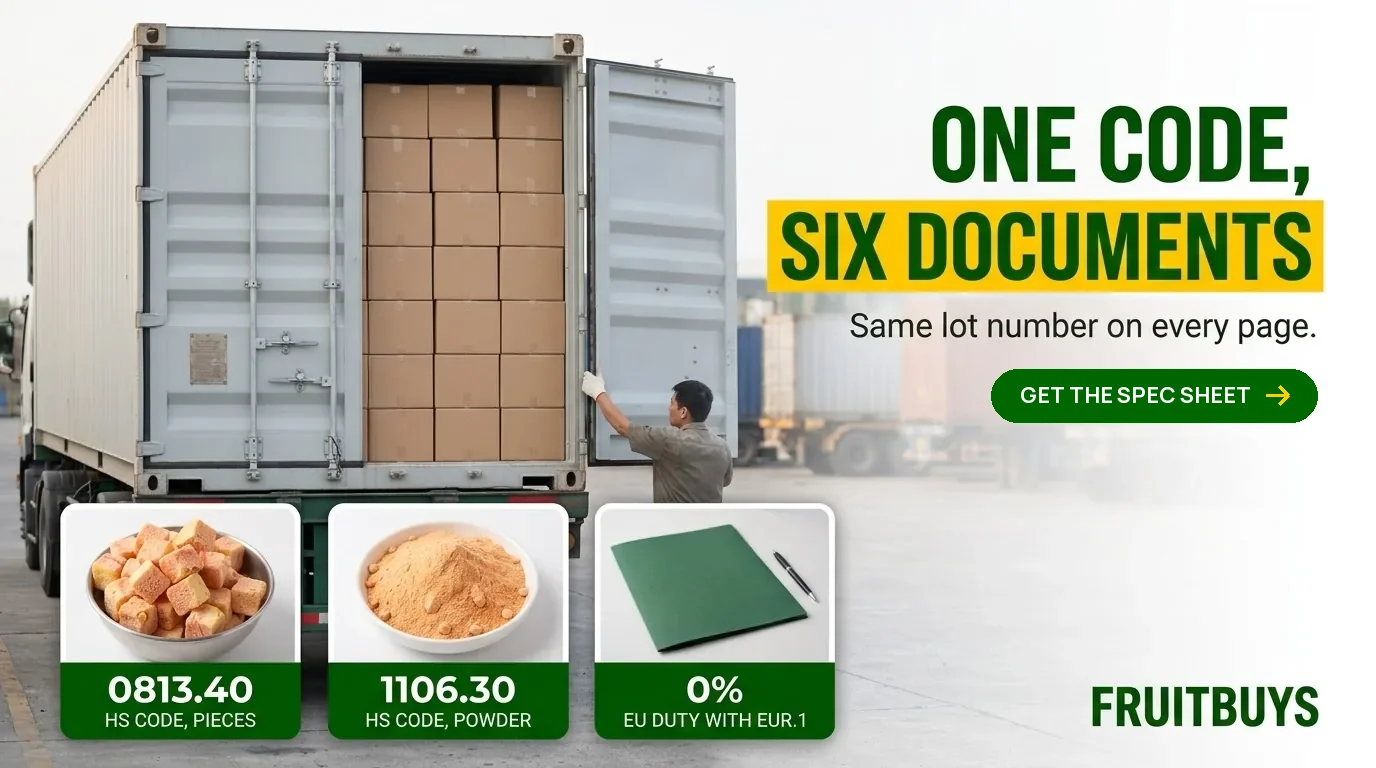
Declare freeze-dried papaya pieces under HS 0813.40 and papaya powder under 1106.30, ship every lot with the same six documents, and add a Certificate of Origin that matches the market: Form EUR.1 for the EU and UK, Form CEPA for the UAE. Into the EU, that EUR.1 takes the duty on both pieces and powder to 0%. Into the US, pieces carry a 1.8% MFN rate and powder 9.6%. Two papaya-specific questions come up at the border: GM papaya in the EU, and food traceability in the US. Both have short answers when the paperwork is ready before the container is sealed.
Which HS code applies to pieces, powder and sugared papaya?
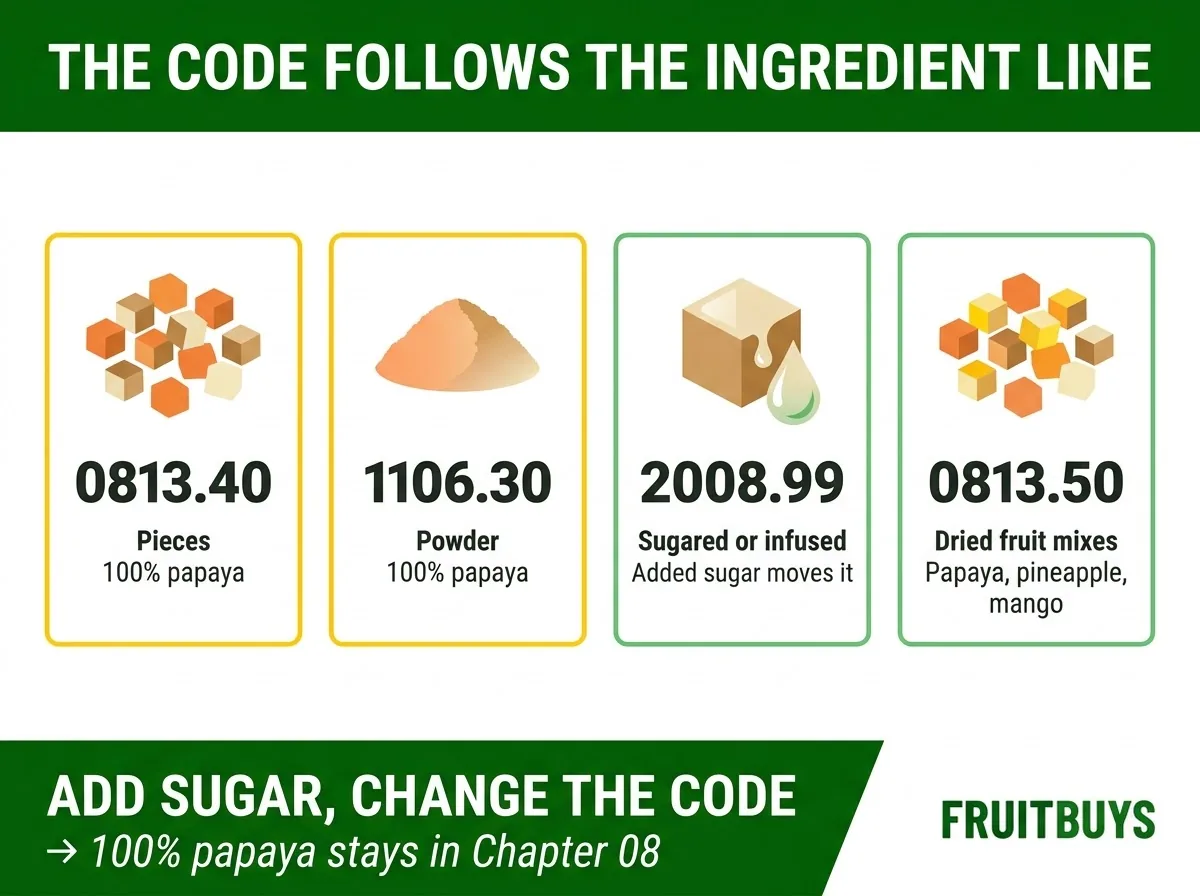
| Product | HS heading | Why |
|---|---|---|
| Freeze-dried papaya dice, slices, granules (100% fruit) | 0813.40 | Fresh papaya sits in heading 08.07; heading 08.13 covers dried fruit of every heading except 08.01–08.06, so dried papaya belongs here |
| Freeze-dried papaya powder (100% fruit) | 1106.30 | Flour, meal and powder of Chapter 8 fruit |
| Sugared, syrup-infused or coated papaya | 2008.99 | Fruit otherwise prepared; added sugar moves it out of Chapter 08 |
| Mixtures of dried fruit (e.g. papaya, pineapple, mango) | 0813.50 | Mixtures of dried fruit |
| Free-flowing powder with silicon dioxide | Confirm before the first shipment | The added flow agent can move the powder out of 1106.30 |
FruitBuys writes one description on the invoice, specification and COA, for example “freeze-dried papaya (Carica papaya), diced 10 × 10 mm, no added ingredients, moisture ≤5%”, and prepares the documents with your customs broker so the entry line and the paperwork match on the first filing. For the free-flowing powder, a binding tariff ruling in your market settles the code before you build a price on it; if you need certainty from the first order, the standard 100% powder stays in 1106.30.
What duty applies in each market?
| Market | Product | National line | MFN rate | With preference |
|---|---|---|---|---|
| United States | Pieces | 0813.40.10 “Papayas” | 1.8% | No FTA rate for Vietnam |
| United States | Powder | 1106.30.40 | 9.6% | No FTA rate for Vietnam |
| European Union | Pieces | CN 0813 40 50 “Papaws (papayas)” | 2.0% | 0% with Form EUR.1 under EVFTA |
| European Union | Powder | CN 1106 30 90 | 8.3% | 0% with Form EUR.1 under EVFTA |
| United Kingdom | Pieces and powder | Broker applies the UK commodity code | Per UK tariff at entry | Preferential rate with Form EUR.1 under UKVFTA |
| UAE | Pieces and powder | Broker applies the UAE tariff line | Per UAE tariff at entry | Preferential rate with Form CEPA |
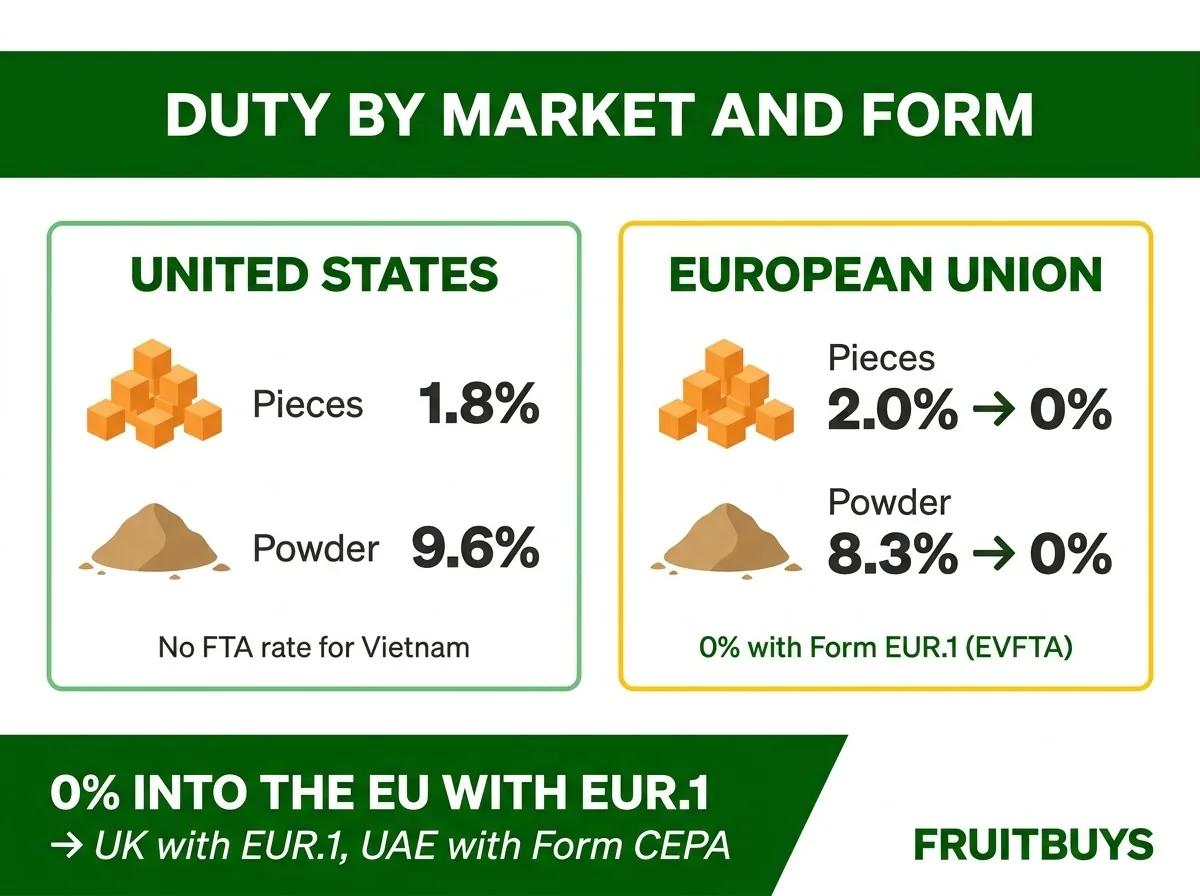
US rates are in the US Harmonized Tariff Schedule and EU rates in the EU TARIC database. The rate that applies is the one for the code declared at entry. In the US, additional duties under other trade measures change during the year, so your customs broker confirms the total duty on each entry.
Pieces or powder: a duty decision as well as a recipe decision. Powder pays a higher MFN rate than pieces in both the US and the EU, while it ships at 15–20 kg per carton against 8–10 kg for dice, so its sea freight per kilogram is lower. Into the EU with EUR.1 both enter at 0%, so freight decides. Into the US, the 7.8-point duty gap can outweigh the freight saving on a large program: a plant with a cold mill and a dry room can import freeze-dried papaya dice and mill in-house, while a plant without them saves the milling step and the caking risk by buying the powder. Put duty, freight and your milling cost on one line before you decide.
Which documents travel with every shipment?
| Document | What it does at the border |
|---|---|
| Commercial invoice | Declares value, HS code and the agreed product description |
| Packing list | Lot numbers, carton count and weights for inspection |
| Bill of lading or air waybill | Title and transport |
| Certificate of Origin | Form EUR.1 for the EU and UK; Form CEPA for the UAE; ASEAN Form D, CPTPP, RCEP, AK/VK and AANZ forms on request |
| Phytosanitary certificate | Issued with every shipment as part of FruitBuys’ standard export dossier |
| COA | Lot moisture, water activity and microbiology from an ISO/IEC 17025 accredited laboratory |
The six documents are prepared together, with the same lot numbers and product description on each, so a broker never has to reconcile one paper against another. A mismatch between the invoice description and the COA invites a customs query; matching papers avoid it.
What do EU borders check on papaya?
GM papaya. Genetically modified papaya is not authorised in the EU, and lots that test positive are stopped. In April 2025 a German laboratory found the GM event 16-0-1 in fresh-cut papaya of unknown origin, reported through the EU’s RASFF alert system, and such lots are typically stopped at Frankfurt. The papaya FruitBuys sources is a Red Lady-type F1 hybrid, bred by conventional crossing, not a GM variety, and a PCR screening report for GM papaya events is available for each shipment on request, before the container is sealed. It gives your QA team a documented answer before the goods reach border control.
Increased official controls. Under Regulation (EU) 2019/1793, the only papaya on the list of increased border checks is fresh green papaya from Mexico, for pesticide residues. Papaya from Vietnam, fresh or dried, is not on the list, so freeze-dried papaya enters under normal official controls.
Pesticide residues. EU maximum residue levels are set for fresh papaya. A result measured on freeze-dried papaya is divided by about 8, the ratio of fresh flesh to finished product, before it is compared with the fresh-fruit limit. A multi-residue panel to EU MRLs is tested before stuffing.
What does the US importer of record need?
- Facility registration: the partner facility holds US FDA Facility Registration.
- FSVP: as importer, you keep a Foreign Supplier Verification Program file; FruitBuys provides the specification, the lot COAs, facility certificates and process description for it.
- Prior Notice: filed with FDA before arrival, at least 8 hours ahead for ocean freight and 4 hours for air.
- Traceability: fresh papaya is on the FDA Food Traceability List; freeze-dried papaya is not, because the list covers papaya only in fresh form. Each FruitBuys lot is still traceable to its harvest region and raw-material intake batch, which is what your FSVP file needs.
- Baby food: if the papaya goes into food for children under two, FDA’s lead action levels and California’s monthly testing law apply to your finished product. ICP-MS testing for lead, arsenic, cadmium and mercury is available for each lot on request; the dose arithmetic is in how much papaya powder you should use.
What do the UK and the UAE need?
United Kingdom: Form EUR.1 under the UK-Vietnam FTA, with the same six-document dossier. UK labelling follows the same pattern as the EU: ingredient “papaya”, none of the listed allergens, and any claim on fibre or sugar meeting UK claim rules.
United Arab Emirates: Form CEPA goes with every shipment, under the UAE-Vietnam Comprehensive Economic Partnership Agreement in force since 3 February 2026. Retail packs carry Arabic labelling, products are registered by the importer before first sale, and no therapeutic claims appear on food. Halal certification is available on request.
Get the document set for your market
Tell us your destination port, product form and first-order volume, and we send the HS line, the document set and a sample COA for your broker to review before you book.
FAQ
What is the HS code for freeze-dried papaya?
0813.40 for 100% freeze-dried papaya pieces. In the US the line is 0813.40.10; in the EU it is CN 0813 40 50.
What is the HS code for papaya powder?
1106.30 for 100% papaya powder. A powder with added silicon dioxide should have its code confirmed before the first shipment.
What duty does freeze-dried papaya pay in the EU?
0% with Form EUR.1 under EVFTA, against a 2.0% MFN rate for pieces and 8.3% for powder.
What duty does freeze-dried papaya pay in the US?
1.8% MFN for pieces and 9.6% for powder; your broker confirms any additional duty on the entry.
Is freeze-dried papaya on the FDA Food Traceability List?
No. The list covers papaya only in fresh form. FruitBuys lots remain traceable to harvest region and intake batch for your FSVP file.
Is papaya from Vietnam subject to increased EU border checks?
No. The only papaya on the EU list is fresh green papaya from Mexico.
Do you provide a non-GMO report?
A PCR screening report for GM papaya events is available for each shipment on request, before the container is sealed. The variety is a conventionally bred Red Lady-type hybrid.
Do you send a phytosanitary certificate?
Yes, with every shipment, as part of the standard export dossier.