Why Source Freeze-Dried Mango from Vietnam, and When Shouldn’t You?
Freeze-dried mango is single-ingredient mango (Mangifera indica L.) from the freeze-dried fruit range. Vietnam, Thailand, the Philippines and India all grow mango at scale; far fewer supply unsweetened, freeze-dried mango with lot-level documents. If you are still deciding between freeze-dried and conventional dried mango, start with our freeze-dried or dried mango guide.
Vietnam’s case is not “better-tasting mango”. It is three practical things: two harvest seasons from the Mekong Delta instead of one short one, cultivars that suit freeze-drying without added sugar, and a processing base oriented to export. Vietnam’s government targets USD 650 million in mango exports by 2030, backed by provincial growing programs in the Mekong Delta. But a country name proves nothing about one supplier’s lot. Choose the origin for its fruit and seasons, then qualify the supplier on documents, exactly as you would anywhere else.
Which origin fits which buyer?
Vietnam fits buyers who need unsweetened product over more months of the year; the Philippines and Thailand fit buyers who want their signature cultivars and sweetened styles; India fits buyers who can manage residue verification closely.
| Origin | Signature fruit | Where it wins | Where it is weaker |
|---|---|---|---|
| Vietnam | Keo, Cát Chu, Hòa Lộc | Main season March–July plus an off-season September–November; low-fiber fruit suited to unsweetened freeze-drying | Supplier quality and certification vary widely; verify each factory |
| Thailand | Nam Dok Mai | Deep-yellow, fiber-free flesh; long-established drying industry; around 3.7–3.8 million tonnes of mango a year | Dried range leans to sweetened products |
| Philippines | Carabao | Strong dried-mango brand recognition; very sweet fruit | Shorter season; exports mostly sweetened dried mango |
| India | Alphonso, Kesar, Totapuri | Largest mango producer (about 25 million tonnes); Alphonso aroma | Residue control varies by region and supply chain; verify every lot |
The origin question sits inside a technology question. Choose the drying method for what your product needs, then the origin:
- Hot-air dried mango is chewy, holds about 10–15% moisture and costs less. It suits confectionery, fillings and bakery, where crispness does not survive anyway.
- Vacuum-fried mango is crisp but carries frying oil, which rules it out for oil-free or single-ingredient labels.
- Freeze-dried mango keeps a crisp, porous structure at about 4% moisture with nothing added. It is the choice when the label must read “100% mango” and the eating texture must be crisp.

None of these rules out a good supplier in any country. They tell you where to start, and what to check hardest.
Which Vietnamese mango should I specify for freeze-drying?
Keo for most freeze-dried lines, Cát Chu where deeper color and stronger aroma justify the extra cost, and Hòa Lộc only for premium, low-volume lines.
- Keo. The standard for freeze-drying: available over a longer harvest window, steadier in supply and lower in fruit cost, at 14–16 °Brix. Its lower dry matter and higher waste mean more fruit per kilogram of finished product, about 11.6 kg of whole fruit against 9.7 kg for Cát Chu, but each kilogram of fruit costs less. How that feeds into price is explained in why freeze-dried mango costs what it does.
- Cát Chu. Available on request for lines where color and aroma lead: ripe fruit at 14–18 °Brix, fine texture, low fiber, strong aroma. It grows around Cao Lãnh in Đồng Tháp and across the Mekong Delta; Đồng Tháp alone has about 9,300 ha of mango, around 70% of it Cát Chu. Its main-season window is shorter, so book it earlier.
- Hòa Lộc. Very sweet, almost fiber-free, grown in a small area of Tiền Giang, and protected in the EU as a geographical indication under the EU–Vietnam trade agreement. A strong origin story for gift and premium retail, but volumes are limited and must be booked well ahead of harvest.

Whichever cultivar you choose, write it into the contract by name, with the ripeness criteria from our freeze-dried mango specification guide. A cultivar name alone is a sourcing direction, not a specification.
Can Vietnam supply freeze-dried mango all year?
The fruit comes in two seasons, not twelve months; year-round supply depends on the supplier’s allocation and finished stock, so ask for the plan in writing. The main Mekong Delta season runs March to July. Off-season fruit, produced by flower induction, arrives September to November, at lower yields and with results that depend on the grower’s technique.
What that means for your contract:
- Book the main season for your base volume. Freeze-dried mango keeps for months in barrier packaging, so product made in the main season can cover the gap months.
- Treat off-season lots as a separate fruit source. Color and sweetness can differ from main-season lots; compare them against your retained sample.
- Ask for an allocation plan that states volumes by month, the cultivar for each, and whether they come from fresh production or stock.

A supplier who promises the same fresh fruit of one cultivar every month of the year is describing something the orchards cannot deliver.
Does sourcing from Vietnam lower my import duty?
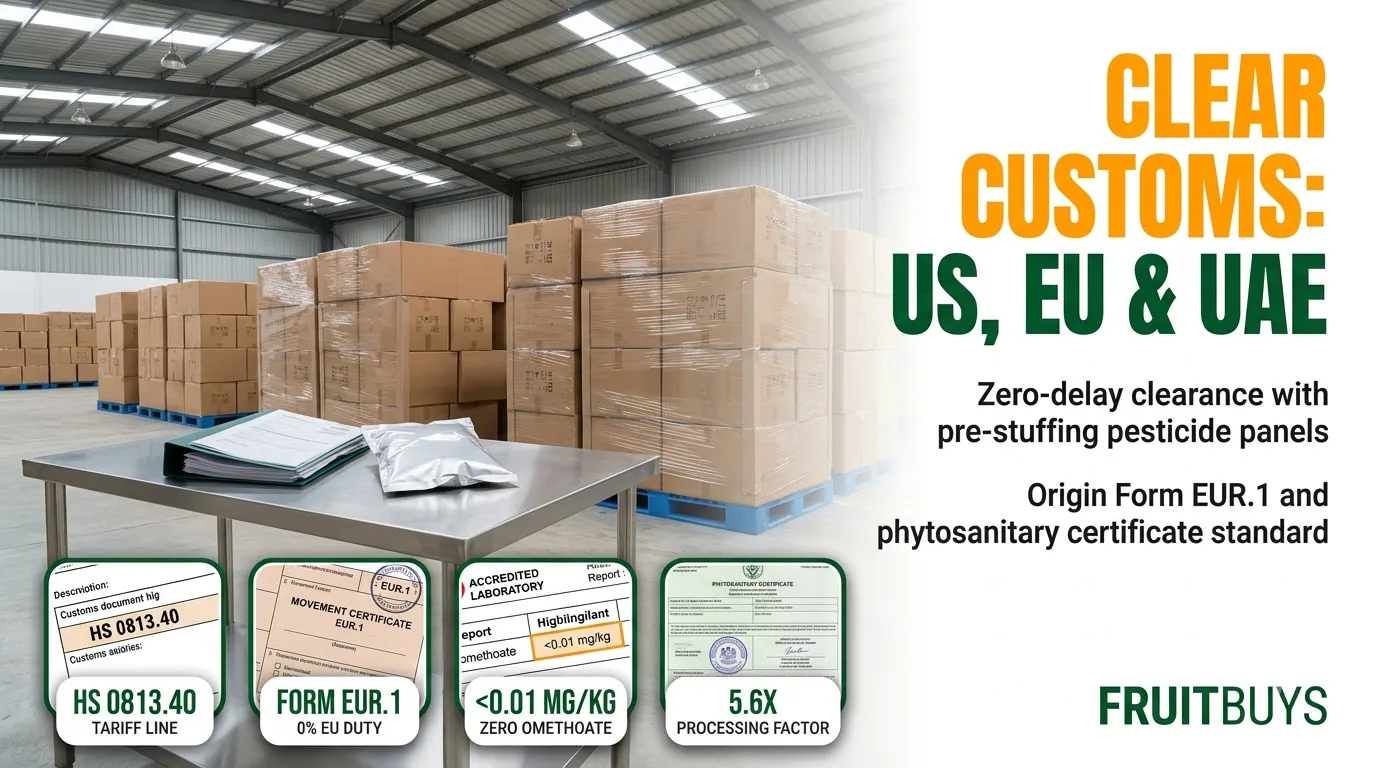
Into the EU, dried mango is duty-free from any origin, so Vietnam’s trade agreement is not a duty advantage on this product; into other markets, ask your broker to compare origins. EU duty on dried mango (CN 0804 50 00) is 0% under the standard tariff and under the EU–Vietnam agreement, and the same 0% applies to Thai, Philippine or Indian mango. The practical benefit for an EU buyer is that duty is not a cost line, whichever origin you choose.
For the US, the UK and the Gulf, duty and any additional charges depend on the exact tariff line and the country of origin at the date of import. Have your customs broker quote the full landed duty for each origin you are considering before you compare prices. The classification and the documents that keep a shipment moving are covered in our freeze-dried mango customs and import guide.
One origin question worth asking any Vietnamese supplier: where was the fruit grown? Some processors supplement local fruit with imported mango in short seasons. That can change the origin you are entitled to declare on labels and documents.
Is unsweetened freeze-dried mango easier to find in Vietnam?
Often, yes, but the proof is in the lot documents, not the country. Philippine and Thai dried-mango exports are dominated by sweetened styles, and many suppliers there offer few unsweetened SKUs. Vietnamese freeze-dried production commonly runs single-ingredient mango. Verify it anyway:
- A formula declaration stating 100% mango
- Added sugars at 0 g as a separate line on each lot COA
- SO₂ below 10 ppm by an accredited laboratory
- A residue screen reported against your destination’s limits
What should I check before choosing a Vietnamese supplier?
The same things you would check anywhere, because origin gives you access, not assurance. A country name never replaces raw-material control, factory certification scope, laboratory results or lot documents.
- Cultivar and fruit source: which cultivar, which provinces, local or imported fruit
- Seasonal plan: monthly volumes, main season versus off-season, stock versus fresh production
- Factory credentials: certification body, certificate number, scope covering freeze-dried fruit, expiry date
- Lot documents: COA from an ISO/IEC 17025 laboratory, matched to the lot you receive
- Sample protocol: sealed retained sample and tolerances agreed before bulk, as set out in our sample-to-bulk guide

What does choosing the wrong source cost?
A missed season costs you the months without supply, a cultivar switch costs you a new product trial. If your peak demand falls in December to February and your volume was not contracted before the main season, the only fruit left is off-season or stock. And if a supplier switches between Keo and Cát Chu without telling you, the color and sweetness change shows up in your finished product, and you pay for a new trial and possibly new pack artwork. Both costs are avoided by a named cultivar, a written allocation plan and a retained sample.
Decision rule
- Need unsweetened freeze-dried mango over most of the year → start with Vietnam, contract the main season.
- Want Carabao or Nam Dok Mai character, or sweetened dried mango → Philippines or Thailand.
- Need Alphonso flavor → India, with lot-level residue screens.
- Buying for the EU → origin does not change duty on dried mango; choose on fruit, supply and documents.
- Product is chewy, baked or a filling → consider hot-air dried mango before paying for freeze-drying.
- Any origin → name the cultivar, get the allocation plan, verify the factory.

When Vietnam is not the right choice
If your product depends on a specific cultivar flavor that Vietnam does not grow, such as Alphonso or Carabao, buy it from its home. If you need very small, one-off volumes of premium Hòa Lộc on short notice, the fruit may simply not be available. And if your only criterion is the lowest price per kilogram with no document requirements, this guide is not for you: the savings disappear the first time a lot is held or rejected.
FAQ
Is Hòa Lộc mango protected in the EU?
Yes. Hòa Lộc mango is among the Vietnamese geographical indications protected in the EU under the EU–Vietnam agreement, which matters if you want to use the name on a label.
How far ahead should I contract?
Before the main season starts in March for your base volume, and earlier still for Hòa Lộc.
Talk to us about sourcing from Vietnam
Evaluating origins for an annual contract? Tell us your target markets, cut format and how your volume splits across the year. FruitBuys will propose a cultivar-matched allocation plan and a pre-season timeline, so supply is secured before the main harvest starts. Reach our team from the freeze-dried mango product page.
Sources & Technical References
- Vietnam Customs News: “Ministry targets 650 million USD from mango exports by 2030”: national mango export target. (https://english.haiquanonline.com.vn/ministry-targets-650-million-usd-from-mango-exports-by-2030-18088.html)
- ACIAR: “Activity 1.4 Market Review”: Vietnamese cultivars, Cát Chu °Brix, main and off-season timing. (https://research.aciar.gov.au/apmangonet/wp-content/uploads/2020/05/AGB2012061-A1.4-Market-Review.pdf)
- CBI (Netherlands Ministry of Foreign Affairs): “Entering the European market for dried mango”: competing origins and the Philippines as a supplier of sweetened dried mango. (https://www.cbi.eu/market-information/processed-fruit-vegetables-edible-nuts/dried-mango/market-entry)
- European Commission: “TARIC”: CN 0804 50 00 third-country and preferential duty. (https://ec.europa.eu/taxation_customs/dds2/taric/taric_consultation.jsp)
- WTO Center, VCCI: “EVFTA opportunities for Vietnamese fruit and vegetable products”: Hòa Lộc mango among Vietnamese geographical indications protected in the EU. (https://wtocenter.vn/german-market/19095-evfta-opportunities-for-vietnamese-fruit-and-vegetable-products)
Basis note: production figures for Thailand and India are industry estimates. Đồng Tháp area and cultivar share are provincial figures. Conversion ratios are calculations from the Fact Registry inputs. Duty rates must be confirmed by a customs broker at the time of import.