

Why Is Freeze-Dried Mango So Expensive? What You Are Really Paying for in a Quote
Freeze-dried mango is single-ingredient mango (Mangifera indica L.) from the freeze-dried fruit range, frozen and then dried under vacuum until only about 4% water remains.
Freeze-dried mango is not expensive because it needs more fruit. Air-dried mango needs about as much: the industry norm for air-dried is 13 kg of whole fruit per kilogram, against roughly 10–12 kg for freeze-dried slices from Vietnamese cultivars. The premium sits in the dryer. A freeze-dryer holds each load frozen under vacuum for close to a day, and electricity, machine time and equipment cost are what you pay for. The second thing that makes freeze-dried mango look expensive is a quote you cannot compare: one supplier says 6:1, another 11:1, and both can be describing the same batch.
Why does one supplier say 6:1 and another 11:1?
6:1 is counted from peeled flesh; 11:1 is counted from whole fruit. Neither supplier is wrong. They are measuring from different points on the line, and a ratio means nothing until the starting point is named.
| Starting point | What the ratio captures | Use it for |
|---|---|---|
| Whole fruit → approved product | Peel, seed, trim, water removal, sorting losses | Raw-material planning and price logic |
| Peeled flesh → approved product | Water removal and sorting losses | Checking the factory’s processing yield |
| Fruit loaded on trays → dried output | Water removal only | Checking the drying step itself |
| Dried output → approved grade | Broken pieces and fines removed | Comparing grades |
The 6:1 figure is the one you will see most often, because it is the figure printed on retail packs: “300 g equals 1.8 kg of fresh mango” is flesh-basis arithmetic. It is correct for the consumer and misleading for a buyer planning raw material.
Here is what one batch looks like end to end, using published inputs for Vietnamese Cát Chu mango (35% peel, seed and trim; flesh at 16.5% dry matter; finished product at 96% solids; 8% of slices sorted out as fines):
- 1,000 kg of whole fruit arrives at the factory.
- After peeling, destoning and trimming: 650 kg of flesh.
- That flesh holds 107 kg of solids; dried to 96% solids it becomes 111.7 kg.
- After sorting out broken pieces and fines: 102.8 kg of approved slices.
Same batch, two honest ratios: 9.7 : 1 on whole fruit, 6.3 : 1 on flesh. For Keo, which carries more waste (42%) and less dry matter (15%), the pair is 11.6 : 1 and 6.7 : 1.

How much could a basis mismatch cost me?
Plan raw material on a flesh ratio when the cost is driven by whole fruit, and you underestimate the fruit behind your order by 35% for Cát Chu and 42% for Keo.
For 1,000 kg of Cát Chu slices, a flesh-basis plan implies 6,300 kg of fruit. The factory needs 9,700 kg. The missing 3,400 kg shows up later: as a price your budget cannot explain, or as a supplier who accepted your target price on paper and cannot deliver it.
The reverse mistake is just as common. Put a whole-fruit quote next to a flesh-basis quote and the whole-fruit supplier looks 35–42% less efficient, even when both factories achieve identical yields. Restate both on whole fruit before you pay a premium or drop a supplier.
What actually drives the amount of fruit per kilogram?
Dry matter first, then waste, then grade. These three explain almost every difference you will see between quotes.
- Dry matter. Water alone sets the floor. Flesh at 15% dry matter needs 6.4 kg per kilogram of product before any waste; flesh at 22% needs 4.4 kg. Published dry matter for mango flesh spans 15.2% to 22.2% across cultivars. Around 16.5%, each percentage point shifts the ratio by roughly 6%. This is why ripeness at receiving is a price lever: fruit picked early for firmness carries more water per kilogram of solids.
- Waste. Peel runs 11–18% and seed 14–22% of whole-fruit weight in published data, before trimming. Large-seeded or small fruit costs more per kilogram of output, which is why cultivar choice shows up in the price. Air-dried benchmarks show the same effect: 13 : 1 for Kent and Keitt, 15 : 1 for smaller cultivars.
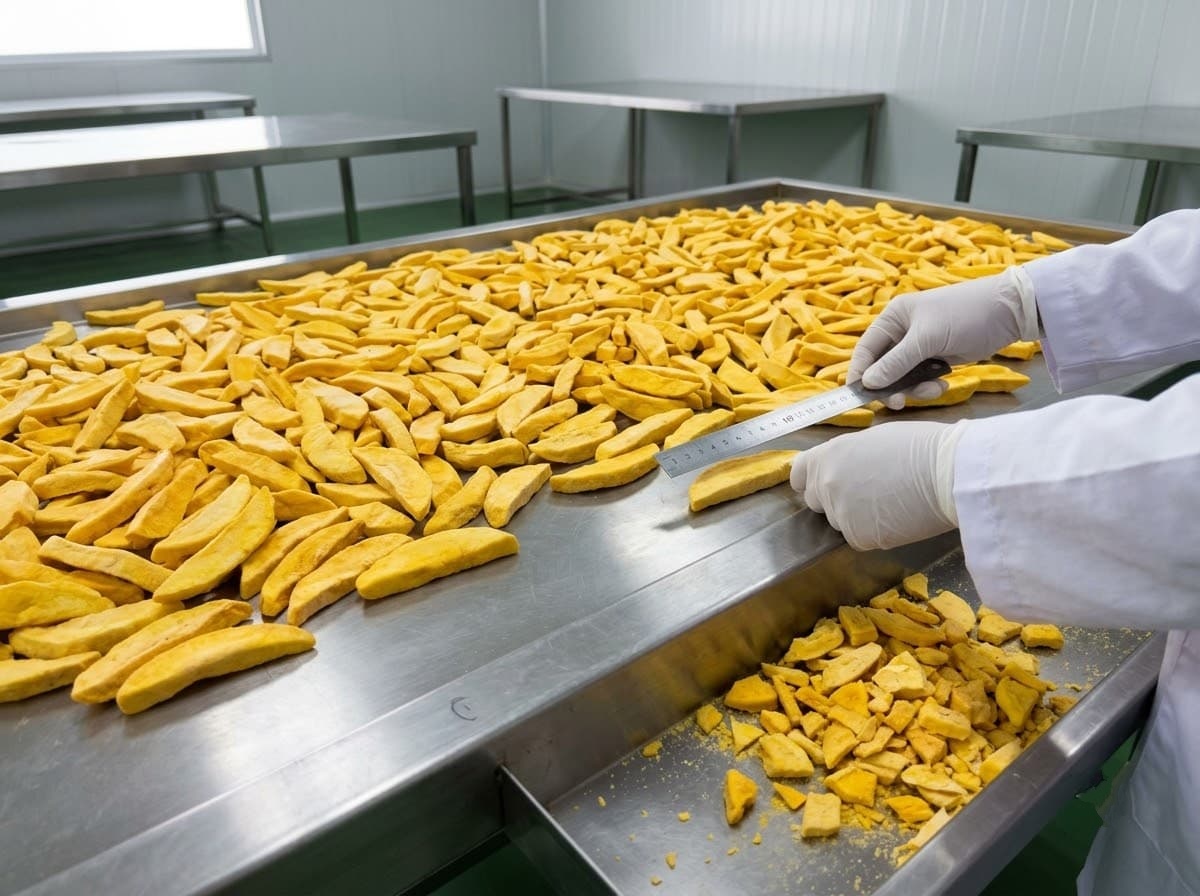
- Grade. Whole slices lose about 8–10% to breakage at sorting; dice lose 4–5%. A price for whole A-grade slices has that loss built in. If broken pieces are acceptable in your application, you are paying for sorting you do not need.
Fruit criteria at receiving, including cultivar and °Brix, belong in the specification. They are covered in our freeze-dried mango specification guide.
Why is freeze-drying so much more expensive than air-drying?
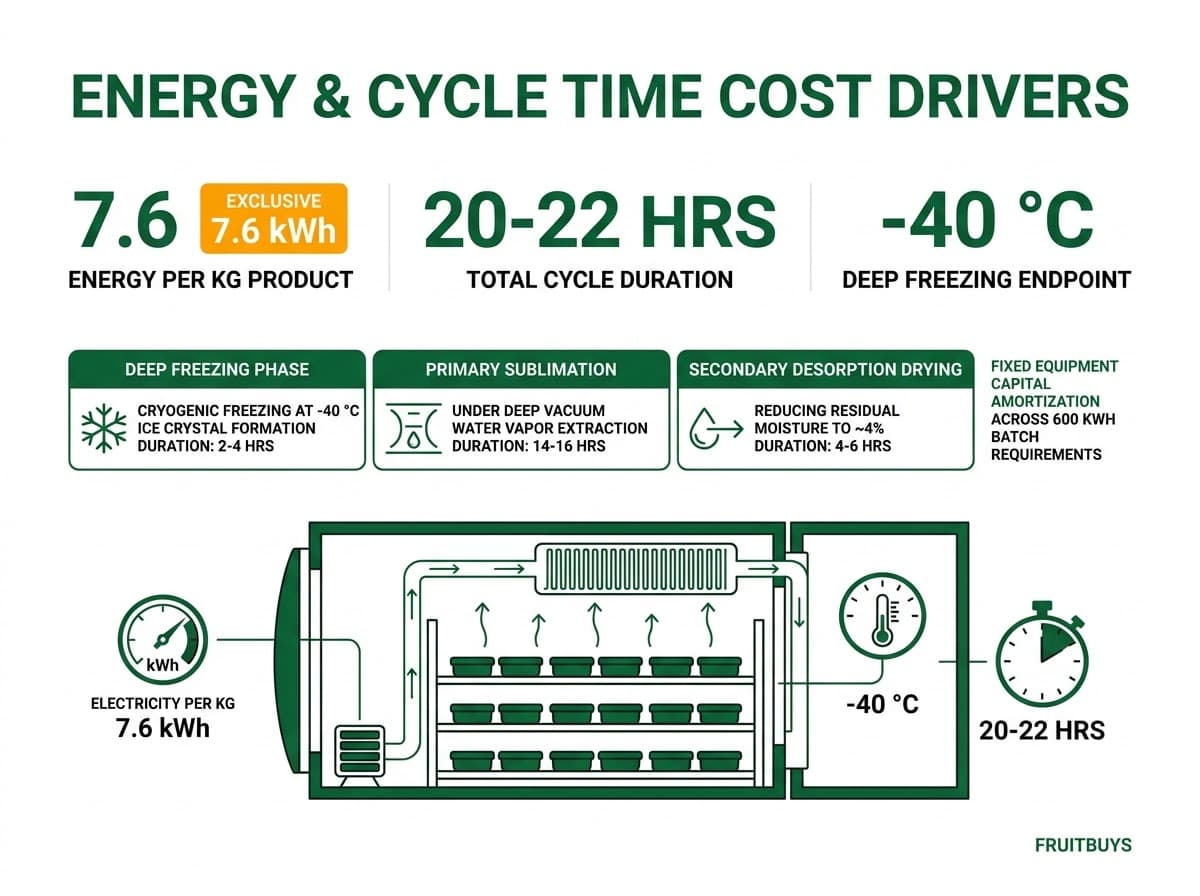
Because a freeze-dryer runs for close to a day per load, and every hour costs electricity and machine capacity. A reference cycle for mango slices is freezing to about −40 °C, then 14–16 hours of primary drying under deep vacuum and 4–6 hours of secondary drying. The chamber produces nothing else in that time.
The electricity is substantial. One industrial equipment maker states about 600 kWh for a 16-hour batch of 500 kg of fresh product. Applied to mango flesh with the inputs above, that batch yields about 79 kg of finished slices, or roughly 7.6 kWh per kilogram of product. Independent trials on freeze-dried vegetables measured 7.5–21.8 kWh per kilogram, with the low end reached only when pretreatment shortened the cycle.
Two practical consequences for your quote:
- Anything that lengthens the cycle raises the price. Thicker cuts and a tighter moisture endpoint both keep the load in the chamber longer.
- Fixed cost is spread over throughput. A freeze-dryer costs many times more than a hot-air dryer of similar capacity, so small or irregular orders carry a larger share of that cost per kilogram.
Air-drying avoids most of this but delivers a different product: typically 10–15% moisture, chewy rather than crisp, with a reference shelf life of about 12 months. Freeze-dried mango at about 4% keeps its shape, color and crunch. That is what the premium buys.
Four quoting mistakes to check before you negotiate
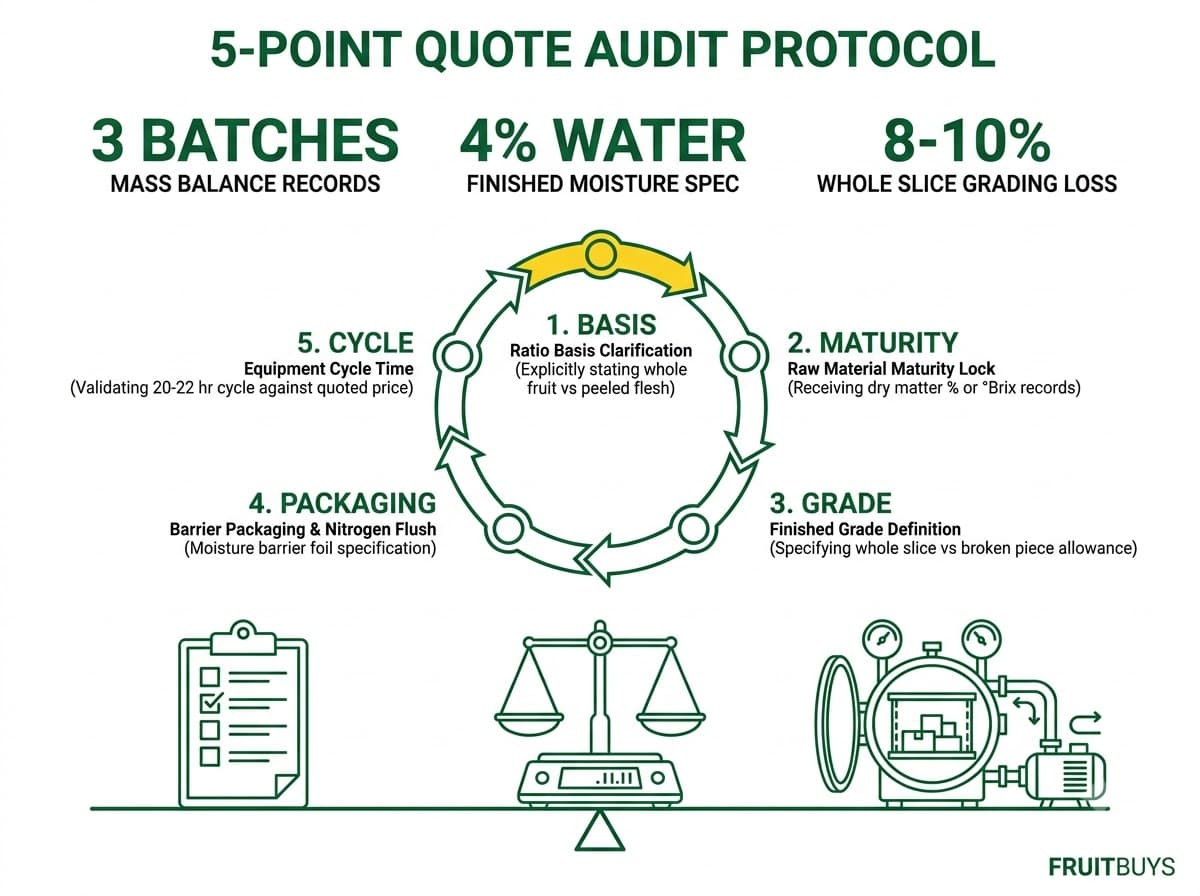
1. Comparing ratios on different bases. Ask each supplier which starting point their ratio uses. If one says 6:1 and another 11:1, you probably have a flesh quote and a whole-fruit quote, not a cheap supplier and an expensive one.
2. Not locking fruit maturity. A lower quoted ratio can come from riper, higher-dry-matter fruit, which is good, or from a calculation that assumes fruit the factory does not actually buy. Ask for receiving dry matter or °Brix on recent batches.
3. Not locking the grade. “Freeze-dried mango slices” can mean whole A-grade slices or a mix with broken pieces. The price difference is the 8–10% sorting loss plus the labour behind it. Name the grade in the quote.
4. Pricing the product but not the protection. Freeze-dried mango absorbs moisture quickly once exposed. A lower quote with a weaker pouch or no nitrogen flush moves the cost to you as soft stock later. Compare packaging specifications along with price; the pouch, seal and nitrogen flush worth paying for are set out in our freeze-dried mango packaging guide.
What does a kilogram really cost once it reaches my line?
More than the quote: freight is paid on space, and broken pieces you cannot use still carry their share of fruit, drying and freight. Compare suppliers on cost per usable kilogram, not price per kilogram.
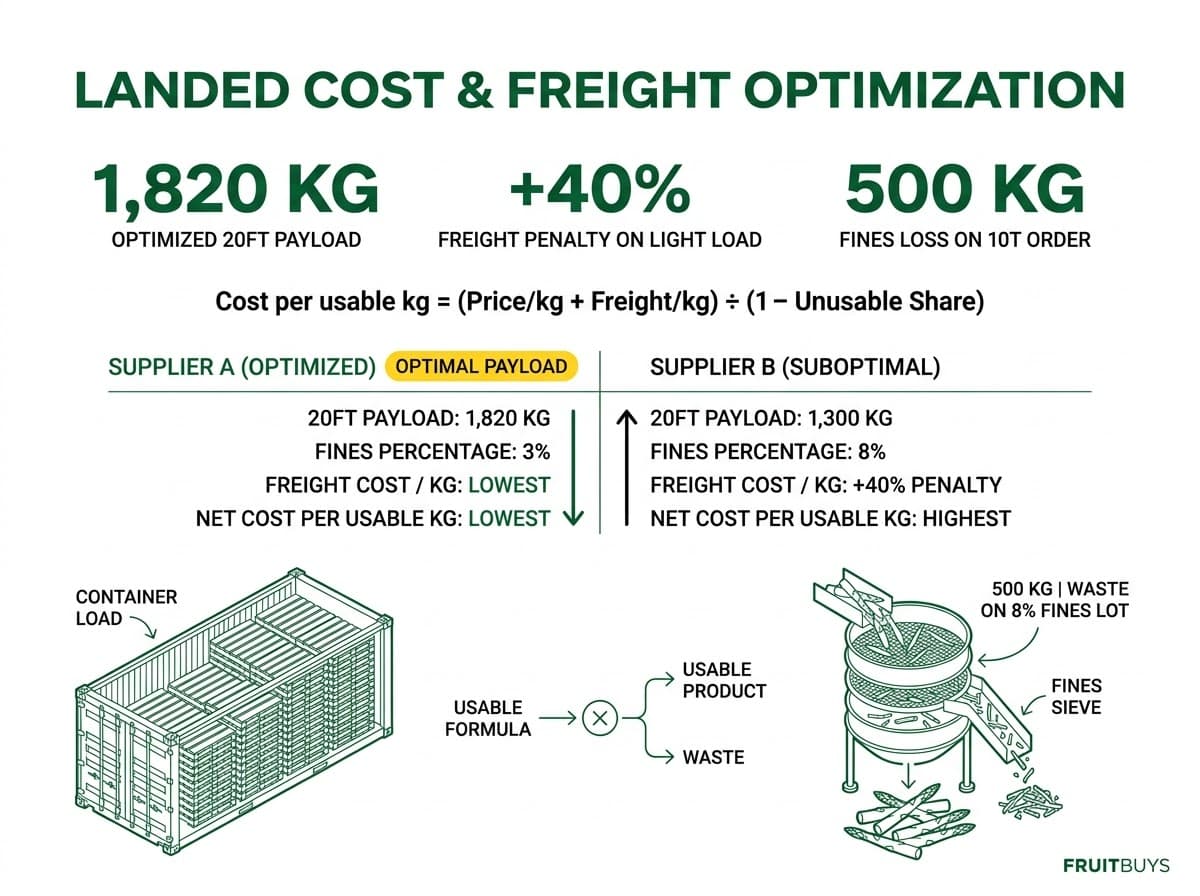
Cost per usable kg = (price per kg + freight per kg) ÷ (1 − share you cannot use)
Both terms move more than buyers expect:
- Freight per kg. Freeze-dried mango fills a container long before it reaches the weight limit. A 20-foot container of slices at 5–7 kg per carton carries about 1,300–1,820 kg in practice. At the same container rate, the light end of that range pays about 40% more freight per kilogram than the heavy end. Carton weight, cut and pallet plan decide where you land.
- Share you cannot use. If your application needs whole pieces and the delivered product carries 8% fines instead of 3%, you pay for 5% more product that ends up as waste or dust. On a 10-tonne order, that is 500 kg.
A worked comparison, with your own numbers in place of the letters: supplier A quotes price P with 1,820 kg per container and 3% fines; supplier B quotes a slightly lower price with 1,300 kg per container and 8% fines. Divide each container rate by its load, add it to the price, then divide by 0.97 and 0.92. The lower quote often loses.
How carton weight and pallet plans change the load is covered in the freeze-dried mango packaging and freight guide.
Is freeze-dried mango worth the premium for my product?
Yes, when crunch, shape or a single-ingredient label is what your customer pays for. No, when the fruit will be rehydrated, baked or blended until those properties disappear. For the full comparison with air-dried and vacuum-fried mango, see whether freeze-dried mango fits your product.
- Worth it: snack pouches, cereal and granola inclusions, chocolate pieces and toppings where the fruit is eaten dry and crisp.
- Hard to justify: fillings, sauces, and baked goods held above about 60 °C for more than 30 minutes without a fat barrier. The freeze-dried structure softens, and air-dried or frozen mango can deliver the same eating result for less.
What to ask a supplier before you compare prices
The quickest way to test a quote is to ask for the numbers behind it. A supplier that knows its process can answer all of these within a day:
- Mass balance from the last three batches: whole fruit received, flesh after peeling, dried output, approved grade, fines and rejects, each with a lot code
- Cultivar and receiving dry matter or °Brix for those batches
- Finished moisture the ratio is calculated at
- Grade the price refers to
- Drying cycle time for the quoted cut and thickness
Hold us to the same standard. A supplier that cannot state its ratio on a named basis cannot defend its price either.
Decision rule
- Quotes on different bases → restate both on whole fruit before comparing price.
- Raw-material plan built on a flesh ratio → add 35–42% to the fruit estimate.
- No batch mass balance available → treat the quoted ratio as a calculation, not a yield.
- Application rehydrates or bakes the fruit → trial air-dried or frozen mango before paying the freeze-dried premium.
- Broken pieces acceptable → ask for a broken-grade price instead of paying for whole-slice sorting.
- Comparing two quotes → compare cost per usable kilogram, including freight per kg loaded and delivered fines.
FAQ
Does a lower moisture specification change the ratio much?
Very little. Moving the finished product between 3% and 5% moisture changes the fruit ratio by about 2%. It changes drying time, and therefore processing cost, far more.
Why does the same supplier’s ratio change between seasons?
Dry matter and fruit size change with season and orchard. Main-season fruit (March to July) and off-season fruit (September to November) can give different ratios, so a price fixed for a year should state the fruit basis it assumes.
Talk to us about your quote
Comparing freeze-dried mango quotes? Send us the ratios and bases you have been given. FruitBuys will restate them on a common basis and show you which figures a supplier should be able to back with batch records. You can reach our team from the freeze-dried mango product page.
Sources & Technical References
- COLEAD: “Sector Study: Processed Mango – Dried Mango”: 13 : 1 fresh-to-dried ratio for Tommy Atkins, Kent, Amélie and Keitt, 15 : 1 for smaller varieties, in air-dried production. (https://resources.colead.link/en/system/files/file_fields/2023/10/04/02-driedmangostudyweb.pdf)
- ACIAR: “Activity 1.4 Market Review”: Vietnamese mango cultivars, edible portion and seasonality. (https://research.aciar.gov.au/apmangonet/wp-content/uploads/2020/05/AGB2012061-A1.4-Market-Review.pdf)
- Asian Food Science Journal: “Morphological, Physical and Biochemical Characteristics of Mango Varieties”: flesh moisture and dry matter of Amelie, Kent and Keitt (15.2–22.2% dry matter). (https://journalafsj.com/index.php/AFSJ/article/download/511/1021)
- Rybak K. et al., Sustainability 13(4):2035 (2021): “Energy and Quality Aspects of Freeze-Drying Preceded by Traditional and Novel Pre-Treatment Methods as Exemplified by Red Bell Pepper”: 7.5–21.8 kWh per kg of dried product and the effect of shorter cycles. (https://www.mdpi.com/2071-1050/13/4/2035)
- Kemolo: “How much electricity does a 500 kg freeze dryer consume”: manufacturer’s stated consumption of about 600 kWh per 16-hour batch. (https://www.youtube.com/watch?v=Ud11V29Q8ok)
- MDPI Foods 11(15):2220: “Effect of Swell-Drying on Mango (Mangifera indica) Drying Kinetics”: UNECE limit of 15% moisture (wet basis) for preservative-free dried mango. (https://www.mdpi.com/2304-8158/11/15/2220)
- Total Prepare: “Freeze Dried Mango 300g”: retail label stating 300 g as equivalent to 1.8 kg of fresh prepared mango. (https://totalprepare.ca/products/freeze-dried-mango-300g)
Basis note: container loads (1,300–1,820 kg), the 40% freight difference and the 500 kg fines example are calculations from FruitBuys carton data (5–7 kg per carton) and industry fines rates. Ratios for Cát Chu and Keo, the 1,000 kg batch, the 35–42% underestimate, the dry-matter floor ratios, the ±6% sensitivity and the 7.6 kWh/kg figure are calculations from the stated inputs. Peel and seed shares, sorting losses, cycle times, the 60 °C heat limit and air-dried shelf life are industry benchmarks. The 600 kWh figure is an equipment maker’s own statement. None of these are FruitBuys batch results.