How do you choose a freeze-dried papaya supplier in Vietnam, and what goes into the RFQ?
Choose the supplier that can show you, in writing, who grows the fruit, who makes your lots, what each lot is released against and what arrives with the container. Price per kilogram means little until those four answers are on paper. FruitBuys is an established Vietnamese B2B exporter specialising in freeze-dried fruits, supplying freeze-dried red-flesh papaya from the Mekong Delta as dice, slices, granules and powder, 100% papaya with nothing added, year-round. A complete RFQ returns a quote and a loading plan within 24–48 hours.
| Freeze-dried papaya at a glance | |
|---|---|
| Fruit | Ripe red-flesh Carica papaya, Red Lady type, non-GM variety |
| Origin | Mekong Delta, Vietnam: Dong Thap, Vinh Long, Can Tho |
| Ingredient | 100% papaya; no sugar, colour, preservative or carrier; processed without sulphites |
| Formats | Dice 5 × 5 mm and 10 × 10 mm, slices 3–7 mm, granules 2–5 mm, powder 60–80 mesh |
| Moisture / water activity | ≤5.0% / aw ≤0.30 on the lot COA; released at ≤4.0% / ≤0.25 |
| Shelf life | 12 months at ≤25 °C, RH ≤60%; 18–24 months at ≤18 °C, RH ≤50% |
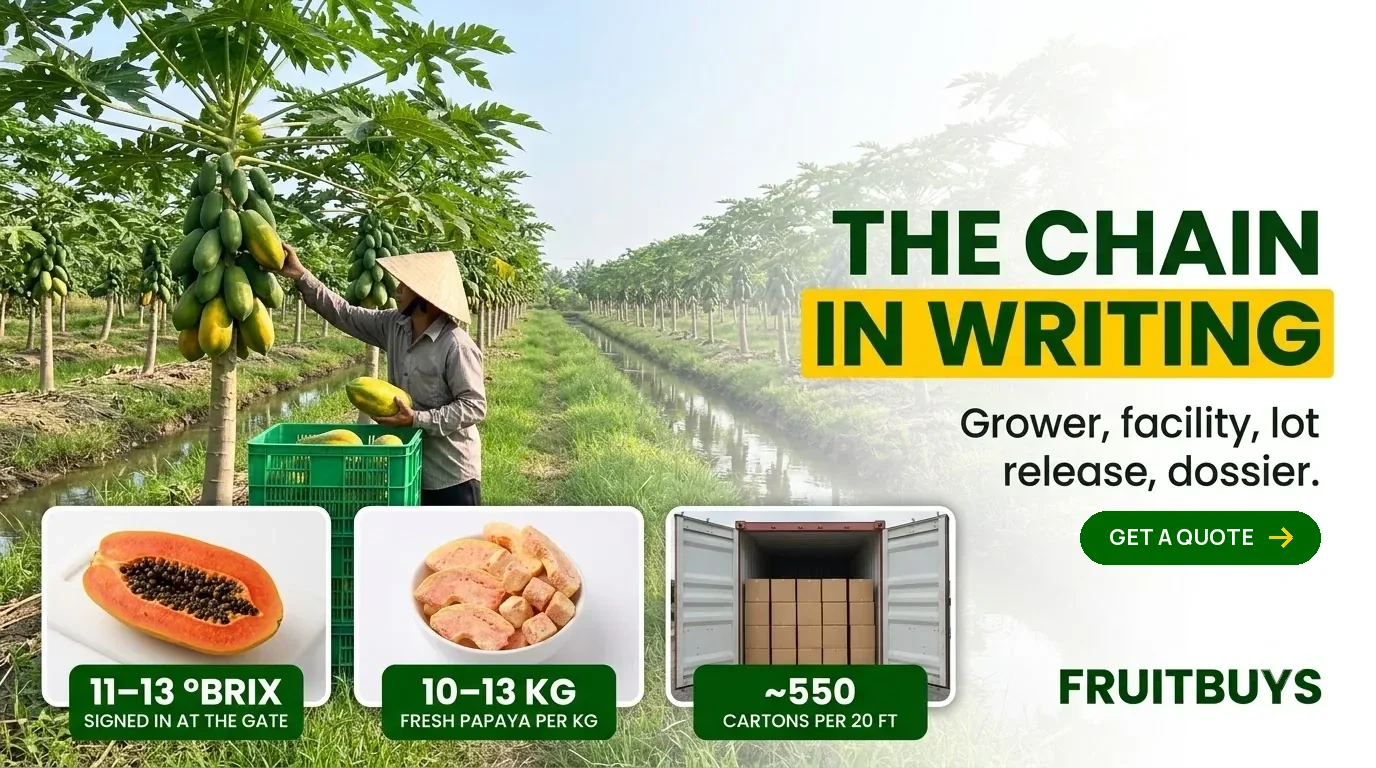
| Container | 20 ft about 550 cartons (4.4–5.5 t of dice); 40 ft HC about 1,100 cartons; dry container, no reefer |
| Minimum order | Trial 50–100 kg; bulk from 300–500 kg; private label 500 kg per SKU |
| Terms | FOB Cat Lai, CIF or DDP; T/T or L/C at sight |
What does FruitBuys supply, and what does it control along the chain?
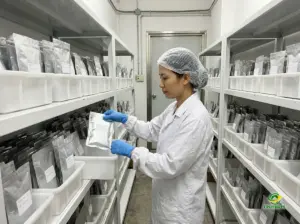
FruitBuys runs the papaya supply chain from grower to sealed container and makes one partner facility answerable for your lots. In practice that means five commitments, each written into the contract:
- Fruit at the gate. Our QC cuts 3–5 fruits from every truckload and reads them on a refractometer. Only loads at 11–13 °Brix are signed in; green and overripe fruit goes back.
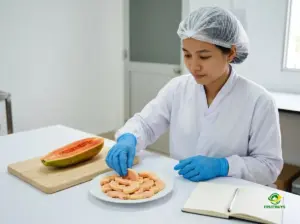
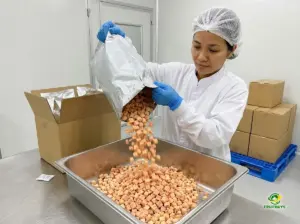
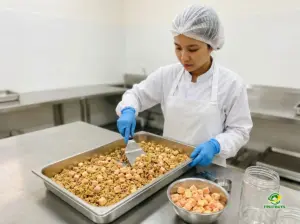
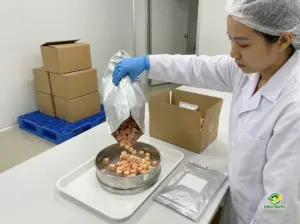
- Processing protocol. FruitBuys sets the processing protocol at one qualified partner facility: seeds and bitter membrane are removed by hand with stainless-steel spoons, the flesh is cut, frozen at −30 to −40 °C and freeze-dried, and every bag is packed in a dehumidified room at ≤40% RH.
- One facility per contract. The partner facility is locked for the length of your contract. Any change needs written notice to you and re-approval of the pre-shipment sample, and you have the right to audit it.
- Lot release. FruitBuys releases each lot against its COA from an independent ISO/IEC 17025 accredited laboratory, with margin to the contract limits.
- Export dossier. FruitBuys prepares the full set of export documents for every shipment.
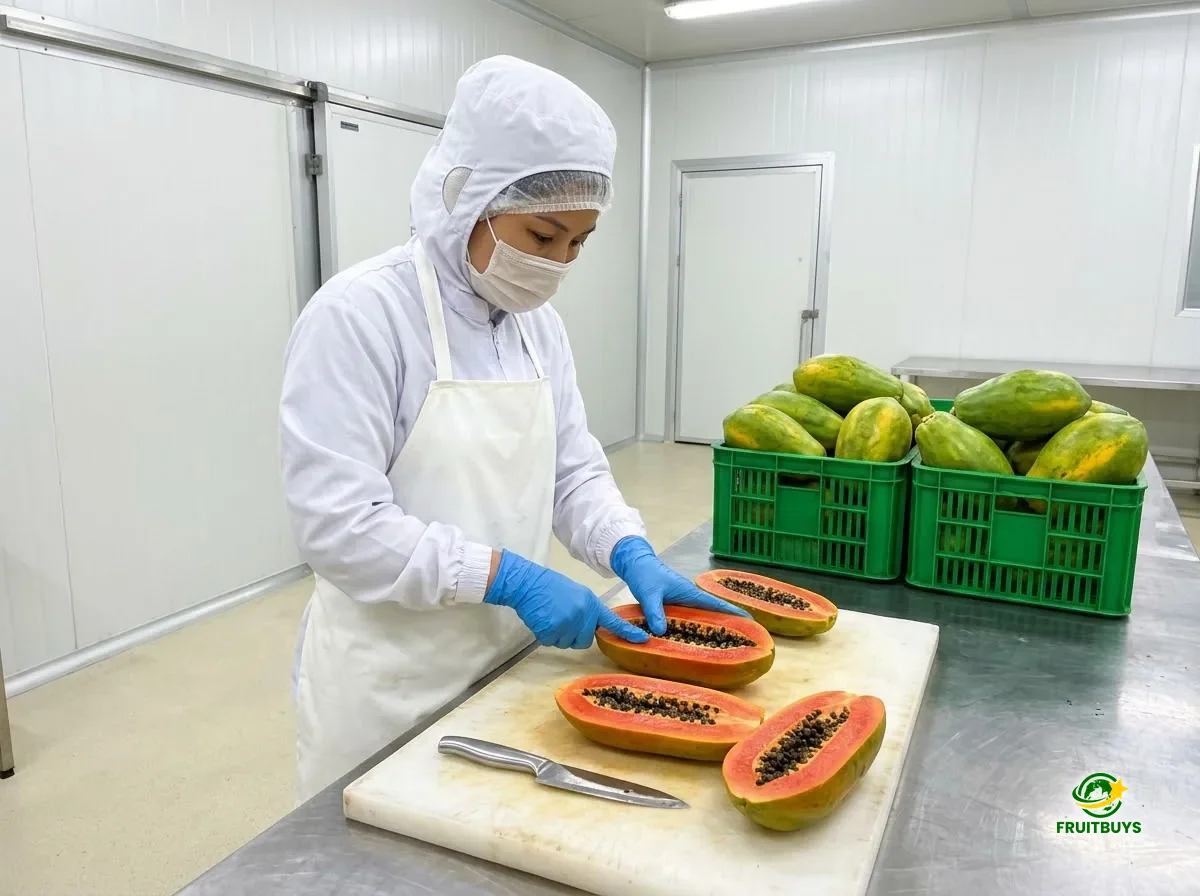
The partner facility holds HACCP, ISO 22000, US FDA Facility Registration and BRC (qualified processing facility) certification. Halal certification is available on request. How these controls keep a container matched to the sample you approved is set out in will your freeze-dried papaya container match the sample you approved.
Where does Mekong Delta papaya come from, and why is supply year-round?
FruitBuys sources papaya from partner growers in Dong Thap (including former Tien Giang), Vinh Long and Can Tho, in the Mekong Delta. The variety is Red Lady type, a conventional F1 hybrid bred by crossing, so it is a non-GM variety: a large fruit, commonly 1.2–2.5 kg, with thick red-orange flesh that holds its shape when diced.
Papaya in the Delta fruits every month of the year, which is why one annual contract can run on fresh fruit every month instead of on stored stock. The season still shows in the fruit:
| Season | What changes | What it means for your SKU |
|---|---|---|
| Dry season, December to April | Highest Brix, firmest flesh, deepest orange-red | Best for retail packs where colour sells; dry-season lots can be reserved for your SKU |
| Rainy season, May to November | More water in the flesh, slightly paler colour, about 2 kg more fruit per kg finished | Steady supply for blends, bakery and powder |
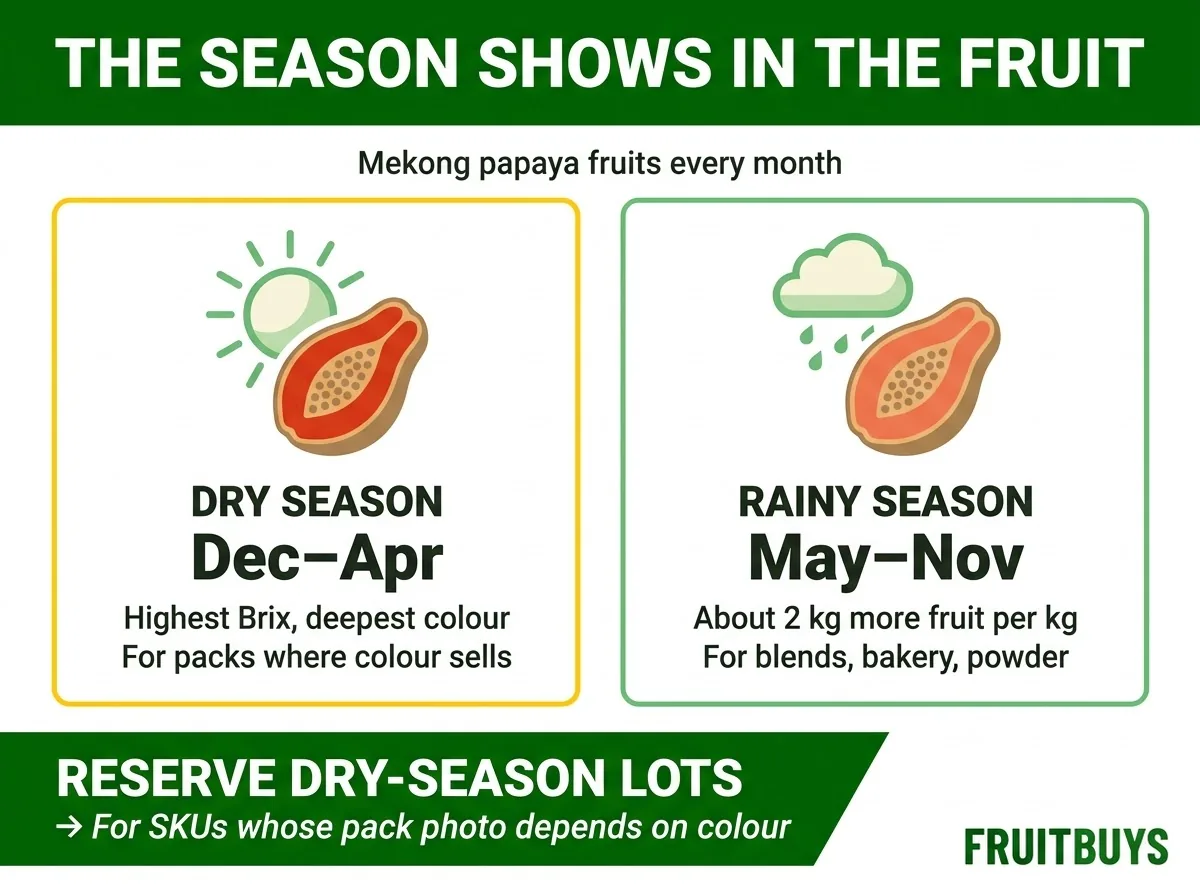
When I plan a year of papaya with a brand, we decide at the start which SKUs need the dry-season colour and which do not. A pack photo shot on February papaya then matches the papaya delivered in September.
Vietnam is a deep base for this kind of supply. Its fruit and vegetable exports reached an estimated record US$8.4 billion in 2025, up 18%, according to the Vietnam Fruit and Vegetable Association (VINAFRUIT, 2026).
For EU buyers, variety matters at the border. Unauthorised GM papaya cannot be placed on the EU market, and GM papaya triggered an EU RASFF alert as recently as 2025. Alongside the non-GM variety, FruitBuys supplies a PCR screening report for GM papaya events for each shipment on request, so your file is complete before the container sails.
Which format fits your product?
| Format | Best for | Typical use |
|---|---|---|
| Dice 5 × 5 mm | Cereal, granola, chocolate, bars | A 3–8% inclusion makes the product read “tropical” |
| Dice 10 × 10 mm | Trail mix, snack packs, yogurt toppings | The piece is seen and eaten as fruit |
| Slices 3–7 mm | Retail snack pouches, gifting | Whole-fruit look; packed lighter to protect the shape |
| Granules 2–5 mm | Bakery, chocolate fillings, coatings | Even dosing, lowest freight per kg of the cuts |
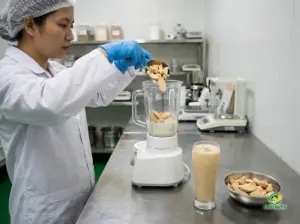
| Powder 60–80 mesh (80–100 for drinks) | Smoothie and drink mixes, baby food, bakery, coatings | 100% papaya milled from freeze-dried papaya; free-flow grade on request |
Choosing the cut is a cost decision as much as a look decision. Where papaya disappears into a muffin or bar, granules or powder deliver the same fruit for less per finished unit than dice cut for show. The full cut guide is in which freeze-dried papaya cut fits your cereal, trail mix, chocolate or yogurt line, and dosing for the powder in how much papaya powder you should use. If you are comparing ripe papaya powder with the enzyme papain, read does papaya powder contain papain first.
Why does freeze-dried papaya cost more than its fresh price suggests?
Because each kilogram carries the fruit of 10–13 kg of whole papaya, or 8–9 kg of peeled, deseeded flesh. Papaya flesh is about 88% water, and peel and seeds take another 25–30% of the fruit before anything reaches the dryer. That ratio is the biggest line in the price, and it explains most of the gap between quotes.
The same ratio works in your favour on freight. You ship about one-twelfth of the fresh weight, in a standard dry container with no cold chain, while frozen papaya ships its water in a reefer.
When two quotes look far apart, ask both suppliers, including us, for six lines in writing: moisture and water activity on the COA, the ingredient line, the fines limit, the cut tolerance, the microbiology grade and the Incoterm. A lower price on infused or high-moisture papaya often costs more per kilogram of papaya that actually reaches your product. The worked comparison is in how many kilograms of fresh papaya make 1 kg of freeze-dried papaya.
What does one container deliver?
| Container | Cartons | Dice | Slices | Powder |
|---|---|---|---|---|
| 20 ft, floor-loaded | about 550 | 4.4–5.5 t | 2.75–3.3 t | 8.25–11 t |
| 40 ft HC, floor-loaded | about 1,100 | 8.8–11 t | 5.5–6.6 t | 16.5–22 t |
| 40 ft HC, palletised (20–21 pallets) | about 600–750 | 4.8–7.5 t | 3.0–4.5 t | 9–15 t |
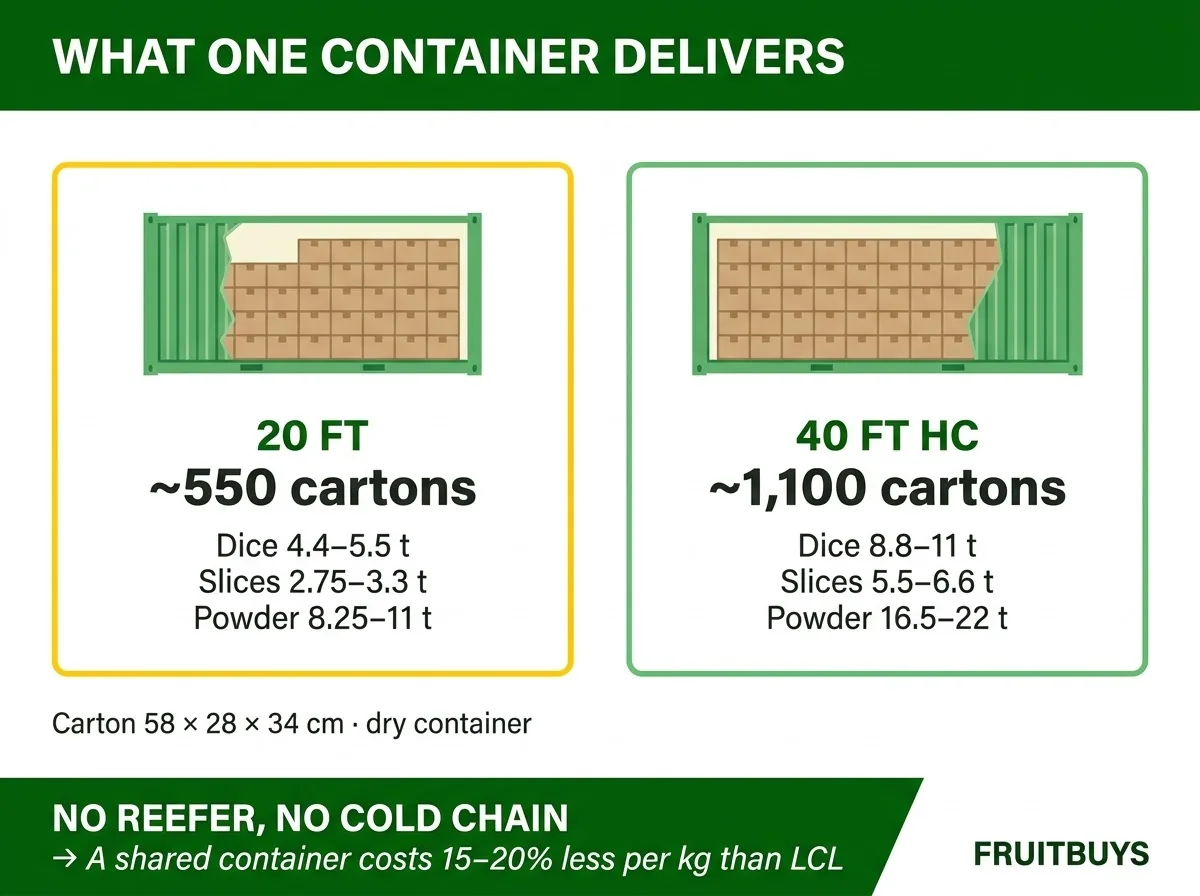
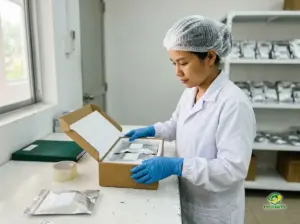
Every carton is the same 5-ply export carton, 58 × 28 × 34 cm, holding 1–5 kg sealed foil bags with food-grade silica gel. Bulk bags are sized to one production batch, so the bag you open is used through and the rest stay sealed. Freeze-dried papaya rides in a standard dry container through port heat with no reefer.
If your volume is below a full container of papaya, ship it in a container shared with other FruitBuys freeze-dried fruits. A consolidated container costs about 15–20% less in logistics per kilogram than LCL, and every product arrives in the same foil-and-desiccant pack. Carton weights, layer plans and route risks are in how long freeze-dried papaya stays crisp, and how it should be packed and loaded.
Which documents come with each shipment?
Quality documents. Every container lot ships with a COA from an independent ISO/IEC 17025 accredited laboratory covering moisture, water activity, total plate count, yeasts and moulds, E. coli and Salmonella. Release limits are TPC ≤10⁴ CFU/g, yeasts and moulds ≤10² CFU/g, E. coli <10 CFU/g and Salmonella not detected in 25 g; an inclusion grade at TPC <1,000 CFU/g is available for chocolate, dairy and bar lines. Multi-residue pesticides to your market’s limits, heavy metals by ICP-MS, the GM screening report and Listeria testing are available for each lot on request, before the container is sealed. The contract limits and the arrival check are in what moisture, water activity and microbiology limits a freeze-dried papaya contract should set.
Export documents. Each shipment carries the commercial invoice, packing list, bill of lading, certificate of origin (Form EUR.1 for the EU and UK, Form CEPA for the UAE), a phytosanitary certificate and the COA. FruitBuys includes the phytosanitary certificate with every shipment as part of its standard export dossier, which keeps clearance quick at the port. HS codes, duty rates and market-by-market entry steps are in what freeze-dried papaya needs to clear US, EU, UK and UAE customs.
What should you check before shortlisting any supplier, including us?
Ten questions separate a supplier who controls the chain from one who resells it:
- Which region and which variety does the fruit come from, and is it a non-GM variety?
- How is ripeness checked at intake, and what is rejected?
- Is anything added: sugar, syrup, colour, carrier, sulphites?
- Which facility makes your lots, and can it change without written notice?
- What moisture and water activity is each lot released at, and against which COA?
- Which laboratory issues the COA, and is it ISO/IEC 17025 accredited?
- Which extra tests can be run on your lot before the container is sealed?
- How are bags packed: foil or PE, desiccant or nitrogen, in what room humidity?
- How long is a retained sample kept, and what is the claim window?
- Which documents travel with each shipment, and is the phytosanitary certificate in every set?
For FruitBuys papaya, the answers are on this page and in the specification sent with every quote. Retained samples are kept for each container lot for its full shelf life, up to 24 months, and claims are accepted within 14 days of unloading, 30 days for lab results.
Can FruitBuys supply organic or private-label papaya?
Private label, yes. Retail pouches of 30 g to 500 g are filled and sealed at source in the dehumidified packing room, with carton and pallet labels to your FBA instructions. Digital print starts at 3,000–5,000 pouches per SKU with no cylinder fee, which suits a test market; rotogravure from 500 kg per SKU gives the lowest pack cost once the SKU repeats. Papaya can also be blended with freeze-dried pineapple, mango or banana for a tropical mix. Approved artwork to a packed digital-print lot takes about 30–45 days; details are on the OEM and private label page. For on-pack nutrition figures and the claims they support, see freeze-dried papaya nutrition facts; for the consumer story behind the product, is dried papaya good for you.
Certified organic, not today. FruitBuys supplies conventional Red Lady papaya and does not hold an organic certificate for papaya. For a clean-label line, the conventional papaya ships with one ingredient on the label, and a multi-residue panel to your market’s limits can be run on your lot before stuffing, so the residue question is answered with a lab result on the papaya you buy.
What goes into the RFQ?
Six lines are enough for a first quote:
- Destination country and port
- Application and format: dice, slices, granules or powder
- Microbiology grade and any lot tests your market needs
- First-order volume and annual volume
- Packaging: bulk bag size, or retail pouch size and artwork status
- Incoterm (FOB Cat Lai, CIF or DDP) and payment term (T/T or L/C at sight)
The full ten-field RFQ, the pre-shipment sample and the trial order are described in will your freeze-dried papaya container match the sample you approved. The specification for each form is on the freeze-dried papaya product page and the freeze-dried papaya powder page, and the wider range is in freeze-dried fruit.
Request a quote for freeze-dried papaya
Send the six lines above and we return the specification, the quote and a loading plan within 24–48 hours, with a sample plan for your R&D team.
FAQ
Where does FruitBuys’ freeze-dried papaya come from?
From partner growers in the Mekong Delta, Vietnam: Dong Thap (including former Tien Giang), Vinh Long and Can Tho. The variety is Red Lady type, a non-GM variety.
Does FruitBuys make the papaya itself?
FruitBuys sets the processing protocol and locks one qualified partner facility per contract, with written change-control and audit access, and releases each lot against its COA.
What is the minimum order for freeze-dried papaya?
Trial orders from 50–100 kg; bulk from 300–500 kg; private label from 500 kg per SKU.
Is papaya available all year?
Yes. Papaya fruits year-round in the Mekong Delta. Dry-season lots, December to April, have the deepest colour and can be reserved for colour-critical SKUs.
Is anything added to the papaya?
No. The ingredient line is “papaya”: no sugar, syrup, colour, preservative or carrier, and it is processed without sulphites.
Which certifications does the partner facility hold?
HACCP, ISO 22000, US FDA Facility Registration and BRC (qualified processing facility). Halal certification is available on request. Organic and Kosher certificates are not held for papaya.
How fast can I get a quote and a sample?
A quote and loading plan within 24–48 hours of a complete RFQ; the pre-shipment sample is dispatched within 24–48 hours, plus courier time.
Which ports and payment terms do you use?
Sea freight from Cat Lai, air freight from Tan Son Nhat; FOB, CIF or DDP; T/T or L/C at sight.