How long does freeze-dried papaya stay crisp, and how should it be packed and loaded?
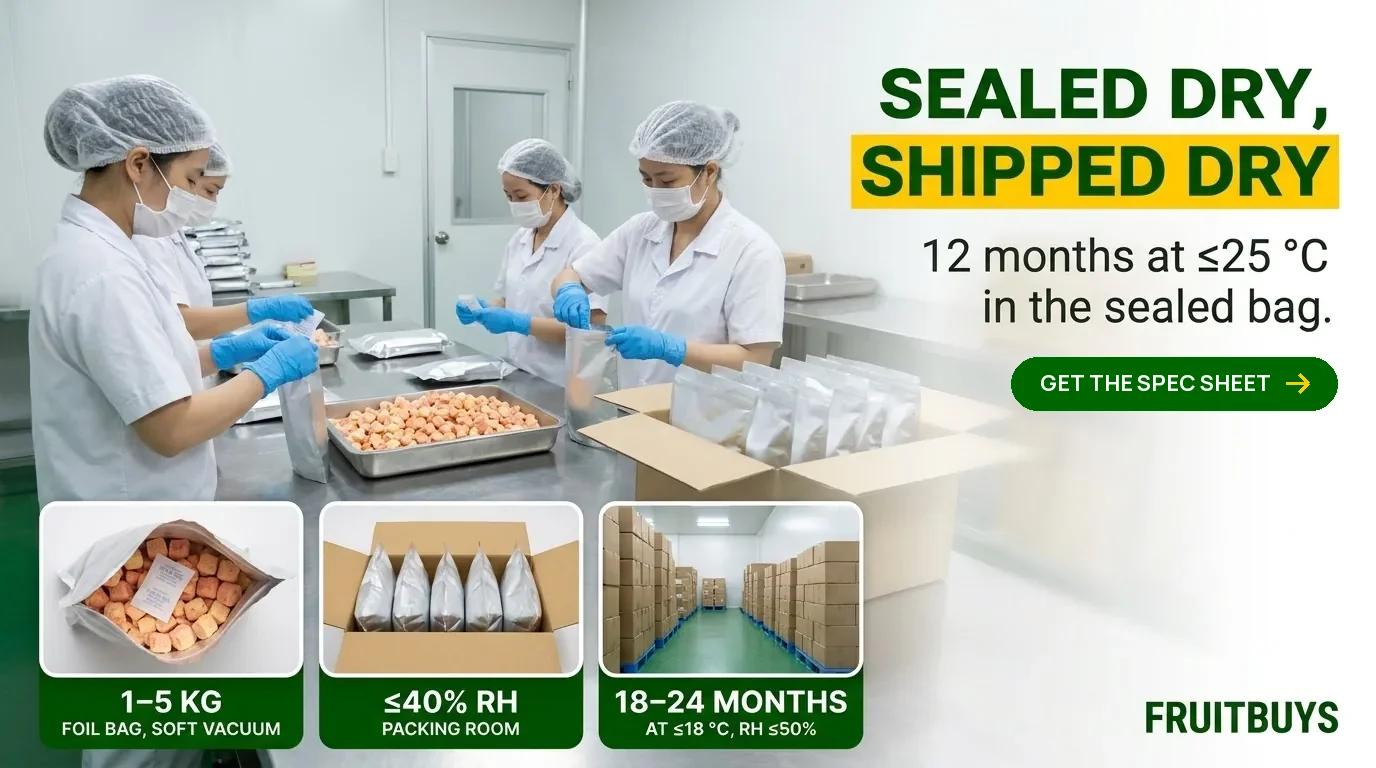
Freeze-dried papaya keeps 12 months at ≤25 °C and ≤60% RH, and 18–24 months in cool storage at ≤18 °C and ≤50% RH, in its original sealed foil bag with desiccant. What protects that shelf life is the bag, not a preservative: an aluminium-foil barrier, a soft vacuum and a food-grade silica gel sachet, packed in a room held at ≤40% RH. A 20 ft container carries about 550 cartons, a 40 ft HC about 1,100, both in a standard dry container with no reefer. The one thing that shortens all of this is humid air reaching the papaya after the bag is opened.
How long does freeze-dried papaya keep, and what shortens it?
| Storage | Shelf life in the unopened foil bag with desiccant |
|---|---|
| Ambient, ≤25 °C and ≤60% RH | 12 months |
| Cool storage, ≤18 °C and ≤50% RH | 18–24 months |
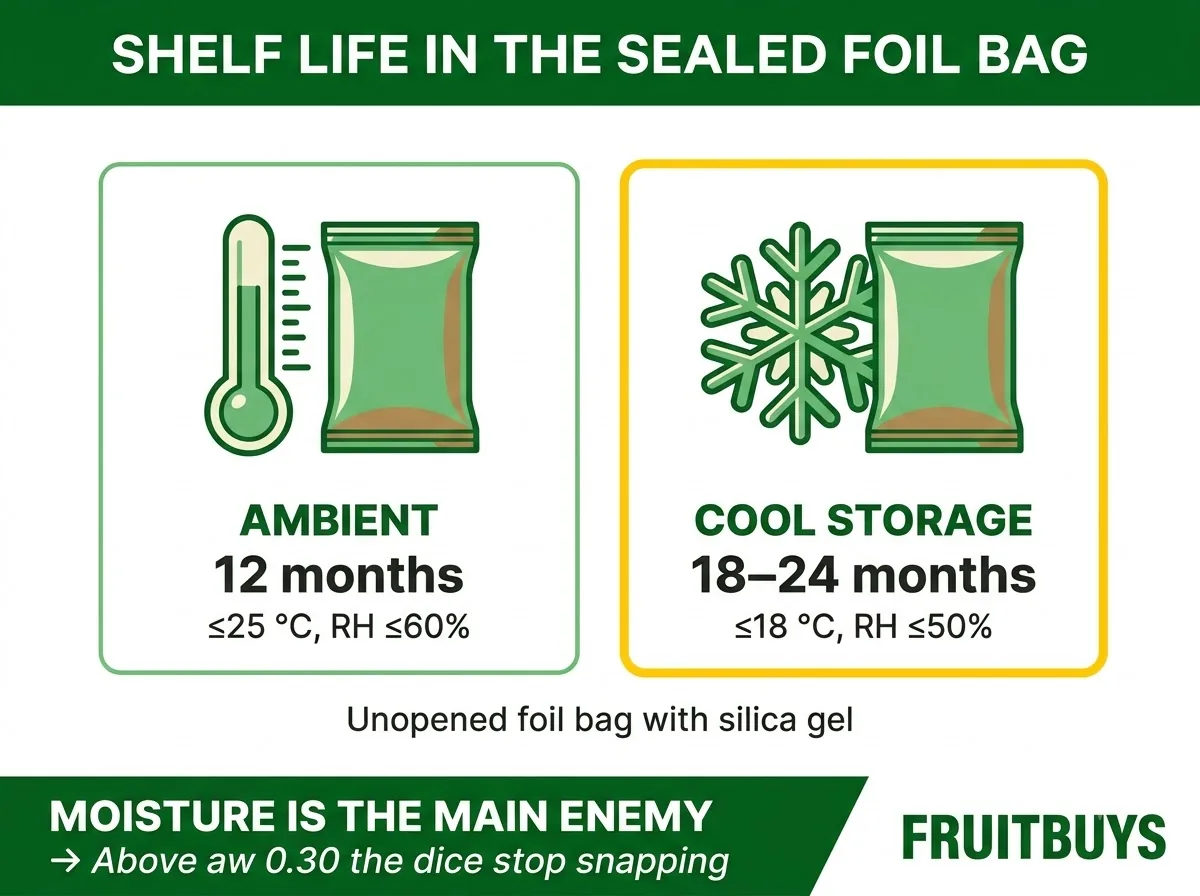
Moisture is the main enemy. Papaya is about 63% natural sugar on a dry basis, so it picks up humidity faster than most freeze-dried fruits; once water activity passes about 0.30, the dice stop snapping, turn tacky and start to cluster. Heat speeds up the slow loss of the orange-red colour, and light does the same through a clear window. A cool, dry, dark store keeps the papaya close to the day it was packed. How water activity behaves in papaya, and how to measure it, is covered in what moisture, water activity and microbiology limits a freeze-dried papaya contract should set.
For private-label programs that want a longer date on the pack, an accelerated shelf-life study on the finished pouch can be arranged as a value-added service, so the date is backed by data in your own packaging.
Which inner bag keeps papaya crisp, and why not double PE?
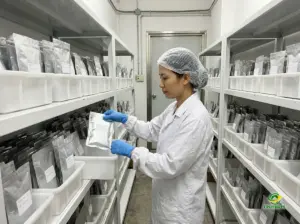
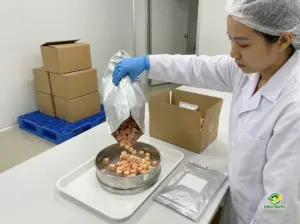
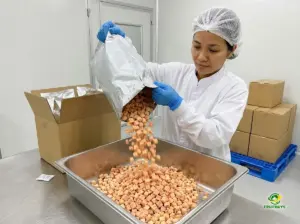
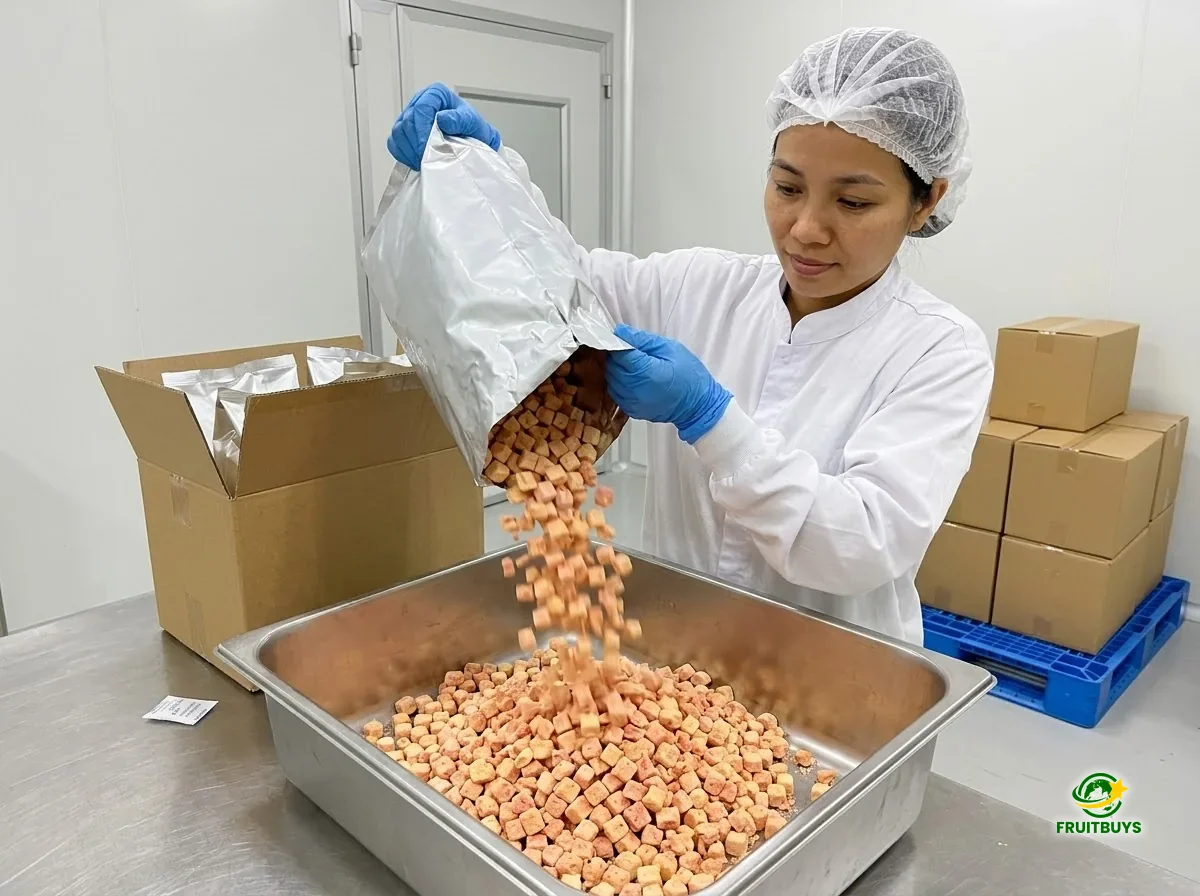
Aluminium-foil laminate, a soft vacuum and a silica gel sachet. Polyethylene lets water vapour through slowly; over four to six weeks at sea and months in a warehouse, that slow leak is enough to lift the water activity of a high-sugar fruit and turn crisp dice tacky. A foil laminate blocks water vapour and light, and the silica gel sachet takes up the little moisture left inside. The soft vacuum removes most of the air without crushing the pieces. No nitrogen is used: for papaya the risk is moisture, and the foil and desiccant handle it.
| Pack | Detail | Best for |
|---|---|---|
| Bulk bag | 1–5 kg sealed aluminium-foil PE bag, soft vacuum, food-grade dust-free silica gel, no nitrogen | Production lines; one bag per batch |
| Powder bulk bag | 5 kg foil bag (1 kg on request), same build; no iron oxygen absorber, never absorber and desiccant together | Powder blending |
| Retail pouch | 30 g / 50 g / 100 g / 500 g aluminium-foil zip pouch; window pouches and high-barrier film for private label | Retail and e-commerce |
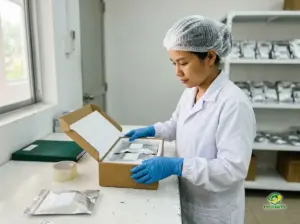
Every bag and retail pouch is sealed in a dehumidified packing room at ≤40% RH and 20–24 °C, so the papaya goes into its foil in drier air than most warehouses will ever see. Bulk bags are sized to one production batch on purpose: the bag that is opened is used through, and every other bag stays sealed until its turn.
How much goes into each carton by format?
All formats ship in the same 5-ply export carton, 58 × 28 × 34 cm. The net weight depends on how densely each cut packs and how much protection it needs.
| Format | Net per carton | Note |
|---|---|---|
| Dice 5 mm or 10 mm | 8–10 kg | Standard for cereal, granola, trail mix |
| Granules 2–5 mm | ~10 kg | Denser pack; lowest freight per kg of the cuts |
| Slices 3–7 mm | 5–6 kg | Packed lighter to protect the shape |
| Powder 60–80 mesh | 15–20 kg (3–4 × 5 kg bags) | About twice the weight per carton of dice |
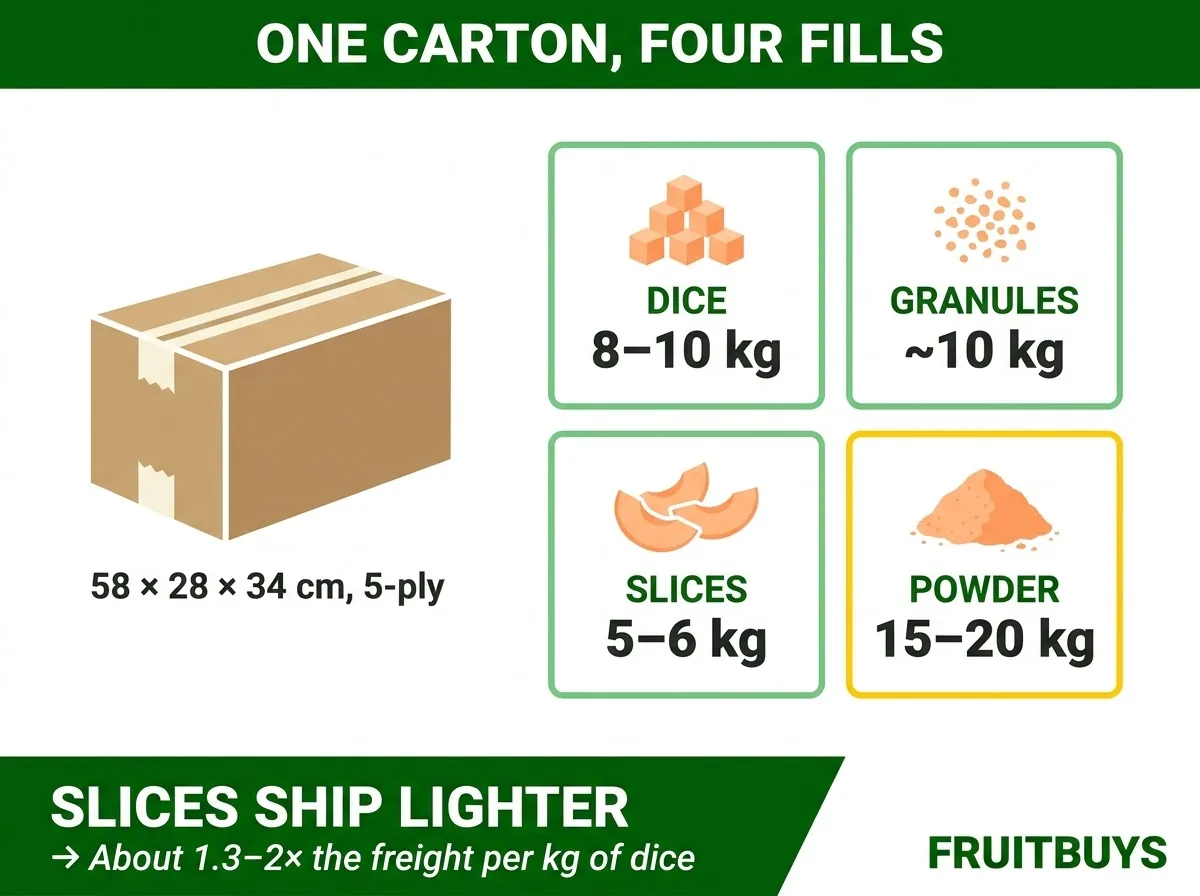
Carton weights are confirmed on the first trial pack for each cut. The weight per carton drives the freight per kilogram: slices carry roughly 1.3–2 times the sea freight per kilogram of dice, and powder roughly half.
How many cartons and kilograms fit a 20 ft and a 40 ft HC?
| Container | Loading | Cartons | Dice | Slices | Powder |
|---|---|---|---|---|---|
| 20 ft | Floor-loaded | about 550 | 4.4–5.5 t | 2.75–3.3 t | 8.25–11 t |
| 40 ft HC | Floor-loaded | about 1,100 (±20–30) | 8.8–11 t | 5.5–6.6 t | 16.5–22 t, planned at 20–21 t |
| 40 ft HC | Palletised, 1,200 × 1,000 mm, 30–36 cartons per pallet, 20–21 pallets | about 600–750 | 4.8–7.5 t | 3.0–4.5 t | 9–15 t |
Floor-loaded or palletised. Floor loading fits the most papaya in the box and gives the lowest freight per kilogram; it takes longer to unload by hand. Palletised loading carries a third to nearly half fewer cartons and unloads in minutes with a forklift, which suits a warehouse paying by the hour at the dock. Pallet configuration follows your instructions.
Seven layers or six. In a 20 ft container the cartons stand 8 across and 10 deep. Seven layers, about 560 cartons, reach the roof; six layers, 480 cartons, leave about 35 cm of headroom. That gap lets air move above the load and keeps the top cartons away from any condensation that forms under the roof. Most loads go at seven layers and about 550 cartons; for a route with a long, hot-to-cold leg, ask for six layers and accept the smaller load.
What happens on the route: port heat, container rain, customs inspection?
- Port heat. A dry container standing in a tropical port in summer gets hot inside. Sealed in foil with desiccant, freeze-dried papaya rides through it; no reefer is needed. At the destination, move cartons into a cool store rather than leaving them in the sun on the dock.
- Container rain. When a warm, humid container sails into a cooler climate, moisture can condense under the roof and drip onto the top layer. The foil bags keep the papaya dry; the cartons may still mark. Six-layer loading and checking the top layer first on arrival deal with it.
- Customs inspection. Inspectors may open cartons and cut bags to sample. Ask your broker to have opened bags set aside or resealed, and check those bags first on arrival: a bag left open in a humid inspection shed is the one that will show tacky pieces.
All of these are covered by the claim window: packaging, appearance, breakage and water activity within 14 days of unloading, lab results within 30 days.
How should an opened bag be handled in your plant?
- Let cold cartons reach room temperature before opening, so no condensation forms inside the bag.
- Open one bag per batch in the driest room available, ideally below 40% RH.
- Use it through in the shift. A bag that stands half-open in a humid store for a week turns tacky.
- Reseal at once with a fresh desiccant sachet if a bag must be reopened.
- Keep cartons on pallets, off the floor and away from walls and strong odours.
Small volumes, same protection. If your monthly volume is too small for a container of papaya alone, ship it in a container shared with other FruitBuys freeze-dried fruits: a consolidated container costs about 15–20% less in logistics per kilogram than LCL, and every product arrives in the same foil-and-desiccant pack. Cuts and full specifications are on the freeze-dried papaya product page and the powder page; how the fruit itself drives the price per kilogram is in how many kilograms of fresh papaya make 1 kg of freeze-dried papaya.
Get a loading plan for your order
Tell us your cut, volume and port, and whether you unload by hand or by forklift, and we return the carton count, net weight and a loading plan for a 20 ft or 40 ft HC.
FAQ
How long does freeze-dried papaya last?
12 months at ≤25 °C and ≤60% RH, or 18–24 months in cool storage at ≤18 °C and ≤50% RH, in the unopened foil bag with desiccant.
Does freeze-dried papaya need refrigeration?
No. It ships in a standard dry container and stores at ambient temperature; cool storage extends the shelf life.
Why has my freeze-dried papaya gone soft or sticky?
It has picked up humidity, usually after a bag stood open. Open one bag per batch, reseal at once, and keep the store dry.
How many cartons fit in a 20 ft container?
About 550 cartons floor-loaded: 4.4–5.5 t of dice, 2.75–3.3 t of slices or 8.25–11 t of powder.
How many cartons fit in a 40 ft HC?
About 1,100 floor-loaded, or about 600–750 on 20–21 pallets of 1,200 × 1,000 mm.
Is nitrogen flushing used?
No. Moisture is the risk for papaya, so a foil barrier, a soft vacuum and a silica gel sachet protect it.
Can I ship a small volume?
Yes. Trial orders start at 50–100 kg, and small volumes can share a container with other FruitBuys freeze-dried fruits at about 15–20% lower logistics cost per kilogram than LCL.