Why Did My Freeze-Dried Mango Arrive Soft When the COA Passed? What Your Specification Must Lock
Freeze-dried mango is single-ingredient mango (Mangifera indica L.) from the freeze-dried fruit range that has been frozen and dried under vacuum into crisp slices, dice or pieces, bought by snack brands, cereal and confectionery manufacturers, and private-label importers. If you are new to the product, our freeze-dried mango buyer’s guide covers the decisions to make before the specification.
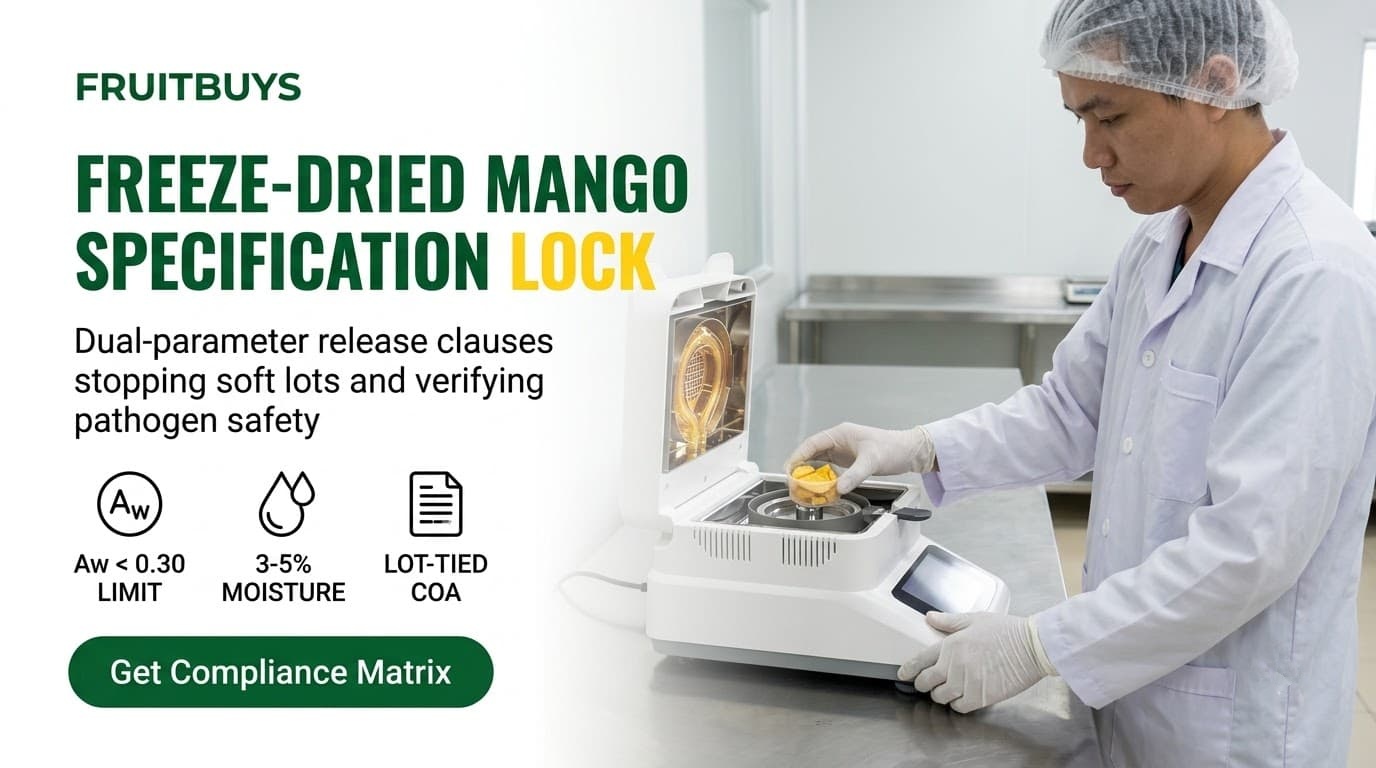
A lot that arrives soft almost always had a COA that reported moisture and nothing else. Moisture tells you how much water is in the bag; it does not tell you whether the mango will stay crisp. FruitBuys releases freeze-dried mango against two numbers measured on the same sample: 3–5% moisture and water activity below 0.30. If either fails, the lot does not ship. That single clause, plus a named test method and a lot-matched COA, prevents most soft-lot disputes. Safety is a separate lock: freeze-drying does not make mango ready-to-eat on its own.
Why did my lot arrive soft when the COA said 4% moisture?
Because the contract controlled moisture but not water activity, and mango’s natural sugars start to soften long before the moisture figure looks alarming. Moisture is the total water. Water activity is how freely that water behaves, and it is what decides whether the porous structure stays glassy and crisp or turns leathery and sticky.

Around four-fifths of mango’s dry matter is sugar, and those sugars pull moisture back from the air the moment the product is exposed. One peer-reviewed study of commercially dried mango found that at 25 °C, softening can begin at under 1 g of water per 100 g of dry solids. A lot that sits at the top of a 5% moisture limit, packed in a weak pouch or opened in a humid warehouse, has very little margin left. The pouch, seal and nitrogen flush that protect that margin are covered in our packaging and shelf-life guide.
That is why a water activity limit is the clause that protects crispness. A moisture-only COA can be accurate and still be the wrong document to accept a lot against.
What should the contract table look like?
Lock both moisture and water activity with methods, then add the raw-fruit, safety and foreign-material clauses that make a rejection enforceable. The table below shows the levels FruitBuys works to on its own freeze-dried mango, next to the reference levels you will meet elsewhere.
| Clause | FruitBuys release level | Reference levels you will see | Method to name in the contract |
|---|---|---|---|
| Moisture | 3–5% | ≤4.0–4.5% commercial; ≤2.0% USDA purchase specification | Named oven or vacuum-oven method, same lab each lot |
| Water activity | <0.30 | ≤0.40 proposed in some specifications | ISO 18787, measured at 25 °C |
| Cultivar | Named: Cát Chu or Keo | “Mango” (unacceptable) | Receiving log per batch |
| °Brix at receiving | Cát Chu 14–18, Keo 14–16 | Varies by cultivar | Refractometer per incoming batch |
| Sulphite (SO₂) | <10 ppm (not detected) | FDA requires sulphite declaration at 10 ppm or more; see the import guide | Optimized Monier-Williams |
| Added sugars | 0 g, shown as its own line on the COA | “Total sugars” only (not enough) | Formula declaration plus sugar profile |
| Salmonella | Not detected in 25 g (n=5, c=0) | Buyer contract limit, not an EU legal criterion for dried fruit | ISO 6579-1 |
| Listeria monocytogenes | Not detected in 25 g | EU criteria apply to ready-to-eat foods | ISO 11290-1 |
| Hygiene indicators | E. coli <10, Enterobacteriaceae <100, TPC <10,000, yeast and mold <1,000 CFU/g | Proposed buyer levels | ISO 16649-2, 21528-2, 4833-1, 21527-2 |
| Metal detection | Fe 1.5 mm, non-Fe 2.0 mm, stainless steel 2.5 mm | Stainless steel often omitted | Challenge-test record per production run |

The FruitBuys levels are working targets confirmed lot by lot on the COA. They are the standard we hold ourselves to, and a reasonable starting point for your own specification.
A contract clause that works in practice:
“Moisture 3–5% (method stated) and water activity <0.30 (ISO 18787, 25 °C), measured on the same retained sample at release. The lot fails if either value is out of specification. The COA shows both values with the lot code.”
Should the moisture limit be 3–5% or 2% like the USDA specification?
Use 3–5% with a water activity limit for most commercial applications; reserve 2% for products that genuinely need it and a supplier that can show it on routine lots. There is no international moisture standard for dried mango: the Codex General Standard for Dried Fruits (CXS 360-2020) has no mango annex, so the limit is a term you negotiate.
The USDA Commercial Item Description A-A-20365 for freeze-dried fruits sets 2.0% maximum moisture. It is a government purchase specification, not a commercial norm. Drying to 2% takes a longer cycle and pushes more lots out of specification, which means more holds and more disputes.
- Long-life dry mixes, or blends with other very dry ingredients: a tighter limit can be justified. Ask for moisture results on the last several lots first.
- Snack pouches and cereal inclusions in barrier packaging: 3–5% moisture with water activity below 0.30 protects crispness at lower cost.
Whichever you choose, name the method. Different moisture methods give different results on the same sample.
What must a COA show before I accept a lot?
Lot code, test date, method, specification limit, actual result and release status, for every parameter, tied to the goods actually shipped. A COA without a lot code is a brochure.
- Both moisture and water activity on the same COA, from the same sample
- Added sugars as a separate line at 0 g, not buried in total sugars
- SO₂ result below 10 ppm if you intend a sulphite-free or clean-label claim
- Microbiology with ISO method numbers and the number of samples tested
- Laboratory accreditation (ISO/IEC 17025) covering the methods reported
Two practical checks that catch most problems: match the COA lot code against the carton labels at receiving, and on large lots, measure water activity on arrival yourself before the goods go into your warehouse.

Which Brix, maturity and dry-matter limits should the factory accept at receiving?
Name the cultivar, set a ripe-fruit °Brix range for it, and require a documented maturity check at receiving.
- Cultivar. Cát Chu and Keo behave differently. Ripe Cát Chu runs 14–18 °Brix, Keo 14–16 °Brix. A contract that says only “mango” lets cultivars be switched or blended, which changes color and sweetness between lots.
- °Brix records. Ask for receiving logs per incoming batch, not a seasonal average.
- Maturity and condition. Require a written maturity check and a reject rule for decay, bruising and fiber defects.
- Dry matter. Dry matter in fresh mango flesh ranges from 15.2% to 22.2% across published cultivars. It drives how much fruit goes into each kilogram, which is a price question, not a safety one. How it moves the conversion ratio and the price is explained in why freeze-dried mango costs what it does.
If the supplier buys across the main season (March to July) and the off-season (September to November), ask whether receiving criteria change between seasons.
Is freeze-dried mango ready-to-eat, or can Salmonella survive freeze-drying?
Salmonella can survive freeze-drying, and in very dry foods it can become more heat-resistant, so freeze-dried mango is ready-to-eat only if the supplier can show a validated pathogen control. Low water activity stops growth. It does not kill what is already there. The US Food and Drug Administration’s guidance on low-moisture ready-to-eat foods treats pathogen survival in dry products as a hazard that sanitation and verification must control.

This changes your contract in three ways:
- State the intended use. “Ready-to-eat” and “for further processing” need different controls and release criteria.
- Ask for the hazard analysis. It should show where pathogens are controlled (raw material, wash step, hygiene zoning after drying) and how that control was validated.
- Do not accept low water activity as the safety argument. It is a quality and stability control, not proof that pathogens are absent.
Which microbiological limits should I specify for ready-to-eat use?
Salmonella and Listeria monocytogenes not detected in 25 g with named ISO methods, plus hygiene indicators, written as contract limits.
- Salmonella: not detected in 25 g, n=5, c=0, ISO 6579-1. EU Regulation 2073/2005 does not set a specific Salmonella criterion for dried fruit, so this is a buyer specification. Write it as one.
- Listeria monocytogenes: not detected in 25 g, ISO 11290-1. EU Regulation 2073/2005 sets Listeria criteria for ready-to-eat foods; confirm which applies to your product and market.
- Hygiene indicators: E. coli <10, Enterobacteriaceae <100, total plate count <10,000, yeast and mold <1,000 CFU/g. A rising trend tells you hygiene is slipping before a pathogen appears.
Two clauses make these limits enforceable: the number of samples per lot, and what happens on a failed result (hold, retest rule, rejection).
What does a soft lot cost you?
Expected loss per lot = share of lots that go soft or fail × lot value, plus the days a held lot occupies your warehouse. If 1 lot in 20 arrives soft and your contract gives you nothing to reject it against, you carry 5% of every lot’s value as unrecovered loss, before storage and the delay to your own production. A precise specification does not make soft lots impossible. It decides who pays for them.
Decision rule
- Contract controls moisture only → add water activity <0.30 (ISO 18787) and a both-must-pass release rule.
- COA has no lot code or no method → do not accept it as release evidence.
- Product sold ready-to-eat and no validated pathogen control → buy for further processing only.
- Clean-label or sulphite-free claim → require SO₂ <10 ppm and added sugars 0 g as separate COA lines.
- Contract says “mango” without a cultivar → name it.
- Metal detection clause omits stainless steel → add it.

Verification checklist before you sign
- Moisture and water activity results for recent lots, same sample, method and lab named
- Laboratory accreditation scope (ISO/IEC 17025) covering those methods
- Receiving logs with cultivar, °Brix and maturity check per batch
- Hazard analysis stating intended use, pathogen control step and its validation
- Metal detector challenge-test records including a stainless-steel test piece
- SO₂ and added-sugar results if you will make clean-label claims
- Written hold, retest and rejection rules for each limit
Where the specification does not fit
A specification cannot fix a mismatch in use. A 2.0% moisture limit may be hard to meet on thick slices. A ready-to-eat claim cannot be made from a supplier with no pathogen validation; in that case buy the product for a process with its own control step, or choose another supplier. And do not carry soft-dried mango rules across: soft-dried products sit at far higher moisture and water activity and need different controls, including cold-chain shipping for some unsweetened lines. Freeze-dried mango does not. Hold every supplier to these checks, including us.
FAQ
Which process records should back the specification?
The freezing and drying cycle record for the lot (product temperature, pressure, time and endpoint), the moisture and water activity release results, and metal detection records. Reference settings such as freezing at about −40 °C and a 22–26 hour drying cycle describe typical practice, not how your lot was made.
Get your specification reviewed
Send us your draft specification or the technical data sheet you are working from. FruitBuys will review each clause against your application and destination market, and tell you which ones a supplier should be able to evidence before you sign. You can reach our team from the freeze-dried mango product page.
Sources & Technical References
- FruitBuys Vietnam: “Premium Freeze Dried Mango”: working release targets of 3–5% moisture and water activity below 0.30, both required before release; ISO 18787 for water activity; lot-specific COA fields. (https://fruitbuys.com/product/freeze-dried-mango)
- USDA Agricultural Marketing Service: “Commercial Item Descriptions (CIDs)”: index including A-A-20365 Fruits, Freeze-Dried, 2.0% maximum moisture. (https://www.ams.usda.gov/grades-standards/commercial-item-descriptions-cids)
- Codex Alimentarius (FAO/WHO): “General Standard for Dried Fruits (CXS 360-2020)”: no mango annex and no mango moisture limit. (https://www.fao.org/fao-who-codexalimentarius/sh-proxy/hu/?lnk=1&url=https%3A%2F%2Fworkspace.fao.org%2Fsites%2Fcodex%2FStandards%2FCXS+360-2020%2FCXS_360e.pdf)
- Caballero-Cerón C. et al.: “Hygroscopic properties and glass transition of dehydrated mango, apple and banana”, Journal of Food Science and Technology 55(2):540–549 (2018): critical water content of dehydrated mango at 25 °C. (https://pmc.ncbi.nlm.nih.gov/articles/PMC5785379)
- U.S. Food and Drug Administration: “Draft Guidance for Industry: Establishing Sanitation Programs for Low-Moisture Ready-to-Eat Human Foods and Taking Corrective Actions Following a Pathogen Contamination Event”: pathogen survival and control in low-moisture foods. (https://www.fda.gov/regulatory-information/search-fda-guidance-documents/draft-guidance-industry-establishing-sanitation-programs-low-moisture-ready-eat-human-foods-and)
- U.S. Code of Federal Regulations: “21 CFR 101.100 Food; exemptions from labeling”: sulphites at 10 ppm or more must be declared. (https://www.ecfr.gov/current/title-21/chapter-I/subchapter-B/part-101/subpart-G/section-101.100)
- ISO: “ISO 18787:2017 Foodstuffs — Determination of water activity”. (https://www.iso.org/standard/63379.html)
- ISO: “ISO 6579-1:2017 Microbiology of the food chain — Horizontal method for the detection, enumeration and serotyping of Salmonella — Part 1: Detection of Salmonella spp.”. (https://www.iso.org/standard/56712.html)
- European Union: “Commission Regulation (EC) No 2073/2005 on microbiological criteria for foodstuffs”: Listeria criteria for ready-to-eat foods; no specific Salmonella criterion for dried fruit. (https://eur-lex.europa.eu/legal-content/EN/TXT/?uri=CELEX%3A32005R2073)
- ACIAR: “Activity 1.4 Market Review”: Vietnamese mango cultivars, °Brix and seasonality. (https://research.aciar.gov.au/apmangonet/wp-content/uploads/2020/05/AGB2012061-A1.4-Market-Review.pdf)
Basis note: FruitBuys levels (moisture 3–5%, water activity <0.30, SO₂ <10 ppm, added sugars 0 g, metal detection Fe 1.5 / non-Fe 2.0 / stainless steel 2.5 mm) are published working targets confirmed per lot by COA, not results for any specific lot. Microbiological and hygiene levels are proposed contract levels. The 1-in-20 soft-lot rate is an illustration. The four-fifths sugar share is calculated from USDA FoodData Central values for fresh mango (13.7 g sugars in about 16.5 g of solids per 100 g).