
What are the nutrition facts of freeze-dried papaya per 100 g and per serving?
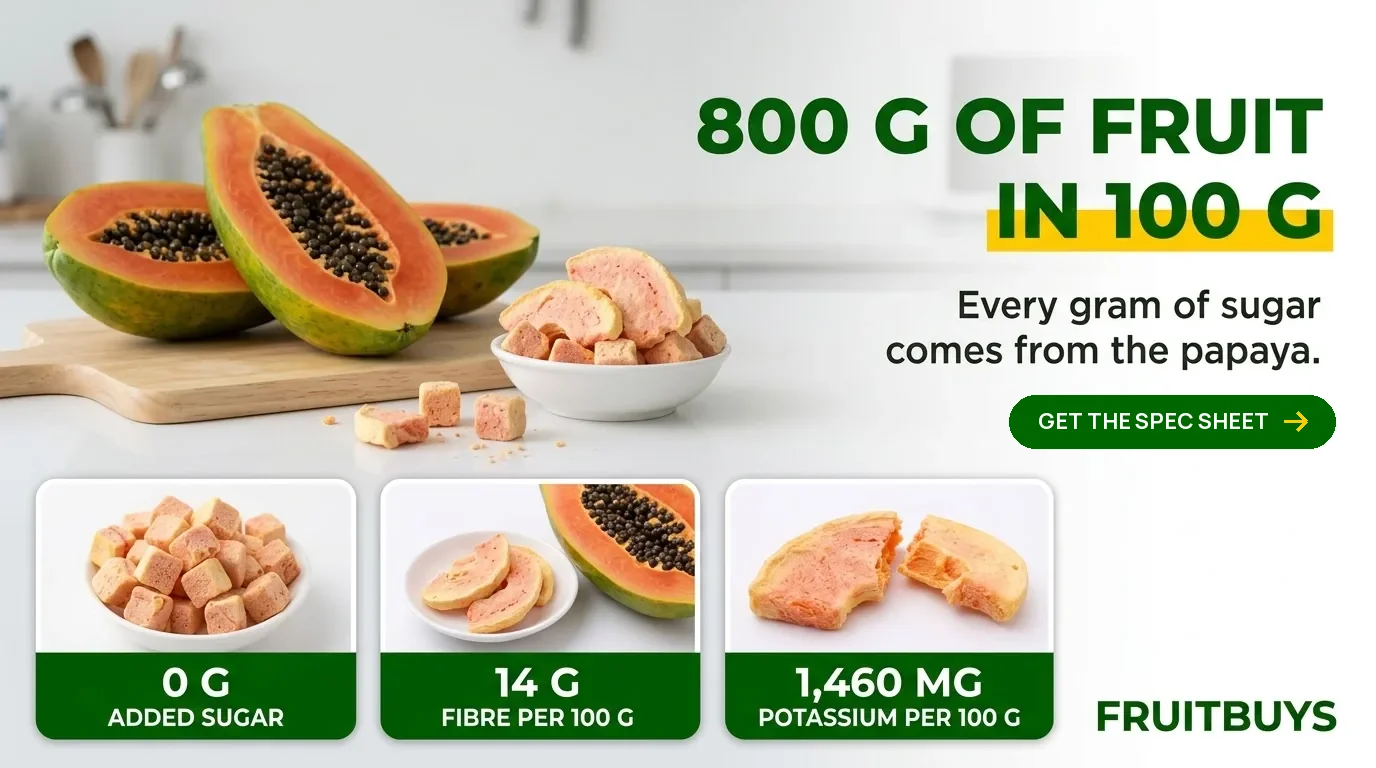
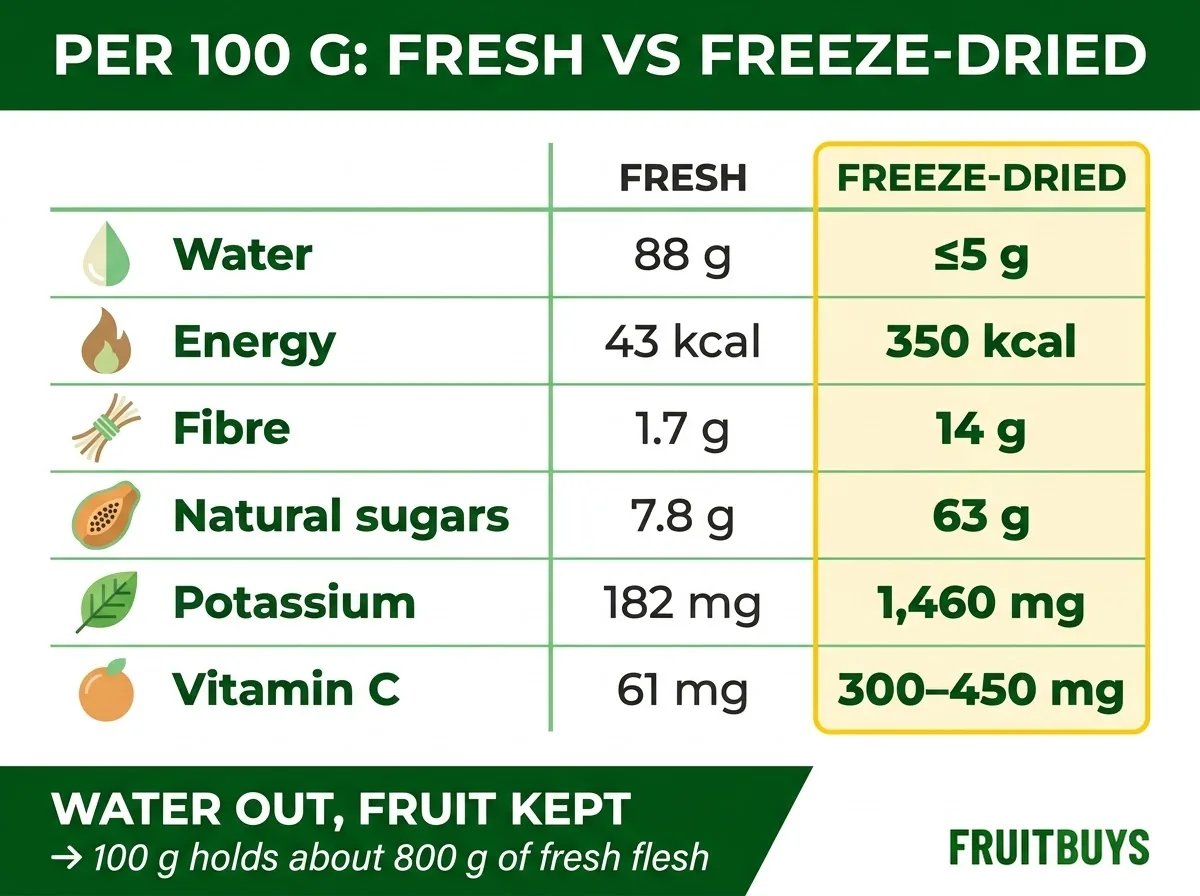
100 g of freeze-dried papaya carries about 350 kcal, 14 g of dietary fibre, 63 g of sugars that all come from the fruit, 1,460 mg of potassium and typically 300–450 mg of vitamin C. Those figures are fresh papaya with the water taken out: 100 g of freeze-dried papaya holds the flesh of about 800 g of fresh fruit. For a private-label brand, the numbers support clear front-of-pack claims for fibre, potassium and “no added sugars”, and they rule out “low sugar”. The sections below give the values per 100 g and per serving, the claims they meet in the EU and the US, and how to get the lot panel your label artwork needs.
What does 100 g of freeze-dried papaya contain compared with fresh?
| Per 100 g | Fresh papaya | Freeze-dried papaya (typical) |
|---|---|---|
| Water | about 88 g | ≤5 g |
| Energy | 43 kcal | 350 kcal (EU 1,460 kJ) |
| Fat / of which saturates | 0.26 g | 2 g / 0.5 g (EU 2.1 g / 0.6 g) |
| Carbohydrate | 87 g total (US) / 73 g (EU, fibre excluded) | |
| of which sugars | 7.8 g | 63 g, all naturally occurring; 0 g added |
| Dietary fibre | 1.7 g | 14 g |
| Protein | 0.47 g | 4 g (EU 3.8 g) |
| Sodium / salt | 65 mg / 0.16 g | |
| Potassium | 182 mg | 1,460 mg |
| Vitamin C | 60.9 mg | typical 300–450 mg |
Typical values for 100% freeze-dried papaya; natural variation by origin, season and ripeness applies. Lot nutrition panel available for label artwork.
The ingredient line is one word: papaya. Nothing is added, so every gram of sugar, fibre and potassium comes from the fruit, and the orange-red colour comes from its own beta-carotene and lycopene. Freeze-drying removes water without heating the fruit, which is why it keeps far more of the heat-sensitive vitamin C than hot-air drying does. Freeze-dried papaya powder carries the same values per 100 g, because it is milled from the same papaya with nothing added; the free-flow grade adds up to 1% silicon dioxide, declared on the label.
How do brands label a serving in the US and the EU?
In the US, the reference amount for dried fruit is 40 g, so the Nutrition Facts panel is built on that serving. In the EU, the per-100 g column is mandatory and a per-portion column is optional, so many snack brands add a 30 g portion.
| Per serving | 30 g portion | 40 g (US reference amount) |
|---|---|---|
| Energy | 105 kcal | 140 kcal |
| Dietary fibre | 4.2 g | 5.6 g (20% DV) |
| Sugars, naturally occurring | 18.9 g | 25 g |
| Added sugars | 0 g | 0 g |
| Potassium | 438 mg | 584 mg (12% DV) |
| Fresh papaya equivalent | about 240 g of flesh | about 320 g of flesh |
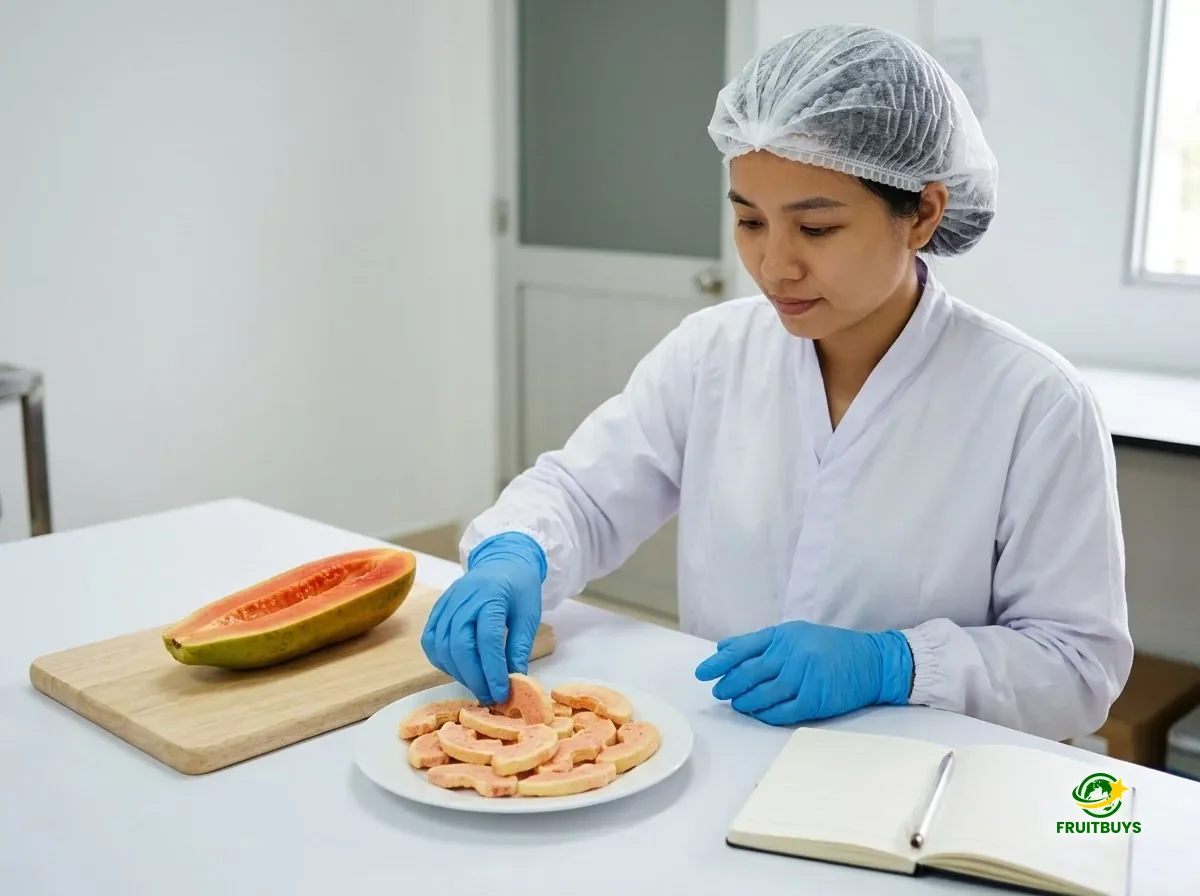
That last row is the one shoppers understand fastest: a 30 g pouch carries the flesh of roughly a quarter of a 1.2 kg papaya, and it fits in a jacket pocket.
Is the sugar in freeze-dried papaya natural or added?
All natural. Papaya flesh is about 8% sugar when fresh; take out 88% water and the same sugar makes up 63% of the freeze-dried weight. No sugar, syrup or juice concentrate is added at any step. That sets freeze-dried papaya apart from most dried papaya on the shelf, which is candied: US retail labels for sweetened dried papaya list around 70–75 g of total sugar per 100 g, with added sugar declared, and many carry sulphur dioxide and added colours. The full comparison is in is dried papaya good for you.
On your label, this shows as 0 g added sugars on a US panel and supports an EU “no added sugars” claim, provided the pack states that the product contains naturally occurring sugars.
For low-sugar and keto products, use papaya as a small inclusion. Its 63 g of sugar per 100 g rules out a “low sugar” claim for papaya on its own, so the right use is colour and flavour at a measured dose: 10 g of dice in a cereal or bar serving adds about 6 g of natural sugar, and a 3–4% dose of freeze-dried papaya powder adds under 1 g per 30 g serving while still giving a visible orange colour and real fruit taste.
Which front-of-pack claims do typical values support?
Before a private-label brand prints a pouch, I ask them to settle which claim goes on the front, because the claim decides which numbers need a lab result behind them.
| Claim | Threshold | Freeze-dried papaya (typical) | Use on pack |
|---|---|---|---|
| EU “high fibre” | ≥6 g per 100 g | 14 g | Yes |
| EU “high potassium” | ≥30% NRV per 100 g (600 mg) | 1,460 mg (73% NRV) | Yes |
| EU “low fat” | ≤3 g per 100 g | 2.1 g | Yes |
| EU “low salt” | ≤0.12 g sodium per 100 g | 0.065 g | Yes |
| EU “no added sugars” | No sugars or sweetening ingredients added | 0 g added | Yes, with “contains naturally occurring sugars” |
| EU “high in vitamin C” | ≥30% NRV per 100 g (24 mg) | typical 300–450 mg | After the lot panel |
| US “good source of potassium” | 10–19% DV per 40 g | 12% DV | Yes |
| US fibre claim | “Excellent source” needs ≥20% DV per 40 g | 20% DV, exactly at the line | “Good source”, or “excellent source” once the lot panel shows ≥5.6 g per 40 g |
| US “no sugar added” | Five conditions, including a “not a low calorie food” statement | 0 g added | Label review confirms the wording |
| US “healthy” | Fruit with no added ingredients other than water qualifies under FDA’s updated rule; compliance date 25 February 2028 | Papaya only | Label review confirms |
| “Low sugar” | EU ≤5 g per 100 g | 63 g | No |
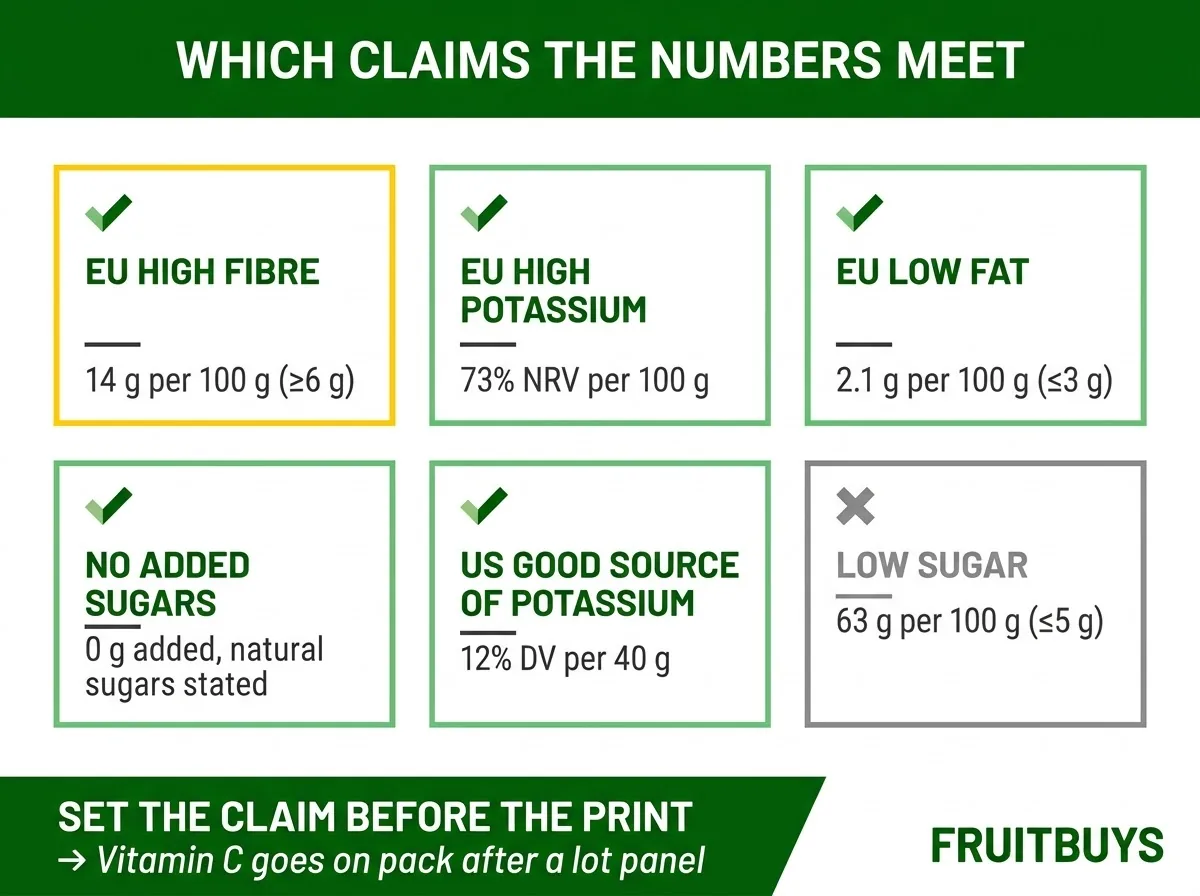
The EU nutrient-function claims that go with these figures are authorised wording: vitamin C contributes to the normal function of the immune system, and potassium contributes to normal muscle function. Disease, digestion or weight claims are off the table for papaya in both markets, and the EU has no authorised health claim for papaya itself.
How do you get a product-specific nutrition panel for label artwork?
Order a lot nutrition panel on the papaya that will go into your pouches. FruitBuys arranges independent testing at an accredited laboratory of your choice, such as Eurofins or SGS in Vietnam, and the panel is available for each lot on request, before the container is sealed.
Three points make the panel worth more than a typical-values table:
- It covers what a US panel must declare. A US Nutrition Facts panel lists vitamin D, calcium, iron and potassium; typical-value tables for fruit usually leave the first three out.
- It backs a vitamin C figure. Vitamin C falls slowly in storage, faster in heat. In the EU, a vitamin declared on a food may test up to 35% below the declared value at any point in its shelf life; in the US, a naturally occurring nutrient must test at 80% or more of the declared value. Declare vitamin C from the lot panel, set conservatively, and it holds to the end of the date.
- It settles the fibre line. A measured 5.6 g or more per 40 g moves the US claim from “good source” to “excellent source”.
The specification, allergen status and full product data sit on the freeze-dried papaya product page and the powder page. How the HS code and import documents work for the same product is in what freeze-dried papaya needs to clear US, EU, UK and UAE customs.
Get the specification and nutrition data
Tell us your market, serving size and the claims you plan to print, and we send the specification, the typical nutrition table and a plan for the lot panel your artwork needs.
FAQ
How many calories are in dried papaya?
Freeze-dried papaya has about 350 kcal per 100 g, 105 kcal per 30 g and 140 kcal per 40 g. Candied dried papaya varies with the sugar added; read its label.
Does dried papaya contain vitamin C?
Yes. Freeze-dried papaya typically carries 300–450 mg of vitamin C per 100 g, because it is dried without heat. Use a lot panel for any figure printed on the pack.
How much sugar is in freeze-dried papaya?
About 63 g per 100 g, all naturally occurring; 0 g added.
Is freeze-dried papaya high in fibre?
Yes. At 14 g per 100 g it meets the EU “high fibre” threshold of 6 g per 100 g.
How much fresh papaya is in 100 g of freeze-dried papaya?
About 800 g of fresh flesh.
Is freeze-dried papaya powder the same nutritionally?
Yes, per 100 g, because it is milled from freeze-dried papaya with nothing added. The free-flow grade contains up to 1% silicon dioxide.
Does freeze-dried papaya contain allergens?
It contains none of the US top-9 or EU-14 allergens as ingredients and is vegan. A gluten-free claim needs a lot gluten test.