
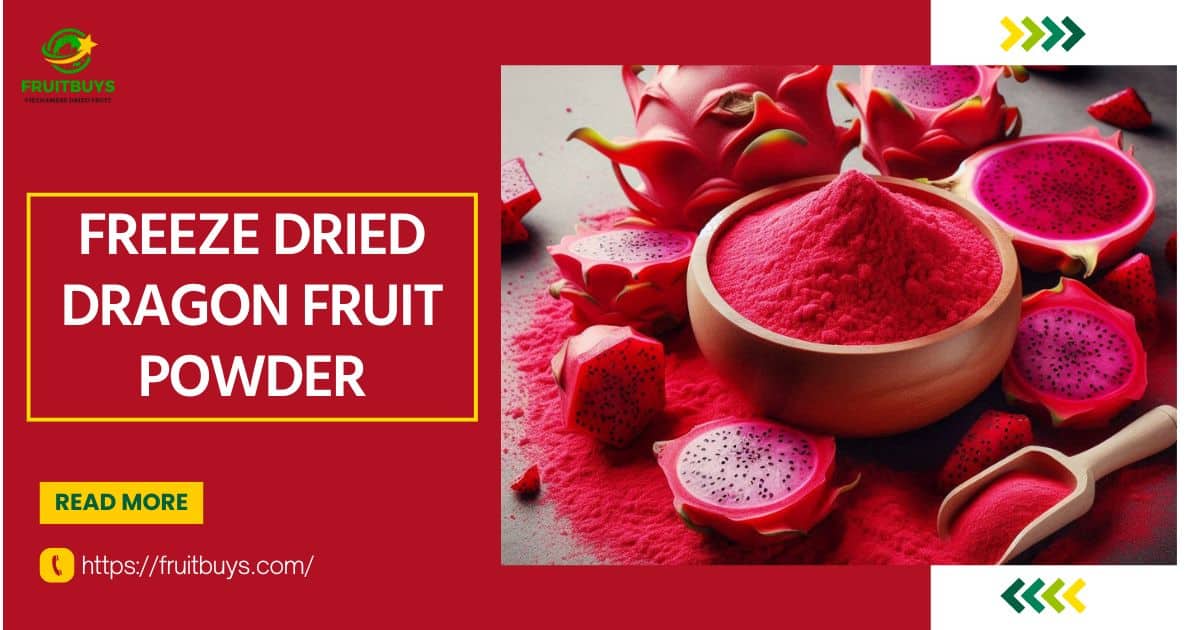
Can dragon fruit powder replace synthetic red and pink food coloring?
In cold and mildly heated products, yes. 0.5–2% of 100% red dragon fruit powder gives pastel pink to deep magenta in yogurt, ice cream, frosting, drinks and confectionery fillings, and the label reads “dragon fruit”. The color holds best between pH 4 and 6 and fades with long heat, so dose it after the hot steps.
Why are brands switching to dragon fruit for pink and red?
Because synthetic reds are becoming a liability on the shelf. In 2025 US regulators announced a plan to phase out petroleum-based synthetic food dyes, and in the EU, foods colored with Allura Red (E129), Carmoisine (E122) and four other synthetic colors must carry a warning about effects on children’s activity and attention. Carmine (E120), the classic “natural” red, comes from insects, which rules it out for vegan and vegetarian lines and many shoppers who simply read the label.
Red dragon fruit solves all three at once: plant-based, no warning statement, and a one-word ingredient. Its color comes from betacyanins, the same pigment family as beetroot red, at roughly 225–360 mg per 100 g of freeze-dried powder. That concentration is why a small dose goes so far.
How much powder do you need?
| Application | Dose (by weight of finished product) | What you get |
|---|---|---|
| Color only (any cold application) | 0.5–2% | Pastel pink at 0.5%, strong magenta at 2% |
| Yogurt, skyr, ice cream | 1–3% | Even pink with a light fruit note |
| Frosting, buttercream, fillings, glazes | 3–6% | Vivid magenta and real fruit flavor |
| Chocolate and compound coatings | 2–5% | Pink chocolate with fruit specks |
| Bakery doughs and batters | 2–4% | Pink-to-mauve crumb (browner after baking) |
| Drinks, smoothies, lemonades | 0.5–1% for color, 2–5% for flavor | Clear magenta in acidic drinks, pastel in milk |
At 0.5–2%, one tonne of finished yogurt or frosting base needs only 5–20 kg of powder. Run that against your current color cost per tonne and the swap is usually easier to justify than buyers expect, because the powder also replaces part of the fruit flavor and fruit content you would otherwise add.
Drinks and café use, with dosing per cup, is covered in how to use freeze-dried dragon fruit in drinks.
What pH and temperature does the color tolerate?
This is the question that decides whether a trial succeeds, so R&D teams should screen it first.
| Factor | Color behavior | What to do in the recipe |
|---|---|---|
| pH 4–6 | Best stability and brightest magenta | Ideal for yogurt, fruit preps, most fillings and drinks |
| pH 3–4 | Still strong; slightly redder | Fine for lemonades, sorbets, gummies |
| Above pH 7 | Shifts toward violet, then brown-yellow | Avoid in alkaline doughs and baking-soda-heavy recipes |
| Heat, short (pasteurization, HTST) | Some loss, color stays pink | Add after the heat step where possible; or overdose slightly and test |
| Heat, long (baking, hot holding, retort) | Fades and browns | Use in toppings, fillings and icings rather than the dough |
| Light | Fades over weeks on a lit shelf | Opaque or UV-blocking packaging |
| Water activity and oxygen | Low aw and low oxygen protect the pigment | Dry products keep color longest; reseal powder bags at once |
Betacyanins also fade faster in the presence of iron and copper, and hold better with a little added vitamin C in the formula. For any product that is cooked, a 4–8 week shelf trial in the final pack under your storage conditions tells you more than any table.
How do you label it in the US and the EU?
The answer depends on why the powder is in the recipe.
- EU and UK. A whole fruit powder made only by drying and milling, with no selective extraction of the pigment, is treated as a colouring food: a food ingredient, not an additive. It is declared by name, “dragon fruit powder”, with no E-number. Beetroot red (E162) is the additive; dragon fruit powder is the fruit. The European Commission’s guidance notes on colouring foods set out this distinction, so confirm the exact wording with your regulatory team.
- United States. When the powder’s main purpose is color, FDA treats it as a color additive under the existing fruit juice color listing, which covers concentrated and dried fruit and is exempt from batch certification. It is commonly declared as “fruit juice (color)” or with the fruit named. When it is there mainly as a fruit ingredient, it is simply “dragon fruit powder”.
Either way, the declaration stays short and plant-based, with no synthetic dye and no warning statement on the pack.
What does the powder look like in the product?
Two things surprise first-time users, and both are selling points once you know them.
- Black specks. The powder is 100% fruit, ground seeds included. Tiny black specks show in frosting, white chocolate and clear drinks. Customers read them as real fruit, and many brands put them on the front-of-pack photo.
- Fruit body. The powder carries fruit fiber and natural sugars (about 44 g sugars and 16 g fiber per 100 g), so at 3–6% it also adds a gentle fruit taste and a little body. At 0.5–1% it is close to neutral.
The free-flowing grade with up to 1% anti-caking agent (E551) runs better in augers, sachet and stick-pack lines; the 100% grade keeps the cleanest label. The grade, mesh and moisture limits are set out in what to specify before buying freeze-dried dragon fruit powder.
How should you run a color trial?
- Pick the hardest product first. If it survives your hottest or longest process, the rest will follow.
- Test three doses. For example 0.5%, 1% and 2%, against your current colored control.
- Add it at the coolest point you can. After pasteurization, into the fruit prep, or into the icing rather than the dough.
- Measure color on day 0 and through shelf life. A colorimeter (L*a*b*) or a fixed photo booth under the same light; check at 2, 4 and 8 weeks in the final pack.
- Check the label and cost together. Fewer additives, a cleaner ingredient line and a color cost per tonne your finance team can sign off.
Where does dragon fruit powder not fit, and what works instead?
If the product is baked for a long time, hot-filled, or must be an even, speck-free red at neutral pH, a whole fruit powder will struggle to hold the shade on its own. In those cases, keep the dough or base neutral and put the color where it is seen: a dragon fruit icing, a filling, a dusting on top, or freeze-dried crumbles folded in after baking. FruitBuys supplies the powder, the crumbles and the pieces, so one trial pack covers all three options.
FruitBuys sources red-flesh dragon fruit from the Lam Dong coastal belt (former Binh Thuan) and the Mekong Delta (Long An, Tien Giang), freeze-dries it at qualified partner facilities and mills it into 60–80 mesh powder released at ≤4.0% moisture and aw ≤0.25. Packing, documents and grades are on the freeze-dried dragon fruit powder product page, and visible-fruit formats are in freeze-dried dragon fruit formats.
Start your color trial
Tell us the product, its pH, your hottest process step and the shade you are matching, and we will ship pre-shipment samples of 100% red dragon fruit powder in sealed foil bags within 24–48 hours of approval.
[email protected] · WhatsApp Export +84 919 739 589
FAQ
Is dragon fruit powder a natural food coloring?
Yes. It is 100% freeze-dried red dragon fruit, colored by its own betacyanin pigments. In the EU it is used as a colouring food and declared by name; in the US, when used for color, it falls under the fruit juice color listing.
How much dragon fruit powder do I need to color frosting pink?
Start at 1–2% for a clear pink and go to 3–6% for deep magenta with fruit flavor. Add it to the finished frosting, not the hot syrup.
Does dragon fruit powder keep its color when baked?
Only partly. Long oven heat dulls it toward mauve and brown. For a bright pink in baked goods, put the powder in the icing, filling or topping.
Is dragon fruit powder vegan?
Yes. It is a plant-only ingredient with no insect-derived carmine and nothing else added.
Does dragon fruit powder change the taste?
At 0.5–1% it is close to neutral. At 3% and above it adds a mild, lightly sweet fruit note that pairs well with berry, citrus, coconut and vanilla.



