

What is the nutrition of freeze-dried mango per 100 g, and what can your label claim?
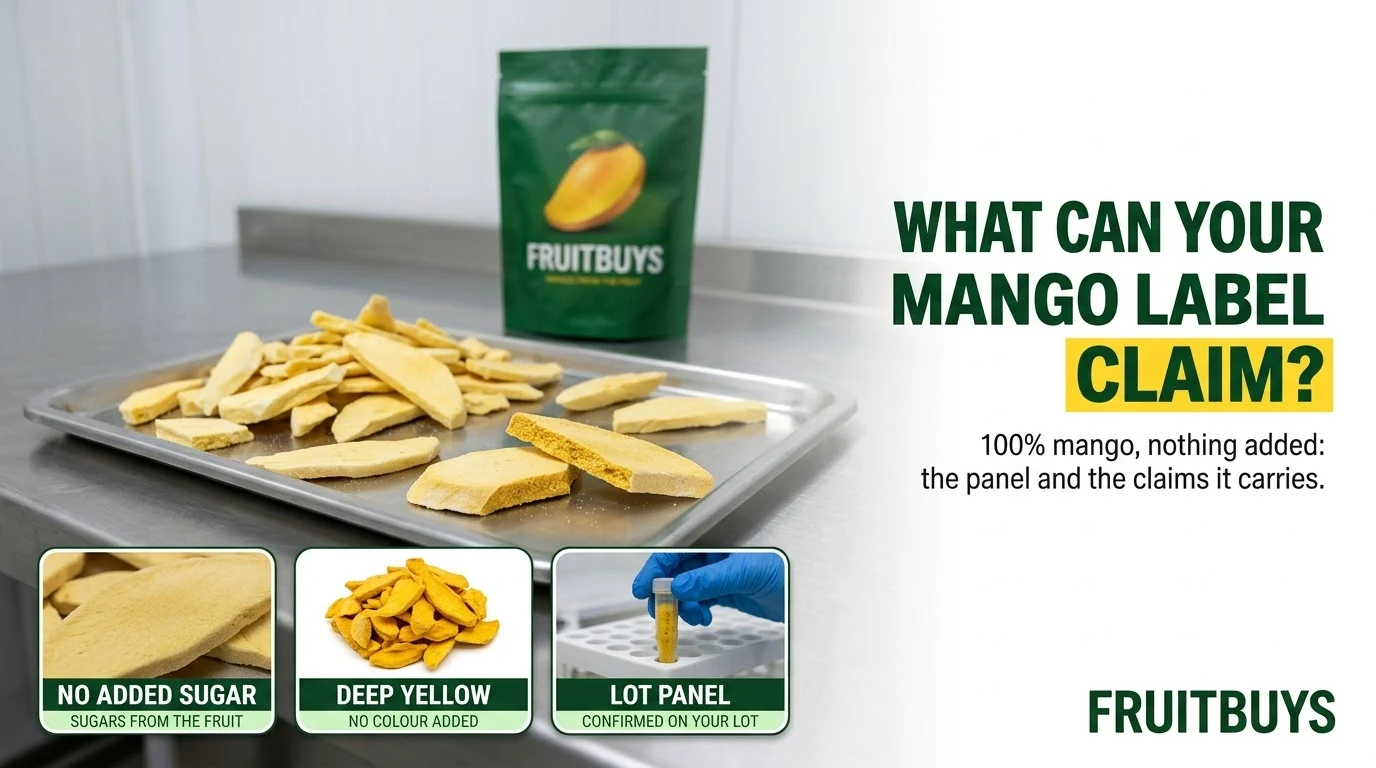
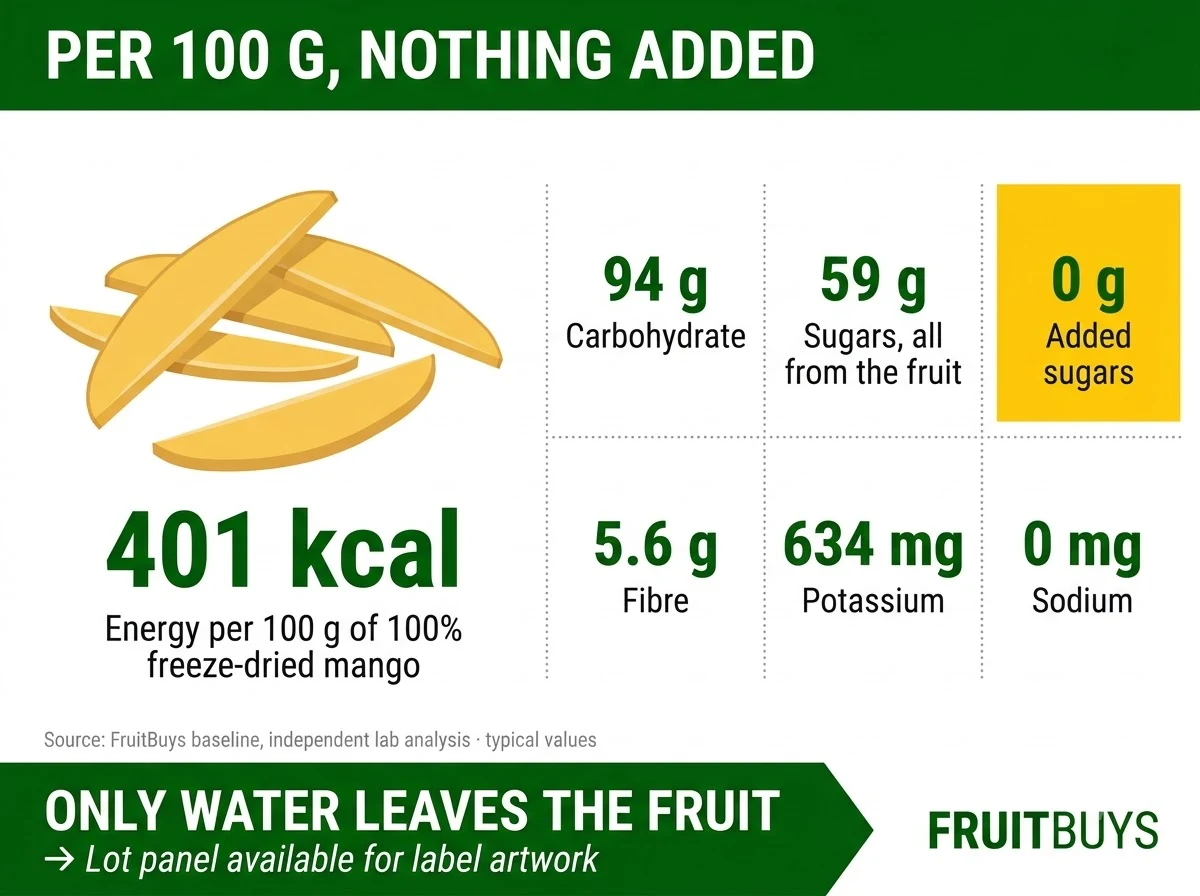
401 kcal, 94 g carbohydrate, 59 g naturally occurring sugars, 5.6 g fiber, 3.1 g protein and 634 mg potassium per 100 g, with zero sodium, zero cholesterol and 0 g added sugars. These are the baseline values from a Eurofins laboratory analysis of FruitBuys freeze-dried mango, 100% mango with nothing added. Your R&D team can cost recipes and set up artwork on them today, and the claim table below shows what the pack can say before you commit to a print run.
Nutrition facts by serving size
| Nutrient | Per 100 g | % DV per 100 g | Per 28 g (1 oz) | Per 40 g |
|---|---|---|---|---|
| Calories | 401 kcal | 112 kcal | 160 kcal | |
| Total fat | 1.3 g | 2% | 0.4 g | 0.5 g |
| Saturated fat | 0.4 g | 2% | 0.1 g | 0.2 g |
| Trans fat | 0 g | 0 g | 0 g | |
| Cholesterol | 0 mg | 0% | 0 mg | 0 mg |
| Sodium | 0 mg | 0% | 0 mg | 0 mg |
| Total carbohydrate | 94 g | 34% | 26.3 g | 37.6 g |
| Dietary fiber | 5.6 g | 20% | 1.6 g | 2.2 g |
| Total sugars | 59 g (naturally occurring) | 16.5 g | 23.6 g | |
| Added sugars | 0 g | 0% | 0 g | 0 g |
| Protein | 3.1 g | 0.9 g | 1.2 g | |
| Potassium | 634 mg | 13% | 178 mg | 254 mg |
| Calcium | 18 mg | 1% | 5 mg | 7 mg |
| Iron | 0.7 mg | 4% | 0.2 mg | 0.3 mg |
| Vitamin D | 0 mcg | 0% | 0 mcg | 0 mcg |
% Daily Value based on a 2,000 calorie diet.
Typical values for 100% freeze-dried mango; natural variation by origin, season and ripeness applies. Lot nutrition panel available for label artwork.
Per 100 g is the basis for EU and UK labels. The 40 g column is the US reference amount for dried fruit, the figure an FDA claim is judged on. 28 g is the common single-serve snack pack. A printed US panel rounds these figures under FDA rules (the 28 g pack prints as 110 kcal). An EU or UK panel lists energy in kJ and kcal, carbohydrate without fibre, and salt instead of sodium. FruitBuys returns the panel already converted and formatted for your market.
Why is freeze-dried mango so high in calories and sugar?
Because only water leaves the fruit. Fresh mango is mostly water; freeze-drying takes it out at low temperature and keeps everything else, so each kilogram of finished product carries the sugars, fiber and minerals of about 9.7–11.6 kg of whole fresh mango. That is the same concentration that makes a 28 g pack taste like a whole ripe fruit, and it is why the price per kilogram sits where it does. Why freeze-dried mango costs what it does walks through the chain from orchard to carton.
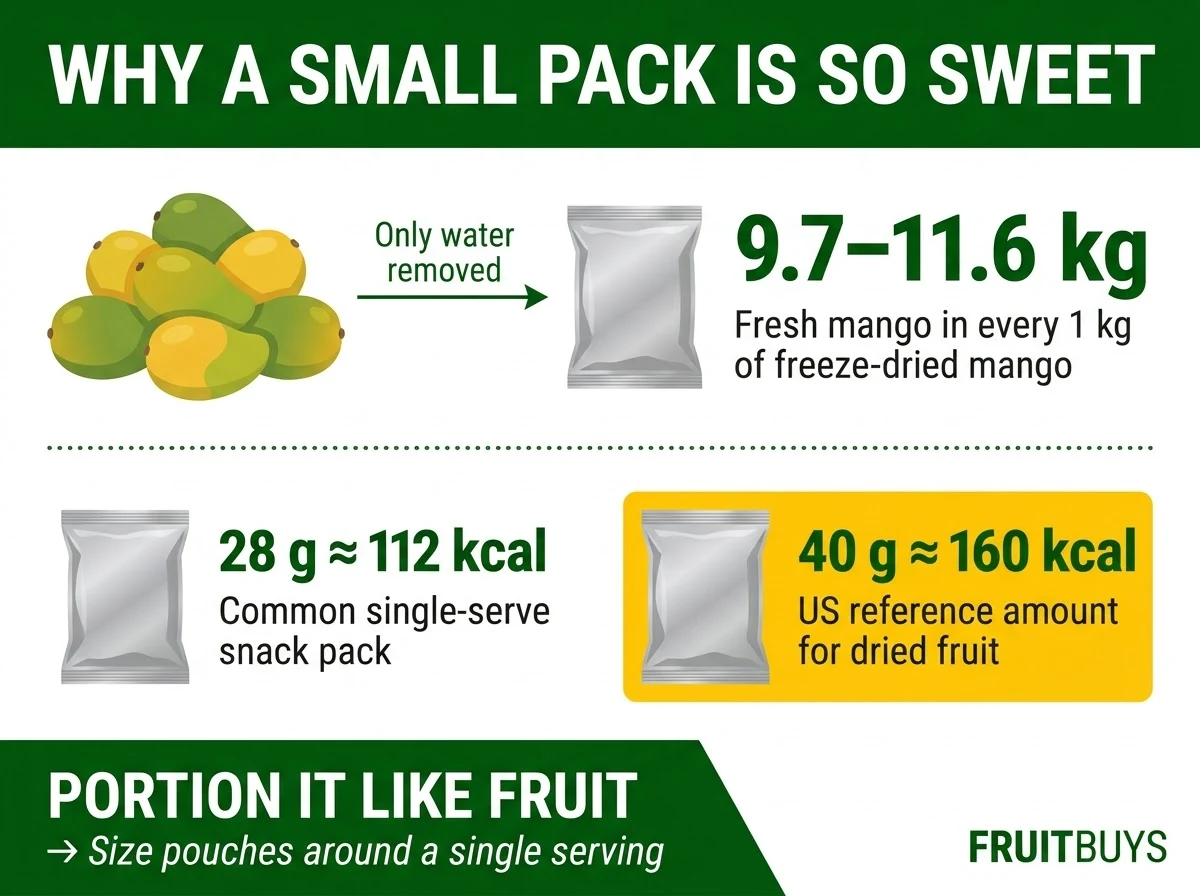
For a cereal, yogurt or snack brand the practical reading is simple: a light inclusion rate already carries real mango flavour and colour, so cost per retail unit stays low even though the ingredient is dense.
Is the sugar added?
No. All 59 g of sugars per 100 g are the fruit’s own, concentrated by drying. The ingredient line reads “mango” and nothing else, so the panel shows 0 g added sugars. In the mouth that reads as a clean, ripe tropical sweetness with a light tartness, without the sticky, syrupy finish of sugar-infused dried mango, which is why a 28 g pack gets finished in one sitting.
A sugar check belongs in every first sample review. Sugar-infused mango dries heavier and cheaper, and a sheet that shows a “100% fruit” claim next to sugars far above the fruit’s natural range deserves a full ingredient declaration before you go further.
What can you claim on your pack?
On the baseline values, freeze-dried mango supports these claims:
| Claim | EU / UK condition | Baseline per 100 g | US condition (per 40 g) | Baseline per 40 g |
|---|---|---|---|---|
| Fibre | Source of fibre: ≥3 g per 100 g | 5.6 g ✓ | Good source starts at 2.8 g (10% DV) | 2.2 g, 8% DV on the panel |
| Potassium | High: ≥600 mg (30% NRV) per 100 g | 634 mg ✓ | Good source starts at 470 mg (10% DV) | 254 mg, 5% DV on the panel |
| Added sugars | “No added sugars”, with “contains naturally occurring sugars” on pack | ✓ | 0 g added sugars on the panel; “no sugar added” wording has its own conditions | ✓ |
| Fat, sodium | Low fat, sodium-free | ✓ | Low fat, sodium-free | ✓ |
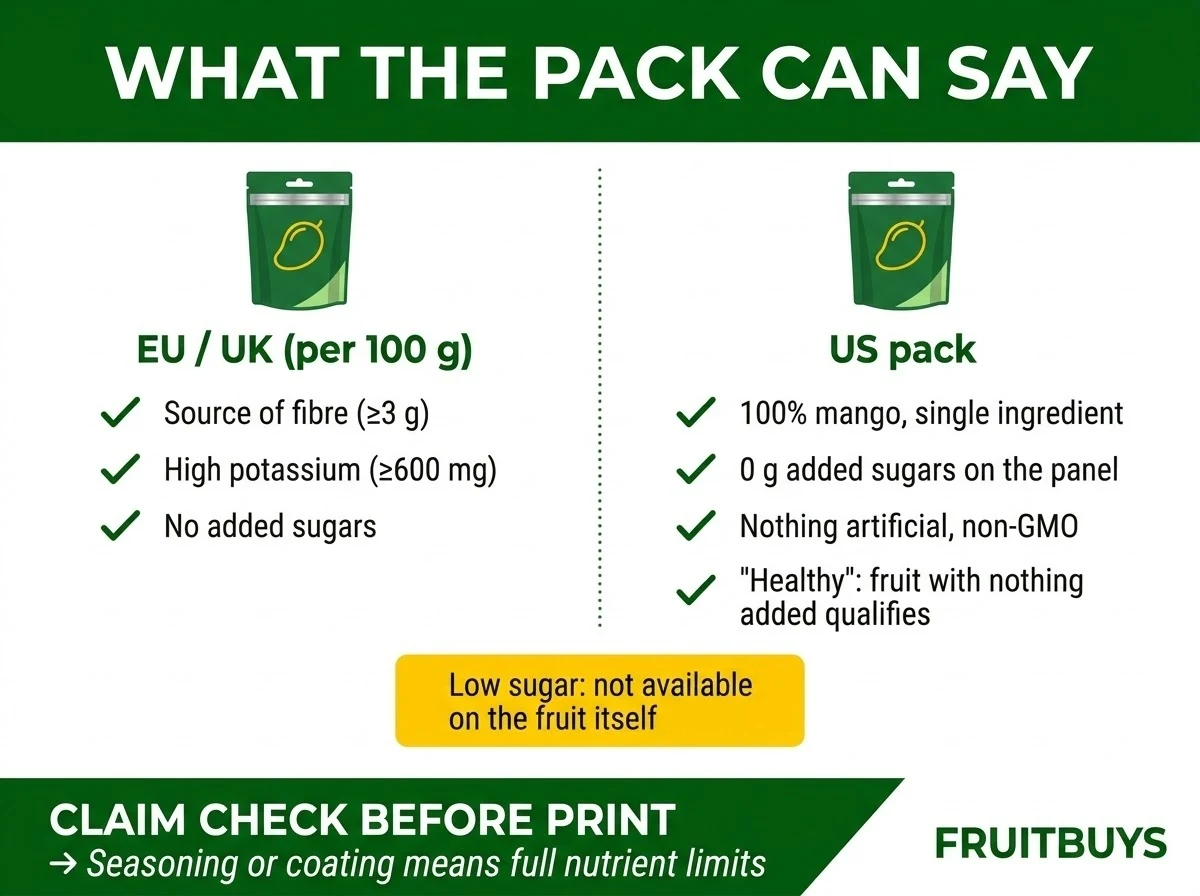
Read the table as two pack strategies for a naturally nutrient-dense fruit. On a per-100 g label (EU, UK, GCC) freeze-dried mango carries a high potassium and source of fibre story on the front. On a US pack the winning lines are the ones American shoppers scan for in the dried-fruit aisle: “100% mango”, “0 g added sugars”, single ingredient, nothing artificial and non-GMO, with fiber and potassium carried on the panel itself. In a granola, trail mix or yogurt cup, the mango adds those panel values on top of the oats, nuts or seeds without a single extra line on the ingredient list.
Can a US pack call freeze-dried mango “healthy”?
Yes. Under FDA’s updated “healthy” rule, fruit with nothing added qualifies automatically. The rule names fruit and vegetables with no added ingredients other than water as foods that meet the definition without further nutrient tests, and the fruit group includes dried fruit. Freeze-dried mango that reads “mango” on the ingredient list sits squarely inside it: no added sugar, no sodium, no saturated fat to check against limits.
For a US brand that is a front-of-pack word most dried-fruit snacks cannot use, because sugar-infused mango fails the added-sugar limit. Brands can already label to the updated definition, and it becomes the only one in use from February 2028, so artwork printed now stays valid. If you add anything to the mango, such as a seasoning or a coating, the product is judged on the full nutrient limits instead; FruitBuys checks the panel against them before you print.
Vitamins are where freeze-drying earns its place. Drying at low temperature under vacuum protects heat-sensitive vitamin C and the carotenoids that make mango orange far better than hot-air drying, which is why the pieces keep the deep yellow-orange of ripe fruit with no colour added. When your pack will print a vitamin C or vitamin A figure, FruitBuys adds both to the nutrition panel on your production lot, so the number on the pouch comes from the fruit inside it.
Does nutrition change between lots and varieties?
Slightly, and labels are built for exactly that. Nutrition panels for natural foods are checked against tolerance bands, not single decimals: in the US, naturally occurring nutrients such as fiber and potassium must reach at least 80% of the declared value, and calories, sugars and fat must stay within 120% of it; EU guidance sets comparable bands for natural foods. FruitBuys keeps lots close to the baseline by running Keo as the standard variety (Cát Chu on request, sweeter), holding one variety for the whole programme and releasing every lot to the same moisture standard.
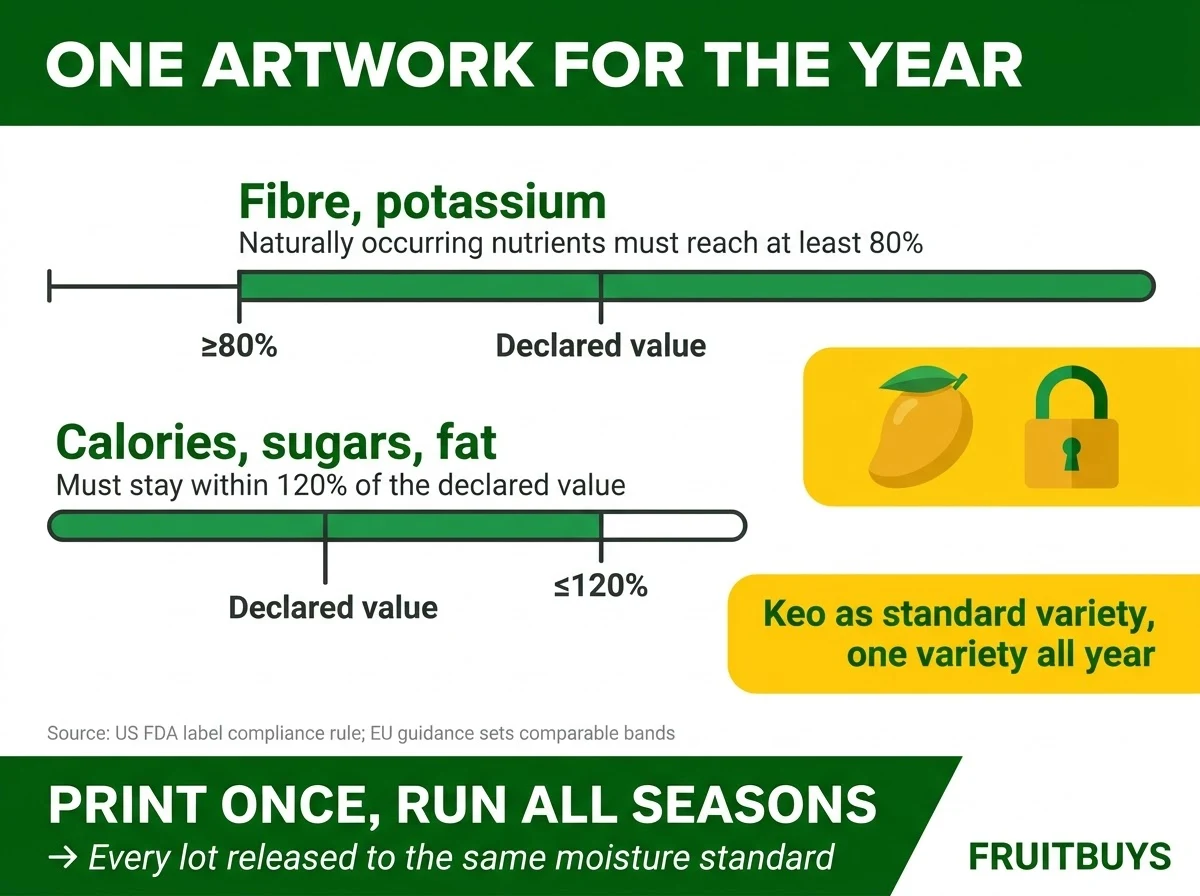
The commercial payoff is one artwork for the year. A private-label brand prints its pouches once, runs them across the seasons, and avoids re-ordering printing cylinders every time the harvest moves.
How do you get label-ready numbers for your product?
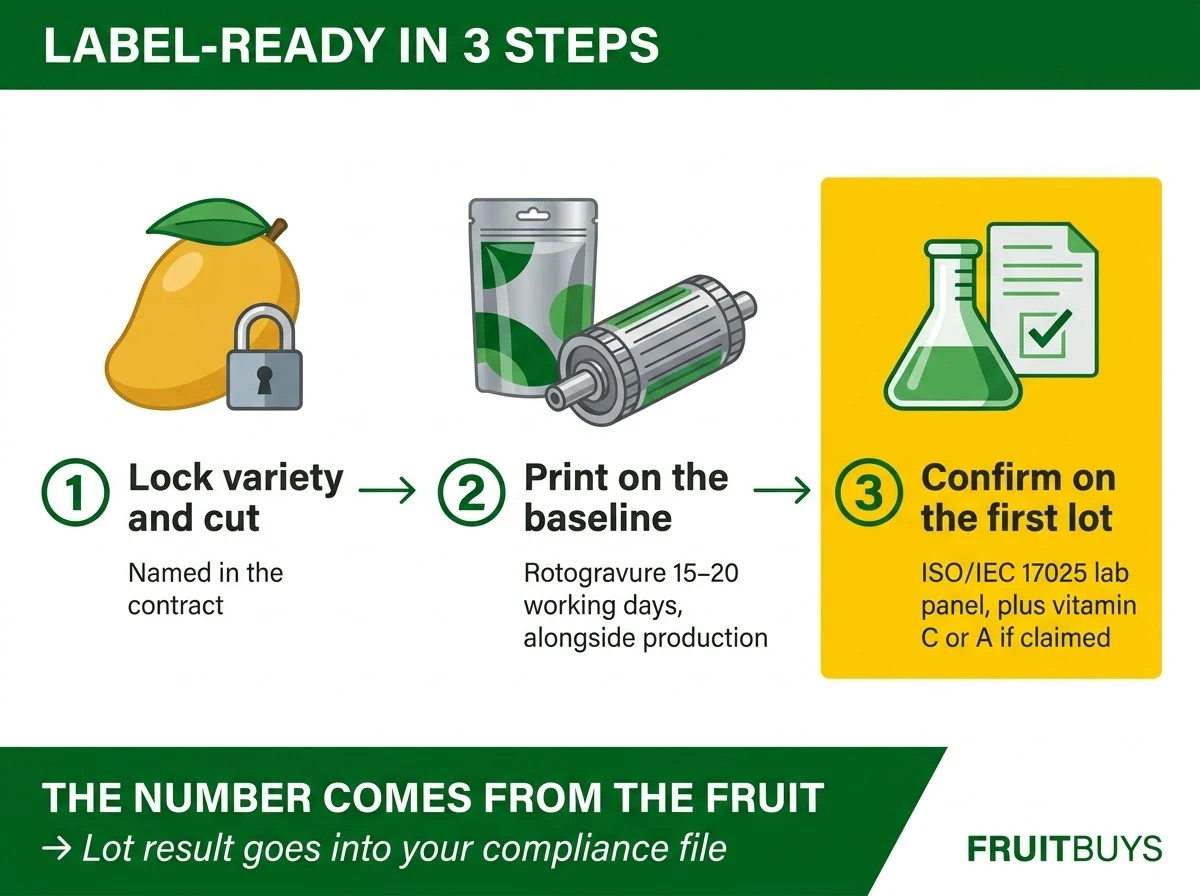
- Lock the variety and cut. The baseline describes 100% freeze-dried mango; name the variety in the contract so every lot stays close to it.
- Print on the baseline. Most programmes send artwork to print from the baseline while production is scheduled, so rotogravure pouches (15–20 working days) are ready when the lot is packed.
- Confirm on the first lot. FruitBuys arranges a nutrition panel at an independent ISO/IEC 17025 accredited laboratory on your commercial production, plus vitamin C or A if the pack claims them. The result confirms the printed figures and goes into your compliance file.
Private-label pouch sizes, print lead times and who owns the label are covered in private label freeze-dried mango.
Is freeze-dried mango good for you?
It is mango with the water taken out, so it carries the fruit’s own fibre, potassium and carotenoids with nothing added. The same concentration makes it energy-dense: 28 g holds about 112 kcal, close to a whole ripe fruit’s worth of sugars. Treated as a fruit snack and portioned like one, it fits a balanced diet the way fresh mango does. It is not a diet food and does not burn calories; on a pack, the honest and effective message is “100% mango, nothing added” with a sensible serving size, and FruitBuys helps brands size pouches around a 28 g or 40 g portion. Shopper questions about allergy, sulphite and blood sugar are answered in side effects of mango.
What if your pack needs a lower-sugar profile?
Freeze-dried mango is a naturally sugar-dense fruit, so a “low sugar” claim is not available on the fruit itself. Brands that want the mango taste at a lower sugar load per serving use it differently rather than replacing it: smaller dice dosed as an inclusion, so each serving carries a few grams of fruit instead of a whole snack portion, or freeze-dried mango powder blended into smoothies, yogurt or coatings at 5–12%. See freeze-dried mango powder or spray-dried and the freeze-dried mango powder product page. Which cut holds up in cereal, chocolate or yogurt is covered in choosing the right freeze-dried mango format.
Get the data pack for your label
Send your target market, serving size and the claims you want on pack, and we return the nutrition baseline formatted for your label template, a claim check against your market’s thresholds and the full specification. Product data is on the freeze-dried mango product page, the choice between freeze-dried and soft-dried mango is in freeze-dried or soft-dried mango, and the full sourcing picture is in the freeze-dried mango supplier guide.
[email protected] · WhatsApp Export +84 919 739 589
FAQ
How many calories are in freeze-dried mango?
401 kcal per 100 g, about 112 kcal in a 28 g pack and 160 kcal in 40 g.
Does freeze-dried mango have added sugar?
No. The 59 g of sugars per 100 g are naturally occurring, and the panel shows 0 g added sugars.
Is freeze-dried mango high in fiber?
It is a source of fibre on an EU or UK label at 5.6 g per 100 g. On a US panel a 40 g serving gives 2.2 g, or 8% DV.
Can I call it high in potassium?
On a per-100 g label, yes: 634 mg meets the EU and UK “high” condition of 600 mg. On a US panel a 40 g serving gives 254 mg, or 5% DV.
Can freeze-dried mango be labeled “healthy” in the US?
Yes. Under FDA’s updated rule, fruit with no added ingredients other than water qualifies automatically, and 100% freeze-dried mango meets that condition.
Is freeze-dried mango good for weight loss?
No food causes weight loss on its own. Freeze-dried mango is energy-dense, about 112 kcal per 28 g, with no added sugar or fat, so it fits a calorie-aware diet when eaten as a measured fruit portion.
Can I use these values on my label?
Yes. Most private-label programmes print from the baseline for the variety locked in the contract, and the nutrition panel on the first commercial lot confirms the figures for your compliance file.



