
OEM Freeze-Dried Mango: From Product Brief to Private Label Delivery
OEM freeze-dried mango fails when the buyer starts with the pouch before the product. A retail design can look ready while the mango format remains undefined, the Nutrition Facts basis remains unverified, the packaging barrier remains untested and the COA scope remains incomplete. Private label brands, importers and retail buyers need one controlled product file before artwork moves.
The pouch does not create the product, the locked specification creates the product that the pouch must protect and describe. FruitBuys supplies OEM freeze-dried mango through one configured route: format selection, sample approval, packaging direction, label inputs, COA review, lot documentation and export readiness. The buyer should approve the product first, then approve the pack that will carry it into market.
OEM Starts with the Product Specification
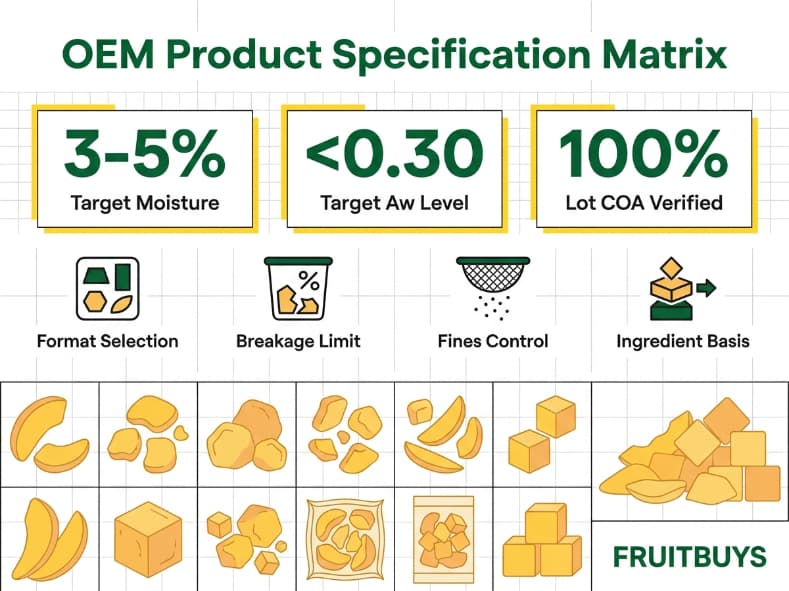
OEM freeze-dried mango starts with the product specification, not the artwork file.
The buyer must define format, size, moisture, Aw, breakage, fines, ingredient statement and application before retail-pack work begins.
Private label approval should move from product proof to packaging proof, then to label and bulk-release proof.
A private label project needs a product spine. Without that spine, every later decision bends. The buyer cannot build a reliable pouch if the mango format remains vague. “Mango slices” does not define thickness, broken-piece limit or visual grade. “Mango bites” does not define minimum piece size or fines. “Mango powder” does not define mesh, bulk density, caking risk or carrier status.
Use mango slices, cubes, bites and powder before starting OEM pack development. The selected format controls packaging, label language, application testing and bulk release.
The OEM product specification should include:
| Specification Field | Buyer Decision |
|---|---|
| Product name | Freeze-Dried Mango |
| Format | Slices, Cubes, Bites, Granules or Powder |
| Ingredient statement | Single ingredient or formula-based product |
| Size or mesh | Dimensions, sieve range or mesh |
| Breakage | Maximum acceptable broken-piece level |
| Fines | Definition and limit |
| Moisture | Target and lot COA value |
| Aw | Target and lot COA value |
| Sensory | Color, aroma, texture and foreign-odor limits |
| Packaging | Bulk bag, retail pouch or private label configuration |
| Documentation | COA, laboratory reports, certificate scope and label basis |
For FruitBuys, the current working technical targets are 3–5% moisture and Aw <0.30, subject to lot COA confirmation. These values must sit inside the release file, not inside a marketing sentence.
Define the Intended Consumer Application
OEM buyers should define where the product will work before they approve a sample. Retail snack, snack mix, cereal inclusion, chocolate inclusion, bakery ingredient, beverage premix and yogurt topping do not need the same mango format.
Use freeze-dried mango food applications before deciding the final SKU. A product that performs well as a snack may fail inside a chocolate coating or beverage system. A powder that works in bakery may settle in a drink. A bite that looks attractive in a sample pouch may produce excess fines during mixed snack filling.
Application definition should answer:
- Will the product be eaten directly?
- Will it enter another food system?
- Will it face mixing, coating, baking, hydration or freezing?
- Will the buyer need visible pieces or flavor dispersion?
- Will the product need a retail pouch, bulk bag or ingredient pack?
- Will the product need private label artwork?
- Will the destination market need a specific label format?
For OEM execution, application sets the brief. The brief sets the format. The format sets packaging. Packaging sets the shelf-life and label route. If the buyer changes the application later, the specification must return to review.
Packaging Configuration
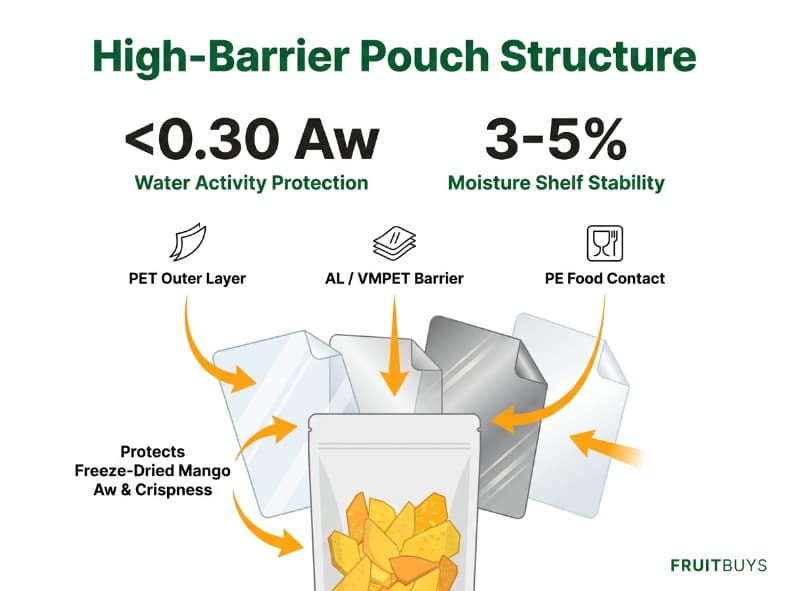
Private label packaging must protect the selected mango format, not only carry the brand design.
Slices need breakage protection, powder needs moisture and caking control, and bites need fines management.
Buyers should approve pouch structure and seal control before approving artwork.
Packaging protects the product after the COA result. Freeze-dried mango can absorb moisture because its dry porous structure exposes it to humidity. FDA explains that water activity relates to available water and microbial growth potential, which makes Aw a stability and safety-related control point, not a decoration value. (U.S. Food and Drug Administration)
Packaging approval should start from the mango format:
| Format | Packaging Priority |
|---|---|
| Slices | Breakage protection, pouch depth, carton support |
| Cubes | Dimensional stability, pack fill, fines control |
| Bites | Fragment control, seal clearance, retail appearance |
| Granules | Dust control, moisture barrier, tight closure |
| Powder | Moisture barrier, caking control, bulk density and flow |
Use moisture-barrier packaging for freeze-dried mango before selecting a private label pouch. The buyer should request packaging structure, food-contact support, seal method, seal integrity review, pack size, carton configuration and storage condition.
Food-contact packaging also enters the compliance file. FDA states that it regulates substances that come into contact with food, including packaging materials, cookware and containers that store food. The EU also requires food contact materials placed on its market to comply with Regulation (EC) No 1935/2004. (U.S. Food and Drug Administration)
A buyer who approves artwork before packaging performance has approved the skin before checking the bones. That sequence creates avoidable rework.
Label and Artwork Inputs
Private label artwork depends on product data. The buyer needs product identity, ingredient statement, net quantity, Nutrition Facts or nutrition declaration basis, storage statement, lot code location and destination language before final design.
FDA explains that nutrition information on the Nutrition Facts label usually appears based on one serving of food, and some containers may also need per-package information. Serving size and servings per container appear prominently on the label. (U.S. Food and Drug Administration) This matters when a private label buyer changes pack size from a sample pouch to a retail pouch.
The EU food information framework also controls mandatory food information and consumer-facing label requirements under Regulation (EU) No 1169/2011. Buyers should verify market-specific label needs before artwork approval. (U.S. Food and Drug Administration)
The label input file should include:
| Label Input | Buyer Control |
|---|---|
| Product name | Must match product identity |
| Ingredient statement | Must match formula |
| Format | Must match actual contents |
| Net quantity | Must match pack size |
| Serving basis | Must match destination rules |
| Nutrition data source | Laboratory, validated calculation or approved basis |
| Added-sugar status | Must match formula |
| Storage statement | Must match packaging and shelf-life basis |
| Lot code | Must match traceability system |
| Country or origin language | Must match destination requirement |
| Allergen and warning review | Market and formula dependent |
Use freeze-dried mango Nutrition Facts before sending artwork for final review. A sample label is not a universal label file. It can support discussion, but it cannot prove the final SKU unless the formula, format, pack size and destination market match.
Sample Development Path
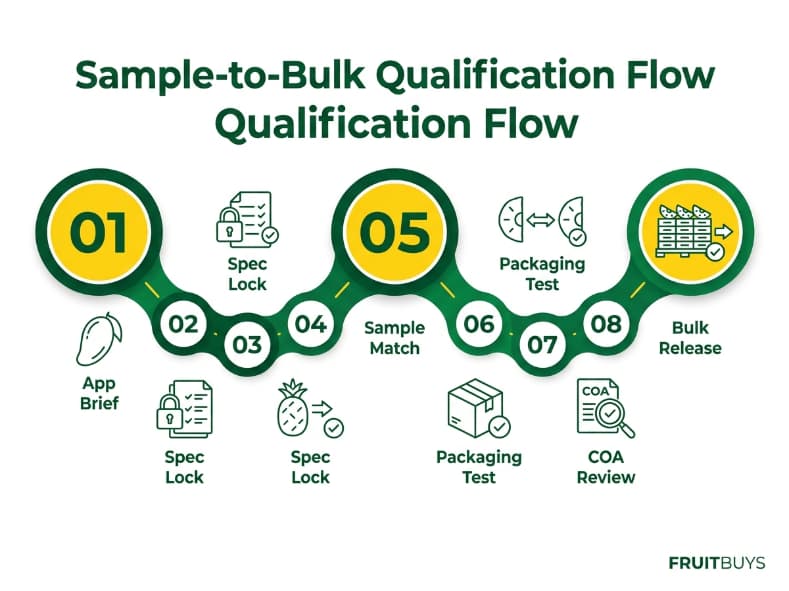
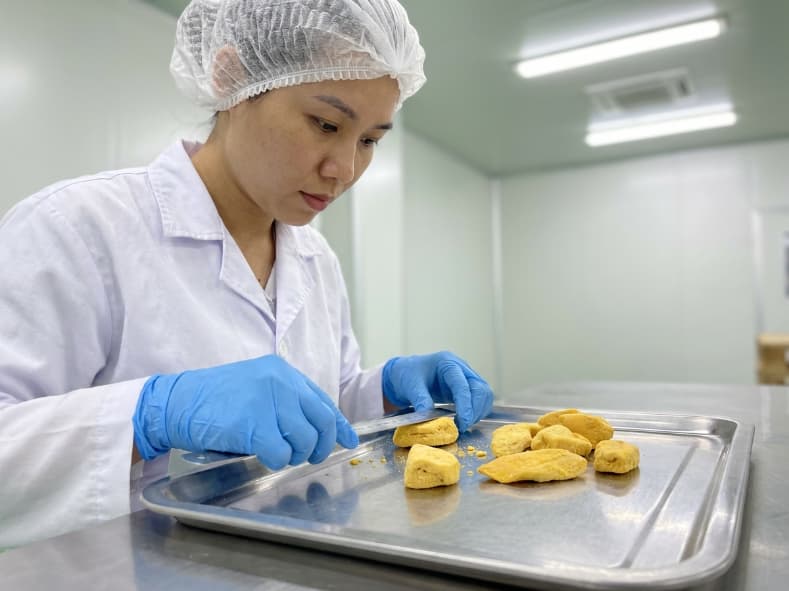
OEM sample development should create a controlled reference, not a pleasant tasting session. The buyer should approve the product sample, then approve the rules that decide whether bulk matches it.
A clean sample path looks like this:
- Buyer defines application.
- FruitBuys confirms feasible format route.
- Buyer receives product sample.
- Buyer tests sample in intended use.
- Buyer reviews size, texture, color, aroma and fines.
- Buyer confirms packaging direction.
- Buyer defines required documents.
- FruitBuys locks the approved sample criteria.
- Buyer confirms pre-bulk release requirements.
This path connects to sample-to-bulk consistency controls. A sample without measurable criteria leaves the bulk lot open to argument. A buyer cannot reject a lot for “not looking like the sample” if the approval file never defined size, breakage, fines or visual grade.
For private label, the sample file should also state whether the sample came in temporary sample packaging or the intended commercial pouch. A sample pouch may not protect the product like the final retail pouch. The buyer must not confuse sample presentation with commercial packaging validation.
COA and Laboratory Scope
OEM approval requires a lot-specific COA and laboratory scope that match the product, format and destination.
Certificate logos and historical reports cannot release a new commercial lot.
Buyers should define the required test panel before production, not after packing.
The COA confirms whether the lot meets release criteria. For freeze-dried mango, the buyer should review moisture, Aw, microbiology and any destination-required testing before commercial release.
Use freeze-dried mango COA requirements before approving the first private label shipment. A useful COA should identify the product, format, lot code, specification limit, actual result, method, test date and release status.
FDA’s FSVP rule requires U.S. importers to use written procedures to ensure they import food from approved foreign suppliers based on risk and supplier-performance evaluation, or from unapproved suppliers under adequate verification activities when appropriate. (U.S. Food and Drug Administration) That means the importer needs supplier and product evidence, not only a branded pouch.
COA review should not stand alone. The release file should connect:
- Approved specification
- Sample record
- Ingredient statement
- Packaging file
- COA
- Laboratory report
- Certificate scope where applicable
- Packing list
- Lot code
- Shipment document set
A private label brand that launches without this file builds a retail SKU on missing proof. That risk returns at the worst moment: buyer audit, border review, distributor onboarding or retail complaint.
Bulk Release for Private Label SKUs
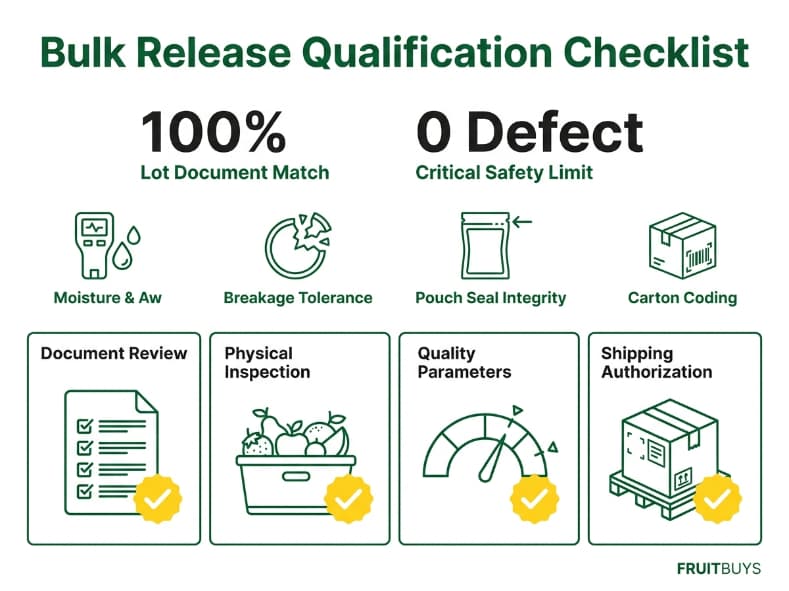
Private label bulk release requires two matches. The product must match the approved sample. The documents must match the product in the carton. If either match fails, the SKU should not move.
Bulk release should confirm:
| Release Item | Required Match |
|---|---|
| Product format | Matches approved sample |
| Piece size or mesh | Matches specification |
| Moisture | Matches COA limit |
| Aw | Matches COA limit |
| Breakage and fines | Matches buyer tolerance |
| Packaging | Matches approved pouch or bulk bag |
| Label | Matches product data and destination market |
| Lot code | Matches COA, packing list and carton labels |
| Carton configuration | Matches shipment file |
| Documents | Match current product and lot |
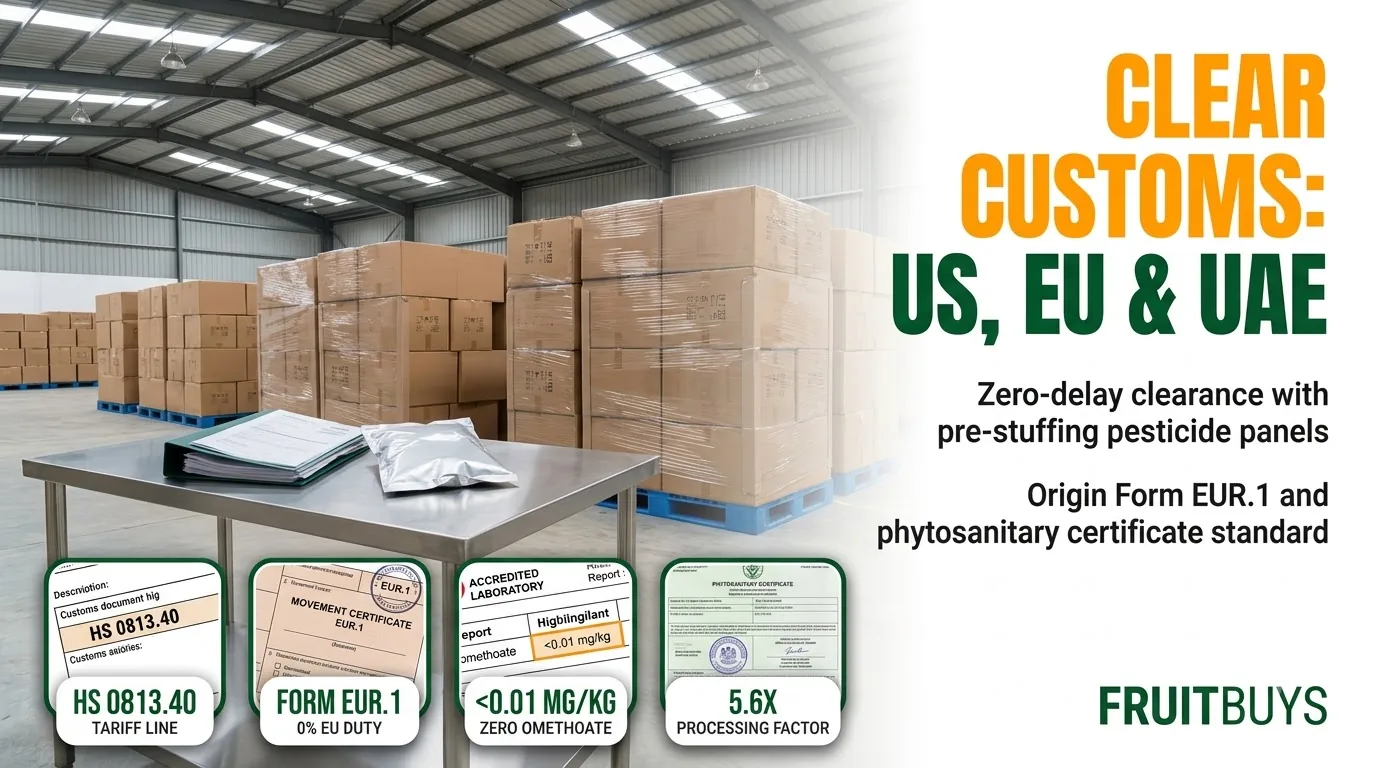
Use freeze-dried mango moisture and Aw when reviewing technical release values. Use market documentation for freeze-dried mango when the buyer needs destination-specific files.
Bulk release should produce one clear decision: accept, hold, conditional review, rework when technically valid, or reject. Vague approval language creates disputes. A retail buyer does not need a poetic explanation when a pouch contains too many fines. The buyer needs a defined tolerance and a release decision.
FruitBuys OEM/Private Label Delivery
FruitBuys supplies the private label product as one finished product route. FruitBuys does not hand the buyer a disconnected list of growers, processors, packaging contacts and logistics parties. The backend network remains behind one accountable supplied product.
FruitBuys controls or aligns:
- Application brief
- Format selection
- Sample criteria
- Specification
- Packaging direction
- Label inputs
- COA and laboratory file
- Certificate scope review where available
- Lot coding
- Case configuration
- Export readiness
This is the core point: private label buyers need one accountable supply relationship. They do not need to stitch together separate proof fragments after the order starts. FruitBuys brings product, packaging, documentation and release into one controlled route.
OEM Brief Buyers Must Submit
A good OEM brief reduces errors before they spread. A weak brief forces assumptions into the supply chain. Assumptions become sample mismatch, label correction, package rework and bulk release delays.
The buyer should submit:
| Brief Field | Required Detail |
|---|---|
| Buyer role | Importer, distributor, retail brand, food manufacturer |
| Destination market | Country and channel |
| Application | Snack, ingredient, powder, topping or private label SKU |
| Format | Slices, Cubes, Bites, Granules or Powder |
| Size requirement | Dimensions, sieve range or mesh |
| Pack type | Retail pouch, bulk bag or ingredient pack |
| Pack size | Required net content and case pack |
| Label language | Market-specific requirement |
| Ingredient statement | Single ingredient or formula route |
| Nutrition basis | Existing data, testing or calculation requirement |
| COA scope | Moisture, Aw, microbiology and other required panels |
| Documentation | Certificates, lab reports and market files |
| Sample criteria | Acceptance points before bulk |
| Release criteria | Conditions before shipment |
Use freeze-dried mango RFQ checklist to structure this brief. The buyer should submit the brief before asking for final sample approval. A proper brief compresses uncertainty before production.
Application Mapping
| Buyer Type | Application | Required Format | Proof Needed | FruitBuys Delivery |
|---|---|---|---|---|
| Private label brand | Retail snack pouch | Slices or controlled Bites | Product spec, pouch file, Nutrition Facts basis, COA and sample match | OEM / Private Label Delivery |
| Importer | Regional distribution | Bites, Slices or Powder | Specification, certificate scope, lot COA and packing file | Documentation and export readiness |
| Retail buyer | Shelf-ready SKU | Slices, Bites or Powder | Label inputs, barcode/coding plan, package protection and release file | Finished private label product route |
| Food manufacturer | Ingredient pack | Cubes, Granules or Powder | Application test, COA, microbiology and particle specification | Quality Control and Documentation |
| Beverage developer | Powder premix | Powder | Mesh, carrier status, moisture, Aw, caking and label basis | Product configuration and technical file |
| QA manager | Supplier and SKU approval | All formats | COA, lab reports, packaging file, certificate scope and traceability | Lot-based release control |
| Distributor | Mixed tropical fruit range | Bites or Slices | Format consistency, carton configuration and market documentation | Product supply plus export logistics coordination |
Why FruitBuys Delivers This
FruitBuys supplies OEM freeze-dried mango through one Integrated Product Supply Model. The buyer does not manage separate product, packaging, label and document threads. FruitBuys aligns them behind the supplied SKU.
The OEM/Private Label Delivery pillar covers product format, pouch direction, label inputs, coding, case packing and buyer approval. The Quality Control pillar covers dimensions, moisture, Aw, breakage, fines, sensory condition and release criteria. The Documentation pillar covers ingredient statement, COA, laboratory reports, certificate scope, nutrition basis, packing file and lot identity. The MOQ Flexibility/Market Trial Support pillar supports sample and market validation when the requested format and operating route allow it. The Export Logistics Coordination pillar aligns carton configuration, document handover and shipment readiness.
FruitBuys does not treat private label as printed packaging. FruitBuys supplies the product that the packaging must protect, describe and move.
Buyer Checklist
Before approving OEM freeze-dried mango, confirm:
- Intended market and channel
- Product application
- Selected format
- Dimensions, sieve or mesh
- Breakage and fines limits
- Ingredient statement
- Formula and carrier status where relevant
- Moisture and Aw targets
- Microbiology and laboratory scope
- Product-specific Nutrition Facts or label basis
- Pouch or bulk bag structure
- Food-contact packaging support
- Storage statement
- Shelf-life validation basis
- Artwork inputs
- Lot code plan
- Carton and case configuration
- COA and document release criteria
- Sample-to-bulk comparison method
Do not approve artwork before the product file can support it.
OEM Freeze-Dried Mango
OEM freeze-dried mango requires a locked product specification before packaging and artwork. Buyers should define format, size, breakage, fines, moisture, Aw, ingredient statement, pack type, label basis, COA scope and destination documents. Slices, Bites, Cubes, Granules and Powder require different packaging and proof.
FruitBuys supplies the configured private label product through Quality Control, Documentation, OEM / Private Label Delivery, Market Trial Support and Export Logistics Coordination under one accountable relationship.
FAQ
What does OEM freeze-dried mango require first?
It requires a product specification first. Format, size, moisture, Aw, breakage, fines, ingredient statement and application must be clear before artwork.
Can buyers start with pouch design?
No. Pouch design should follow product and packaging approval. Artwork cannot prove product format, barrier performance or label data.
Which format works for private label mango snacks?
Slices or controlled Bites usually fit snack pouches. The buyer must define piece size, breakage, fines, texture and packaging protection.
Does private label require product-specific Nutrition Facts?
Yes, when the SKU needs consumer-facing label support. The nutrition basis must match the formula, format, pack size and market.
Can one sample approve the bulk order?
No. The approved sample needs measurable bulk-release criteria, COA review, packaging match and lot documentation.
What should an OEM brief include?
It should include application, format, pack size, label market, ingredient statement, COA scope, packaging requirement and sample approval criteria.
What does FruitBuys supply in OEM delivery?
FruitBuys supplies the configured product, packaging direction, label inputs, documentation alignment, lot release review and export readiness.
Conclusion
OEM freeze-dried mango starts with product control. The buyer must lock the mango format, application, moisture, Aw, breakage, fines, ingredient statement, packaging file, Nutrition Facts basis and lot documentation before treating a private label SKU as ready. Artwork without those controls creates motion, not readiness.
Submit the private label brief after locking the mango format, pouch configuration and documentation scope.
References
- U.S. Food and Drug Administration. What’s on the Nutrition Facts Label. (U.S. Food and Drug Administration)
- U.S. Food and Drug Administration. Serving Size on the Nutrition Facts Label. (U.S. Food and Drug Administration)
- U.S. Food and Drug Administration. FSMA Final Rule on Foreign Supplier Verification Programs for Importers of Food for Humans and Animals. (U.S. Food and Drug Administration)
- U.S. Food and Drug Administration. Guidance for Industry: Foreign Supplier Verification Programs for Importers of Food for Humans and Animals. (U.S. Food and Drug Administration)
- U.S. Food and Drug Administration. Food Ingredients & Packaging. (U.S. Food and Drug Administration)
- European Commission. Food Contact Materials. (U.S. Food and Drug Administration)