
Which HS Code Applies to Freeze-Dried Mango, and What Else Can Hold Your Shipment?
Freeze-dried mango is single-ingredient mango (Mangifera indica L.) from the freeze-dried fruit range, dried under vacuum with nothing added, and imported as an ingredient or a retail snack into the US, EU, UK and Gulf markets.
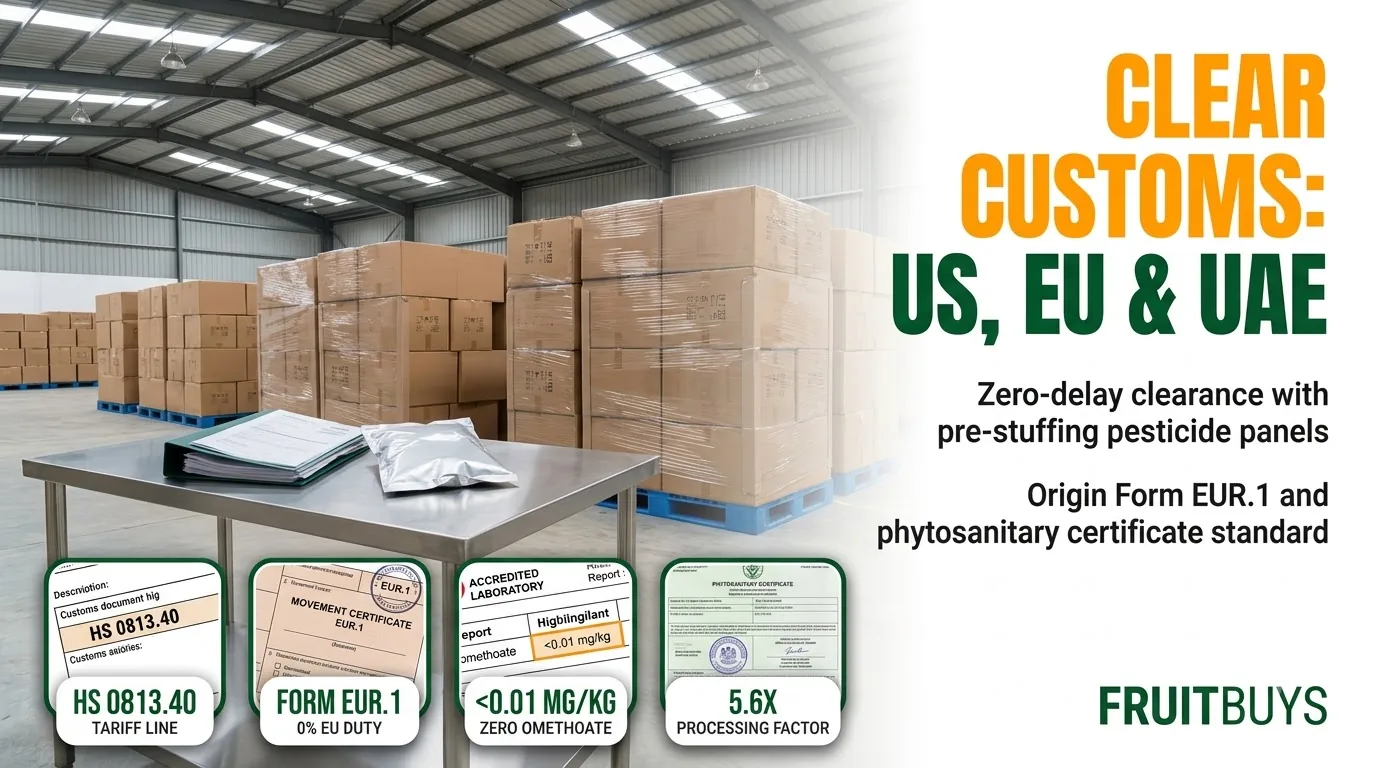
Containers are rarely held because the product is unsafe. They are held because the paperwork describes a different product from the one in the box. For 100% freeze-dried mango pieces with nothing added, the international HS direction is 0804.50 (“guavas, mangoes and mangosteens, fresh or dried”). Search the web and you will also find 0813 and 2008 quoted for the same product, and Vietnamese export records show dried mango shipped under 0813.50. That disagreement is exactly what triggers holds. Lock the product description first, then the code, then make sure the COA, label and invoice all say the same thing.
Is freeze-dried mango 0804.50, 0813 or 2008?
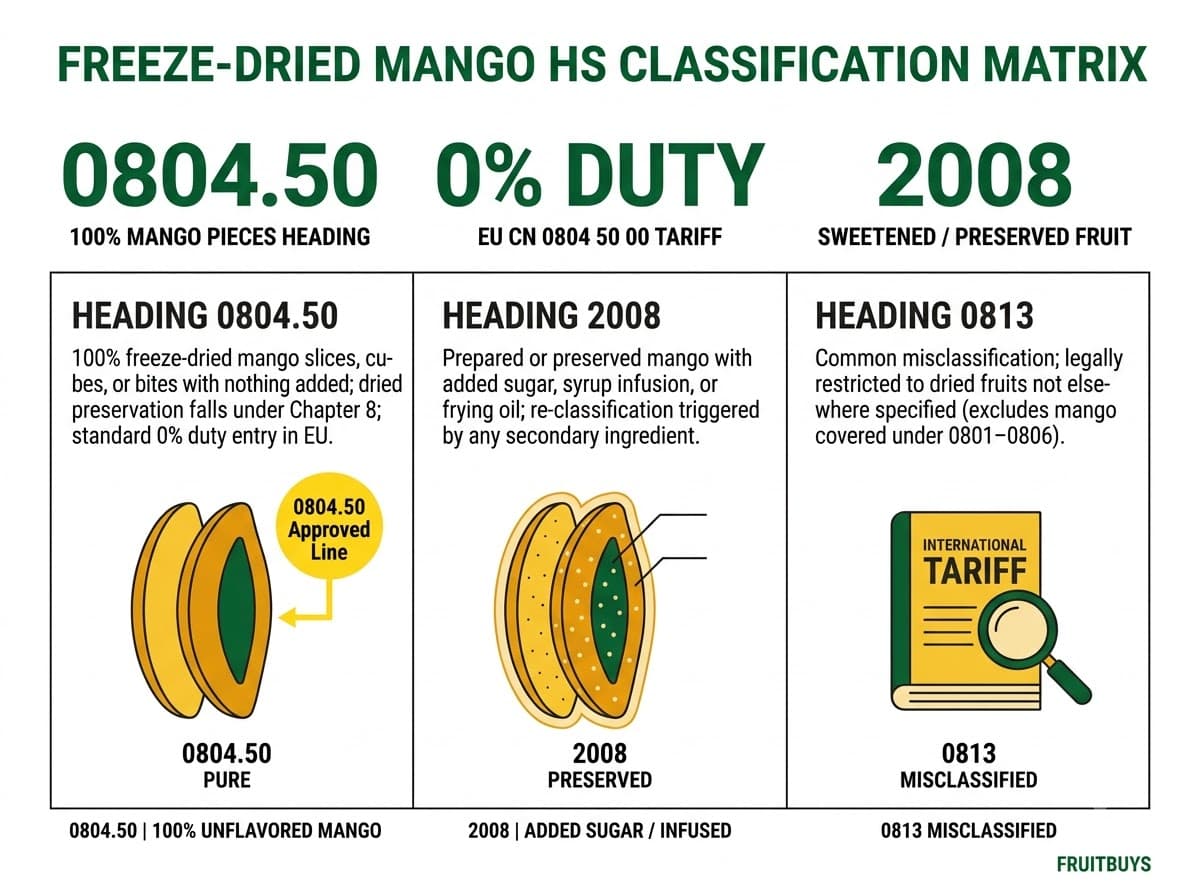
0804.50 when it is 100% mango with nothing added; 2008 once sugar, oil or other ingredients go in; 0813 is a common misclassification for plain dried mango. Freeze-drying does not move the product out of Chapter 8: drying is a preservation method, and heading 0804 covers mangoes “fresh or dried”.
| What is in the bag | HS direction | When to re-check |
|---|---|---|
| Freeze-dried mango slices, cubes or bites, 100% mango | 0804.50 | Any carrier, anti-caking agent or coating |
| Sugar-infused, syrup-dipped or flavored mango | 2008 (prepared or preserved fruit) | Always confirm with a broker |
| Dried mango declared under 0813 | Common in practice, but 0813 is for dried fruit not covered by 0801–0806 | Expect questions if the description says “mango” |
| Freeze-dried mango powder | Separate product; do not copy the pieces code | Classify on its own file |
The rule we apply: the HS code is a conclusion, not a starting point. Write down form, ingredients, processing, pack type and intended use first. If the description changes, for example sugar is added for a new customer, the code changes with it.
Which 10-digit code do I declare in the US, EU and Gulf, and what duty will I pay?
Start from 0804.50, then have your customs broker confirm the full national code and every duty and fee before you price the contract; for the EU, the duty is zero. Duty is the importer’s responsibility, and it changes more often than product specifications do.
- Get the national code in writing. The US uses a 10-digit line, the EU and UK an 8- to 10-digit line, and Gulf states their own extended codes. Different databases quote different suffixes for the same product. Only your broker, working from the current official tariff, should give you the line you file.
- Do not copy the exporter’s code. The most common error is re-using the code on the supplier’s export declaration instead of the importing country’s own line.
- Ask about additional duties and exemptions. Some markets add duties by country of origin, with exemptions that depend on the exact tariff line. Ask your broker to confirm, in writing, the total duty and fees for your line and origin at the date of import.
- EU: dried mango enters duty-free. CN 0804 50 00 carries 0% duty, and 0% under the EU–Vietnam trade agreement. For an EU buyer of freeze-dried mango from Vietnam, import duty is not a cost line, and a delayed origin certificate cannot cost you duty on this line. Your broker or buyer’s system may still ask for one, so ship it anyway.
- Everywhere else, ask about origin documents. Depending on the line and the trade agreement, a preferential origin certificate may or may not reduce duty. Confirm before shipment rather than at arrival.
What data on the COA prevents a hold?
Sulphite, pesticide residues and mycotoxins are the three results that most often decide whether a dried-fruit shipment is detained, so each needs a number, a method and a lot code. Moisture and water activity belong on the same COA, the limits and methods to lock are set out in our freeze-dried mango specification guide.
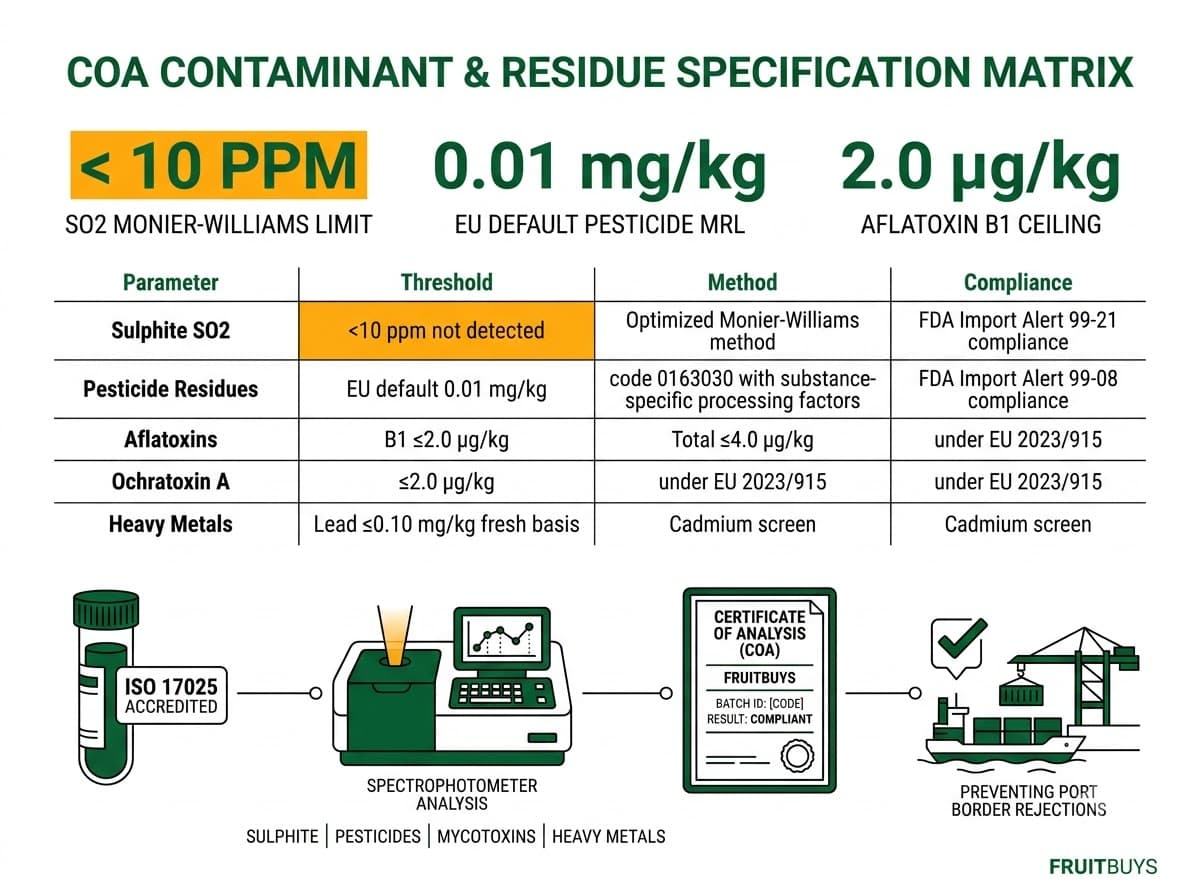
Sulphite. Undeclared sulphite is the most frequent reason dried mango is rejected at EU borders. In the US, FDA Import Alert 99-21 allows detention without physical examination of foods containing undeclared sulfiting agents above 10 ppm. A “no preservatives” statement is not a test result. Ask for SO₂ below 10 ppm by the Optimized Monier-Williams method on the lot COA.
Pesticide residues. In the EU, any pesticide without a specific limit on mango defaults to 0.01 mg/kg. Mango limits are set on the fresh fruit (EU code 0163030), and for dried products the EU applies processing factors active substance by active substance; there is no single “dried fruit multiplier”. Ask for a multi-residue screen reported against the destination’s limits, with the limit of quantification stated. In the US, FDA Import Alert 99-08 covers detention of processed foods for pesticide residues, and a supplier’s history counts.
Mycotoxins. For dried fruit sold directly to consumers in the EU, aflatoxin limits start at 2.0 µg/kg for B1 and 4.0 µg/kg total, and ochratoxin A is limited to 2.0 µg/kg for dried fruit other than raisins and figs (EU Regulation 2023/915, which replaced 1881/2006). Mango is not a high-risk crop for these toxins, but retail buyers routinely ask for the results.
Heavy metals. EU lead limits are set on fresh fruit (0.10 mg/kg) and apply to dried products after allowing for drying. Ask for lead and cadmium results, and let your regulatory adviser apply the drying factor.
Can I use fresh-mango nutrition data on my label?
No. Fresh-mango values understate a freeze-dried product about sixfold, and a label built on the wrong basis has to be reprinted. Fresh mango provides about 60 kcal per 100 g. Scaling by solids gives roughly 349 kcal per 100 g at about 4% moisture, but that is an estimate. The label must come from an analysis of your SKU, rounded under 21 CFR 101.9 in the US or Regulation 1169/2011 in the EU.
Two points that save rework:
- Added sugars. In the US, the natural sugar in single-ingredient dried fruit is not counted as added sugar. The label can show 0 g added sugars if the product really is 100% mango. Ask for a formula declaration and an added-sugars line on the COA to back it.
- Product name. Codex uses “freeze dried” in the product name. “Dried mango” alone describes a different, chewy product and invites questions.
What else, besides the HS code, gets a container held?
Documents that do not match each other. The EU’s annual control report found documentary and certification problems to be the largest group among more than 14,000 border rejections. In the US, a mismatch between the declared weight, value and commodity can trigger an examination. The practical checks:
- One product identity everywhere. Invoice, packing list, COA, label and HS code describe the same form and ingredients.
- Lot codes match. The lot on the COA is the lot on the cartons and the packing list.
- Weights match. Net and gross weights on the packing list reconcile with the stuffing plan.
- Wooden pallets are stamped. Pallets need the ISPM 15 treatment mark; an unmarked pallet can hold a compliant cargo.
- Market filings are in place. US shipments need FDA Prior Notice before arrival and an importer with an FSVP file; EU consignments subject to border checks are notified through TRACES NT.
- Gulf labeling and shelf life. Bilingual Arabic-English labels under GSO 9, and a declared shelf life consistent with GSO 150-1. A missing Arabic label is a common reason for holds at Gulf ports.
- Halal certification for Gulf buyers who require it, from a body recognized in the destination country.
What does a hold cost?
Cost of a hold = days held × (storage + demurrage per day) + relabeling or retesting cost + the value of sales missed while the goods wait. A 10-day hold for a missing sulphite result costs ten days of port charges plus a retest, and if the result then shows sulphite above 10 ppm, the cost becomes relabeling or re-export. Every item on the checklist below is cheaper than one day of that.
Checklist before the container is sealed
- HS code confirmed in writing by your broker for the exact product description
- National tariff line, total duties and fees confirmed in writing by your broker for your origin and import date
- Lot COA with moisture and water activity, microbiology, SO₂ <10 ppm, pesticide screen against destination limits, aflatoxin and ochratoxin A, lead and cadmium
- Nutrition label from SKU analysis, with 0 g added sugars backed by a formula declaration
- Invoice, packing list, COA and label reviewed side by side for identical product name, lot and weights
- ISPM 15 marks on wooden pallets
- US: FDA Prior Notice and FSVP file ready. EU: TRACES NT notification where required

Where this guide does not fit
If your mango has sugar, oil, flavor or a carrier added, most of this page no longer applies: the HS code, the added-sugar statement and the label all change. Treat it as a different product and classify it from scratch. The same applies to freeze-dried mango powder. And none of this replaces a binding ruling: if the classification matters to your margin, apply for one. For the product decisions that come before classification, see our freeze-dried mango buyer’s guide.
FAQ
Should I get a binding tariff ruling?
If you import regularly or the classification affects your duty, yes. A US CBP ruling or an EU Binding Tariff Information decision removes the argument at the border.
Does freeze-dried mango need a phytosanitary certificate?
It depends on the destination’s rules for processed plant products. Many markets do not require one for dried fruit; some do. Ask your broker before shipment, not after arrival.
Talk to us about your import file
Preparing an import filing, or reviewing a supplier’s documents? Send us your draft commercial invoice, packing list and COA. FruitBuys will check them for HS consistency, contaminant results and lot alignment before your container leaves port, and flag the questions to put to your customs broker. You can reach our team from the freeze-dried mango product page.
Sources & Technical References
- World Customs Organization: “HS Nomenclature, Chapter 8: Edible fruit and nuts”: heading 0804 covers mangoes, fresh or dried. (https://www.wcoomd.org/en/topics/nomenclature/instrument-and-tools/hs-nomenclature-2022-edition/hs-nomenclature-2022-edition.aspx)
- U.S. Food and Drug Administration: “Import Alert 99-21: Detention Without Physical Examination of Food Products Containing Undeclared Added Sulfiting Agents”. (https://www.accessdata.fda.gov/cms_ia/importalert_265.html)
- U.S. Code of Federal Regulations: “21 CFR 101.100 Food; exemptions from labeling”: sulphites at 10 ppm or more must be declared. (https://www.ecfr.gov/current/title-21/chapter-I/subchapter-B/part-101/subpart-G/section-101.100)
- CBI (Netherlands Ministry of Foreign Affairs): “Entering the European market for dried mango”: sulphite as the main reason for EU border rejections of dried mango. (https://www.cbi.eu/market-information/processed-fruit-vegetables-edible-nuts/dried-mango/market-entry)
- European Union: “Regulation (EC) No 396/2005 on maximum residue levels of pesticides”: default limit of 0.01 mg/kg; processing factors for processed products. (https://eur-lex.europa.eu/eli/reg/2005/396/oj/eng)
- European Union: “Commission Regulation (EU) 2023/915 on maximum levels for certain contaminants in food”: aflatoxin, ochratoxin A and lead limits. (https://eur-lex.europa.eu/eli/reg/2023/915/oj/eng)
- U.S. Department of Agriculture: “FoodData Central, Mangos, raw (FDC 169910)”: 60 kcal per 100 g fresh mango. (https://fdc.nal.usda.gov/food-details/169910/nutrients)
- Food Safety News: “EU publishes annual report on food trade platform” (November 2025): documentary and certification problems as the largest group of border rejections. (https://www.foodsafetynews.com/2025/11/eu-publishes-annual-report-on-food-trade-platform/)
- European Commission: “TARIC”: CN 0804 50 00 third-country duty 0% and EU–Vietnam preferential duty 0%. (https://ec.europa.eu/taxation_customs/dds2/taric/taric_consultation.jsp)
Basis note: the 349 kcal figure is a calculation from fresh values and 96% solids, not a label value. The 0813.50 export-record observation comes from commercial shipment data. Apart from the EU duty rate, tariff lines, duties and fees are for the importer and its customs broker to confirm; contaminant limits must be re-checked at the time of shipment.