Mango Freeze-Drying Process: From Frozen Flesh to Crisp Product
Mango freeze-drying can produce a light, crisp, porous fruit product, but the process name does not approve the lot. A buyer still needs to know which mango entered production, how it was cut, how the drying endpoint was controlled, how pieces were sorted, how moisture and Aw were tested, and how the finished goods were packed. Importers, QA managers, R&D teams and private label buyers should not treat “freeze-dried” as a shortcut for quality.
The process only protects the buyer when FruitBuys connects raw material, drying control, sorting, COA, packaging and bulk release into one approved specification. If the buyer skips those controls, a sample can look correct while the bulk lot carries different texture, breakage, fines, moisture drift or documentation gaps.
What Freeze-Drying Does to Mango
Freeze-drying removes water from frozen mango under vacuum through sublimation and later drying control.
The process can protect a porous, crisp structure, but it does not automatically prove lot quality or food safety.
Buyers should review raw material, cut size, drying endpoint, COA and packaging before approving bulk supply.

Freeze-drying, also called lyophilization, normally includes freezing, primary drying and secondary drying. A technical review of freeze-drying describes those three steps and identifies primary drying as a critical stage in the process. (ScienceDirect)
For mango, this process matters because fruit contains high water and delicate cellular structure. Freezing turns product water into ice. Under vacuum and controlled heat input, ice changes directly into vapor during primary drying. Secondary drying reduces remaining bound water to help the product reach the target dry condition.
This article sits inside the broader freeze-dried mango supplier Vietnam qualification path. It does not replace COA review. It explains which process points the buyer should verify before accepting a sample, private label SKU or bulk lot.
A buyer should treat freeze-drying as a controlled route, not a magic word. The final product still depends on raw mango maturity, flesh firmness, cut geometry, tray loading, drying endpoint, sorting discipline and packaging protection.
Raw Material Preparation Before Freezing
Freeze-dried mango quality starts before the mango enters the freeze dryer. The process cannot correct weak raw material. Under-ripe fruit may lack aroma and color. Overripe fruit may smear during cutting, create more fragments and increase sorting loss. Bruised or defective flesh can create off-color pieces and weak sensory results.
Raw material preparation normally includes:
| Step | Buyer Control Point |
|---|---|
| Mango selection | Variety direction, maturity, firmness and defects |
| Washing and preparation | Hygiene and foreign matter control |
| Peeling and seed removal | Edible flesh recovery |
| Trimming | Removal of damaged or unsuitable flesh |
| Cutting | Format and thickness control |
| Tray loading | Uniform exposure and handling discipline |
| Pre-freezing | Product condition before vacuum drying |

Use mango variety and maturity controls before approving the process route. A buyer who skips raw material criteria cannot blame only the dryer when bulk color, texture or conversion changes.
FruitBuys should connect raw mango intake to the final lot code. That link supports Raw Material Sourcing Governance and Documentation. The buyer needs traceability from incoming fruit to finished lot, not a generic statement that mango was selected.
How Cutting and Thickness Affect the Drying Route
Cutting converts raw mango into the format the buyer will approve. This stage controls more than appearance. Slice thickness, cube size and bite geometry affect drying behavior, breakage risk, texture, sorting output and final application performance.
A published study comparing drying methods for mango slices tested different slice thicknesses and included vacuum-freeze drying among the methods reviewed. The study examined mango slices at 3, 5, 7 and 10 mm, which shows that thickness matters in drying trials. It does not establish one universal commercial thickness for FruitBuys mango. (PMC)
For buyer specification, the practical lesson is direct: do not approve “slices” without dimensions.
| Format | Process Sensitivity | Buyer Specification |
|---|---|---|
| Slices | Thickness affects drying endpoint and breakage | Length, width, thickness, intact-piece level |
| Cubes | Size tolerance affects dosing and texture | Cube size and allowable variation |
| Bites | Mixed pieces need minimum size control | Min/max piece size and fines limit |
| Granules | Particle distribution affects application | Sieve range and dust limit |
| Powder | Grinding changes flow and caking risk | Mesh, bulk density and carrier status |

Use mango slices, cubes, bites and powder before approving the cutting standard. A format name without dimensions creates a weak sample approval file.
Freezing, Primary Drying and Secondary Drying
Freeze-drying control depends on freezing condition, heat input, chamber pressure and drying endpoint.
These process points affect final moisture, texture and consistency, but buyers still need lot testing.
The release file should connect process control to moisture, Aw, COA and sample-to-bulk review.
Freezing sets the product structure before water removal. Primary drying removes ice through sublimation under vacuum. Secondary drying reduces remaining bound water. A review of freeze-drying notes that primary drying input parameters such as shelf temperature and chamber pressure affect output parameters including product temperature and sublimation rate. (ScienceDirect)

For freeze-dried mango, the buyer does not need secret machine settings. The buyer needs release criteria that prove the process reached the intended product condition. Those criteria include moisture, Aw, sensory condition, breakage, fines and lot identity.
The current working targets for FruitBuys freeze-dried mango are:
| Technical Control | Target |
|---|---|
| Moisture | 3–5% |
| Aw | <0.30 |
| Format | Cubes, Bites, Slices or Powder |
| Release proof | Lot COA and specification match |
These values need COA confirmation. Use freeze-dried mango moisture and Aw when reviewing the technical release logic. A buyer should not request full process parameters unless their QA system requires them. The stronger commercial request is this: define the endpoint, test method and release rule.
Why Freeze-Drying Is Not a Sterilization Step
Freeze-drying removes water. It does not automatically sterilize food. Low moisture and low Aw can limit microbial growth, but they do not prove pathogens are absent. That distinction matters when freeze-dried mango enters ready-to-eat snacks, cereal, chocolate, dairy toppings, beverage mixes or private label retail packs.
FDA explains that water activity relates to the amount of water available for microbial growth. (U.S. Food and Drug Administration) FDA guidance on low-water-activity ingredients also states that Salmonella can become more heat resistant as water activity decreases in certain dry foods. (U.S. Food and Drug Administration)
That does not mean freeze-dried mango carries that specific issue. It means the buyer should not use low Aw as a replacement for hazard analysis, sanitation control or microbiology testing.
The buyer should separate:
- Drying endpoint
- Moisture result
- Aw result
- Microbiology panel
- Post-drying handling control
- Packaging control
- Lot COA
- Laboratory report

Use freeze-dried mango COA requirements before approving the product for commercial release. A process claim without lot proof leaves the buyer exposed.
Post-Drying Sorting, Grading and Fines Management
After freeze-drying, mango becomes fragile. The product must move through unloading, sorting, grading and packing without losing the approved format. This stage can create the visible difference between a strong sample and a weak bulk lot.
Sorting should classify:
| Output Grade | Buyer Use |
|---|---|
| Uniform slices | Retail snack, garnish, visual applications |
| Controlled bites | Snack pouch, fruit mix, ingredient use |
| Cubes | Cereal, toppings, controlled dosing |
| Granules | Toppings, chocolate, bakery decoration |
| Powder or fines | Beverage, bakery, flavor systems where approved |
| Rejects | Material outside specification |
Codex’s General Standard for Dried Fruits recognizes freeze-dried naming and sets general quality expectations for dried fruits, including characteristic color, flavor, odor and texture, while requiring products to remain practically free from visible foreign matter and moldy fruit. (FAOHome) This does not define FruitBuys’ format grades, but it supports the need for visible quality control and defect review.
The uploaded mango images align more closely with irregular pieces or Bites than with strict uniform Slices. That is not a problem if the buyer approves the grade honestly. It becomes a problem when a supplier uses the same photo for a higher visual grade without a breakage and fines limit.
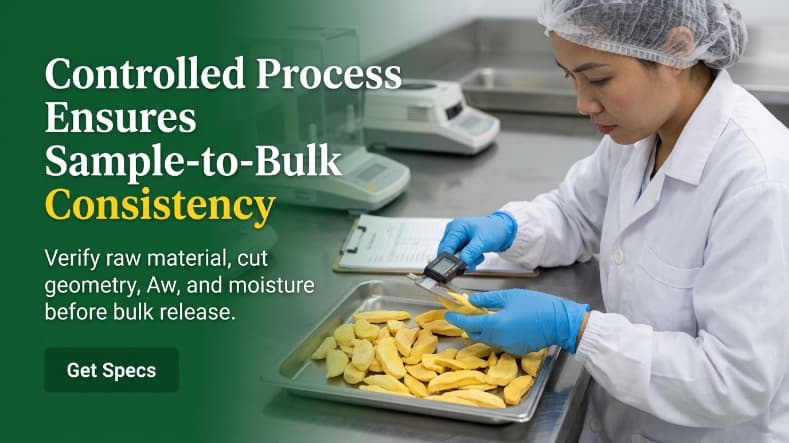
Sorting and grading must connect to sample-to-bulk consistency controls. The buyer should approve not only the sample but also the acceptable distribution of pieces, fragments and fines in the commercial lot.
Process Records Required for Bulk Approval
A process record should connect raw mango, cut format, drying batch, sorted grade, COA and packed lot.
Without that chain, the buyer cannot prove that the bulk lot matches the approved sample.
FruitBuys should release bulk only after the process file and lot documents align.
A process record does not need to expose every factory parameter. It must show the buyer that the product route stayed controlled from raw material to packed goods.
A practical process file should include:
| Record | Buyer Purpose |
|---|---|
| Raw material lot | Links origin and intake control |
| Variety or commercial type | Supports raw material direction |
| Maturity or intake criteria | Supports consistency |
| Cut format | Connects to sample and application |
| Tray-loaded quantity | Supports yield and batch review |
| Drying batch identity | Links process to finished lot |
| Sorting output | Shows grade recovery and fines |
| Moisture result | Confirms dry endpoint |
| Aw result | Confirms available-water control |
| Microbiology result | Supports release review |
| Packing file | Connects product to shipment |
| Lot code | Links all documents |

This is where fresh-to-freeze-dried mango conversion ratio also matters. Conversion should come from batch records, not memory or general ratios. The buyer should know whether the yield basis starts from whole fruit, peeled flesh, tray-loaded flesh or approved finished grade.
A release file should connect the process record to the COA, not let them live in separate folders.
Process Risks by Product Format
Freeze-drying process risk changes by format. A buyer ordering powder faces a different control problem from a buyer ordering retail slices.
| Format | Process Risk | Release Control |
|---|---|---|
| Slices | Uneven thickness, breakage, weak visual grade | Dimensional spec, breakage limit, moisture and Aw |
| Cubes | Uneven cube size, fragments | Size tolerance, fines, COA |
| Bites | Undefined minimum size, mixed fragments | Piece-size range, fines limit, sample match |
| Granules | Dust and distribution issues | Sieve range, moisture, bulk behavior |
| Powder | Caking, poor flow, wrong mesh | Mesh, bulk density, Aw, packaging |
The buyer should approve format before process scale-up. If the buyer changes from Bites to Slices, the process route changes. If the buyer changes from pieces to Powder, the technical file changes. Use freeze-dried mango RFQ checklist before requesting samples or bulk production.
This is the point where vague RFQs damage buyer control. “Freeze-dried mango, good quality” is not a specification. It gives the supplier no release standard. It gives the buyer no defensible rejection basis.
Packaging After Freeze-Drying
The process does not end when drying stops. Freeze-dried mango can absorb moisture after release. Pieces can soften. Powder can cake. Slices can break. Granules can dust. Packaging protects the process result.
A packaging review should confirm:
- Inner pouch or bag structure
- Moisture barrier
- Seal method
- Seal integrity
- Pack size
- Carton protection
- Storage instruction
- Lot coding
- Shipment handling

Use moisture-barrier packaging for freeze-dried mango after process approval. If the packaging fails, the process achievement drains away quietly in storage. A passing Aw result on the COA becomes less useful when the pouch allows moisture ingress.
For private label buyers, connect process approval to OEM freeze-dried mango packaging. Artwork should come after technical package approval. Otherwise, the buyer designs a pouch before knowing whether that pouch protects the product.
Application Mapping
| Buyer Type | Application | Required Format | Proof Needed | FruitBuys Delivery |
|---|---|---|---|---|
| Importer | Bulk supply | Bites, Slices, Cubes or Powder | Process record, COA, sorting grade and packing file | Documentation and export logistics coordination |
| QA manager | Supplier and lot approval | All formats | Moisture, Aw, microbiology, lot code and process identity | Quality Control and controlled release |
| R&D developer | Application testing | Cubes, Granules, Bites or Powder | Cut size, texture, application trial and sample match | Market Trial Support with controlled samples |
| Retail buyer | Consumer snack | Slices or controlled Bites | Visual grade, breakage, texture and package protection | OEM/Private Label Delivery |
| Food manufacturer | Inclusion ingredient | Cubes, Granules or Powder | Particle size, fines, microbiology and COA | Application-specific product configuration |
| Private label brand | Retail SKU | Bites, Slices or Powder | Process-controlled sample, packaging file and label inputs | Finished private label product under one relationship |
Why FruitBuys Delivers This
FruitBuys supplies freeze-dried mango through an Integrated Product Supply Model. The buyer does not approve an attractive sample and then chase disconnected answers about raw mango, drying, sorting, packaging, laboratory testing and shipment files. FruitBuys aligns those controls behind the supplied product.
The Raw Material Sourcing Governance pillar controls variety direction, maturity, intake suitability and raw lot traceability. The Quality Control pillar connects cut format, drying endpoint, moisture, Aw, sorting grade, breakage and fines. The Documentation pillar connects raw material, process identity, COA, laboratory report, packing file and lot code. The OEM/Private Label Delivery pillar connects the approved product to pouch, code, case and buyer documentation.
The process matters because it creates the product. The release file matters because it proves what the process delivered.
Buyer Checklist
Before approving a mango freeze-drying process route, confirm:
- Raw material type and maturity criteria
- Intended product format
- Cutting specification
- Sample code
- Process batch identity
- Sorting and grading rule
- Breakage and fines limit
- Target moisture
- Target Aw
- COA and laboratory method
- Microbiology panel
- Packaging structure
- Storage condition
- Sample-to-bulk comparison method
- Lot code and packing file
Do not approve a process description without release criteria. The buyer needs proof tied to the product in the carton.
Mango Freeze-Drying Process
Mango freeze-drying removes water from frozen mango under vacuum through freezing, primary drying and secondary drying. The process can produce a porous, crisp product, but it does not automatically prove lot quality or pathogen absence.
Buyers should verify raw material, cut size, drying endpoint, sorting grade, moisture, Aw, microbiology, packaging and COA. FruitBuys connects those controls through raw material governance, Quality Control, Documentation and sample-to-bulk release before supplying export-ready freeze-dried mango.
FAQ
What is the mango freeze-drying process?
It freezes mango and removes ice under vacuum through sublimation, followed by drying control to reduce remaining moisture.
Does freeze-drying make mango sterile?
No. Freeze-drying removes water, but it does not prove pathogen absence. Buyers still need microbiology testing and lot documentation.
Why does cut size matter?
Cut size affects drying behavior, texture, breakage and final application. Buyers should define dimensions before approving samples.
What happens after drying?
The product goes through unloading, sorting, grading and packing. This stage controls slices, bites, granules, powder, breakage and fines.
Which tests should buyers request?
Buyers should request moisture, Aw, microbiology and any destination-required tests through a lot-specific COA and supporting laboratory reports.
Can one process work for all formats?
No. Slices, cubes, bites, granules and powder have different cutting, drying, sorting, packaging and release risks.
What should private label buyers approve first?
Approve the product format, process-controlled sample, COA scope, package structure and label inputs before approving bulk production.
Conclusion
Mango freeze-drying is a process, not a guarantee. It can create a crisp, porous product only when raw material, cutting, drying endpoint, sorting, packaging and documentation stay aligned. A buyer who accepts the process name without release criteria accepts uncertainty.
Request the process-control and release criteria after confirming the required piece format.
References
- Nowak, D. and Jakubczyk, E. Freeze-Drying: A Relevant Unit Operation in the Manufacture of Foods, Nutritional Products, and Pharmaceuticals. Trends in Food Science & Technology, 2020. (ScienceDirect)
- Lin, Q. et al. Based on Quality and Energy Consumption, Selecting Optimal Drying Methods of Mango Slices and Kinetics Modelling. Food Chemistry: X, 2023. (PMC)
- U.S. Food and Drug Administration. Water Activity (aw) in Foods. (U.S. Food and Drug Administration)
- U.S. Food and Drug Administration. Guidance for Industry: Measures to Address the Risk for Contamination by Salmonella Species in Food Containing a Peanut-Derived Product as an Ingredient. (U.S. Food and Drug Administration)
- Codex Alimentarius Commission. General Standard for Dried Fruits, CXS 360-2020. (FAOHome)