
Freeze-Dried Banana Powder Specification for Food and Beverage Buyers
Freeze-dried banana powder specification should not start and end with mesh size. A powder sample can look fine, smell strong and pour well during the first review, then fail in bulk because the buyer never locked moisture, Aw, particle distribution, caking behavior, bulk density, packaging and COA scope. Beverage developers, bakery manufacturers, ingredient distributors, R&D teams and private label buyers need a powder that performs inside the formula, not only inside the sample pouch.
A mesh number without moisture, Aw and application proof leaves the buyer with a powder name, not a controlled ingredient. FruitBuys treats freeze-dried banana powder as a separate product configuration with its own specification, release file and packaging route. Powder cannot be managed as leftover fines from slice production.
What Should a Banana Powder Specification Include?
A usable powder specification must cover particle size, moisture, Aw, flow behavior, sensory criteria and microbiology.
Mesh size alone does not predict caking, dispersion or formulation performance.
Buyers should qualify powder against the final application.
Freeze-dried banana powder comes from a low-moisture fruit matrix that has been dried and milled or processed into a defined powder form. Freeze-drying removes water primarily through sublimation under reduced pressure, and process conditions affect the final physical properties of food materials, according to the peer-reviewed review on freeze-drying process parameters in foods.
That process creates useful flavor concentration and low-moisture structure. It also creates a powder that can absorb humidity, cake, clump or change handling behavior when the specification remains vague.
This article sits under the freeze-dried banana wholesale guide. The hub explains the full product route. This spoke focuses on powder as an ingredient format for R&D, QA and OEM development.
A serious powder specification should include:
| Specification Area | Buyer Control Point |
|---|---|
| Particle size | Mesh or distribution range |
| Moisture | Target and method |
| Aw | Target, method and test condition |
| Bulk density | Filling, dosing and formulation behavior |
| Color | Batch comparison and finished-product appearance |
| Aroma and taste | Sensory consistency |
| Caking behavior | Storage and handling stability |
| Microbiology | Lot-release evidence |
| Packaging | Moisture protection and reseal discipline |
| COA | Lot-specific confirmation |
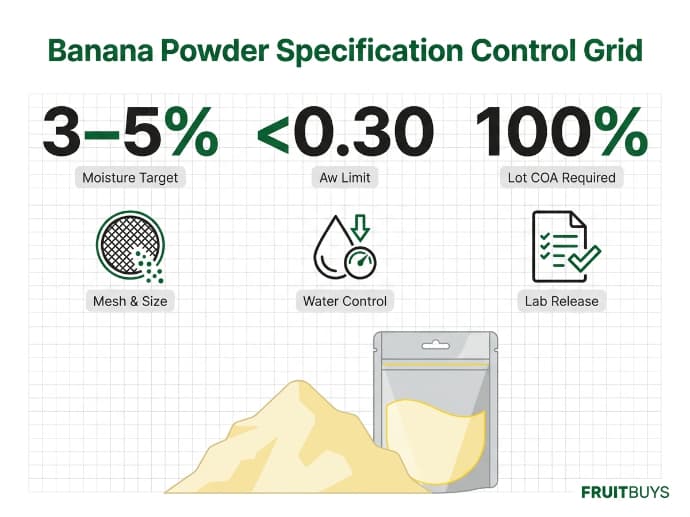
The current dataset uses moisture 3–5% and Aw <0.30 as working targets. These are specification targets, not confirmed lot results. The buyer needs COA evidence before release.
Intended Powder vs Uncontrolled Fines
Powder and fines are not the same product. Intended freeze-dried banana powder should follow a defined route: approved raw material, drying endpoint, milling or powder preparation, particle-size control, packaging and lot testing. Uncontrolled fines are small particles generated from broken slices, cubes or bites during handling. They may contain inconsistent particle sizes, variable color, higher surface exposure and unknown behavior in formulation.
A buyer should ask:
- Was the powder intentionally produced or collected from broken pieces?
- What particle-size range applies?
- What mesh or sieve method supports the claim?
- Does the powder come from the same ingredient route as slices?
- Does the powder include any anti-caking carrier or processing aid?
- Does the ingredient statement reflect the actual product?
- Does the COA match the powder lot, not a slice lot?
This distinction matters for ingredient buyers. A beverage developer needs controlled powder. A cereal producer may tolerate small particles as part of a mixed inclusion. These are different decisions. The buyer should compare this format against banana slices, cubes, bites and powder before approving any powder route.
Mesh and Particle-Size Distribution
Mesh is useful, but it does not complete the specification. It indicates a sieve relationship or particle-size target, depending on how the supplier defines it. It does not prove distribution, flow, caking, dispersibility or final application performance.
A strong powder specification should define:
- Nominal mesh
- Acceptable particle-size distribution
- Oversize limit
- Undersize or dust limit
- Agglomerate tolerance
- Sieve method or particle-size method
- Sampling plan
- Product format basis
- Release rule
The buyer should avoid ordering “fine powder” without a measurable target. Fine powder can disperse differently, cake faster and create more dust during handling. Coarser powder can give better flow but weaker dispersion in some dry mixes.
For bakery applications, the powder must match mixing behavior. For beverage blends, it must match mouthfeel and dispersion requirements. For dessert powders, it must balance flavor release, color and flow. A mesh number makes the conversation cleaner. It does not replace application testing.
Moisture, Aw and Caking
Caking risk starts when moisture control and packaging discipline are weak.
Aw supports stability review, but it does not replace moisture testing or microbiology review.
Buyers should approve powder only after checking moisture, Aw, packaging and storage requirements together.
Powder has a high surface area compared with slices or cubes. That makes moisture exposure more punishing. A small amount of moisture uptake can change flow, create clumps and reduce dosing consistency.
FDA defines water activity as the ratio between the vapor pressure of food and the vapor pressure of distilled water under identical conditions. FDA also notes that temperature affects Aw values, so the test condition matters when buyers review results. The FDA water activity guidance supports separating Aw from total moisture.
For this dataset:
- Moisture target: 3–5%
- Aw target: <0.30
- Status:
[COA NEEDED]for lot confirmation.
Powder buyers should connect this article with freeze-dried banana moisture and Aw. A powder that meets the correct mesh but fails water control can still fail in the formulation room.
Caking review should define:
| Caking Control | Buyer Question |
|---|---|
| Moisture | Does the powder meet the approved limit? |
| Aw | Does the powder meet the available-water target? |
| Packaging | Does the pack resist moisture uptake? |
| Storage | Can the buyer maintain dry storage after opening? |
| Flow | Does the powder pour, dose or blend as required? |
| Retained sample | Does the powder remain acceptable during review? |
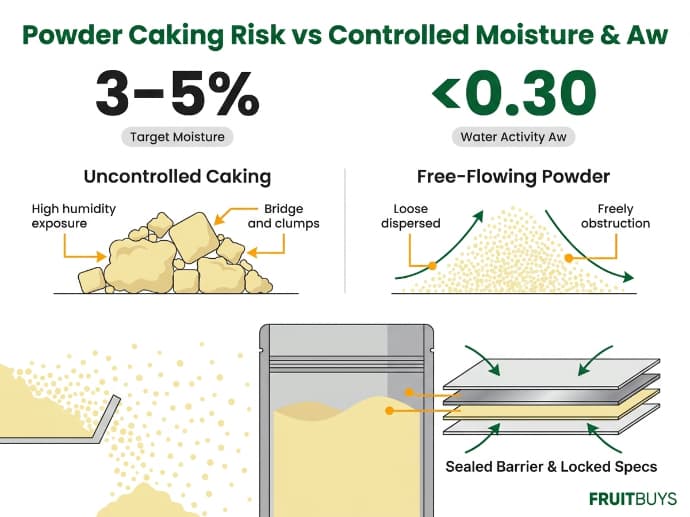
Do not publish caking-resistance claims without product-specific evidence.
Color, Aroma and Flavor Standard
Banana powder should carry a clear sensory target. It should not rely only on the word “banana.” Color can shift with maturity, browning, drying conditions and milling. Aroma can fade when packaging fails or when powder remains exposed to air. Flavor can vary with banana maturity and raw-material route.
A useful sensory file should define:
- Color reference
- Acceptable variation
- Aroma description
- Flavor direction
- Off-odor rejection
- Burnt or over-browned rejection
- Reference sample
- Comparison method
Research on freeze-dried banana slices shows that pretreatment can affect browning and quality characteristics, including color-related outcomes. The study on freeze-dried banana slices with ascorbic acid and quince seed mucilage supports the broader technical point that pretreatment and processing conditions affect banana color. It does not prove a FruitBuys powder lot uses a specific treatment.
The buyer should therefore request an ingredient statement and pretreatment declaration before approving any “banana-only” or clean-label claim. Strong claims need exact documentation.
Bulk Density and Dosing
Bulk density affects how powder fills, doses and behaves in production. It matters for pouch filling, scoop volume, dry-blend formulation, mixing ratio and industrial handling. Do not invent bulk-density values. The current dataset does not provide them. The correct status remains.
The buyer should ask for:
- Loose bulk density
- Tapped bulk density where relevant
- Measurement method
- Sample condition
- Pack size
- Powder moisture at measurement
- Lot identity
A beverage brand may need repeatable scoop behavior. A bakery manufacturer may need stable weight-to-volume behavior in dry premixes. A private label pouch may need consistent fill appearance. Bulk density supports these controls.
A powder that tastes good but fills inconsistently can disrupt production. The issue looks small during a sample review and becomes visible when the buyer scales the formula.
Microbiology and COA Requirements
Low moisture does not remove the need for microbiology review. Low Aw can limit microbial growth, but it does not prove the absence of pathogens or replace sanitation control.
FDA’s draft guidance on sanitation programs for low-moisture ready-to-eat foods focuses on sanitation programs, environmental monitoring, root-cause investigation and corrective actions. The buyer-facing point is direct: product testing alone does not carry the whole safety system.
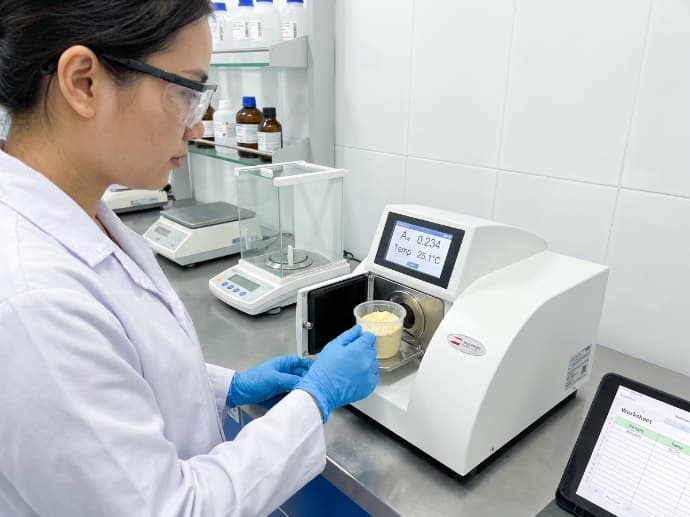
A powder COA should state:
- Product name
- Format: powder
- Lot number
- Moisture result
- Aw result
- Microbiology panel
- Method
- Result
- Acceptance limit
- Sample identity
- Report date
- Authorized release
The buyer may also require contaminant, residue or sulphite testing based on destination, product brief and ingredient route. The proof path belongs in lot-specific COA and laboratory testing. A COA for slices should not be reused as powder proof unless the lot, format and test scope match.
Powder Applications
Freeze-dried banana powder works when the buyer needs banana flavor or fruit identity inside a formulation rather than visible pieces.
Common application routes include:
| Buyer Type | Application | Required Proof |
|---|---|---|
| Beverage developer | Smoothie powder, shake mix, dry beverage | Mesh, dispersion, caking, microbiology |
| Bakery manufacturer | Dough, filling, topping or dry premix | Flavor, moisture behavior, dosing, heat trial |
| Dessert brand | Pudding, cream mix, topping powder | Color, aroma, flow, ingredient statement |
| Cereal manufacturer | Coating or flavor system | Particle size, blend behavior, moisture |
| Private label buyer | Retail powder pouch | Nutrition file, label input, packaging |
| Ingredient distributor | Multi-application resale | Standardized specification and COA |
Application testing should not start after bulk production. It should guide the powder specification before sample approval. For broader use cases, continue with food and beverage applications for freeze-dried banana.
Powder Packaging
Powder packaging carries stricter moisture-control requirements than many visible-piece formats because caking and flow loss directly affect formulation.

A powder packaging file should define:
- Inner bag or pouch structure
- Pack size
- Seal method
- Reseal requirement where applicable
- Carton configuration
- Headspace discipline where relevant
- Storage statement
- Open-pack handling guidance
- Lot-code location
- Retained-sample plan
- Packaging validation route
Shelf-life language should remain conditional until product and pack evidence supports it. Powder shelf life depends on moisture, Aw, package barrier, seal integrity and storage conditions. The detailed route belongs in freeze-dried banana packaging and shelf-life control.
A buyer should not approve powder from a sample jar if the bulk product will ship in a different inner bag or retail pouch. That is not the same packaging system.
Highest-Risk Powder Shortcut
The highest-risk shortcut is approving freeze-dried banana powder from a good aroma and a mesh claim.
Aroma and mesh do not prove water control, flow behavior, caking resistance, microbiology or packaging performance.
Buyers should approve a powder specification before approving the sample.
The shortcut looks harmless. The sample smells like ripe banana. The powder looks fine. The supplier states a mesh number. The buyer approves.
Then bulk arrives. The powder cakes in the pouch. It flows poorly in dry blending. The particle size drifts. The COA does not identify the powder lot. The packaging file has no barrier data. The R&D team cannot reproduce the formulation.
That failure did not start in production. It started when the buyer approved a sensory impression instead of a release specification. The correction is simple: define the powder’s application, particle distribution, water controls, packaging and lot testing before scaling.
Application Mapping
| Buyer Type | Application | Required Format | Proof Needed | FruitBuys Delivery |
|---|---|---|---|---|
| Beverage developer | Smoothie or dry drink mix | Powder | Mesh, dispersion, caking, moisture, Aw | Powder specification and QA file |
| Bakery manufacturer | Dough, filling or topping | Powder | Particle size, flavor, dosing and moisture behavior | R&D sample and release spec |
| Dessert brand | Powdered dessert mix | Powder | Color, aroma, flow, microbiology | Application-matched powder route |
| Cereal manufacturer | Flavor coating or dry blend | Powder | Particle distribution, moisture and flow | Lot-based powder control |
| Ingredient distributor | Multi-application ingredient | Powder | Standardized spec, COA, packaging file | Documentation and export readiness |
| Private label buyer | Branded powder pouch | Powder | Label input, nutrition file, packaging and COA | OEM / Private Label Delivery |
| QA manager | Supplier and lot approval | Powder | Methods, limits, lot identity and lab reports | Quality Control and Documentation |
Why FruitBuys Delivers This
FruitBuys supplies freeze-dried banana powder as a configured ingredient, not as an undefined by-product of other formats. The buyer receives one product route, one specification, one sample-to-bulk standard and one document file under one accountable supplier relationship.
For powder, FruitBuys applies five controls.
Raw Material Sourcing Governance aligns banana maturity, raw-material suitability and ingredient direction before drying and powder preparation.
Quality Control defines particle size, moisture, Aw, sensory standard, caking risk, bulk density where available and lot-release criteria.
Documentation connects specification, COA, laboratory report, ingredient statement, physical inspection and lot identity. A mesh claim without a COA does not support release.
OEM/Private Label Delivery aligns powder format with pouch, label input, coding, nutrition file and market-review needs.
Export Logistics Coordination protects the powder through packaging, carton configuration, storage instructions and document handover.
Private label buyers should continue with OEM and private label delivery. Buyers preparing a technical request should use the freeze-dried banana buyer RFQ checklist.
Buyer Checklist
Before approving freeze-dried banana powder, request:
- Intended application
- Ingredient statement
- Pretreatment declaration
- Powder production route
- Mesh or particle-size distribution
- Oversize limit
- Undersize or dust limit
- Moisture target
- Moisture method
- Aw target
- Aw method and condition
- Bulk density where required
- Flow or caking review where required
- Color reference
- Aroma and flavor reference
- Microbiology panel
- Contaminant or residue panel where required
- COA template
- Packaging structure
- Seal method
- Storage statement
- Open-pack handling guidance
- Retained sample plan
- sample-to-bulk comparison rule
Do not approve powder only from mesh size. Mesh is one control point. It cannot carry formulation, packaging and QA approval by itself.
Summary
Freeze-dried banana powder needs a separate specification from slices, cubes or bites. Buyers should verify particle-size distribution, moisture, Aw, bulk density, caking behavior, sensory criteria, microbiology, packaging and lot-specific COA.
For this FruitBuys dataset, working targets are 3–5% moisture and Aw below 0.30, subject to COA confirmation. Powder should not be treated as uncontrolled fines. FruitBuys connects powder qualification through Quality Control, Documentation, OEM/private label delivery and export logistics coordination.
FAQ
Is freeze-dried banana powder the same as banana fines?
No. Powder should follow a defined powder route with particle-size control. Fines are uncontrolled small particles generated by breakage or handling.
Is mesh size enough for powder approval?
No. Buyers also need moisture, Aw, caking behavior, bulk density, sensory standard, packaging and COA evidence.
What moisture should banana powder target?
This dataset uses 3–5% as a working moisture target. The lot-specific COA must confirm the actual result.
What Aw should banana powder target?
This dataset uses Aw <0.30 as the working target. The buyer should verify method, result, test condition and lot identity.
Why does banana powder cake?
Powder can cake when moisture exposure, packaging weakness or storage conditions allow water uptake. The package and open-pack handling matter.
Can powder be used in beverages?
Yes, but buyers should verify particle size, dispersion, caking, flavor, microbiology and formulation performance before bulk approval.
What should buyers request before approving powder?
Request the powder specification, particle distribution, moisture and Aw methods, COA template, packaging file and sample-to-bulk protocol.
Conclusion
Freeze-dried banana powder succeeds when the buyer treats it as a controlled ingredient. Mesh size starts the conversation but cannot finish it. Particle distribution, moisture, Aw, caking behavior, bulk density, sensory profile, microbiology, packaging and COA scope decide whether the powder performs in a beverage, bakery, dessert, cereal or private label product. A good-smelling sample can still fail in bulk if the release file stays thin.
Submit the formulation, required particle distribution and testing scope before approving the powder sample.
References
- Nowak, D.; Jakubczyk, E. The Freeze-Drying of Foods: The Characteristic of the Process Course and the Effect of Its Parameters on the Physical Properties of Food Materials. Foods, 2020. MDPI full text.
- U.S. Food and Drug Administration. Water Activity (aw) in Foods. FDA technical guidance.
- U.S. Food and Drug Administration. Draft Guidance for Industry: Establishing Sanitation Programs for Low-Moisture Ready-to-Eat Human Foods and Taking Corrective Actions Following a Pathogen Contamination Event. January 2025. FDA draft guidance.
- Moraga, G. et al. Implication of Water Activity and Glass Transition on the Mechanical and Optical Properties of Freeze-Dried Apple and Banana Slices. Journal of Food Engineering, 2011. ScienceDirect record.
- Milani, A. et al. Production and Characterization of Freeze-Dried Banana Slices Pretreated with Ascorbic Acid and Quince Seed Mucilage: Physical and Functional Properties. Food Science & Nutrition, 2020. PMC full text.