What should you specify before buying freeze-dried mangosteen powder in bulk?
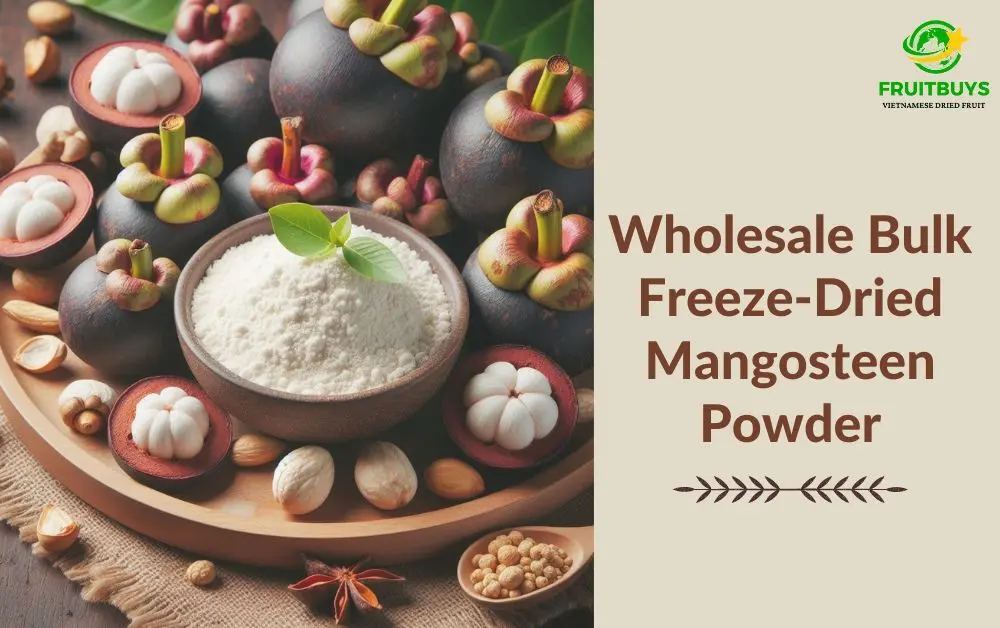
Start with the part of the fruit. “Mangosteen powder” is sold as three different products: freeze-dried aril (fruit) powder for flavour, spray-dried juice powder on a carrier, and peel (pericarp) powder for supplements, which is bitter and not a food flavour. Then specify six lines. First, which part of the fruit: the whole aril with its natural seed, and none of the rind. Then what else is in the bag: nothing for clean label, or up to 1% flow aid for automatic filling lines. Then moisture ≤5.0% and water activity ≤0.30, 60–80 mesh with ≥95% passing, how it is milled and packed, and the lot COA. Get those right and the powder pours into your mixer as a fine ivory dust that tastes of fresh mangosteen, and your ingredient line reads “100% mangosteen”. Get them wrong and you receive a beige brick, or a supplement ingredient that tastes of bark.
Mangosteen powder is a demanding product to make. The dried aril carries about 70 g of natural sugar per 100 g, and milling multiplies its surface area many times over. The powder pulls water out of humid air in minutes, and heat from the mill turns its sugar sticky and its colour beige. Every line below stops one of those things.
Which “mangosteen powder” are you actually buying?
Settle this before you compare any quote. Three very different products are sold under the same name:
| Product | What it is | Taste and colour | What it is for | Ingredient line |
|---|---|---|---|---|
| Freeze-dried aril (fruit) powder | The white flesh with its seed, freeze-dried and milled cold | Sweet-tart, floral; ivory | Flavour, colour and real fruit in drinks, dairy, desserts and confectionery | “100% mangosteen” |
| Spray-dried juice powder | Juice dried hot on a carrier, typically 30–50% maltodextrin | Milder, often cooked note; off-white | Low-cost flavouring where “fruit” on the label is not the point | Mangosteen juice, maltodextrin |
| Peel (pericarp) powder or extract | The dried purple rind, ground or extracted | Bitter, astringent; brown to purple | Supplement and tea ingredient, sold for xanthones | Mangosteen pericarp |
FruitBuys supplies the first. It is milled from whole freeze-dried arils, seed-in, as the fruit comes from the peeling table, with no maltodextrin or other carrier, so it carries the fruit’s own sugars, acids and 13.3 g of fibre per 100 g. Each kilo starts as about 17–24 kg of whole fruit, or 5–6 kg of hand-peeled aril, which is why a quote far below that fruit cost is usually a juice powder on a carrier. Compare quotes by fruit content first: a spray-dried powder at 50% fruit costs more per kilo of mangosteen than its price suggests.
If your brief is a xanthone supplement or a mangosteen peel tea, you need peel powder or extract, which is a different raw material and a different supply chain. Most of the fruit’s xanthones sit in the rind and the white flesh carries only small amounts, so aril powder is sold on taste, clean label and fibre. The nutrition basis is set out in freeze-dried mangosteen nutrition per 100 g.
What should be in the bag?
That depends on how the powder goes into your product. Choose the version by your filling equipment:
| Version | Composition | Choose it when |
|---|---|---|
| Pure (standard) | 100% mangosteen | Batch mixing for ice cream, gelato, chocolate, bakery creams and drink bases, in a room below 40% RH |
| Free-flowing (on request) | + up to 1% silicon dioxide (E551) | High-speed stick-pack or sachet lines with auger fillers, where pure powder can turn tacky and stop the line |
The pure version carries the strongest claim a fruit powder can put on a pack: “100% mangosteen (Garcinia mangostana)”, with no added sugar, carrier or preservative. The free-flowing version holds silicon dioxide at 1% or less, the EU maximum for dried powdered foods, so one recipe serves EU and non-EU customers alike; the additive is declared on the label as E551.
Pure powder forms soft, friable lumps that break under light finger pressure or the first turn of a mixer. That is normal for a fruit this sweet. What is not acceptable in either version is hard caking: a lump that needs a knife. Write that distinction into the specification.
Why is the seed milled in?
Because the seed is part of the aril as it leaves the peeling table, and milling it with the flesh keeps the whole fruit in the powder. FruitBuys freeze-dries every format seed-in; once dried, the seed is crisp and goes through the chilled mill with the flesh to the same 60–80 mesh, so no seed statement is needed on a powder label. Cutting seeds out of thousands of arils by hand would add labour and handling to the fruit without changing what matters in your product. Bitterness in mangosteen comes from the purple rind, which is why rind, not seed, is the control point.
How is rind kept out of the powder?
Before milling, not after. On whole arils a fragment of purple rind is visible and is picked out by hand. Once milled, it disappears into the powder as fine grey-purple specks and a bitter, astringent note that no sieve can remove. So the arils going to the mill pass the same visual rind inspection as the arils packed whole, and the powder inherits that control.
On your sample, look for an even ivory to light-cream colour with no grey or purple specks, and taste it in water: clean, sweet-tart mangosteen with no bitterness is the sign of careful peeling and sorting upstream. The arils themselves are specified in what limits freeze-dried mangosteen should meet.
What moisture and water activity should it meet?
Write moisture ≤5.0% and aw ≤0.30 into the contract, the same limits as for whole arils and diced. A buyer might expect powder to be drier than the arils it comes from. It cannot be: powder is milled from fruit that has already left the dryer, so it can only gain moisture during milling, never lose it. That is why the milling room, not the dryer, decides the quality of the powder.
With about 70 g of natural sugar per 100 g, mangosteen powder draws moisture from the air fast. That is why the acceptance reading for aw ≤0.30 is taken, to ISO 18787, on a sample drawn straight from the sealed bag: it measures the powder as it left the packing room.
How should it be milled and packed?
This is the question that separates suppliers who make mangosteen powder from those who simply grind it.
- Chilled milling. A pin or hammer mill heats the product. Warm mangosteen sugar softens, smears onto the 60–80 mesh screen and starts to brown, and the ivory powder turns beige with a cooked note in place of the fresh fruit.
- A very dry room. Milling and packing run in a cool, dehumidified room at 22–25 °C and below 35–40% RH, drier than the room used for whole arils, because fine powder takes up humidity far faster than whole fruit.
- Straight into foil. The powder goes directly into 5 kg aluminium-foil bags, gently de-aerated, with a food-grade silica gel sachet. No nitrogen, and no iron-based oxygen absorbers, which release moisture and cause caking.
The 5 kg bag, packed four to a 20 kg carton, is sized for your mixer. An operator cuts one, tips it all in, and never weighs out part of a bag or leaves one half-open overnight. The other three bags stay sealed until their own batch. Open powder bags in a room below 40% RH and the powder flows the way it left the packing room.
Ask to see the milling room and its humidity log. This is what every buyer should check, including with us.
Which particle size should you write in?
60–80 mesh, with at least 95% passing, suits drinks, dairy, fillings, coatings and confectionery. At that size the powder disperses smoothly, with no gritty feel in a drink or a ganache. The natural ivory colour sits quietly in pale bases, so white chocolate, gelato, yogurt and milk tea keep their soft pastel tone while gaining a sweet-tart tropical note, with no colouring or flavouring on the label. Write the mesh into the contract and approve it on the pre-shipment sample, the same reference your container is loaded against.
What does a container of powder look like?
Dense, and that makes powder the lowest freight per kilo in the mangosteen range. Powder packs 20 kg per carton, against 7 kg for whole arils, so a 20ft container floor-loaded with about 550 cartons carries about 11 tonnes. A kilo of powder travels for about 35% of the freight cost of a kilo of whole arils. Powder is shipped in 20ft containers; a full 40ft HC of powder would exceed road weight limits before it left the port. The loading logic is in how freeze-dried mangosteen should be packed and loaded.
When can you buy it?
All year. Arils are IQF-frozen at −25 °C in season and freeze-dried and milled to order, so powder ships in every month with a recent production date. Powder also does not depend on shape, so late-season fruit from August and September, softer and less even but with the same sweetness and aroma, goes into it as well. Arils that cannot make the whole-aril grade carry their full flavour into the powder, and you are not paying for a shape your recipe will dissolve. That widens the production window, and with 12 months of shelf life at ≤25 °C, RH ≤60% and 18–24 months in cool storage at ≤18 °C, RH ≤50%, one purchase covers a year of production. The harvest calendar is in where and when Vietnam’s mangosteen is harvested.
Which tests and documents come with it?
The same set as whole arils and diced:
- A third-party lot COA on every full container for moisture, water activity, total plate count, yeasts and moulds, E. coli and Salmonella
- Periodic third-party surveillance for lead, arsenic and aflatoxin
- HS 1106.30, flour and powder of Chapter 8 fruit, a different heading from whole arils and diced (0804.50); the heading changes the duty in some markets, and the Form EUR.1 that travels with every EU and UK container claims the EVFTA or UKVFTA preference
- C/O Form CEPA with every UAE shipment, and a phytosanitary certificate with every shipment as part of the standard export dossier
Mangosteen is not on the EU list of foods under increased border checks, so powder moves through routine controls. Duty by market for powder and arils, and the residue panels, are in which HS code freeze-dried mangosteen ships under.
How much do you need?
At a typical dose of 3–8% of the recipe, a 50–100 kg trial covers a real factory run: 100 kg at 5% flavours 2 tonnes of finished product.
Judge the price the same way, per finished unit rather than per kilo of powder:
Fruit cost per unit = powder price per kg × dose × unit weight (kg)
At a 5% dose, a 100 g ice-cream cup carries 5 g of powder, so even a large difference in price per kilo moves the cost of each cup by a small fraction of it. What the cup gains is a “100% fruit” ingredient line and real mangosteen flavour, which is what lets a brand price it above a flavoured product. Standard bulk orders run from 200–500 kg, and private-label retail packs, such as stick packs or jars, start at 500 kg.
Use powder where the flavour should be everywhere and the fruit invisible: drinks, ice cream, fillings and coatings. Where the consumer should also see and bite the fruit, pair it with pieces: powder in a white chocolate or yogurt coating carries mangosteen through every bite, and diced mangosteen adds the visible, crisp signature. Format choice is covered in which freeze-dried mangosteen format fits your product, and ideas for the kitchen in mangosteen powder recipes.
When is freeze-dried aril powder not the right buy?
When your product is a crystal-clear drink that must show no cloud, when the brief is a xanthone supplement, or when the only goal is the lowest price per kilo of “mangosteen flavour”. A filtered juice concentrate, a peel extract or a flavouring does each of those jobs. And if your plant already runs a cold mill and a dry room, importing diced freeze-dried mangosteen and milling it yourself can lower the import duty in some markets; FruitBuys ships diced for exactly that. Freeze-dried aril powder milled at source earns its price where real fruit on the label, real fibre, real aroma and a dry-room mill you do not have to run matter.
The specification to send your supplier
| Line | Write into the contract |
|---|---|
| Source | Whole mangosteen aril, seed-in; no rind |
| Composition | Pure: 100% mangosteen · Free-flowing: + ≤1% SiO₂; no carrier or added sugar |
| Moisture | ≤5.0% |
| Water activity | ≤0.30 |
| Particle size | 60–80 mesh, ≥95% passing |
| Caking | Soft lumps only; no hard caking |
| Colour and taste | Ivory to light cream, no grey or purple specks; sweet-tart, no bitterness, no cooked note |
| Microbiology | TPC ≤10⁴, yeasts & moulds ≤10² CFU/g, E. coli <10 CFU/g, Salmonella ND/25 g |
| Milling | Chilled, in a room at 22–25 °C and <35–40% RH |
| Packing | 5 kg foil bags, de-aerated, silica gel; 4 bags per 20 kg carton |
| Documents | Lot COA, surveillance report, EUR.1 (EU/UK) or CEPA (UAE), phytosanitary certificate |
Request a powder sample
Tell us your application, dose and filling equipment. FruitBuys sends powder from current production with this specification filled in, so your R&D team tests the material your container will carry. Full product details are on the freeze-dried mangosteen powder page, the wider range is in the dried fruit powder category, and the whole-fruit buyer guide is what to check before buying freeze-dried mangosteen in bulk.
FAQ
Is freeze-dried mangosteen powder 100% fruit?
The pure version is: whole arils, seed-in, with no maltodextrin, carrier or added sugar. The free-flowing version for auger lines adds up to 1% silicon dioxide.
Does the powder contain the seed?
Yes. The natural seed is milled with the aril to 60–80 mesh. The rind is kept out, since that is where mangosteen’s bitterness comes from.
Is mangosteen powder the same as mangosteen peel powder?
No. Peel (pericarp) powder is made from the purple rind, tastes bitter and is sold as a supplement or tea ingredient. Freeze-dried aril powder is the white flesh, used for flavour and colour.
Can mangosteen fruit powder be used in tea?
Yes, as a flavour in milk tea, fruit tea and tea blends at 3–8%. It brings sweet-tart fruit, not the astringency of a peel tea.
Does mangosteen fruit powder contain xanthones?
Only small amounts. Most of the fruit’s xanthones sit in the rind, so aril powder is sold on taste, clean label and fibre.
What is the HS code for freeze-dried mangosteen powder?
1106.30, flour, meal and powder of Chapter 8 fruit. Whole arils and diced ship under 0804.50. Your broker confirms the national line.
Why does mangosteen powder cake or turn beige?
It was milled warm or in humid air, or a bag was left open. Chilled milling below 40% RH and 5 kg bags used whole prevent it.
How much fits in a 20ft container?
About 550 cartons of 20 kg, or about 11 tonnes.
What is the minimum order?
Trials from 50–100 kg, bulk from 200–500 kg, private label from 500 kg.