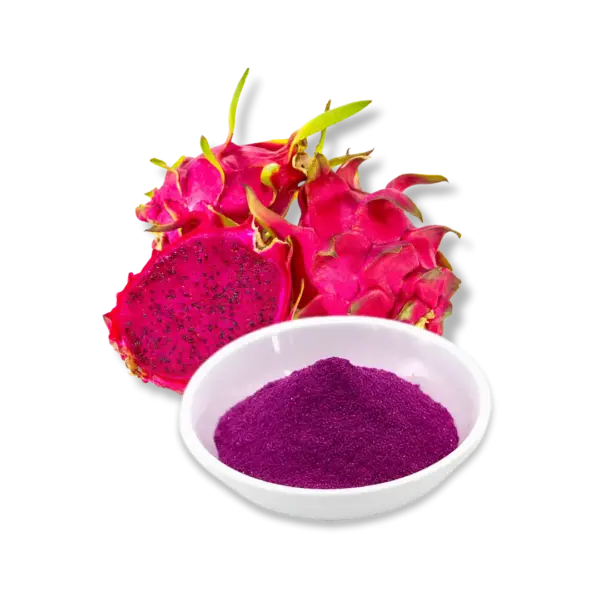
Freeze-Dried Red Dragon Fruit Powder
Freeze-dried red dragon fruit powder is 100% red-flesh pitaya, freeze-dried and milled cold into a fine magenta powder with nothing added. It colours a product vivid pink at 0.5–2% and reads on the label as “dragon fruit”, replacing beetroot extract or a synthetic red in drink premixes, yogurts, ice cream, frostings and bakery.
FruitBuys’ partner facility mills it in Vietnam from export-grade freeze-dried lots, and it ships in 20 kg cartons, about 11 t to a 20 ft container. What to specify before you buy is set out in what to specify before buying freeze-dried dragon fruit powder in bulk.
Product specification
| Parameter | Specification |
|---|---|
| Ingredient | 100% freeze-dried red-flesh dragon fruit (Selenicereus monacanthus); no carrier, no maltodextrin, no added sugar, no added colour |
| Free-flowing grade | + up to 1% silicon dioxide (E551), for auger, sachet and stick-pack lines: keeps high-speed filling running without auger jams or clean-down stops |
| Particle size | 60–80 mesh, ≥95% passing (about 180–250 µm) |
| Bulk density (working range) | 0.45–0.51 g/ml: size hoppers, stick packs and jars on this figure |
| Moisture | ≤5.0% contract; release target ≤4.0% |
| Water activity | ≤0.30 contract; release target ≤0.25 |
| Colour | Vivid natural magenta from the fruit’s own betacyanin (reference range for dried red-flesh pitaya: 225–360 mg per 100 g), with fine dark seed specks |
| Taste | Mild, clean, slightly tart |
| Microbiology | TPC ≤10⁴ CFU/g; yeasts and moulds ≤10² CFU/g; E. coli <10 CFU/g; Salmonella not detected/25 g |
| Origin | Vietnam: Lam Dong coastal belt (former Binh Thuan) and the Mekong Delta (Long An, Tien Giang); main season April–October, light-induced off-season crop November–March |
Why 60–80 mesh. Red dragon fruit carries 44 g of natural sugar per 100 g and oil in its seeds. Milled finer, the heat of grinding starts to soften the sugar and smear the seed oil, and the powder balls up in the mill. At 60–80 mesh it stays loose, disperses well under high shear and still reads as a smooth colour in the finished product.
Why release at ≤4.0%, not lower. Pushing a high-sugar powder down to 3% would add 4–6 hours of secondary drying: more power per kilogram, and natural sugars that start to brown at the end of the cycle. Release at ≤4.0% and aw ≤0.25 keeps the colour bright and holds a buffer below the contract limits for the voyage.
The seed specks are a feature. They are milled in, and in a yogurt, frosting or smoothie they show as fine dark dots: the visual signal to a shopper that the pink comes from real fruit.
The powder is milled from export-grade freeze-dried lots released to the same limits as whole pieces, using fruit cut outside the whole-piece size tolerance. You get the full colour and nutrition of the fruit at a lower commercial price than whole cuts. Whole pieces, slices and dice are on the freeze-dried red dragon fruit product page.
Nutrition per 100 g
| Nutrient | Per 100 g | % DV |
|---|---|---|
| Calories | 400 kcal | |
| Total fat | 6 g | 8% |
| Saturated fat | <2 g | <10% |
| Sodium | 0 mg | 0% |
| Total carbohydrate | 84 g | 31% |
| Dietary fiber | 16 g | 57% |
| Total sugars | 44 g (naturally occurring) | |
| Added sugars | 0 g | |
| Protein | 8 g | 16% |
| Potassium | 1,800 mg | 38% |
Same fruit and moisture basis as FruitBuys freeze-dried red dragon fruit pieces. FruitBuys runs a nutrition panel on your commercial lot for the printed label.
Applications and dosage
| Application | Typical dosage | What it does |
|---|---|---|
| Colour only (dairy, frostings, confectionery) | 0.5–2% | Natural pink to magenta, no E-number |
| Smoothie, shake and drink premixes | 2–5% | Colour plus fruit taste and fibre |
| Yogurt, dairy desserts, ice cream | 1–3% | Even pink through the base |
| Frostings, creams, fillings | 3–6% | Bright colour in low-heat products |
| Chocolate and compound coatings | 2–5% | Pink coatings without an added colour |
| Bakery | 2–4% | Macarons and other short, low-temperature bakes; post-bake frostings, glazes, fillings and decor |
Cost-in-use. At 1% in a yogurt, one 20 kg carton colours 2 tonnes of finished product. Divide your powder price per kilogram by 100 and you have the colour cost per kilogram of yogurt.
Against beetroot. Beetroot gives a similar pink but carries an earthy note that is hard to hide in ice cream, yogurt and confectionery. Dragon fruit powder gives magenta with a clean, mild taste that leaves the base flavour alone.
Colour holds best in neutral to mildly acidic bases and in low-heat or post-bake steps. For bakery, that makes it a natural fit for macarons, mirror glazes, frostings, fruit fillings and decorating sauces, where the magenta goes on after the oven. Pack retail products in light-blocking film. Formats and colour behaviour across products are compared in freeze-dried dragon fruit formats.
Packaging
| Specification | |
|---|---|
| Bulk | 5 kg aluminium-foil bags, gently de-aerated, with a food-grade silica gel sachet; no nitrogen, no iron-based absorbers |
| Carton | 58 × 28 × 34 cm, 20 kg (4 × 5 kg bags), 5-ply |
| Retail (OEM) | Stick packs, sachets, jars or foil pouches |
The powder is strongly hygroscopic. The 5 kg bag is sized to one production batch: open a bag in a room below 40% RH and use the whole bag in that batch, so no half-open powder sits in a humid store.
Commercial terms
| Container | About 550 cartons per 20 ft, about 11 t net, floor-loaded. Powder-only orders ship in 20 ft; a 40 ft HC carries powder mixed with pieces. Palletised loading on request |
| Freight | About 11 t per 20 ft against about 5.5 t for dice, so freight per kilogram is roughly halved |
| Capacity | Around 100 tonnes/year of finished freeze-dried red dragon fruit, pieces and powder, across qualified partner facilities |
| Production time | 20–30 days for a 20 ft container after deposit |
| Sample | 3–5 working days |
| MOQ | OEM / private label from 500 kg |
| Payment | T/T 40% deposit, 60% before shipment or against copy of B/L; L/C at sight |
| Loading | Cat Lai sea port or Tan Son Nhat airport; FOB, CIF, DDP |
| Shelf life | 12 months at ≤25 °C, RH ≤60%; 18–24 months in cool storage at ≤18 °C, RH ≤50%, in original unopened bags |
Quality and documents
Every full container ships with a lot COA from an independent ISO/IEC 17025 accredited laboratory for moisture, water activity, total plate count, yeasts and moulds, E. coli and Salmonella. Lead, arsenic and aflatoxin are covered by periodic third-party baseline surveillance, with reports available on request.
A vivid red powder is exactly what a border lab or a retail QA team looks at twice, so three extended panels are available before stuffing: pesticide multi-residue, a synthetic colour screen that proves the magenta is the fruit, and sulfite below 10 mg/kg. On trial and LCL orders, FruitBuys provides a free in-house release QC log (moisture, aw, sensory) plus baseline reports; independent testing on a small lot runs at net lab cost, credited in full against your first full container.
The standard dossier ships with every shipment: commercial invoice, packing list, bill of lading, certificate of origin (EUR.1 for the EU and UK), phytosanitary certificate and lot COA. Partner facilities hold HACCP, ISO 22000, BRC (qualified processing facility) and US FDA Facility Registration, with Halal certification available on request.
Import and labeling
- HS classification. 100% dragon fruit powder classifies as fruit powder under heading 1106.30; in the EU it falls under CN 1106 30 90 in the EU tariff. The free-flowing grade with E551, or any version with a carrier, can move to 2106.90; FruitBuys cross-checks the declared line with your broker on the draft documents before the first shipment.
- EU and UK border checks. The increased checks on Vietnamese dragon fruit under the EU list of higher-risk imports of non-animal origin cover fresh fruit only; powder enters under routine controls.
- Residues. EU limits apply on the fresh-fruit basis under the EU pesticide residue database. A result on the powder is divided by a processing factor of about 6–7.4 before it is compared, so keep that factor on file with the COA.
- Label. The ingredient line reads “dragon fruit” (or “dragon fruit, silicon dioxide” for the free-flowing grade). The full market dossier for the US, EU, UK and UAE is in freeze-dried dragon fruit market compliance.
Verify the sample
You do not need to wait for a lab. Three minutes, a pot of plain yogurt and a spoon tell you most of what matters:
- Colour. Stir 1 g into 100 g of plain yogurt: an even magenta should develop within a minute, with fine dark seed specks.
- Flow. Tip the bag: soft clumps should break with a spoon or a sieve; hard lumps mean moisture pickup.
- Fineness. Sieve a spoonful through 60 mesh: almost all of it should pass.
- Taste. Mild, clean and slightly tart; no burnt or caramel note.
- Check the COA. Moisture and aw against the limits above, with the lot number matching the bag.
FAQ
Is freeze-dried dragon fruit powder 100% fruit?
Yes. The standard grade is 100% red dragon fruit with no carrier, sugar or colour. A free-flowing grade adds up to 1% silicon dioxide for high-speed filling.
How much powder do I need to colour a product pink?
0.5–2% for colour alone; 2–5% in drink premixes where you also want fruit taste.
Why choose dragon fruit powder over beetroot?
It gives a similar natural pink without beetroot’s earthy note, and the label reads “dragon fruit”.
What mesh size is the powder?
60–80 mesh, with at least 95% passing, milled cold in a dehumidified room.
How is it packed?
5 kg foil bags with silica gel, four bags to a 20 kg carton, about 550 cartons to a 20 ft container.
Can I use it in bakery?
Yes, in short low-temperature bakes such as macarons and in post-bake frostings, glazes and fillings, where the magenta stays bright. Long, hot bakes dull the colour.
Request a quote
Send these details and we return a specification, a loading plan and a sample schedule in one reply:
- Grade: 100% powder or free-flowing (E551)
- Application and dosage
- Volume: trial lot and annual estimate
- Packaging: 5 kg bulk bags or retail format
- Destination port and Incoterm
- Documents and panels needed for your market
Everything to specify before your first order is in what to specify before buying freeze-dried dragon fruit powder in bulk.
[email protected] · WhatsApp Export +84 919 739 589