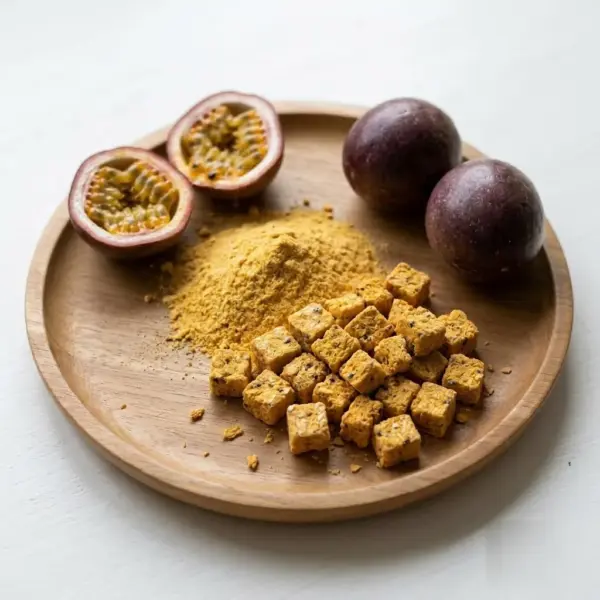
Freeze-Dried Passion Fruit Powder
Freeze-dried passion fruit powder is the whole pulp of Vietnamese passion fruit (Passiflora edulis), freeze-dried and cold-milled to 60–80 mesh at ≤5.0% moisture and water activity ≤0.30. The standard version is 100% pure fruit: no sugar, no carrier, no synthetic flavouring.
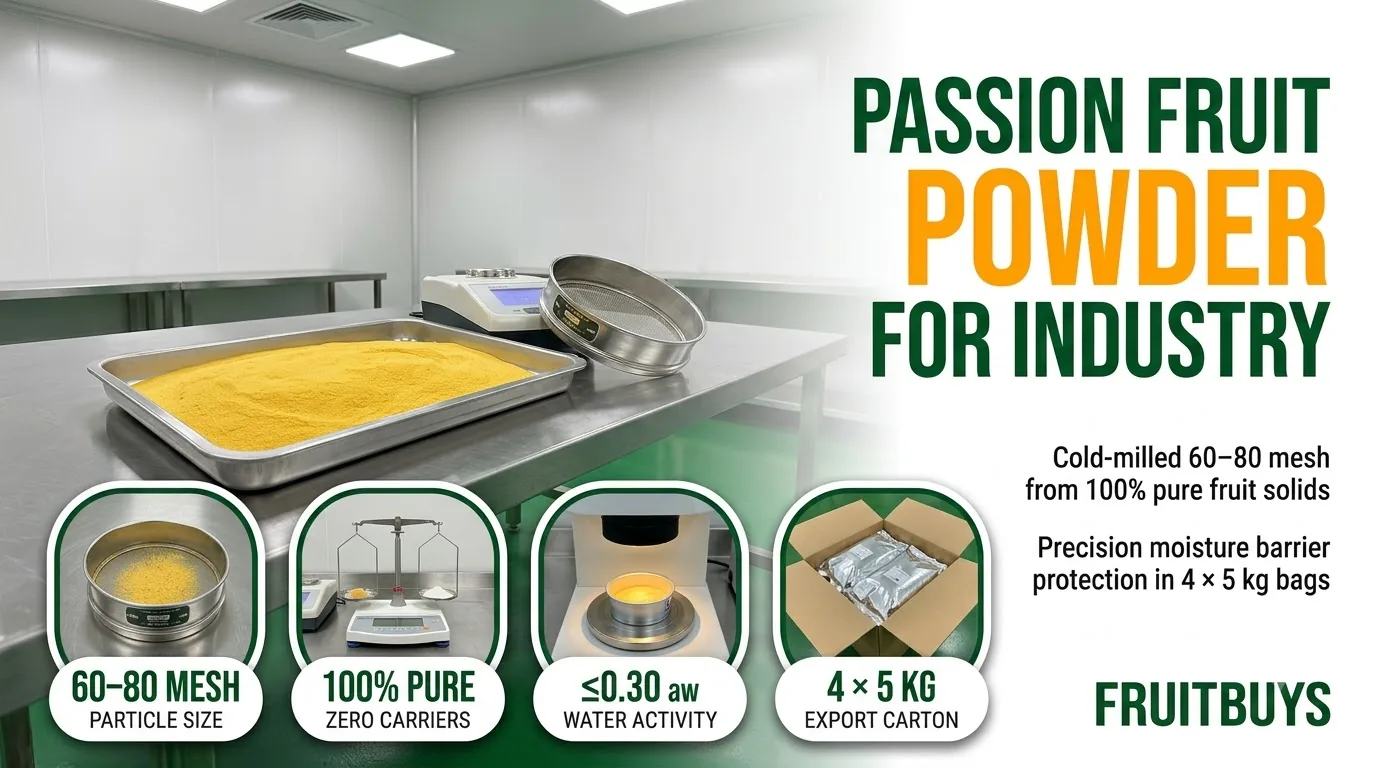
The powder delivers a sharp tropical tartness and a natural golden colour at just 2–5% of a formula, while keeping the real fruit body that flavourings and spray-dried juice powders never have. FruitBuys mills in a humidity-controlled room, packs straight into foil bags, and releases every container lot with a third-party COA.
The choice between versions comes down to two questions: seedless or seed-in, and pure or free-flowing (anti-caking). Both are walked through step by step in what to specify before buying freeze-dried passion fruit powder.
Product specification
| Parameter | Specification |
|---|---|
| Base | Seedless (standard, uniform golden colour) or seed-in (fine black seed flecks, more fibre) |
| Versions | 100% pure passion fruit · Free-flowing with up to 1% silicon dioxide (E551) · Carrier version with 5–10% maltodextrin or tapioca starch |
| Raw fruit | Central Highlands, Vietnam; Dai Nong 1 hybrid and purple types; pulp 13–17 °Brix, pH 2.8–3.2 |
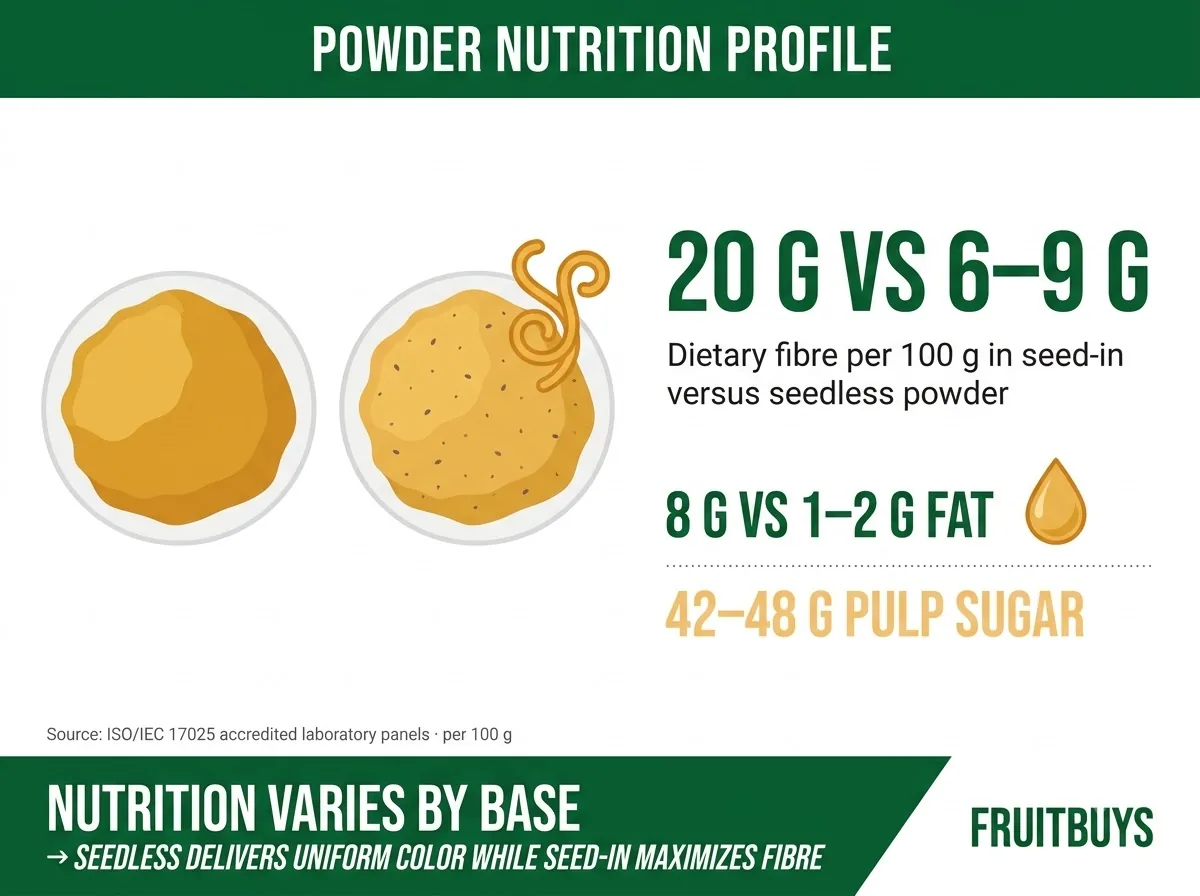
| Particle size | 60–80 mesh, ≥95% passing |
| Moisture | ≤5.0% |
| Water activity | ≤0.30 |
| Colour / taste | Golden; natural tartness, fresh passion fruit aroma; no burnt heat notes |
| Caking | Soft caking that breaks under a light hand squeeze is allowed (pure version); no hard caking |
| Total plate count | ≤10⁴ CFU/g |
| Yeasts & moulds | ≤10² CFU/g |
| E. coli | <10 CFU/g |
| Salmonella | Not detected / 25 g |
| Shelf life | 12 months at ≤25 °C, RH ≤60%; 18–24 months in cool storage at ≤18 °C, RH ≤50% |
| HS code | 1106.30, powder of Chapter 8 fruit under the WCO Harmonized System; your customs broker confirms the national subheading line |
Why three versions? Pure passion fruit powder carries a high load of natural fructose and fruit acids, which lower the glass transition point and make the powder extremely hygroscopic. On long stick-pack or sachet lines running at high speed, pure powder turns sticky in humid air and jams the dosing auger. The free-flowing and carrier versions exist to keep automatic lines running without stoppages; for batch mixing, the pure version is the cleaner-label choice.
Silicon dioxide is held at 1% or below in the free-flowing version. That is the ceiling for dried powdered foods under Regulation (EC) No 1333/2008, so a single formula can serve both EU and non-EU customers.
Nutrition (per 100 g)
| Nutrient | Seedless powder (standard) | Seed-in powder |
|---|---|---|
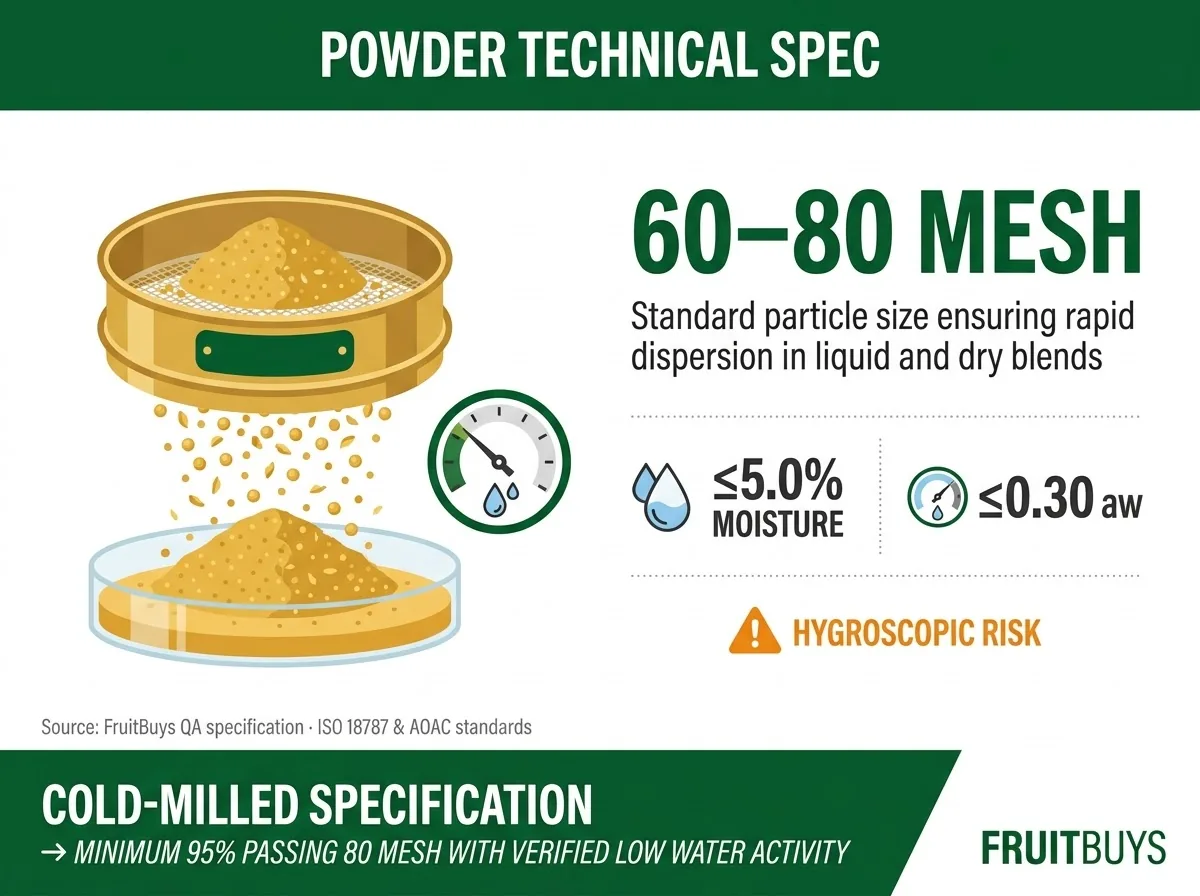
| Total fat | about 1–2 g | 8 g |
| Saturated fat | 0 g | 0 g |
| Sodium | 0 mg | 0 mg |
| Dietary fibre | about 6–9 g | 20 g |
| Total sugars | about 42–48 g (0 g added) | 36 g (0 g added) |
| Added sugars | 0 g | 0 g |
| Potassium | high, from the pulp | 1,000 mg |
| Protein | lower than seed-in | 8 g |
The seed-in figures are typical results from an independent third-party laboratory on seed-in freeze-dried passion fruit — the base material milled into the powder. The seedless values are calculated from the same fruit after the seeds are removed: taking out the oil- and fibre-rich seed fraction lowers the fat and fibre, and concentrates the pulp’s natural sugar share.
For your printed packaging, FruitBuys samples the commercial lot of the exact specification you order (seedless or seed-in, pure, free-flowing or carrier) and arranges the nutrition panel at an ISO/IEC 17025 accredited laboratory, formatted for your market.
Seedless or seed-in?
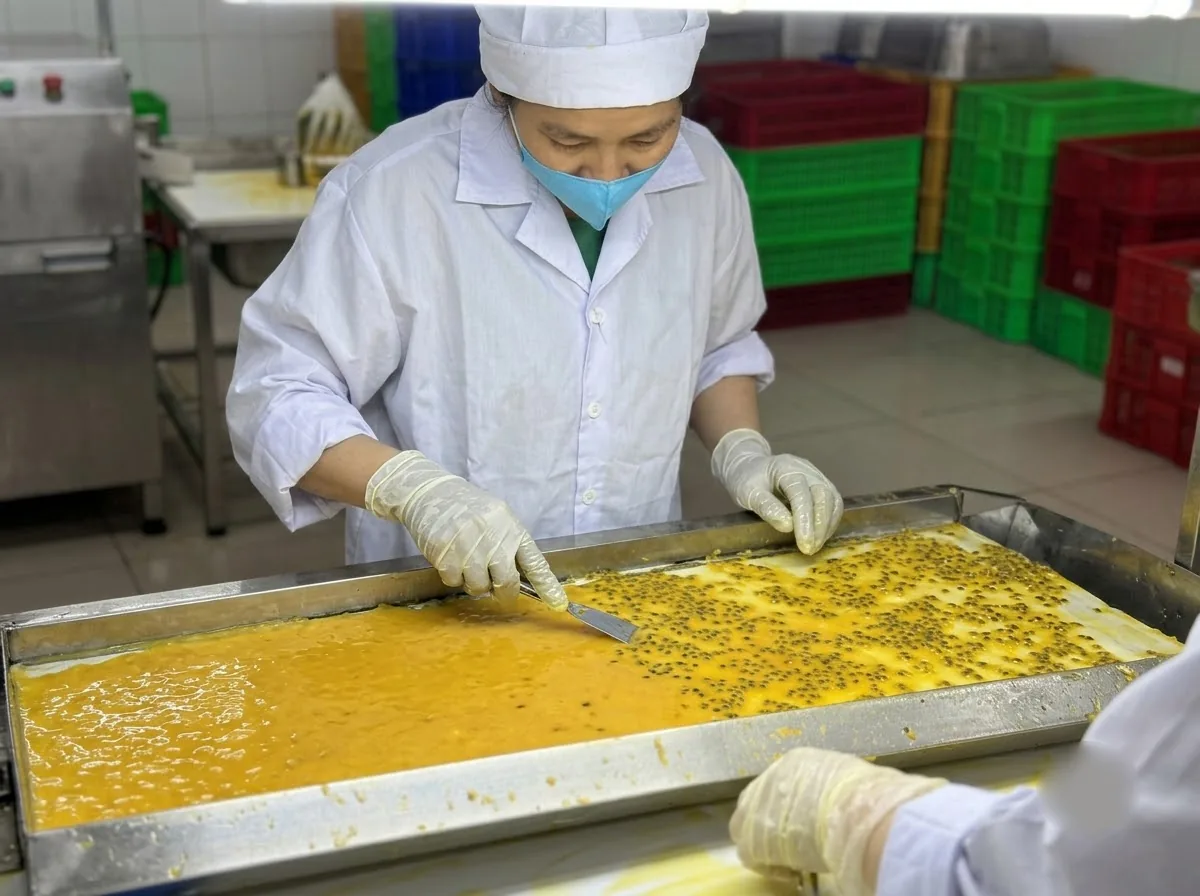
Seedless is the standard because most powder applications need a uniform golden colour: milk tea, beverage premixes, white chocolate, pale creams and coatings. The seed-in version keeps the finely milled seeds, visible as fine black flecks, and adds fibre and natural seed oil. Dusting granola or mixing rustic bakery creams, those flecks read clearly as real fruit. In a white sauce, though, a QA team that has not been briefed can log the flecks as foreign matter; agree the base specification clearly and send your QA team a reference sample before the first order.
Applications and dosage
| Application | Recommended version | Typical dosage |
|---|---|---|
| Beverage premixes, milk tea, smoothies | Seedless, pure or carrier | 2–5% |
| Yogurt, ice cream, fillings | Seedless, pure | 2–4% |
| White chocolate, coatings, icing | Seedless, pure | 2–3% |
| Sachet and stick-pack lines | Free-flowing | Per formula design |
| Granola dusting, rustic bakery creams | Seed-in, pure | 2–5% |
At a pH of around 3, the powder brings strong acidity on its own, so many formulas can cut added citric acid and keep the ingredient list shorter.
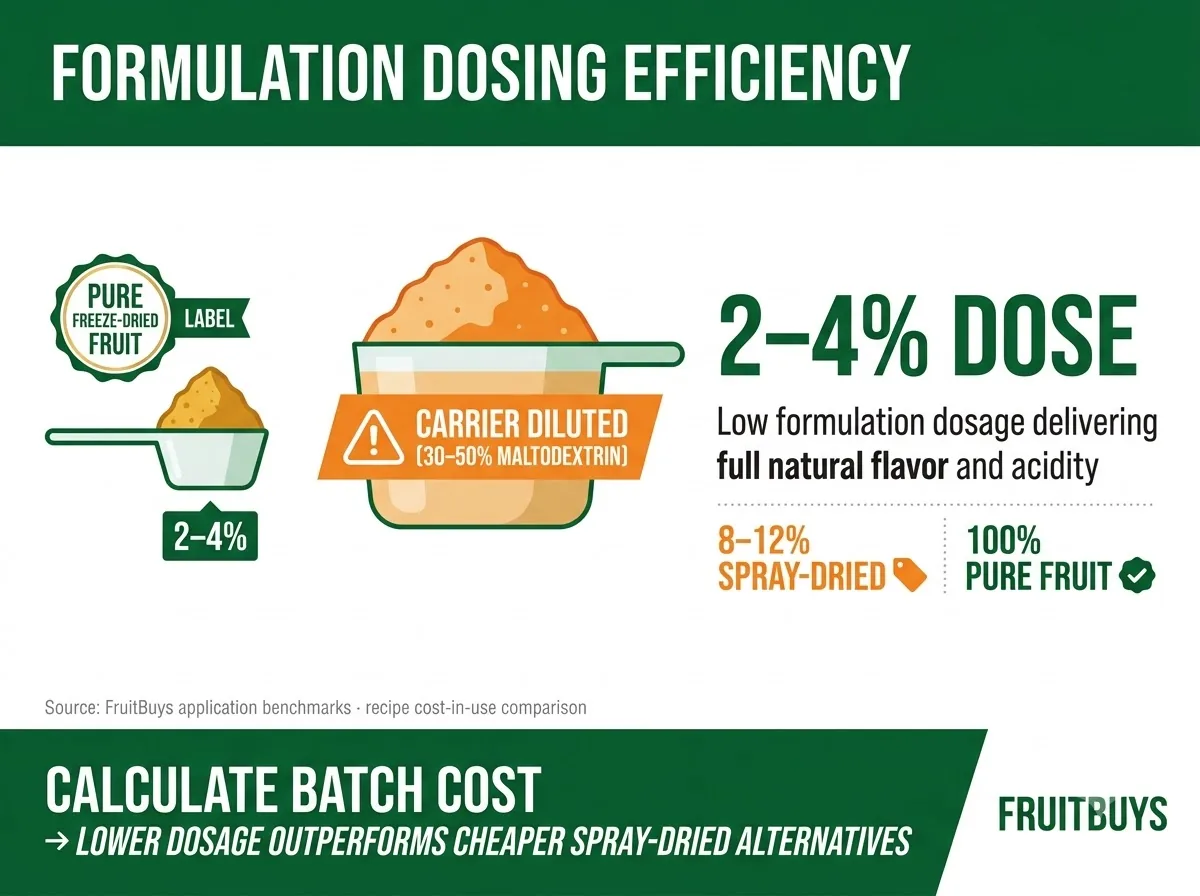
Dosage is where freeze-dried powder proves its economics. Spray-dried passion fruit powder is cheaper per kilo, but it carries 30–50% maltodextrin and loses most of the fresh aroma in the hot drying tower, so R&D teams often need 8–12% to reach the target flavour. Freeze-dried powder, dried cold under vacuum, usually does the job at 2–4%. Compare the cost per finished batch, not the price per kilo: the freeze-dried powder often wins while holding the clean-label claim. Combine the powder with cubes where shoppers need to see the fruit: powder in the coating carries flavour into every bite, and freeze-dried passion fruit cubes add the black-and-gold signature.
Milling and packing process
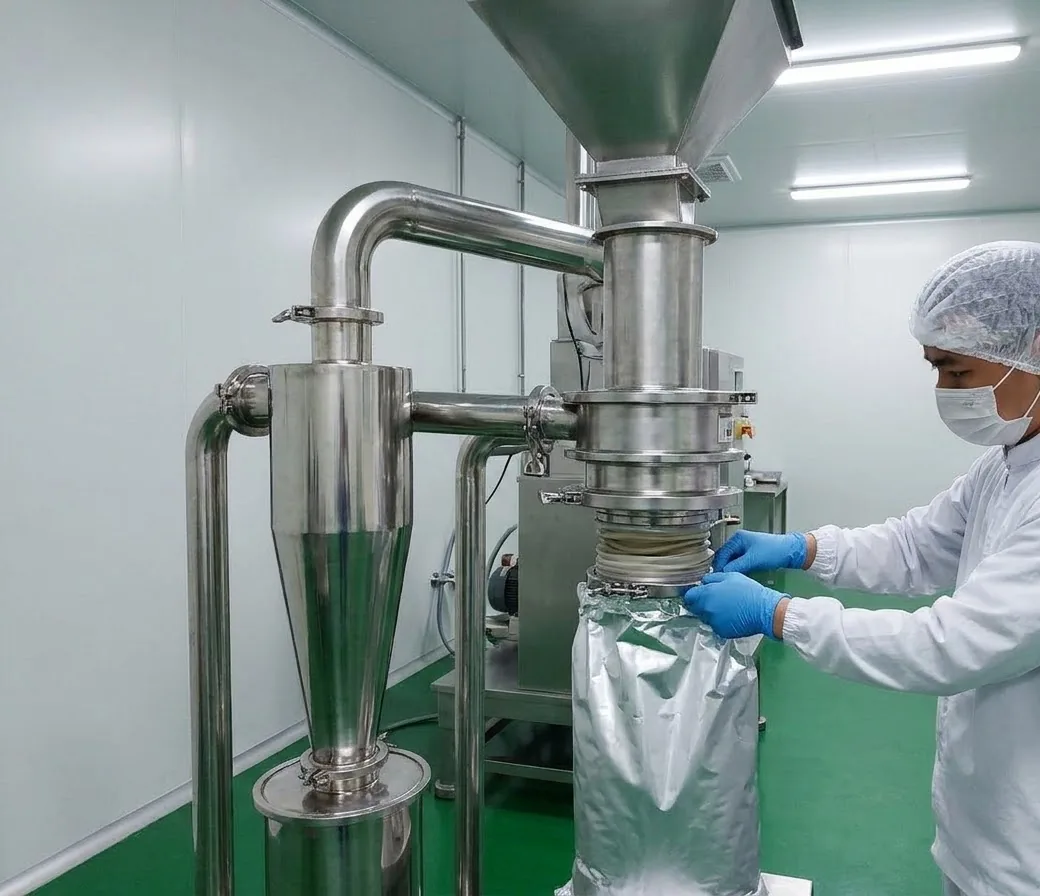
Powder can only gain moisture after it leaves the drying chamber, never lose it, so the milling room decides the finished quality. FruitBuys’ partner facilities cold-mill to stop the passion fruit sugars smearing on the sieve and scorching the aroma, inside a humidity-controlled room held at 22–25 °C and RH under 35–40%. Milled powder moves straight into foil bags.
| Item | Detail |
|---|---|
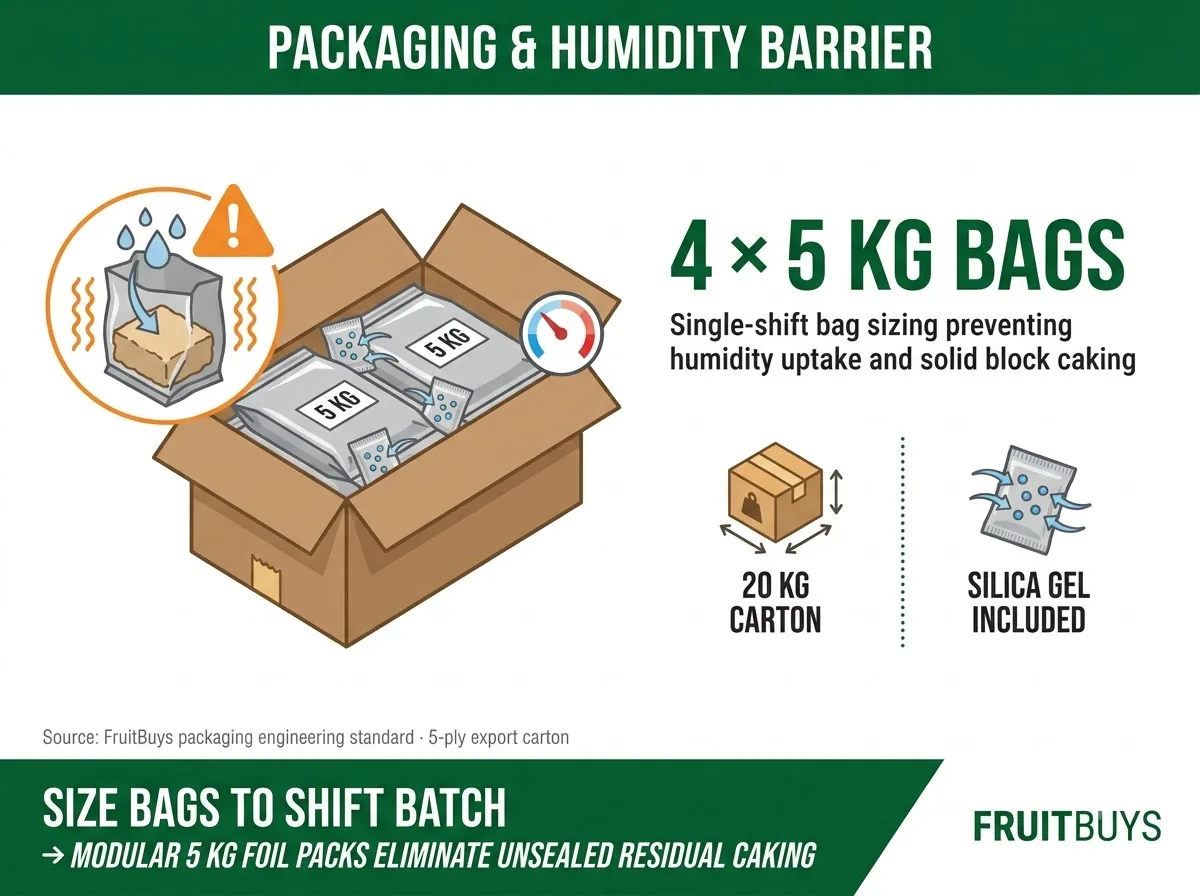
| Bulk bag | 5 kg or 10 kg aluminium-foil PE bags, de-aerated, with a food-grade silica gel desiccant sachet; no nitrogen flushing, no iron-based oxygen absorbers |
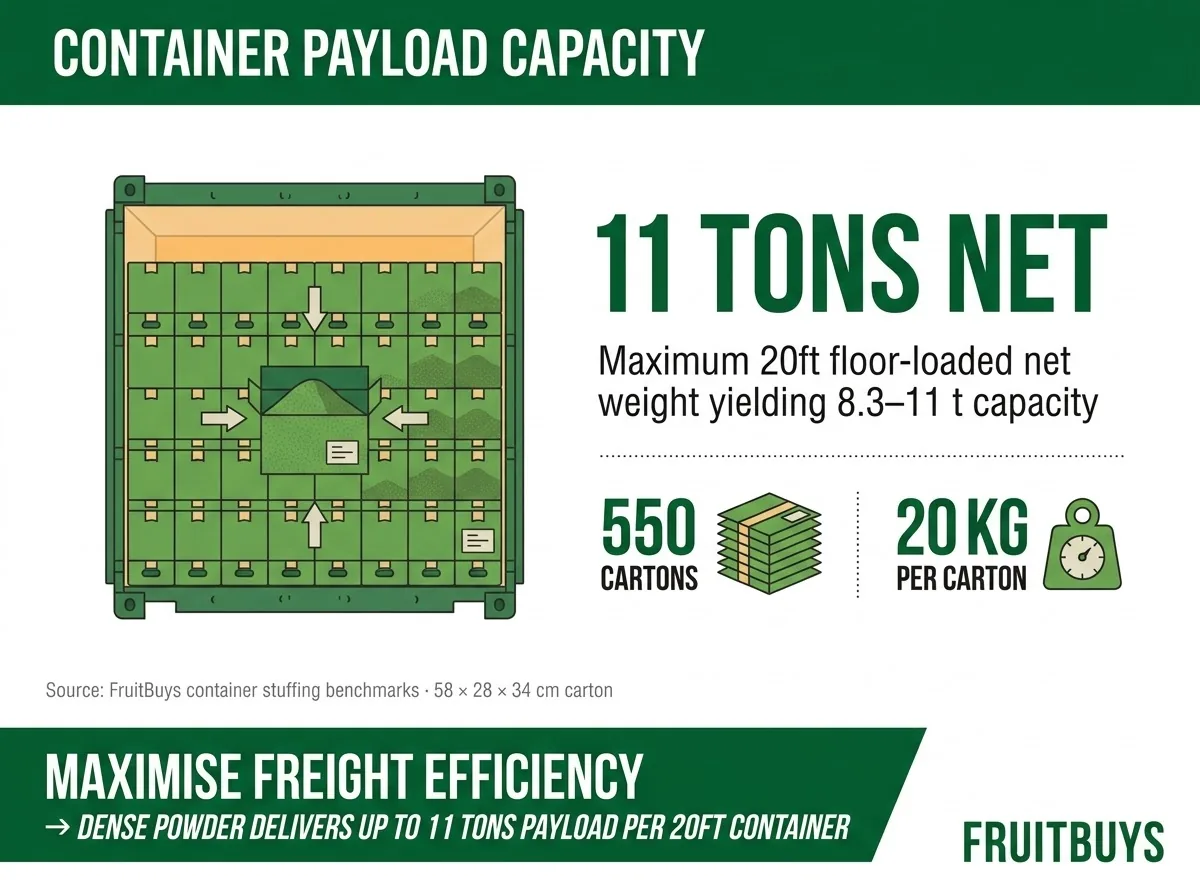
| Carton | 58 × 28 × 34 cm, 20 kg net as 4 × 5 kg bags (standard) or 2 × 10 kg on request |
| Retail (OEM) | Stick packs, sachets, plastic or glass jars, or foil zip pouches |
We recommend the 4 × 5 kg standard per 20 kg carton. A 10 kg bag opened in normal plant humidity and not used within one shift can set into a solid block by the next day. A 5 kg bag matches one shift’s batch on most lines: open the bag in a dry area, use the whole bag, and the remaining bags in the carton stay sealed until the next batch.
Commercial terms
| Term | Detail |
|---|---|
| Supply capacity | Within the total passion fruit capacity of 100 tons/year |
| 20ft, floor-loaded | About 550 cartons, 8.3–11 t net, loaded to order size |
| Trial orders | 50–100 kg, by air freight or LCL |
| Bulk orders | From 200–500 kg upward |
| OEM / private label | MOQ 500 kg |
| Production lead time | 20–30 days after deposit |
| Sample preparation | 3–5 working days |
| Payment | T/T 40% deposit, 60% before shipment or against copy B/L; or L/C at sight |
| Incoterms | FOB, CIF, DDP |
| Port of loading | Cat Lai Port or Tan Son Nhat Airport |
A 100 kg trial order at a 3% dose flavours more than 3 tons of finished product — enough for a full production-line trial before you commit to bulk volume.
Quality and documents
- Every full-container lot: third-party COA for moisture, water activity, total plate count, yeasts & moulds, E. coli and Salmonella.
- Periodic surveillance: lead, arsenic and aflatoxin (total and B1) tested at an ISO/IEC 17025 accredited laboratory. Reports available on request.
- EU release gate: EU-bound containers are released only on a non-detect multi-residue result for omethoate and dimethoate, tested before stuffing.
- Trial and LCL orders: in-house release log plus the baseline surveillance report; an independent third-party COA is arranged at net lab cost and credited in full against your first full-container order.
- Claims: 14 days from devanning for physical checks and water activity; 30 days for laboratory results.
- Facility control: one qualified processing facility is locked per contract, with prior written notice and a new pre-shipment sample before any change, and audit access for you.
- Facility compliance & certifications: HACCP, ISO 22000, BRC (qualified processing facility) and US FDA Facility Registration, with Halal certification available on request.
- Shipment documents: commercial invoice, packing list, bill of lading, COA, Certificate of Origin Form EUR.1, and a phytosanitary certificate with every shipment.
Verify the sample in three steps
- Check the bag. Seal intact, silica gel sachet still dry, powder free-flowing or only softly caked so it crumbles easily between your fingers.
- Sieve and measure. Pass 100 g through an 80-mesh sieve in a dry room; at least 95 g should pass. For water activity, move the sample into the measuring cup and close the chamber within 60 seconds of opening the bag, then let the meter equilibrate, usually 2–5 minutes.
- Test in your real product. Dose the powder at the target rate in your actual base and check colour, aroma and dispersion after one week of storage.
FAQ
Is freeze-dried passion fruit powder 100% fruit?
The pure version is 100% fruit. The free-flowing version adds up to 1% silicon dioxide; the carrier version adds 5–10% maltodextrin or tapioca starch.
Why are there tiny black flecks in some powders?
They are finely milled passion fruit seeds in the seed-in version. Choose seedless if you need a fully uniform golden colour.
How much should I use?
Typically 2–5% of the total formula.
What is the minimum order?
Trial orders from 50–100 kg, bulk from 200–500 kg, private label from 500 kg.
How is it different from spray-dried powder?
Spray-dried powder is juice dried hot with 30–50% maltodextrin. Freeze-dried powder is the whole fruit pulp, cold-milled after freeze-drying, at up to 100% pure fruit.
Request a sample and quote
Send the details below and we return a specification, sample and terms in one reply:
- Destination country and port
- Application and target dosage
- Base: seedless or seed-in
- Version: pure, free-flowing or carrier
- Filling and packing equipment (mixer, dosing auger, stick-pack machine)
- First-order volume: trial, bulk or full container
- Annual volume and preferred delivery months
- Packaging: 5 kg / 10 kg bulk bags, or retail format
- Labelling market
- Extra tests required by your market or customer