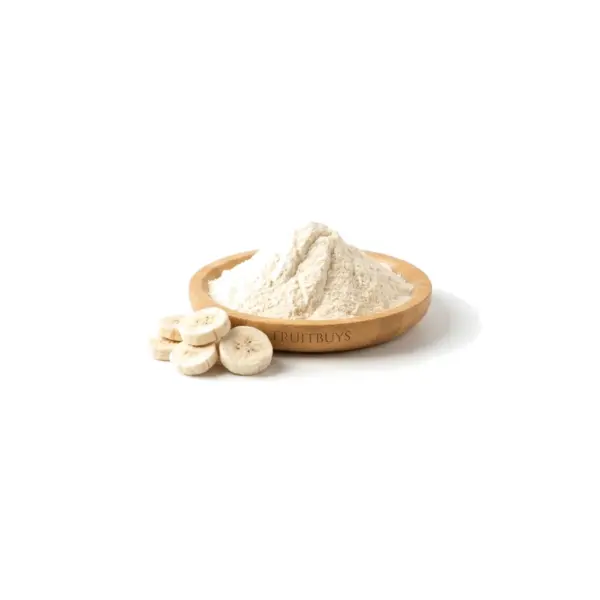
Freeze-Dried Banana Powder
Freeze-dried banana powder is ripe Vietnamese banana, sliced, frozen at −35 to −40 °C, dried under vacuum and milled cold to 60–80 mesh. It ships at ≤5.0% moisture and water activity ≤0.30. Banana is the only fruit in the bag and nothing else bulks it out: 0% maltodextrin, no carrier, no added sugar and no added sulfites. That is the difference you taste against spray-dried banana powders built on 30–50% carrier. In a shake, premix, cereal or ice cream it brings ripe banana flavour, natural sweetness and a creamy body, plus 1,600 mg of potassium per 100 g from the fruit itself.
Container orders run on a dedicated powder line, from freeze-dryer to chilled mill to foil in a dehumidified room, and every container lot ships with a third-party COA. To set the contract terms and compare it with spray-dried and drum-dried powders, read what to specify before buying freeze-dried banana powder in bulk.
Product specification
| Parameter | Specification |
|---|---|
| Composition | Standard: banana with ascorbic acid and citric acid from the anti-browning dip; 0% maltodextrin, no carrier, no anti-caking agent, no added sugar, no added sulfites · Free-flowing: + up to 1% silicon dioxide (E551), for high-speed filling lines · No-dip line: banana only, natural honey-gold colour, custom run from 500 kg |
| Production | Container orders: dedicated powder run; banana cut for fast, even drying, freeze-dried and milled straight after on a closed chilled line · Trial and flexible lots: milled from export-grade slices of released lots · Same release limits for both |
| Lines | Cavendish G9 base line: lowland fruit from Dong Nai, Binh Duong and the Mekong Delta, stage 5–6, 20–22 °Brix; body and rounded sweetness · Laba flavour line: Lam Dong highlands, 24–26 °Brix; markedly stronger banana aroma · Harvested year-round |
| Milling | Chilled milling system in a dehumidified room at 22–25 °C, below 35–40% RH |
| Fruit per kilo | 5–6 kg of peeled banana flesh per kg of powder |
| Particle size | 60–80 mesh (about 180–250 µm), ≥95% passing |
| Moisture | Typically 2–4% off the dryer; released at ≤5.0% |
| Water activity | ≤0.30 |
| Colour / taste | Standard: cream to pale yellow, even, no dark specks · Ripe banana, sweet, no cooked note |
| Texture in the bag | Soft clumps from natural fruit sugar that fall apart on stirring or sieving; no hard caking |
| Total plate count | ≤10⁴ CFU/g |
| Yeasts & moulds | ≤10² CFU/g |
| E. coli | <10 CFU/g |
| Salmonella | Not detected / 25 g |
| Shelf life | 12 months at ≤25 °C, RH ≤60%; 18–24 months in cool storage at ≤18 °C, RH ≤50% |
| HS code | 1106.30, powder of Chapter 8 fruit; slices and dice sit under 0803 |
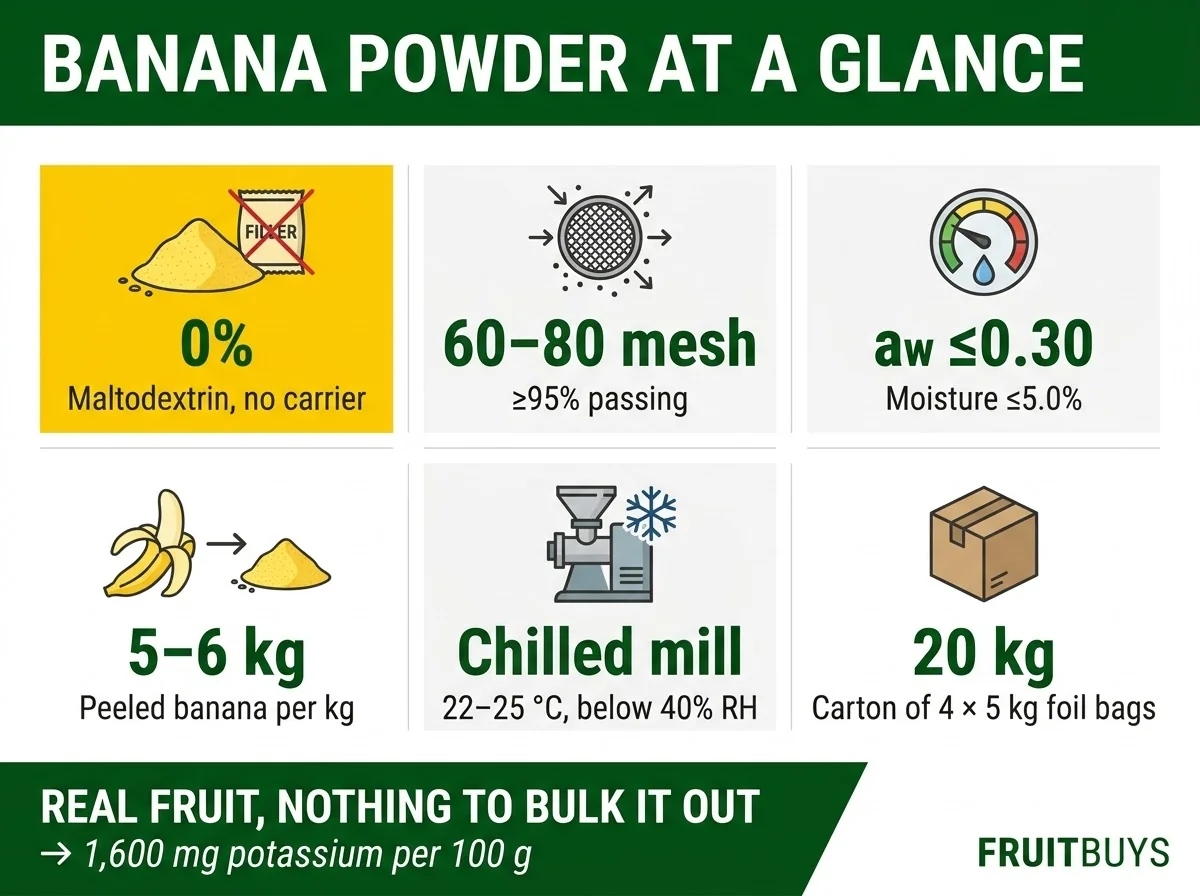
The 2–4% gap is your safety buffer. Lots leave the dryer at 2–4% moisture and are released against a ≤5.0% limit. A container spends four to six weeks at sea through warm ports and cold nights, and that margin is what keeps the powder loose and pale when your team opens the first bag.
Why the dip matters more in powder than in slices. Milling multiplies the surface of every particle, so any browning in the fruit shows across the whole bag as a dull beige powder. The vitamin C and citric acid dip that keeps slices cream before freezing keeps the powder bright in a white shake or vanilla ice cream. Total acid stays at 2% or less and slices are rinsed before freezing, so the powder tastes of banana, not lemon. If your label must read banana and nothing else, the no-dip line delivers it in a natural honey-gold shade.
Soft clumps are what real fruit powder looks like. With no maltodextrin or starch to dilute it, the powder is about two-thirds natural banana sugar, and particles pressed together during gentle de-aeration form light clumps. They break with a stir or pass straight through a sieve. A powder that never clumps at all usually has a filler in it. Hard, rock-like caking is different: it means water reached the powder, and it is covered by the 14-day arrival check.
Two lines, two jobs. Cavendish G9 is the base: body, rounded sweetness and steady supply for premixes, cereals and bakery. The Laba flavour line, from highland fruit at 24–26 °Brix, carries a markedly stronger banana aroma through drying and milling. In ice cream, puddings, artisan bakery and drinks where banana leads, it lets R&D cut or drop added banana flavouring and keep the ingredient list to real fruit.
Nutrition (per 100 g)
| Nutrient | Amount |
|---|---|
| Energy | 370 kcal (US convention) / 360 kcal (EU convention) |
| Total fat | 0.5 g |
| Saturated fat | 0.2 g |
| Sodium | 5 mg |
| Total carbohydrate | 88 g |
| Dietary fibre | 7 g |
| Total sugars | 65 g, naturally occurring (0 g added) |
| Protein | 4 g |
| Potassium | 1,600 mg |
Typical harvest values for freeze-dried banana; natural sugars and potassium move within ±5–10% with season and ripeness. Lot nutrition panel available for label artwork.
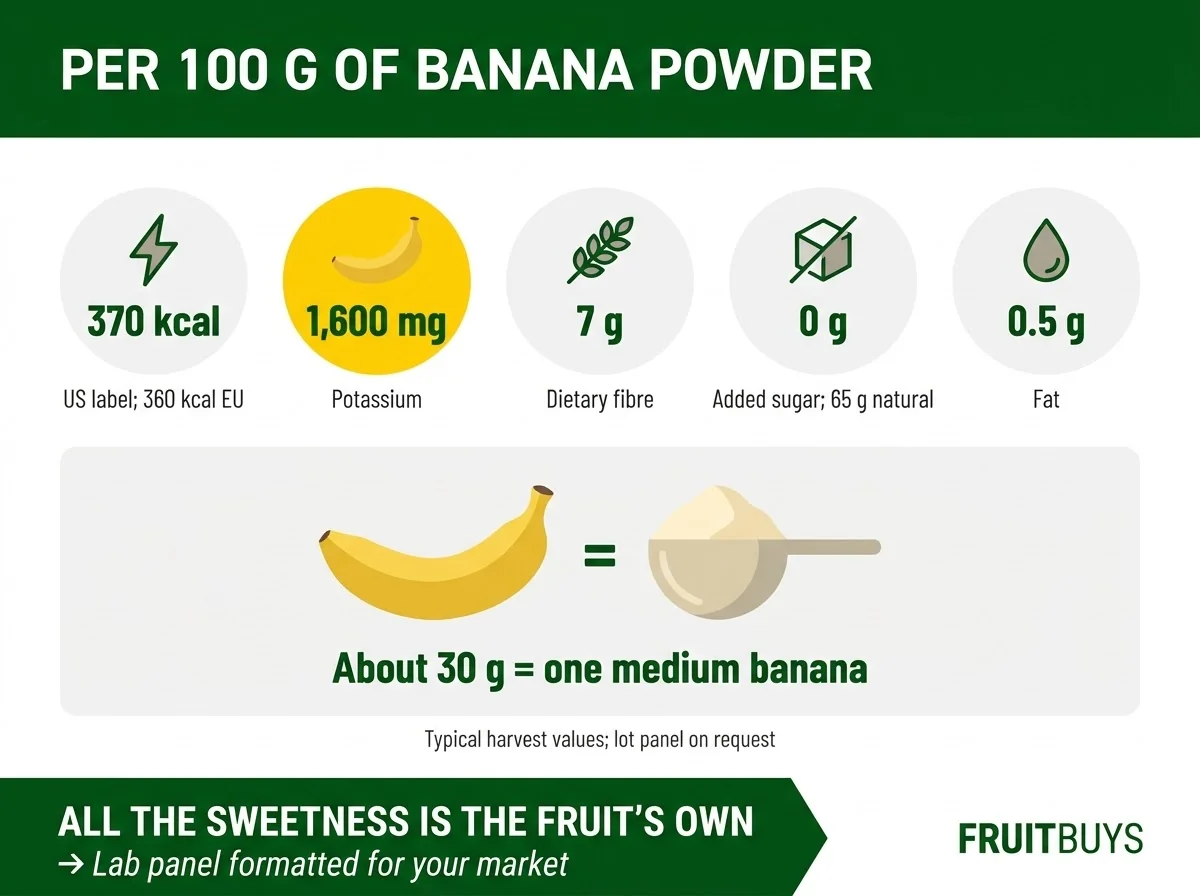
The two energy figures follow two label conventions: US labels count fibre in total carbohydrate, while EU labels count it at 2 kcal/g. About 30 g of powder carries the fruit of one medium banana, a useful anchor for a “one banana in every serving” message. For your printed label, FruitBuys samples your commercial lot and arranges the nutrition panel at an independent ISO/IEC 17025 accredited laboratory, formatted for your market. Claim rules by serving are in freeze-dried banana nutrition facts.
Applications and dosing
| Application | Typical dose | What it brings |
|---|---|---|
| Smoothie, shake and protein premixes | 5–10% | Banana flavour and natural sweetness; fruit fibre gives a creamy body; rounds off protein notes |
| Baby cereal and porridge bases | 5–10% | Fruit sweetness with 0 g added sugar (category rules set by your market) |
| Bakery mixes, fillings, cookies | 3–8% | Real-fruit flavour and a “made with banana” ingredient line |
| Ice cream, yogurt, desserts | 3–6% | Flavour and a pale, natural colour without flavouring |
| Chocolate, coatings, compound | 3–5% | Banana in every bite of a fat-based system, with no added water |
| Stick packs and sachets on auger lines | As formulated | Free-flowing version keeps the line running |
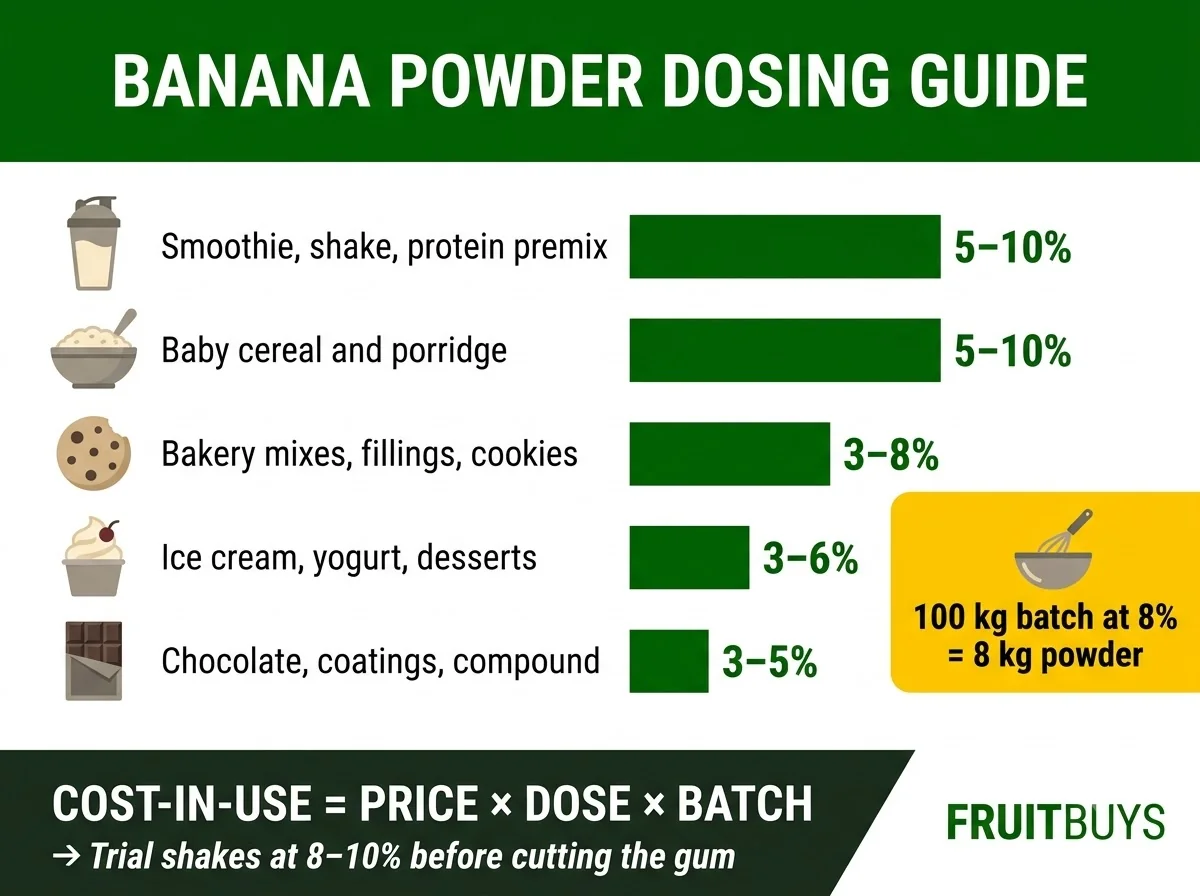
Shakes and smoothies: body from the fruit. Freeze-drying leaves the fruit as a porous structure that keeps its fibre. The powder disperses as soon as it is shaken into cold water, milk or plant milk and thickens the drink as it hydrates. In many premixes that natural body lets R&D reduce xanthan or guar gum and shorten the label. Trial it at 8–10% against your current formula before you cut the gum.
Chocolate and fat-based systems: two R&D rules.
- Particle size. At 180–250 µm the powder is coarser than solid chocolate, which is refined to around 30 µm. Add banana powder with the sugar and milk powder before refining, never into finished chocolate, where it feels gritty. Fillings and compound coatings take it as supplied.
- Dryness. Chocolate seizes when it meets water. At aw ≤0.30 the powder adds fruit without free water, so it does not push moisture into the shell and cause sugar bloom. That is why it works where purée or juice cannot. Keep bags sealed until the moment of dosing.
Banana powder often earns its place by replacing added sugar as much as by adding flavour. At 65% natural sugars, a 10% dose in a shake premix brings sweetness that would otherwise sit on the label as added sugar. Cost-in-use is one line: powder price per kg × dose × batch weight. A 100 kg premix batch at 8% takes 8 kg of powder, under two 5 kg bags. Pair it with freeze-dried banana slices and dice wherever the consumer should also see and bite the fruit.
How it is milled and packed
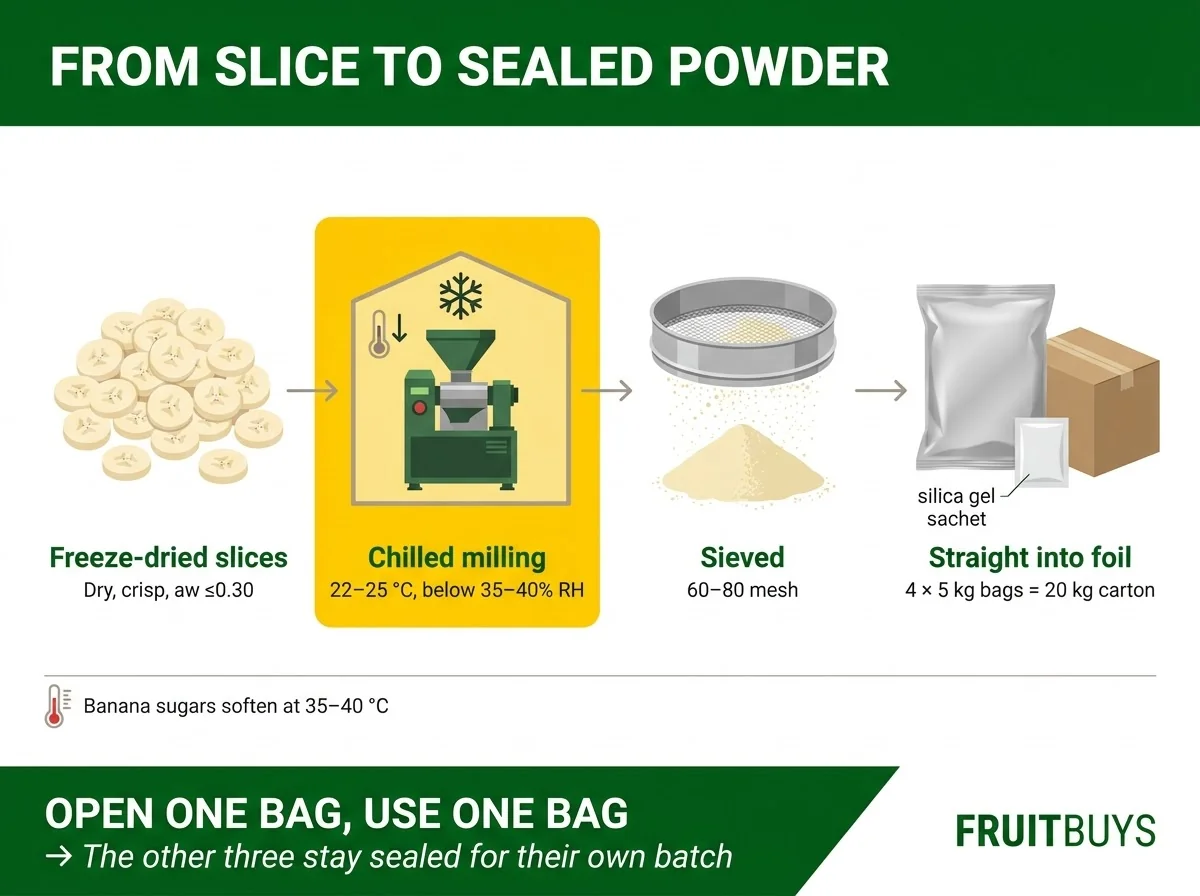
Banana is one of the most hygroscopic fruit powders: two-thirds sugar spread over a fine particle. After the dryer it can only gain moisture, never lose it. In a tropical milling room without chilling, banana sugars soften around 35–40 °C: they smear the screen, overload a standard mill motor and brown the powder. That is why partner facilities mill on a chilled milling system in a dehumidified room at 22–25 °C and below 35–40% RH, and the powder goes straight into foil.
| Item | Detail |
|---|---|
| Bulk bag | 5 kg aluminium-foil PE bags, gently de-aerated, food-grade silica gel sachet; no nitrogen, no iron-based absorbers |
| Carton | 58 × 28 × 34 cm, 20 kg as 4 × 5 kg bags |
| Retail (OEM) | Stick packs, sachets, jars or foil pouches |
A 5 kg bag matches one batch on most lines. Open it in a room below 40% RH and use the whole bag; the other three in the carton stay sealed until their own batch.
Commercial terms
| Term | Detail |
|---|---|
| 20ft, floor-loaded | About 550 cartons, about 11 t, loaded to order size |
| 40ft HC | Mixed load with slices or dice, e.g. about 250 cartons of powder (5 t) on the floor and about 850 cartons of slices (about 6 t) above; powder-only orders ship in 20ft for road weight |
| Freight per kg | About 35% of the freight per kg of slices (20 kg against 7 kg per carton) |
| Trial order | 50–100 kg, air or LCL |
| Bulk order | 200–500 kg and up |
| OEM / private label | MOQ 500 kg; no-dip line from 500 kg |
| Capacity | 100 t/year of finished freeze-dried banana across slices, dice and powder |
| Production lead time | 20–30 days per 20ft after deposit |
| Samples | Prepared in 3–5 working days |
| Payment | T/T 40% deposit, 60% before shipment or against copy B/L; L/C at sight |
| Shipping terms | FOB Cat Lai, CIF or DDP |
| Port of loading | Cat Lai Port (sea) or Tan Son Nhat Airport (air) |
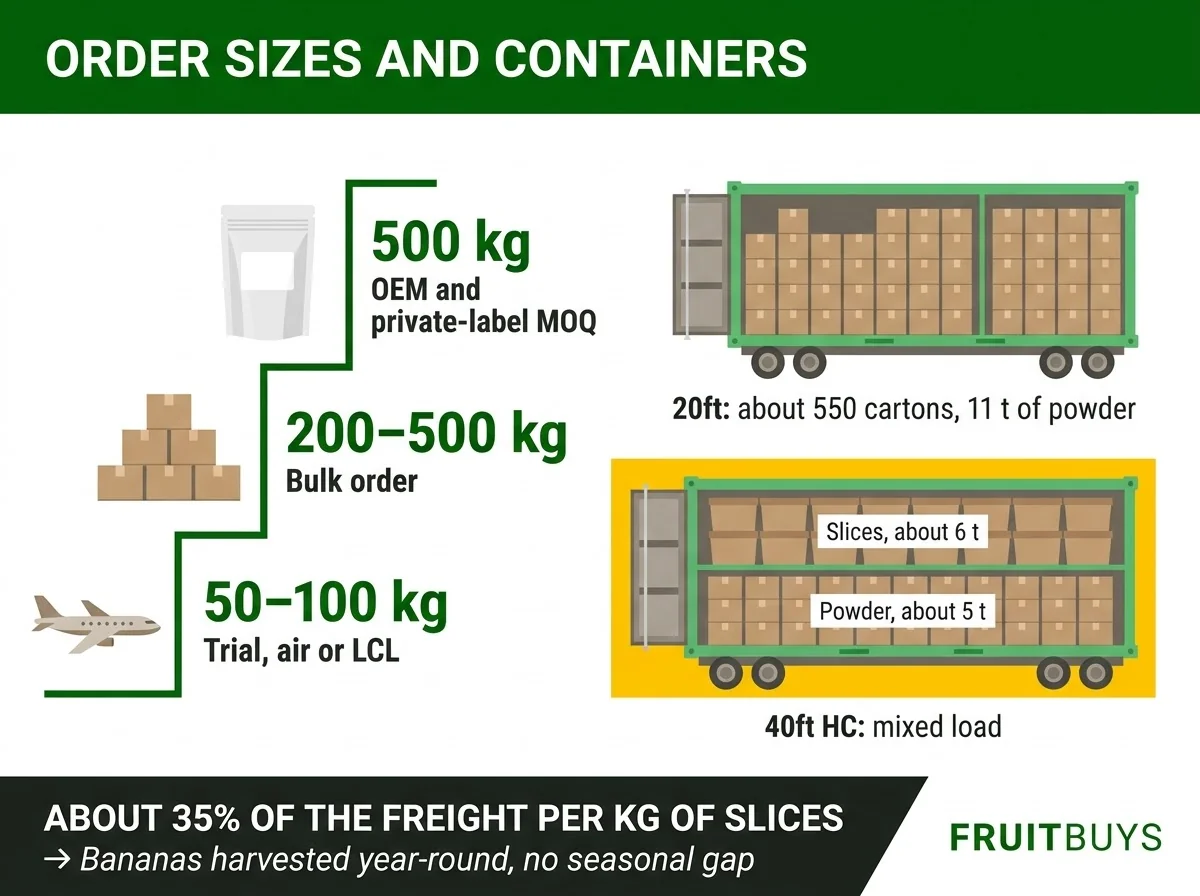
Bananas are harvested year-round in Vietnam, across lowland farms near Cat Lai and the Lam Dong highlands. Powder supply has no seasonal gap, so repeat orders follow your production plan, not a harvest calendar. The full sourcing picture is on the freeze-dried banana wholesale and bulk guide.
Quality and documents
- Every full-container lot: third-party COA for moisture, water activity, total plate count, yeasts & moulds, E. coli and Salmonella.
- Periodic surveillance: lead, arsenic and aflatoxin (total and B1) at an independent ISO/IEC 17025 accredited laboratory. Reports available on request.
- Trial and LCL orders: in-house release log plus the surveillance report. An independent COA is available at net lab cost in 3–5 working days, credited in full against your first container.
- EU residue panel: for EU contracts, a pre-shipment pesticide panel including ethephon and post-harvest fungicides is coordinated before stuffing, as an optional panel paid by the buyer or shared by volume.
- Claims: 14 days from devanning for packaging, appearance, caking and water activity; 30 days for laboratory results.
- Facility control: one qualified processing facility locked per contract, written notice and a new pre-shipment sample before any change, and audit access for your QA team.
- Facility certifications: HACCP, ISO 22000, BRC (qualified processing facility) and US FDA Facility Registration, with Halal certification available on request.
- Shipment documents: commercial invoice, packing list, bill of lading, COA, Certificate of Origin Form EUR.1 for the EU and UK, and a phytosanitary certificate with every shipment as part of the standard export dossier, so your broker clears without chasing paperwork.
Import and labelling
- Classification: declare the powder under heading 1106.30 (flour, meal and powder of Chapter 8 fruit), not the banana heading 0803 used for slices. In the US the national line is HTS 1106.30.20 for banana and plantain powder; your broker confirms the line and duty at entry.
- EU and UK: Form EUR.1 claims the preferential rate under the EU–Vietnam Free Trade Agreement and the UK–Vietnam agreement. Check the UK line on the UK Trade Tariff for banana powder.
- Ingredient line: Banana, antioxidant (ascorbic acid), acidity regulator (citric acid), plus anti-caking agent (silicon dioxide) on the free-flowing version. The no-dip line reads banana. No sulfites are added, so no sulfite allergen line is needed.
- Front of pack: sell on real fruit, 0% maltodextrin, no added sugar and potassium. Market-by-market import detail is in what freeze-dried banana needs to clear US, EU, UK and UAE customs.
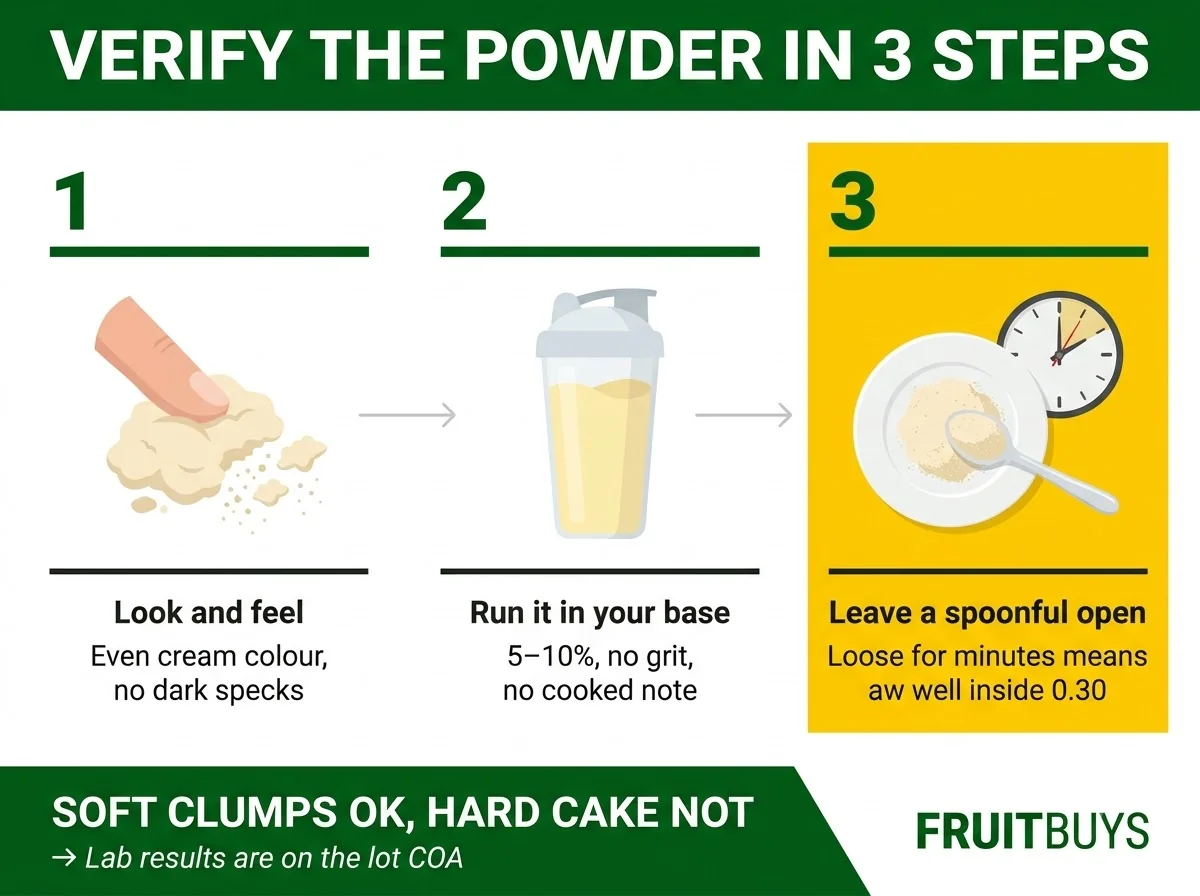
Verify the sample in three steps
- Look and feel. Even cream to pale-yellow colour with no dark specks (honey-gold on the no-dip line). Free-flowing powder or soft clumps that break under a finger. Moisture, water activity and microbiology are on the lot COA.
- Run it in your base. Blend at 5–10% into milk, water or your premix. It should disperse without grit and taste of ripe banana with no cooked or sour note.
- Leave a spoonful open. Put it on a plate in your production room. A powder well inside aw 0.30 stays loose for the first several minutes; one near the limit turns tacky almost at once. That tells you how long a bag can stand open on your line.
FAQ
Is it 100% banana powder?
Banana is the only fruit and there is 0% maltodextrin and no carrier. The standard powder declares the vitamin C and citric acid from the anti-browning dip that keeps it cream-coloured. If your label must read banana only, the no-dip line is made to order from 500 kg.
How much banana powder equals one banana?
About 30 g of freeze-dried banana powder carries the fruit of one medium banana.
How is powder produced for container orders?
On a dedicated powder run: banana is cut for fast, even drying, freeze-dried and milled straight after on a chilled line. Trial and flexible lots are milled from export-grade slices of released lots, to the same limits.
Cavendish or Laba?
Cavendish G9 for body and sweetness in premixes, cereals and bakery. Laba where banana is the lead flavour and you want to cut added flavouring.
Does it contain an anti-caking agent?
The standard powder has none. Silicon dioxide is added only to the free-flowing version for high-speed filling lines.
What sets the price of banana powder per kg?
The fruit behind it (5–6 kg of peeled flesh per kg), the line (Cavendish or Laba), the version (standard, free-flowing or no-dip), the bag size and your annual volume. A quote that looks far cheaper usually carries a carrier or a lower fruit content.
What is the minimum order?
Trials from 50–100 kg, bulk from 200–500 kg, private label and the no-dip line from 500 kg.
Why are there soft clumps in the bag?
They come from the natural fruit sugar in a powder with no filler, and they fall apart on stirring or sieving. Keep bags sealed until use, open them in a room below 40% RH, and choose the free-flowing version for auger and stick-pack lines.
Request a sample and quote
Send these details and we return a specification, sample plan and terms in one reply. The full specification guide is what to specify before buying freeze-dried banana powder in bulk; more fruit powders are in our dried fruit powder range.
- Destination country and port
- Application and target dose
- Line (Cavendish G9 or Laba) and version (standard, free-flowing or no-dip)
- Filling equipment (mixer, auger, stick-pack)
- First-order volume: trial, bulk or container
- Annual volume and delivery months
- Packaging: 5 kg bulk bags or retail format
- Labelling market and any extra tests required by your customer
Prefer to talk it through? Email [email protected] or WhatsApp +84 919 739 589.