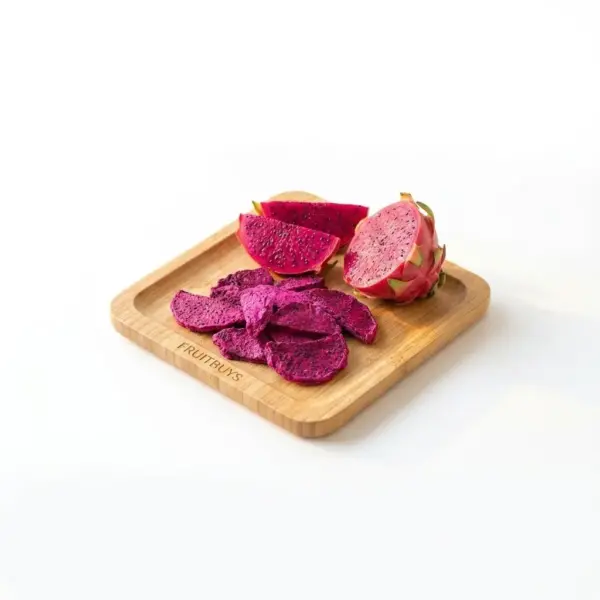
Freeze-Dried Red Dragon Fruit
Freeze-dried red dragon fruit is peeled red-flesh pitaya, frozen and dried under vacuum into a crisp piece released at 3.0–4.0% moisture and aw ≤0.25, keeping the fruit’s magenta colour and black seed pattern. FruitBuys supplies it from Vietnam in bulk cartons and private-label retail packs.
It serves brands building premium cereal, snack, smoothie-bowl and confectionery lines, and importers and distributors. It belongs to our freeze-dried fruit range.
The colour is the fruit’s own betacyanin pigment, so your label reads “dragon fruit” and nothing else while the product still looks vivid pink on shelf. Comparing suppliers? Our guide to buying freeze-dried dragon fruit in bulk lists the checks that separate a working supply from a cheap quote.
Product specification
| Item | Specification |
|---|---|
| Product | Freeze-dried red dragon fruit (red pitaya) |
| Ingredient | 100% red-flesh dragon fruit (Selenicereus monacanthus), peeled; no sugar, preservatives or colours added |
| Origin | Vietnam: Lam Dong coastal belt (former Binh Thuan) and the Mekong Delta (Long An, Tien Giang); main season April–October, light-induced off-season crop November–March |
| Forms | Natural pieces 10–25 mm (standard); slices 5–8 mm; dice 10 mm or 5 mm; custom cuts |
| Texture / colour / taste | Crisp, porous, melts on the tongue; deep magenta with visible black seeds; clean, mildly sweet with a light tartness |
| Raw-fruit Brix (working range) | 11–14 °Brix main season; 9–11 °Brix off-season |
| Moisture | ≤5.0% contract limit; release ≤4.0%, typically 3.0–4.0% |
| Water activity | ≤0.30 contract limit; release ≤0.25 |
| Total plate count | ≤10⁴ CFU/g |
| Yeasts and moulds | ≤10² CFU/g |
| E. coli / Salmonella | <10 CFU/g / not detected in 25 g |
| Size tolerance / fines (3 mm screen) | ≥85% on size; dice ≤3–5%, pieces ≤5–8%, slices ≤8–10% |
| Bulk density (working range) | Dice 0.20–0.28 g/ml; slices 0.08–0.15 g/ml: the reason a carton holds 10 kg of dice but 7–8 kg of slices, and the figure to size retail pouches on |
| Production yield | 13–15 kg whole fresh fruit → 8–9 kg peeled flesh → 1 kg finished product |
| HS code | 0813.40; EU CN 0813 40 65 (dried pitahaya) |
| Shelf life | 12 months at ≤25 °C, RH ≤60%; 18–24 months in cool storage at ≤18 °C, RH ≤50%; original foil bag with desiccant |
The moisture buffer: FruitBuys releases at aw 0.25. Southern Vietnam packs in tropical humidity, and every port stop and customs opening pulls moisture back toward the fruit. FruitBuys drives each lot a full step below the 0.30 contract limit, so the piece still snaps and the magenta still glows when your team opens the bag in a cold warehouse weeks later. That buffer is what keeps soft lots, claims and returns off your books. Full contract limits and the lot COA are set out in freeze-dried dragon fruit moisture, water activity and COA.
Season, sweetness and colour. Main-season fruit (April–October) comes in at 11–14 °Brix with the deepest magenta; light-induced off-season fruit (November–March) runs smaller at 9–11 °Brix and keeps supply open year-round. Rainy months add water to the fruit, so more fresh fruit goes into each kilogram. For a flavour profile that holds steady across a year, lock an annual volume and FruitBuys allocates main-season fruit to your programme.
Nutrition baseline (per 100 g, laboratory analysis)
| Nutrient | Amount | % Daily Value* |
|---|---|---|
| Calories | 400 kcal | |
| Total fat | 6 g | 8% |
| Saturated fat | <2 g | <10% |
| Trans fat | 0 g | |
| Cholesterol | 0 mg | 0% |
| Sodium | 0 mg | 0% |
| Potassium | 1,800 mg | 38% |
| Total carbohydrate | 84 g | 31% |
| Dietary fiber | 16 g | 57% |
| Total sugars | 44 g (naturally occurring) | |
| Protein | 8 g | 16% |
*Based on a 2,000 calorie diet.
Typical values for 100% freeze-dried red dragon fruit, from a Eurofins laboratory analysis; natural variation by origin, season and ripeness applies. Red-flesh pitaya also carries 225–360 mg of betacyanin and 150–210 mg of magnesium per 100 g. Run your R&D formulations on these values now; a lot nutrition panel on your commercial lot is available for label artwork. The 6 g of fat comes from the edible black seeds. Full breakdown: freeze-dried dragon fruit nutrition facts.
Formats and applications
| Format | Best fit | Carton fill |
|---|---|---|
| Natural pieces | Trail mix, smoothie-bowl and yogurt toppings, snack packs | 10 kg |
| Slices | Whole-slice retail pouches, cocktail and beverage garnish | 7–8 kg |
| Dice | Breakfast cereal, granola, bakery and chocolate inclusions | 10 kg |
| Powder | Beverages, smoothie and dairy mixes: see freeze-dried dragon fruit powder and what to specify for powder | – |
In the mouth the fruit dissolves in seconds into a fresh, mildly tart sweetness, which is why it lifts a bowl of cereal or yogurt the moment it is added. Fines are pack-out yield. Every point of dust under 3 mm is weight that cannot go into a retail pouch, and in a white granola or cereal it shows up as pink powder on the base. Dice held at ≤3–5% fines run straight from carton to hopper without sieving. Add the fruit after baking to protect colour; in milk or yogurt it softens and bleeds within minutes, so dose at the point of eating, coat it, or switch to powder. Cut-by-cut guidance: freeze-dried dragon fruit formats.
Packaging
| Option | Detail |
|---|---|
| Bulk | 1–5 kg PET/AL/LLDPE barrier bags (100–120 µm), light-vacuum sealed with 50–100 g silica gel, in a 5-ply export carton |
| Export carton | 58 × 28 × 34 cm; 10 kg dice and pieces, 7–8 kg slices |
| Retail / private label | 30 g, 50 g, 100 g, 500 g aluminium-foil zip pouches, gently vacuumed with silica gel, no nitrogen flush; window pouches in high-barrier laminate |
| Storage | ≤25 °C, RH ≤60%, dark; ≤18 °C, RH ≤50% for stock held longer |
The foil blocks light as well as moisture, which is what keeps the pigment bright. Bulk bags are sized to a production batch: open a bag, use the whole bag that shift, and keep half-open bags out of a humid store. Format decides freight cost: dice and pieces fill a carton at 10 kg, so a 40 ft HC carries up to 11,200 kg, 43% more than a 7 kg slice fill. Choose slices for shelf appeal, dice or pieces when landed cost per kilogram decides. See how freeze-dried dragon fruit is packed and loaded.
Commercial terms
| Item | Detail |
|---|---|
| Supply capacity | Around 100 tonnes/year of finished freeze-dried red dragon fruit, pieces and powder, across qualified partner facilities |
| Private label / OEM / ODM | From 500 kg per SKU |
| Samples | Dispatched in 3–5 working days |
| Production lead time | 20–30 days for a 20 ft container, after deposit |
| 20 ft container, floor-loaded | About 550 cartons, 3,850–5,500 kg net |
| 40 ft HC container, floor-loaded | Up to 1,120 cartons, 7,840–11,200 kg net |
| Palletized loading | On request |
| Batch consistency | One processing line runs your programme for the full contract year, so colour, crunch and taste match shipment to shipment; on-site audit access |
| Payment terms | T/T 40% deposit, 60% before shipment or against copy of B/L; L/C at sight |
| Port of loading | Cat Lai Port or Tan Son Nhat Airport |
| Shipping terms | FOB, CIF, DDP (sea and air) |
FruitBuys loads the standard carton floor-stacked in straight columns, which is how a 20 ft reaches about 550 cartons and a 40 ft HC up to 1,120. Your stuffing plan for the chosen cut comes with the booking.
Use the yield to screen quotes. One kilogram of pure freeze-dried dragon fruit takes 13–15 kg of whole fresh fruit: peel is 35–40% of the fruit, trimming and breakage take more, and drying takes the flesh from about 84–87% water to below 4%. When a quote sits far below what that input supports, check three things before the sample: sugar infusion on the ingredient line, moisture above 5% (you are paying for water), and fines above the cut tolerance. How many kilos of dragon fruit make 1 kg of freeze-dried walks through the numbers.
Quality and documents
- Lot COA with every full container: moisture, water activity, total plate count, yeasts and moulds, Salmonella and E. coli, from an independent ISO/IEC 17025 accredited laboratory.
- Baseline surveillance: lead, arsenic and aflatoxin tested on periodic batches; current reports on request.
- Market panels: pesticide multi-residue, cadmium, Listeria, ethylene oxide, sulfite and nutrition panels coordinated before stuffing.
- Trial and LCL orders: free release QC log per batch (moisture, water activity, sensory); independent testing on request, with the fee credited to your first full container.
- Retained samples: kept from every container lot for its full shelf life.
- Certifications: HACCP, ISO 22000, BRC (qualified processing facility), US FDA Facility Registration; Halal certification available on request.
- Standard export dossier with every shipment: commercial invoice, packing list, bill of lading, C/O Form EUR.1, phytosanitary certificate and lot COA, so the container clears on arrival without a document chase.
Import and labeling
- European Union: dried pitahaya enters under CN 0813 40 65 at 0% duty for every origin (EU TARIC). The increased border checks on Vietnamese dragon fruit under Regulation (EU) 2019/1793 apply to fresh fruit, not dried product, so freeze-dried lots go through routine controls. For EU buyers this is a strong reason to move volume from fresh or frozen to freeze-dried; a pre-shipment multi-residue panel is the best insurance. Dragon fruit is not one of the 14 EU allergens.
- United Kingdom: 0% duty for every origin; Form EUR.1 travels in the standard dossier.
- United States: HTSUS 0813.40.90; the facility holds US FDA Facility Registration, and FruitBuys supplies Prior Notice data and the supplier file your FSVP needs. Label to 21 CFR 101.
- UAE / GCC: importer product registration and Arabic labeling for retail packs.
- Documents and test panels by market: freeze-dried dragon fruit market compliance.
Verify the sample
- Snap test: a piece should break cleanly with an audible crack, not bend.
- Colour: deep, even magenta with visible seeds; dull brown-pink means heat damage or an old lot.
- Water activity: read a sealed pouch within minutes of opening; ≤0.30 passes, and FruitBuys releases at ≤0.25.
- Fines: shake 200 g over a 3 mm screen and weigh what falls through against the tolerance for your cut.
- Ingredient line: “dragon fruit” only; any sugar or carrier means a different product.
FAQ
Is the pink colour natural?
Yes. It is betacyanin from red-flesh dragon fruit. The ingredient is 100% fruit.
Will the colour fade?
Light and heat fade it. Sealed foil, cool dark storage and adding the fruit after baking keep it bright.
Why no preservatives?
At water activity ≤0.30 microorganisms cannot grow, so dry fruit in a sealed foil barrier needs no preservative. It holds 12 months at ≤25 °C and RH ≤60%, and 18–24 months in cool storage at ≤18 °C and RH ≤50%.
Does it contain added sugar?
No. The 44 g of sugars per 100 g come from the fruit, concentrated by drying.
How much fresh dragon fruit goes into 1 kg?
13–15 kg of whole fruit, giving 8–9 kg of peeled flesh after peel, trimming and breakage.
Do I get a COA for every lot?
Every full container ships with a lot COA for moisture, water activity, total plate count, yeasts and moulds, Salmonella and E. coli. Trial and LCL orders get a free release QC log backed by baseline reports.
Is this the same as soft-dried dragon fruit?
No. Soft-dried dragon fruit is heat-dried, chewy and higher in moisture; this range is freeze-dried only, crisp and at aw ≤0.25.
How do I start?
Most buyers run a trial lot in full export cartons, approve it against the sample checks above, then move to 20 ft container contracts. Private label starts at 500 kg per SKU.
Request a sample
Send these five details and we return a specification, a container loading plan and a sample schedule in one reply:
- Cut: pieces, slices or dice
- Packaging: bulk carton or retail pouch sizes
- Volume: trial lot and annual estimate
- Destination port and Incoterm
- Market panels beyond the standard COA (e.g. EU multi-residue)
[email protected] · WhatsApp Export +84 919 739 589