
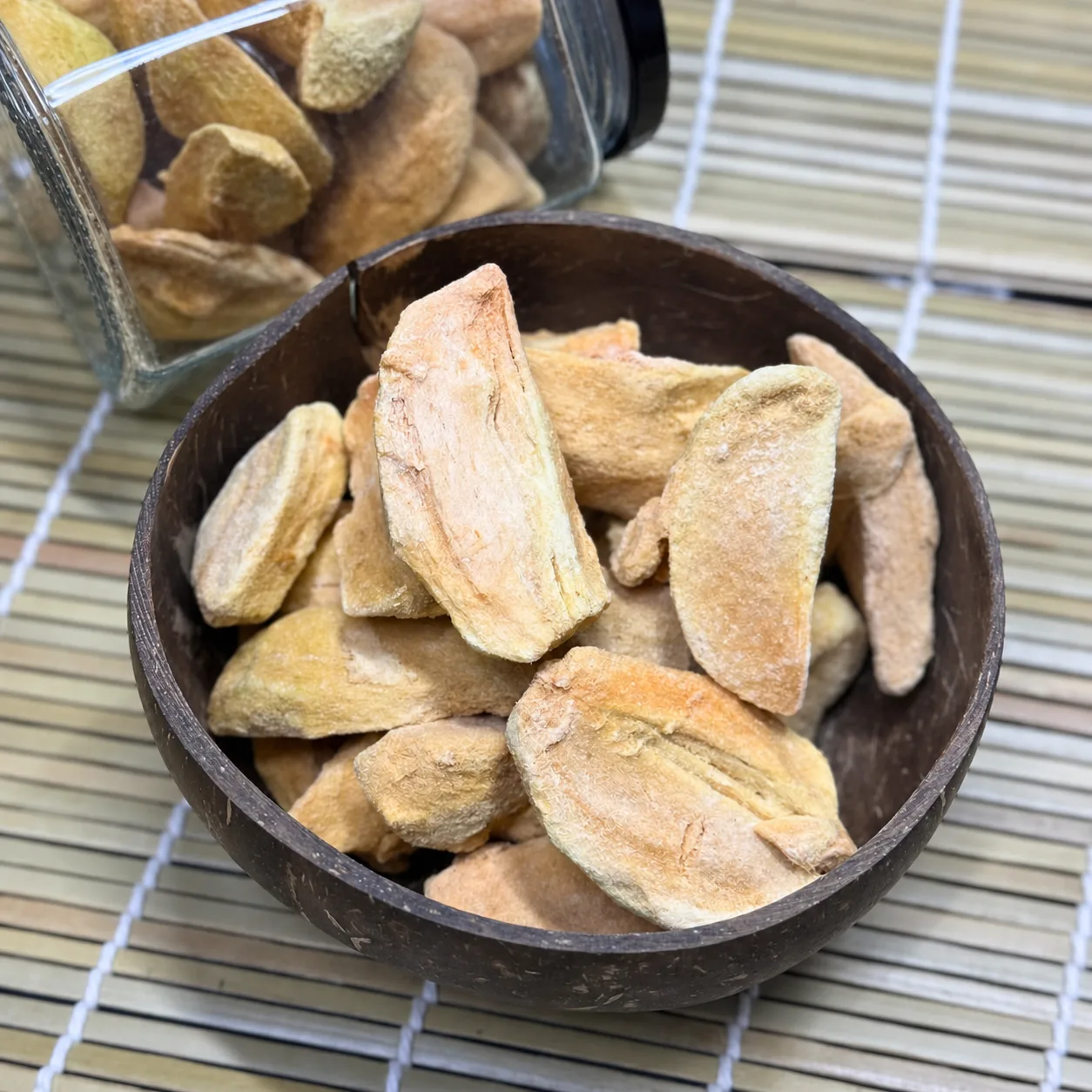
How do you use freeze-dried sapodilla in cereal, chocolate and snack products?
Use it where you want caramel flavour without a sugar line on the label. Freeze-dried sapodilla tastes of brown sugar and malt, and the only ingredient is the fruit. In a breakfast cereal, a dark chocolate bark or a trail mix, that gives your product a dessert note shoppers notice on the first bite and a clean ingredient list your marketing team can put on the front of the pack. Start with 10 mm dice for cereal and bars, natural wedges for snack packs, and dose at 5–15% depending on the product. The rest of this guide sets out the cut, the dose, the pairings and the one rule that keeps it crisp.
What does it taste like, and what story does it give your pack?
Ripe sapodilla tastes like a soft pear dipped in brown sugar, with a malty, almost toffee finish. Freeze-drying keeps that flavour and turns the melting flesh into a crisp, airy bite that dissolves on the tongue, with the fine, pear-like grain that tells the eater this is real fruit. The colour runs from golden tan to light caramel, so it reads as “caramel” in a bowl or on a bar before anyone tastes it.
That profile gives a brand three things to say:
- Caramel taste, fruit ingredient. Sweetness comes entirely from fruit ripened to 18–24 °Brix; the ingredient line reads “sapodilla” and nothing else, with no added sugar, colour or flavouring.
- Numbers that sit well on a label. Per 100 g the fruit carries 23 g of dietary fibre and 850 mg of potassium, with natural fruit polyphenols and zero cholesterol. Once confirmed by a panel on your lot, the fibre level supports a fibre claim; FruitBuys runs that panel for your label artwork.
- A fruit with a following. In South Asian homes it is chikoo; in the Caribbean, naseberry; across Southeast Asia, an everyday market fruit. For those shoppers in the US, UK and EU, a crisp chikoo snack is a taste of home. For mainstream shoppers, it is an exotic fruit few shelves carry yet. One SKU can speak to both.
Wedges, slices or dice: which cut fits which product?
Choose the cut by what the eater sees and how your line doses it.
| Cut | Best fit | Why | Carton fill |
|---|---|---|---|
| Natural wedges 30–50 mm | Retail snack pouches, gift packs, ethnic-grocery packs, trail mix | Whole fruit shape reads as real sapodilla through a window pouch | 7–8 kg |
| Slices 8–10 mm | Whole-slice snack packs, dessert and coffee garnish | Flat face shows the grain; tidy on a plate or cup | 7–8 kg |
| Dice 10 × 10 × 10 mm | Breakfast cereal, granola, chocolate bars and bark, bakery toppings | Even distribution, clean dosing, lowest freight per kg | 10 kg |
| Powder | Smoothie and shake mixes, dairy and beverage blends | Even caramel flavour through a liquid or powder base | 5 kg bags |
Fines matter as much as the cut. Dice are held at ≤3–5% fines through a 3 mm screen, wedges at ≤5–8%, slices at ≤8–10%. Low fines mean no re-sieving labour, no dust at the bottom of the carton lost from your pack-out, and no beige powder settling at the base of a clear cereal bag. Dice also fill a carton at 10 kg against 7–8 kg for wedges, which puts up to 43% more product in the same container. If landed cost per kilogram drives your decision, dice win; if shelf appeal does, wedges.
How much goes into cereal, chocolate and trail mix?
Use these as R&D starting points, then adjust to taste and cost-in-use:
| Product | Starting dose | What the eater gets |
|---|---|---|
| Granola and breakfast cereal | 5–8% | A caramel piece in most spoonfuls |
| Chocolate bark and bars | 8–12% | Visible fruit on the cut face; crisp contrast to the snap of the chocolate |
| Trail mix and snack blends | 10–15% | A hero ingredient worth naming on the front of pack |
Cost-in-use is a one-line calculation for your procurement team: dose × price per kg of freeze-dried sapodilla = fruit cost per kg of finished product. At 6% in granola, one tonne of cereal takes 60 kg of fruit; at 10% in bark, one tonne takes 100 kg. Because the pieces are light, dose by weight but check fill by count: a 10 mm dice cube of freeze-dried fruit weighs far less than the same cube of a dense inclusion, so a little goes a long way visually.
What pairs best: chocolate, coffee, caramel, nut butter?
Anything that already speaks the language of brown sugar.
- Dark chocolate, 60–70% cocoa. The malt note of sapodilla softens the bitterness of the cocoa, and the crisp piece contrasts with the snap of the chocolate. Fold dice into the tempered chocolate just before depositing.
- Coffee and mocha. Roasted coffee and a brown-sugar fruit share the same warm register, and in southern Vietnam sapodilla is a favourite blended with condensed milk and ice, the same flavours as a Vietnamese iced coffee. Use slices as a garnish on iced coffee desserts, or dice in a mocha granola.
- Caramel, toffee and dulce de leche systems. The fruit underlines the caramel and lets you cut back on added caramel flavour while the fruit carries the note.
- Nut butters and roasted nuts. Cashew, peanut and almond pair well. Vietnam grows sapodilla, cashews and robusta coffee side by side, so a sapodilla and roasted cashew trail mix with coffee-dusted chocolate tells a single-origin Vietnamese story on the pack.
- Warm spices. Cinnamon and cardamom bring out the toffee side of the fruit, a natural fit for chai-flavoured cereals aimed at South Asian shoppers.
How do you keep it crisp in yogurt, bars and milk-based products?
Keep the fruit away from free water until the moment of eating. Freeze-dried sapodilla leaves FruitBuys at water activity ≤0.25. Any base wetter than that will pull moisture into the fruit, and because sapodilla is naturally rich in sugar, it softens faster than a tart fruit would. The fix is a choice of format, not a compromise on the fruit:
- Chocolate, compound coatings and fat-based fillings. Fat carries almost no free water, so the fruit stays crisp for the life of the product. This is the easiest home for sapodilla.
- Snack and protein bars. Typical syrup, honey or polyol binders run at aw 0.45–0.65, high enough to soften the fruit within weeks. Bring the binder down to about 0.35–0.38 with glycerine or polyols, or coat the dice in cocoa butter or a fat-based coating before mixing.
- Baked granola clusters. Mix the fruit in after baking and cooling, so it never meets the oven or the steam.
- Yogurt, milk and overnight oats. Pack the fruit in a separate topper compartment or a side pouch, or tell the consumer to add it at the point of eating.
- Shakes, smoothie mixes and beverages. Use the powder, milled to order: it disperses evenly and carries the caramel flavour through the drink. Mesh, flow grade and starting doses are in what to specify before buying freeze-dried sapodilla powder.
Inside your plant, the same logic applies to the bag. Bulk bags are sized to one production batch, so your line tips a whole bag into the mixer in one go and never leaves an open bag on a humid floor. The full moisture and packaging specification is in what moisture and water activity keep freeze-dried sapodilla crisp.
Choose your format with this table
| Your product | Cut | Starting dose | Where to add it | Watch for |
|---|---|---|---|---|
| Breakfast cereal, granola | Dice | 5–8% | After baking and cooling | Fines at the base of the bag: specify ≤3–5% |
| Dark chocolate bark or bar | Dice | 8–12% | Into tempered chocolate before depositing | None; fat protects the fruit |
| Snack or protein bar | Dice, coated if needed | 8–12% | Into the binder at the end of mixing | Binder aw above 0.38 |
| Trail mix, snack blend | Wedges or dice | 10–15% | Dry blend | Breakage in long transport: wedges at ≤5–8% fines |
| Retail snack pouch | Wedges or slices | 100% | Direct pack | High-barrier pouch with desiccant |
| Yogurt or dessert topping | Dice or slices | Topper pack | At the point of eating | Contact with the wet base |
| Shake, smoothie, beverage | Powder | 2–5% | Dry mix | – |
Test it in your own base
The fastest way to decide is a bench trial in your real product. FruitBuys sends wedges, slices and dice from the same lot, so your R&D team can compare cuts side by side in your base within a week of the sample landing. Samples leave within 3–5 working days by express courier. Full specifications are on the freeze-dried sapodilla product page; the yield behind the price is in how many kilos of fresh sapodilla make 1 kg of freeze-dried, and the full supplier checklist is in what to check before buying freeze-dried sapodilla in bulk.
FAQ
What does freeze-dried sapodilla taste like?
Brown sugar and malt, with a light pear-like grain. It is crisp at first bite and melts on the tongue.
Does it contain added sugar?
No. The sweetness comes from fruit ripened to 18–24 °Brix; the ingredient is 100% sapodilla.
Which cut should I use for cereal?
10 mm dice at 5–8%, added after baking. Specify fines at ≤3–5% so the base of the bag stays clean.
Will it stay crisp in a snack bar?
Yes, if the binder sits at about aw 0.35–0.38, or if the dice are coated in a fat-based coating before mixing.
Can I use it in yogurt?
Pack it as a separate topper or add it at the point of eating. In contact with a wet base, any freeze-dried fruit softens within minutes.
Is a powder available?
Yes. FruitBuys mills the same freeze-dried lots to order for shakes, smoothie mixes and beverages; see the freeze-dried sapodilla powder page.
Is it the same fruit as chikoo and naseberry?
Yes. Sapodilla, chikoo, sapota and naseberry are names for the same fruit, Manilkara zapota. You can name it whichever way your shoppers know it on the pack.
About the author
Udo Nguyen is CEO at FruitBuys Vietnam. He coordinates sapodilla sourcing with partner orchards in the Mekong Delta, freeze-drying and milling at qualified partner facilities, and the specifications, loading plans and export documents that importers and food brands use to set their landed cost.



