
What should you check before buying freeze-dried sapodilla in bulk from Vietnam?
Check six things: year-round fruit supply, ripeness at 18–24 °Brix, release at water activity ≤0.25, a standard export dossier with every container, a container plan for your cut, and private-label capability if you are building a brand. Get those right and freeze-dried sapodilla becomes one of the simplest exotic fruits to run as a programme: it grows every month in the Mekong Delta, enters the EU and UK at 0% duty, and tastes like caramel with nothing added. FruitBuys coordinates sourcing from partner orchards across the Mekong Delta, hand-prepares the fruit and ships it in bulk cartons or retail packs under your label. This guide walks through each check and ends with the ten lines to put in your RFQ.
When is sapodilla season in Vietnam, and can you buy every month?
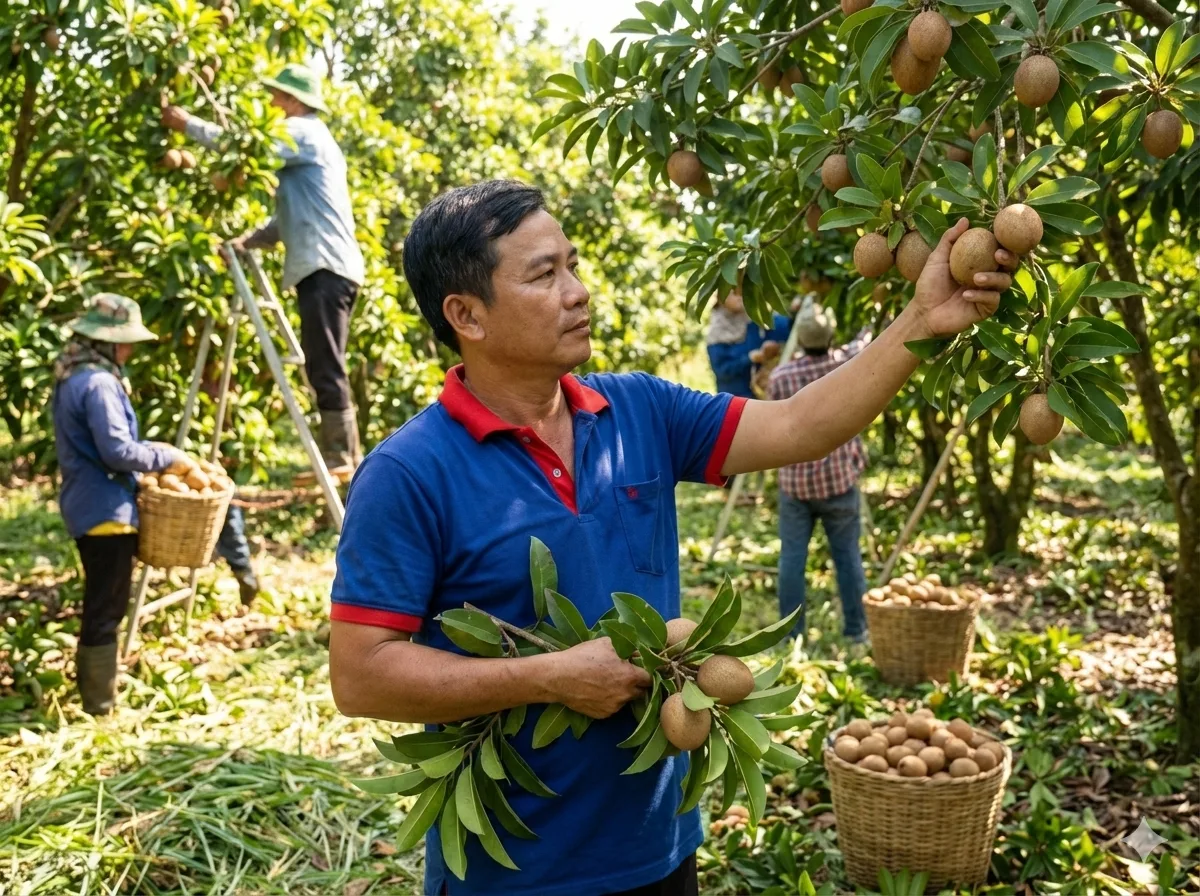
Yes, and that is the first reason to source it from here. In the Mekong Delta, sapodilla trees flower and fruit continuously, so orchards in Tien Giang (around Chau Thanh and Kim Son), Vinh Long and Ben Tre are harvested every month rather than in one short season. Tien Giang alone grows sapodilla on close to 3,000 hectares. For a buyer, that means no harvest window to wait for and no peak-season squeeze on raw material.
FruitBuys books fruit with its partner orchards ahead of each production slot, and allocates fruit to programmes locked for the year first. In the rainy months, when fruit takes up more water and each kilo of finished product needs more fresh fruit, contracted programmes keep shipping on schedule. If you plan a retail line that must be on shelf all year, an annual programme with monthly or quarterly containers is the natural structure.
How does ripeness decide flavour and crispness?
Ripeness is the whole product. Sapodilla is picked mature and finishes ripening after harvest; only then does the firm, milky latex of the young fruit give way to sugar and soft, melting flesh. FruitBuys releases fruit to the line only once it reaches 18–24 °Brix, then hand-peels it clean of skin and latex, removes the seeds by hand and freezes it.
That discipline is what you taste:
- Clean caramel sweetness, with brown-sugar and malt notes and no astringency at the back of the throat.
- Even, crisp structure, because ripe flesh freezes and dries uniformly.
- Consistent colour, golden tan to light caramel across the lot.
It is also why the fruit input is high. Every kilogram of freeze-dried sapodilla takes 6.5–7.5 kg of whole fresh fruit once water, skin, seeds and ripeness sorting are accounted for. That ratio sets a cost floor every buyer should know before comparing quotes; the numbers are worked through in how many kilos of fresh sapodilla make 1 kg of freeze-dried.
Which specification, documents and tests come standard?
The specification your QA team signs is short and firm:
| Item | Standard |
|---|---|
| Ingredient | 100% sapodilla; no sugar, preservatives, colours or flavourings |
| Moisture | ≤4.0% at release (contract ceiling 5.0%) |
| Water activity | ≤0.25 at release (contract ceiling 0.30) |
| Microbiology | TPC ≤10⁴ CFU/g; yeasts and moulds ≤10² CFU/g; E. coli <10 CFU/g; Salmonella not detected/25 g |
| Shelf life | 12 months at ≤25 °C, RH ≤60%; 18–24 months at ≤18 °C, RH ≤50% |
| Certifications | HACCP, ISO 22000, BRC (qualified processing facility), US FDA Facility Registration; Halal certification available on request |
Sapodilla is naturally rich in sugar, and sugar draws moisture from humid air. Releasing at aw 0.25, a full step inside the contract limit, is what keeps wedges crisp through a tropical port and a long voyage. The full specification and receiving routine are in what moisture and water activity keep freeze-dried sapodilla crisp.
Every full container ships with the same dossier: commercial invoice, packing list, bill of lading, C/O Form EUR.1, phytosanitary certificate and a lot COA from an independent ISO/IEC 17025 accredited laboratory. Freeze-dried sapodilla enters the EU and UK under CN 0813 40 65 at 0% duty, and it is not on the EU list of Vietnamese foods under increased border checks. Codes, duty and residue panels by market are set out in what freeze-dried sapodilla needs to clear US, EU, UK and UAE customs.
Before loading, FruitBuys sends a pre-shipment sample of 100–200 g from the packed lot, keeps a retained sample from every container lot for its full shelf life, and runs your programme on one processing line for the full contract year, with on-site audit access for your team.
How much fits in a container, by cut?
Cut decides both the product on shelf and the cost of freight. All cuts ship in the same 58 × 28 × 34 cm export carton, floor-loaded in a standard dry container.
| Cut | Carton fill | 20 ft, about 550 cartons | 40 ft HC, up to 1,120 cartons | Fresh fruit behind a 20 ft |
|---|---|---|---|---|
| Dice 10 mm | 10 kg | 5,500 kg | 11,200 kg | 36–41 tonnes |
| Natural wedges 30–50 mm | 7–8 kg | 3,850–4,400 kg | 7,840–8,960 kg | 25–33 tonnes |
| Slices 8–10 mm | 7–8 kg | 3,850–4,400 kg | 7,840–8,960 kg | 25–33 tonnes |
Dice put up to 43% more product in the same box than a 7 kg wedge fill, so they win when landed cost per kilogram decides. Wedges win on shelf, where the whole fruit shape reads as real sapodilla through a window pouch. Many buyers split a container: wedges for retail, dice for their own cereal or chocolate line. Palletised loading is available on request.
For cereal, chocolate and snack formulations, starting doses and pairings are in how to use freeze-dried sapodilla in cereal, chocolate and snack products.
Can you launch it under your own brand for chikoo and naseberry shoppers?
Yes, from 500 kg per SKU. Sapodilla is one of the rare exotic fruits that arrives with customers already waiting: shoppers from South Asian homes know it as chikoo, Caribbean shoppers as naseberry, and Southeast Asian shoppers as an everyday market fruit. For them, a crisp freeze-dried snack is a taste of home in a modern format. For mainstream shoppers, it is a caramel-flavoured fruit few shelves carry yet. One SKU can serve both.
What FruitBuys supplies for a private-label programme:
| Element | What you get |
|---|---|
| Retail packs | 30 g, 50 g, 100 g and 500 g aluminium-foil zip pouches, gently vacuumed with silica gel; window pouches in high-barrier laminate |
| Printing | Digital print in 7–10 working days for first runs and tests; rotogravure in 15–20 working days for repeat volume |
| Label numbers | Typical nutrition values for artwork now; a nutrition panel on your commercial lot, in US or EU format, before printing |
| Shelf-life support | An accelerated shelf-life study on your final pack if you plan a date beyond 12 months |
| Minimum | 500 kg per SKU |
The pack sells itself on three lines: 100% sapodilla, nothing added; 23 g of fibre per 100 g; and the name your shopper knows, “sapodilla” with “chikoo” alongside. The claims each market allows are set out in what nutrition numbers you can put on a freeze-dried sapodilla label.
What lead time is realistic?
The fixed steps on FruitBuys’ side add up to about five to six weeks from sample request to a loaded container; the variable is how long your bench trial takes.
| Step | Time |
|---|---|
| Samples dispatched by express courier | 3–5 working days |
| Your bench trial and approval | Set by your team |
| Production of a 20 ft container, after deposit | 20–30 days |
| Pre-stuffing laboratory panels (e.g. EU multi-residue) | 3–5 working days, run alongside production |
| Retail pouch printing (private label) | 7–10 working days digital; 15–20 rotogravure, run alongside production |
| Port of loading | Cat Lai Port or Tan Son Nhat Airport |
Payment runs T/T 40% deposit and 60% before shipment or against copy of B/L, or L/C at sight; shipping terms FOB, CIF or DDP by sea or air. Trial and LCL orders are welcome before a full container: they ship with a free release QC log for each batch, and any independent test your QA team needs on a trial lot is credited in full against your first full container.
Is freeze-dried sapodilla the right format for you?
Choose it if you want a crisp, light, shelf-stable fruit with a caramel taste and a one-word ingredient list. If your product needs a softer bite in a bar or bakery base, ask for 8–10 mm slices, which take up moisture from the base fastest; a chewy, air-dried format sits outside the current freeze-dried range, so name it in your RFQ and FruitBuys will advise. If you need a powder for shakes or beverages, FruitBuys mills the same freeze-dried lots to order; the specification checks are in what to specify before buying freeze-dried sapodilla powder. And if your brand requires certified organic fruit, note it in the RFQ and FruitBuys will set out what that programme would take.
Your RFQ in ten lines
Send these and FruitBuys returns a specification, a container loading plan and a sample dispatch date in one reply:
- Format: wedges, slices, dice or powder
- Pack: bulk 1–5 kg bags, or retail pouch sizes for private label
- Volume: trial lot and annual estimate
- Delivery rhythm: monthly, quarterly or one-off containers
- Destination port and Incoterm
- Target market(s): EU, UK, US, UAE or other
- Market panels beyond the standard COA, such as EU multi-residue
- Label needs: nutrition format, claims, name on pack (sapodilla, chikoo)
- Application: snack pack, cereal, chocolate, bar, beverage
- Documents your customer or retailer asks for beyond the standard dossier
Full specifications, packaging and commercial terms are on the freeze-dried sapodilla product page, and the rest of our freeze-dried fruit range can share the same container.
FAQ
Where does FruitBuys source its sapodilla?
From partner orchards across the Mekong Delta in Tien Giang, Vinh Long and Ben Tre, where sapodilla fruits all year.
Is freeze-dried sapodilla available all year?
Yes. The trees fruit continuously, so containers can ship every month. Annual programmes get fruit allocated first in the rainy season.
What is the minimum order?
Trial and LCL orders are welcome; private label starts at 500 kg per SKU.
How much fits in a 20 ft container?
About 550 cartons: 5,500 kg of dice or 3,850–4,400 kg of wedges or slices.
Does it contain added sugar?
No. The ingredient is 100% sapodilla; the sweetness comes from fruit ripened to 18–24 °Brix.
What duty applies in the EU?
0% from every origin under CN 0813 40 65; the UK applies the same.
How long does it keep?
12 months at ≤25 °C and RH ≤60%; 18–24 months in cool storage at ≤18 °C and RH ≤50%, in the unopened foil bag.
Is FruitBuys a manufacturer or a broker?
Neither label fits. FruitBuys Vietnam runs your sapodilla programme from orchard to container: it books fruit with partner orchards in the Mekong Delta, sets the ripeness, peeling and drying standard, locks one qualified partner facility to your contract with written change-control, opens that facility to your audit, and issues the export dossier with the lot COA. You deal with one accountable supplier for every container.
Is chikoo the same as sapodilla?
Yes. Chikoo, sapota, naseberry and sapodilla are names for the same fruit, Manilkara zapota.
About the author
Udo Nguyen is CEO at FruitBuys Vietnam. He coordinates sapodilla sourcing with partner orchards in the Mekong Delta, freeze-drying and milling at qualified partner facilities, and the specifications, loading plans and export documents that importers and food brands use to set their landed cost.



