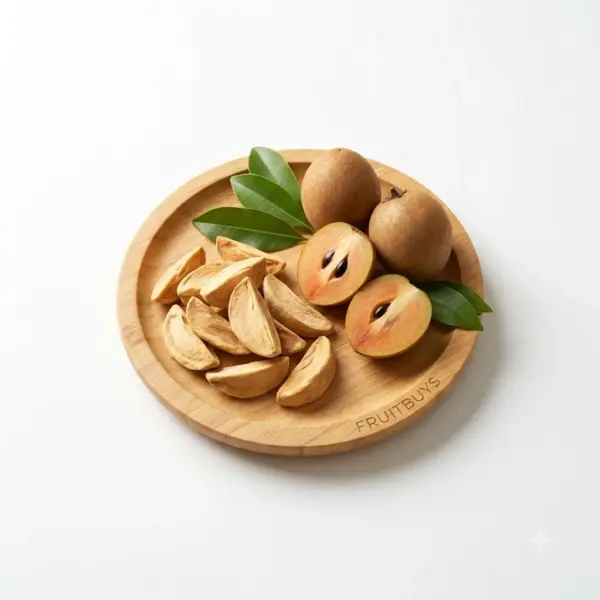
Freeze-Dried Sapodilla
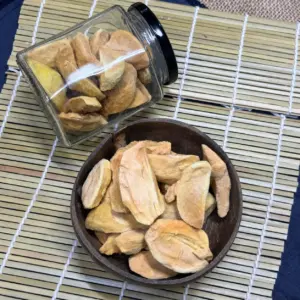
Freeze-dried sapodilla is fully ripe Manilkara zapota, peeled and deseeded, then frozen and dried under vacuum into crisp, low-water-activity wedges with a natural brown-sugar and malt flavour. You may know it as chikoo, sapota or naseberry. FruitBuys supplies it from Vietnam’s Mekong Delta in bulk cartons and private-label retail packs for snack, cereal and confectionery brands, importers and distributors. It belongs to our freeze-dried fruit range.
One bite explains the opportunity: it tastes like a caramel dessert, yet the ingredient line reads “sapodilla” and nothing else. That gives a brand two markets in one SKU: shoppers from South Asian, Southeast Asian and Caribbean communities who already know chikoo and naseberry by name, and mainstream snack and cereal shoppers looking for an exotic fruit few shelves carry yet, with a clean-label caramel taste. Comparing suppliers? Our guide to buying freeze-dried sapodilla in bulk lists the checks that separate a working supply from a cheap quote.
Product specification
| Item | Specification |
|---|---|
| Product | Freeze-dried sapodilla (chikoo, sapota, naseberry) |
| Ingredient | 100% fully ripe sapodilla (Manilkara zapota), peeled and deseeded; no sugar, preservatives, colours or flavourings added |
| Origin | Mekong Delta, Vietnam (Tien Giang, Vinh Long, Ben Tre); harvested every month of the year |
| Forms | Natural wedges 30–50 mm (standard, 6–8 per fruit); slices 8–10 mm; dice 10 mm; custom cuts |
| Texture / colour / taste | Crisp, airy bite that melts on the tongue with sapodilla’s signature pear-like grainy flesh; natural tan to light caramel; brown-sugar and malt notes |
| Raw-fruit Brix (working range) | 18–24 °Brix, hand-sorted at full ripeness |
| Moisture | ≤4.0% at release (contract ceiling 5.0%) |
| Water activity | ≤0.25 at release (contract ceiling 0.30) |
| Total plate count | ≤10⁴ CFU/g |
| Yeasts and moulds | ≤10² CFU/g |
| E. coli / Salmonella | <10 CFU/g / not detected in 25 g |
| Size tolerance / fines (3 mm screen) | ≥85% on size; dice ≤3–5%, wedges ≤5–8%, slices ≤8–10% |
| Production yield | 6.5–7.5 kg whole fresh fruit → about 4.4 kg peeled, deseeded flesh → 1 kg finished product |
| HS code | 0813.40; EU CN 0813 40 65 (dried sapodillo plums) |
| Shelf life | 12 months at ≤25 °C, RH ≤60%; 18–24 months in cool storage at ≤18 °C, RH ≤50%; original foil bag with desiccant |
Ripeness is the flavour. Sapodilla is picked mature and finishes ripening after harvest, and only then does the firm, milky latex of the young fruit give way to sugar and soft, melting flesh. FruitBuys releases fruit to the line only once it reaches 18–24 °Brix, then hand-peels it clean of skin and latex and removes the seeds before freezing. Getting that moment right is the craft of the product, and it is why every wedge carries the clean caramel sweetness and dries to an even crisp structure. Because sapodilla trees flower and fruit all year, the supply runs every month without a peak-season squeeze, and your programme does not have to wait for a harvest window.
Never cooked, so more of the fruit survives. Freeze-drying turns ice straight into vapour at low temperature, so the fruit keeps far more of its natural vitamins, minerals and polyphenols, along with its shape, colour and caramel flavour, than hot-air or heat drying can. That is the story your pack can tell.
The moisture buffer: FruitBuys releases at aw 0.25. Sapodilla is naturally rich in sugar, and sugar is what draws moisture back from the air. FruitBuys drives each lot a full step below the 0.30 contract limit and seals it with silica gel in a foil barrier, so the wedges still snap when your team opens the carton weeks later in a different climate. That buffer is what keeps soft lots and claims off your books.
Nutrition (per 100 g, typical values)
| Nutrient | Amount | % Daily Value* |
|---|---|---|
| Calories | 370 kcal | |
| Total fat | 5 g | 6% |
| Saturated fat | 1 g | 4% |
| Trans fat | 0 g | |
| Cholesterol | 0 mg | 0% |
| Sodium | 55 mg | 2% |
| Potassium | 850 mg | 18% |
| Total carbohydrate | 88 g | 32% |
| Dietary fiber | 23 g | 84% |
| Total sugars | 60 g (naturally occurring) | |
| Protein | 2 g | 4% |
*Based on a 2,000 calorie diet.
Typical values for 100% freeze-dried sapodilla; natural variation by origin, season and ripeness applies. What the panel gives your label: 0 g added sugar, with all sweetness from the ripe fruit; 23 g fibre per 100 g, well above the 6 g level that supports a “high fibre” claim in the EU; and 850 mg potassium. Use these values to design formulations and pack artwork now; when you are ready to print, FruitBuys runs a nutrition panel on your commercial lot in US or EU label format.
Formats and applications
| Format | Best fit | Carton fill |
|---|---|---|
| Natural wedges | Retail snack pouches, trail mix, gift and ethnic-grocery packs | 7–8 kg |
| Slices | Whole-slice retail packs, dessert and coffee garnish | 7–8 kg |
| Dice | Breakfast cereal, granola, chocolate and bakery inclusions | 10 kg |
| Powder | Smoothie and shake mixes, dairy and beverage blends that need even caramel flavour; milled to order from the same freeze-dried lots | 5 kg bags |
The brown-sugar note is the reason R&D teams reach for sapodilla. Three product concepts it fits well:
- Dark chocolate inclusions: malt and caramel notes set against 70% cocoa, with a crisp bite that contrasts the snap of the bar.
- Clean-label snack and protein bars: 10 mm dice spread caramel sweetness through the bar without a sugar line on the label and without adding moisture to the binder.
- Trail mix, cereal and gift packs: whole wedges keep their natural shape, so they read as real fruit through a clear window pouch.
As a starting point for R&D trials, most teams dose 5–8% in granola and breakfast cereal, 8–12% in chocolate bark and bars, and 10–15% in trail mix, then adjust to taste and cost-in-use. The fruit’s natural sugar blends easily into fat-based coatings and baked clusters. For yogurt and milk-based products, pack it as a topper or add it at the point of eating to keep the crunch, and fold it in after baking so the caramel note stays fresh. Dice held at ≤3–5% fines run straight from carton to hopper: no re-sieving labour, and no dust at the bottom of the carton lost from your pack-out.
Packaging
| Option | Detail |
|---|---|
| Bulk | 1–5 kg PET/AL/LLDPE barrier bags (100–120 µm), light-vacuum sealed with 50–100 g silica gel, in a 5-ply export carton |
| Export carton | 58 × 28 × 34 cm; 10 kg dice, 7–8 kg wedges and slices |
| Retail / private label | 30 g, 50 g, 100 g, 500 g aluminium-foil zip pouches, gently vacuumed with silica gel, no nitrogen flush; window pouches in high-barrier laminate |
| Storage | ≤25 °C, RH ≤60%, dark; ≤18 °C, RH ≤50% for stock held longer |
Bulk bags are sized to one production batch, so your line tips a whole bag into the mixer in one go and every piece stays crisp: open a bag, use the whole bag in that shift, and keep unopened bags in the original carton. Format decides freight cost: dice fill a carton at 10 kg, so a 40 ft HC carries up to 11,200 kg, 43% more than a 7 kg wedge fill. Choose wedges for shelf appeal, dice when landed cost per kilogram decides.
Commercial terms
| Item | Detail |
|---|---|
| Supply capacity | 100 tons/year |
| Private label / OEM / ODM | From 500 kg per SKU |
| Samples | Dispatched in 3–5 working days |
| Production lead time | 20–30 days for a 20 ft container, after deposit |
| 20 ft container, floor-loaded | About 550 cartons, 3,850–5,500 kg net |
| 40 ft HC container, floor-loaded | Up to 1,120 cartons, 7,840–11,200 kg net |
| Palletized loading | On request |
| Batch consistency | One processing line runs your programme for the full contract year, so colour, crunch and taste match shipment to shipment; on-site audit access |
| Payment terms | T/T 40% deposit, 60% before shipment or against copy of B/L; L/C at sight |
| Port of loading | Cat Lai Port or Tan Son Nhat Airport |
| Shipping terms | FOB, CIF, DDP (sea and air) |
Use the yield to screen quotes. One kilogram of pure freeze-dried sapodilla takes 6.5–7.5 kg of whole fresh fruit: the flesh is about 78% water, and peeling, deseeding and ripeness sorting take another 30–40% of the fruit before it reaches the drying tray. That is also what makes freeze-dried sapodilla efficient to buy: the peeling, deseeding and sorting are done in Vietnam, and what you ship is fruit solids in a standard dry container, with no reefer, no cold store and 12 months at room temperature. That fruit input also sets a cost floor that physics does not move. A quote well below it is usually paid for in one of three ways: sugar or maltodextrin added to the fruit, heat-dried or hybrid-dried product sold as freeze-dried, or underripe fruit with latex still in it. The sample checks below show all three in minutes.
Quality and documents
- Lot COA with every full container: moisture, water activity, total plate count, yeasts and moulds, Salmonella and E. coli, from an independent ISO/IEC 17025 accredited laboratory.
- Baseline surveillance: lead, arsenic and aflatoxin monitored on periodic batches.
- Market panels: pesticide multi-residue to EU or US limits, cadmium, Listeria, ethylene oxide, sulfite and nutrition panels coordinated before stuffing.
- Trial and LCL orders: free release QC log per batch (moisture, water activity, sensory); independent testing at net laboratory cost, credited in full to your first full container.
- Pre-shipment and retained samples: 100–200 g from the packed lot in two sealed foil pouches; a retained sample from every container lot kept for its full shelf life.
- Certifications: HACCP, ISO 22000, BRC (qualified processing facility), US FDA Facility Registration; Halal certification available on request.
- Standard export dossier with every shipment: commercial invoice, packing list, bill of lading, C/O Form EUR.1, phytosanitary certificate and lot COA, so the container clears on arrival without a document chase.
Import and labeling
- European Union: dried sapodilla has its own named line, CN 0813 40 65 (“dried sapodillo plums”), at 0% duty for every origin (EU TARIC). A code that names the fruit leaves little room for classification disputes at entry. Sapodilla is not one of the 14 EU allergens.
- United Kingdom: the same commodity code, 0813 40 65, at 0% duty, with Form EUR.1 under UKVFTA.
- United States: classified under HTSUS heading 0813.40; the facility holds US FDA Facility Registration, and FruitBuys supplies Prior Notice data and the supplier file your FSVP needs.
- UAE / GCC: importer product registration and Arabic labeling for retail packs. Retail labels can name the fruit “sapodilla” with “chikoo” alongside for South Asian shoppers.
Verify the sample
A quick buyer’s checklist that separates true freeze-dried sapodilla from cheaper look-alikes:
- Snap and melt: a wedge breaks with a clean crack, then melts softly on the tongue without sticking to your teeth. A bend or a chewy pull means heat-dried or high-moisture product.
- Aroma and aftertaste: a light brown-sugar aroma and a clean sweet finish. A dry, puckering feel at the back of the throat means underripe fruit with latex left in it.
- Look: even golden-tan to light caramel, crisp edges and full shape. Shrunken, flattened or scorched pieces point to heat damage.
- Ingredient line: “sapodilla” only; any sugar, maltodextrin or carrier means a different product.
- For your QA team: water activity ≤0.30 on a freshly opened pouch (FruitBuys releases at ≤0.25), and fines through a 3 mm screen within the tolerance for your cut.
FAQ
What does freeze-dried sapodilla taste like?
Brown sugar and malt, with a light pear-like grain. Freeze-drying keeps the shape and flavour of the ripe fruit and turns the soft flesh into a crisp bite that melts on the tongue.
Does it contain added sugar?
No. The sugars come from the fruit, concentrated by drying. The ingredient is 100% sapodilla.
Why no preservatives?
At water activity ≤0.30 microorganisms cannot grow, so dry fruit in a sealed foil barrier needs no preservative. It holds 12 months at ≤25 °C and RH ≤60%, and 18–24 months in cool storage at ≤18 °C and RH ≤50%.
Is sapodilla available all year?
Yes. Sapodilla trees in the Mekong Delta flower and fruit continuously, so fresh fruit is harvested every month and container programmes run year-round.
How much fresh sapodilla goes into 1 kg?
6.5–7.5 kg of whole fruit, giving about 4.4 kg of peeled, deseeded flesh.
Do I get a COA for every lot?
Every full container ships with a lot COA for moisture, water activity, total plate count, yeasts and moulds, Salmonella and E. coli. Trial and LCL orders get a free release QC log backed by baseline surveillance.
Is this the same as dried sapodilla?
No. Most dried sapodilla on the market is air-dried: chewy, darker and much higher in moisture. Freeze-drying keeps the caramel flavour and the shape of the wedge and gives a crisp bite with no sugar added. Need a softer bite for bars or bakery? Ask for 8–10 mm slices, or use the freeze-dried sapodilla powder for an even flavour through the mix.
How do I start?
Request a sample: it is dispatched by express courier within 3–5 working days. Approve it against the checklist above, run a trial lot in full export cartons, then move to 20 ft container contracts. Private label starts at just 500 kg per SKU, so a new brand can test the market without tying up capital. Our bulk buying guide sets out the full checklist.
Request a sample
Send these five details and FruitBuys returns a specification, a container loading plan and a sample dispatch date in one reply. Samples leave within 3–5 working days by express courier; private label runs from 500 kg per SKU.
- Cut: wedges, slices or dice
- Packaging: bulk carton or retail pouch sizes
- Volume: trial lot and annual estimate
- Destination port and Incoterm
- Market panels beyond the standard COA (e.g. EU multi-residue)