
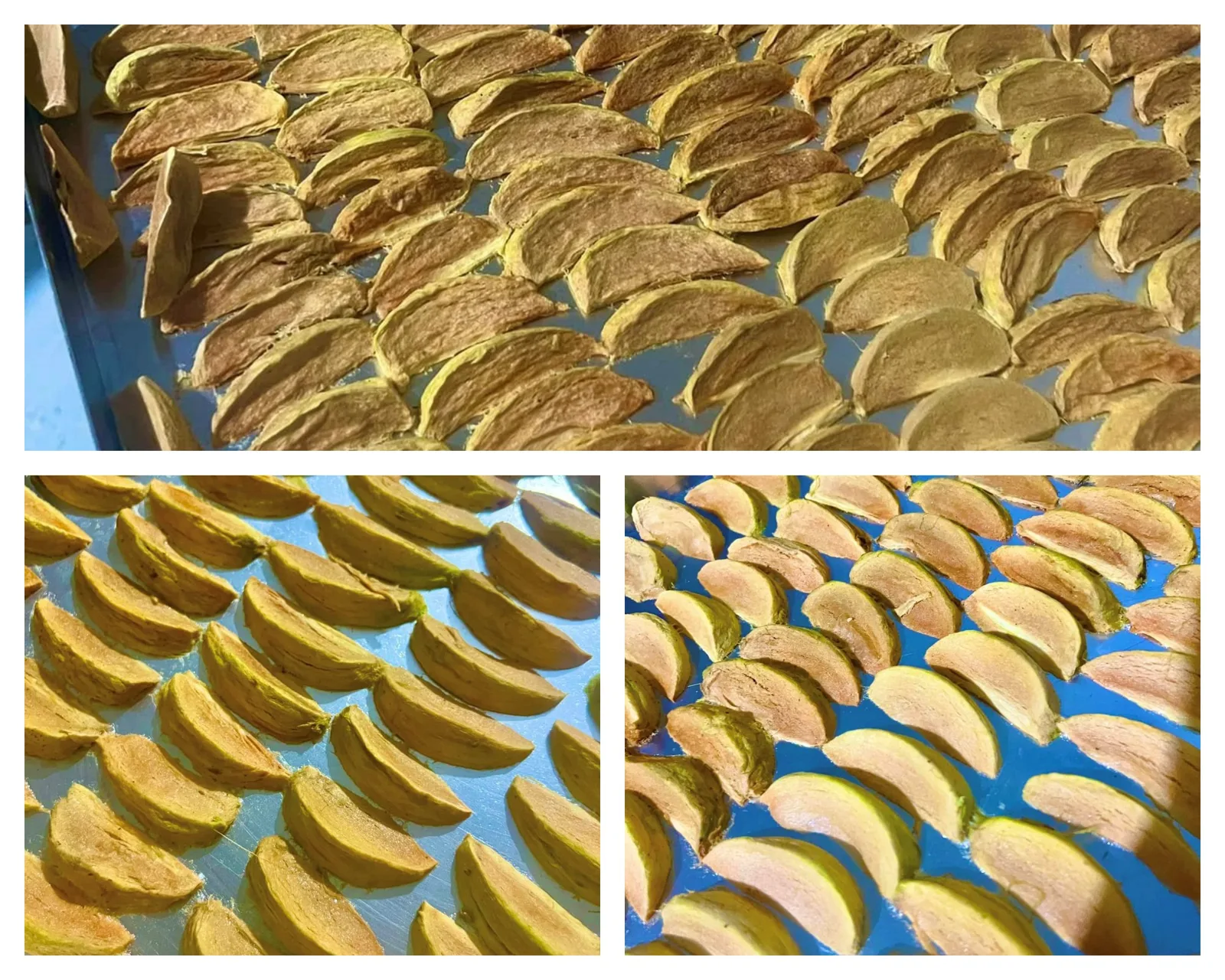
How many kilos of fresh sapodilla make 1 kg of freeze-dried?
6.5–7.5 kg of whole fresh sapodilla go into every kilogram of freeze-dried product on FruitBuys’ processing line, depending on ripeness and fruit size in each harvest. That number is the most useful figure in your sourcing file. It tells you what you are really buying, the concentrated solids of 6.5–7.5 kg of ripe fruit in every kilo, and it sets a cost floor that no honest supplier can quote below. Use it to value the product and to screen every quote that lands on your desk.
Why does it take 6.5–7.5 kg?
Two things take weight out of the fruit: water and preparation.
Water. Ripe sapodilla flesh is about 78% water, so every 100 kg of flesh holds about 22 kg of fruit solids. Dried to the ≤4.0% moisture FruitBuys releases at, one kilogram of finished product needs about 4.4 kg of prepared flesh on the drying tray.
Preparation. Between the facility gate and the tray, 30–40% of the fruit’s weight comes off: skin, latex, seeds and anything that fails ripeness sorting. Divide 4.4 kg of flesh by the 60–70% that survives preparation, and you arrive at 6.3–7.4 kg of whole fruit. In real production FruitBuys plans on 6.5–7.5 kg.
| Stage | Per 1 kg freeze-dried | Per 1,000 kg of fruit at the gate |
|---|---|---|
| Whole fruit arriving at the facility | 6.5–7.5 kg | 1,000 kg |
| Hand-peeled, deseeded flesh on the tray | about 4.4 kg | 600–700 kg |
| Freeze-dried sapodilla, ≤4.0% moisture | 1 kg | about 136–159 kg |
At container scale the numbers become a sourcing plan. A 20 ft container of dice at about 5,500 kg net draws on roughly 36–41 tonnes of fresh sapodilla; a 20 ft of wedges at 3,850 kg net, on 25–29 tonnes. That is why FruitBuys books fruit with partner orchards across the Mekong Delta before it confirms your production slot.
Where does the 30–40% gate-to-tray loss go?
Into the steps that decide how the product tastes.
- Ripeness sorting. Sapodilla is picked mature and ripens after harvest. Only fruit that has reached 18–24 °Brix goes to the line; fruit that is still firm and milky with latex waits or is rejected, because it would dry astringent instead of sweet.
- Hand-peeling. Every fruit is peeled by hand, clean of the thin skin and the latex layer beneath it. A trained hand follows the soft, uneven shape of a ripe sapodilla without bruising the flesh or leaving latex behind.
- Deseeding and trimming. The seeds come out by hand, and any bruised or overripe flesh is trimmed away before cutting into wedges, slices or dice.
Each of those losses is a quality step. A supplier who shows a much smaller loss is skipping one of them, and the result shows up in the bag as latex astringency, dark patches or seed fragments.
What does 1 kg of freeze-dried save you against fresh or frozen fruit?
More than the price per kilo suggests. When you buy freeze-dried sapodilla, the heavy, messy work is already done in Vietnam, close to the orchards:
- No peeling line at your end. Hand-peeling a sticky, latex-bearing fruit is the most labour-intensive step in the chain. It is finished before the product leaves Vietnam.
- No water in the freight. Each kilo you ship carries the solids of 6.5–7.5 kg of fresh fruit, with the water already gone.
- No cold chain. Freeze-dried sapodilla ships in a standard dry container and stores at room temperature: 12 months at ≤25 °C, RH ≤60%, and 18–24 months in cool storage at ≤18 °C, RH ≤50%. Fresh sapodilla ripens and spoils within days; frozen pulp needs a reefer and a freezer.
- No seasonal gap. Sapodilla fruits all year in the Mekong Delta, and a dry, shelf-stable ingredient lets you hold stock instead of chasing harvests.
For a brand, the result is a fruit ingredient that goes straight from carton to mixer, with caramel sweetness and no preparation waste on your floor.
How does the season change the yield?
Within the range, not outside it. In the dry months, fruit carries more sugar and less water, and yield sits near 6.5 kg. In the rainy season, the fruit takes up more water and Brix runs lower, so more fruit goes into each kilo and yield moves toward 7.5 kg. Ripeness sorting holds the product to the same 18–24 °Brix window all year, so the taste you approve stays the taste you receive; what moves with the weather is the raw-material cost behind it.
If your programme runs all year, plan your budget on the middle of the range and ask for an annual price that averages the seasons. FruitBuys allocates fruit to locked programmes first, so your containers are not the ones that wait when rain thins the harvest.
How do you spot a quote that cannot be real?
Start with the raw-material floor, then check the sample. The cost of fruit alone in every kilo of true freeze-dried sapodilla is:
Fresh fruit price per kg × 6.5–7.5 = raw-fruit cost per kg of finished product
Add freeze-drying energy, hand labour, packing and the foil bag, and you have the real cost base. Fill in the fresh fruit price you see in the market and compare it with the quote in front of you. When a quote sits well below that floor, the gap is usually paid for in one of three ways:
| What was changed | How it lowers the price | How to see it in the sample |
|---|---|---|
| Sugar or maltodextrin added | Cheap solids replace fruit solids | Ingredient line shows anything other than sapodilla; surface feels sticky or glossy |
| Heat-dried or hybrid-dried product sold as freeze-dried | Hot-air drying costs a fraction of freeze-drying | Pieces bend or chew instead of snapping; shrunken shape; darker, toasted colour |
| Underripe fruit with latex left in | Cheaper fruit, less sorting loss | Dry, puckering feel at the back of the throat; patchy colour |
Moisture is the fourth thing to check. A lot at 6% moisture instead of 4% carries 2 extra kilos of water in every 100 you pay for, and it softens faster in your warehouse. Ask for moisture and water activity as measured numbers on the COA.
Every buyer should run these checks, including on us. The freeze-dried sapodilla product page lists the full sample checklist, and what moisture and water activity keep freeze-dried sapodilla crisp sets out the specification to write into your contract.
Which ratio applies to residue checks?
A different one, and the difference matters at the border. Pesticide limits in the EU are set for fresh fruit, and the EU pesticide residue rules read a dried-product result against them through a processing factor. No specific factor is published for freeze-dried sapodilla, so the working basis is the concentration caused by water loss:
Processing factor = (100 − moisture of dried product) ÷ (100 − moisture of fresh fruit)
For freeze-dried sapodilla at 2–5% moisture from fruit at 78%, the factor is 4.3–4.5. Divide the dried-product result by that factor to compare it with the fresh-fruit limit. Do not use the 6.5–7.5 production ratio here: peel, seeds and sorting losses are not water, and using the larger number would make a lot look cleaner than it is. FruitBuys reports multi-residue results with the moisture of the tested lot, so your QA team can do the conversion in one line. The conversion works in your favour: a lot dried from fruit that meets the fresh-fruit limit reads as compliant once converted, and for EU-bound containers the multi-residue panel FruitBuys coordinates before stuffing puts that evidence in your file before the ship sails.
Get the specification and cost basis
Send your cut, annual volume and destination. FruitBuys returns the specification, a container loading plan for your cut and the yield basis behind the quote, so your procurement team can compare suppliers on the same numbers.
The full supplier checklist is in what to check before buying freeze-dried sapodilla in bulk.
FAQ
How many kilos of fresh sapodilla make 1 kg of freeze-dried?
6.5–7.5 kg of whole fruit, depending on ripeness and fruit size. That gives about 4.4 kg of hand-peeled, deseeded flesh, which dries to 1 kg.
Why is freeze-dried sapodilla more expensive than air-dried?
Freeze-drying keeps the open, crisp structure and the fresh caramel flavour, but it takes far more energy and time than hot-air drying, and every kilo needs 6.5–7.5 kg of hand-prepared fruit.
Does the ratio change through the year?
Yes, within the range. Dry-season fruit sits near 6.5 kg; rainy-season fruit, with more water, moves toward 7.5 kg. The ripeness window and taste stay the same.
How much fresh fruit goes into one container?
About 36–41 tonnes for a 20 ft container of dice at 5,500 kg net, and 25–29 tonnes for a 20 ft of wedges at 3,850 kg net.
Can I use 6.5–7.5 to convert residue results?
No. Use the processing factor based on moisture, 4.3–4.5 for freeze-dried sapodilla. The production ratio includes peel, seeds and sorting, which are not water.
Is any sugar added to raise the yield?
No. The ingredient is 100% sapodilla; all the sweetness comes from the ripe fruit.
About the author
Udo Nguyen is CEO at FruitBuys Vietnam. He coordinates sapodilla sourcing with partner orchards in the Mekong Delta, freeze-drying and milling at qualified partner facilities, and the specifications, loading plans and export documents that importers and food brands use to set their landed cost.



