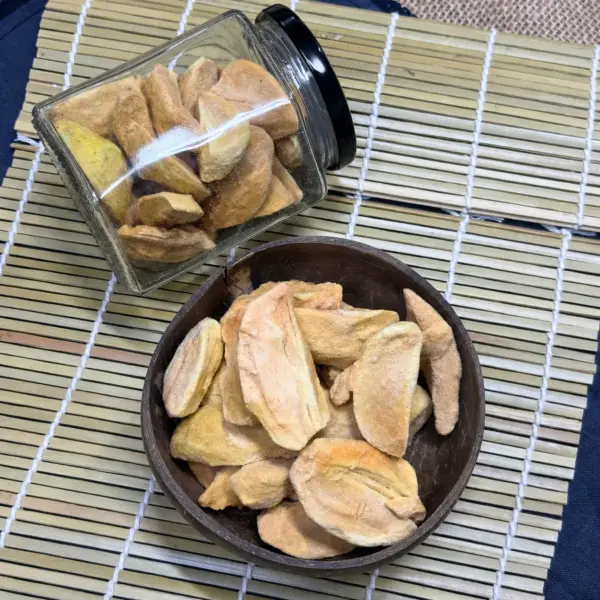
Freeze-Dried Chikoo (Sapodilla) Powder
Freeze-dried sapodilla powder is ripe Manilkara zapota, hand-peeled, deseeded, freeze-dried and milled fine, with nothing added. It tastes of brown sugar and malt, so a chikoo shake, a caramel latte premix or a malt smoothie gets its sweetness and flavour from fruit alone, and the label reads one word: sapodilla. Never cooked, it keeps far more of the fruit’s natural vitamins, minerals and polyphenols than a heat-dried powder, which is the difference between a fruit ingredient and a caramel flavouring. You may know it as chikoo or sapota powder. FruitBuys mills it to order from the same lots as its freeze-dried sapodilla pieces and supplies it in bulk bags and private-label packs. It belongs to our freeze-dried fruit range.
Not every “sapodilla powder” on the market is fruit. Many are juice dried onto maltodextrin, sold at a lower price per kilo and a much higher cost per kilo of real fruit. Our guide on what to specify before buying freeze-dried sapodilla powder in bulk shows how to tell the two apart in one sample.
Product specification
| Item | Standard grade | Free-flowing grade |
|---|---|---|
| Ingredient | 100% sapodilla | Sapodilla + up to 1% silicon dioxide (E551) |
| Best for | Batch mixing, beverage and dairy bases, fillings | Auger filling, sachets, stick packs |
| Mesh | 60–80 mesh, ≥95% passing (about 180–250 µm) | Same |
| Moisture | ≤4.0% at release (contract ceiling 5.0%) | Same |
| Water activity | ≤0.25 at release (contract ceiling 0.30) | Same |
| Colour | Light tan to caramel | Same |
| Flavour | Brown sugar and malt, from fruit ripened to 18–24 °Brix | Same |
| Microbiology | TPC ≤10⁴ CFU/g; yeasts and moulds ≤10² CFU/g; E. coli <10 CFU/g; Salmonella not detected/25 g | Same |
| Shelf life | 12 months at ≤25 °C, RH ≤60%; 18–24 months at ≤18 °C, RH ≤50%, unopened | Same |
Sapodilla powder is about 60% natural sugar, and that decides how it must be milled. A fast mill at room temperature heats the powder by friction until the sugar softens and sticks to the screen, and the flavour turns from fresh caramel to toasted. FruitBuys mills it chilled in a dehumidified room at RH ≤35–40% and packs it straight from the mill, so the powder stays light tan, loose and full of brown-sugar and malt aroma, and reaches the bag as dry as it left the freeze-dryer. At 60–80 mesh it disperses smoothly in milk powder, ice cream bases and chocolate without the caking of an ultra-fine grind. Because every lot of powder comes from the same hand-peeled, released lots as the pieces, one specification, one COA routine and one supplier cover both formats.
Nutrition
| Per 100 g | Amount | %DV |
|---|---|---|
| Energy | 370 kcal | |
| Total fat | 5 g | 6% |
| Saturated fat | 1 g | 4% |
| Sodium | 55 mg | 2% |
| Potassium | 850 mg | 18% |
| Total carbohydrate | 88 g | 32% |
| Dietary fibre | 23 g | 84% |
| Total sugars | 60 g (0 g added) | |
| Protein | 2 g | 4% |
Typical values for 100% freeze-dried sapodilla powder; natural variation by origin, season and ripeness applies. Lot nutrition panel available for label artwork.
For a finished product, the label numbers scale with your dose. The fibre is the signature of real fruit: a juice-on-carrier powder cannot show it.
Applications and starting doses
| Application | Starting dose | What the powder does |
|---|---|---|
| Shakes, protein shakes, smoothie, bubble-tea and milk-tea premixes | 2–5% | Caramel-malt flavour and natural sweetness in place of refined sugar and added flavouring; the classic chikoo shake in a dry mix |
| Coffee and malt drinks | 2–5% | A caramel note with no syrup and no added sugar |
| Yogurt, ice cream, chikoo kulfi, dairy desserts | 1–3% | Flavour and natural tan colour; chikoo kulfi and ice cream are South Asian favourites |
| Fillings, frostings and creams | 3–6% | Fruit flavour in a fat or sugar base |
| Chocolate, caramel white chocolate, compound coatings | 2–5% | Caramel flavour; dose inside the fat phase moisture budget |
| Bakery mixes and cookies | 2–4% | Brown-sugar flavour in dry mixes |
Cost-in-use: every kilogram of powder carries the fruit solids of 6.5–7.5 kg of ripe sapodilla. A 1 kg shake premix dosed at 4% uses 40 g of powder, the equivalent of 260–300 g of whole fresh fruit. Compare suppliers on that number, not on price per kilo of powder.
Blend the powder with the other dry ingredients first, then add liquid under shear. With 23 g of fibre per 100 g it disperses into a full-bodied fruit suspension rather than a clear solution, which is what makes a shake taste like fruit.
Packaging
| Item | Standard |
|---|---|
| Inner bag | 5 kg aluminium-foil bag, gently de-aerated, food-grade silica gel sachet; no nitrogen |
| Carton | 5-ply export carton, 58 × 28 × 34 cm, 4 × 5 kg = 20 kg net |
| Retail and OEM | Stick packs, sachets, jars or foil pouches under your label, from 500 kg per SKU |
Each 5 kg bag is sized to one production batch. Sapodilla powder is rich in natural sugar and draws moisture fast, so open the bag in a room below 40% RH and use the whole bag; the powder stays loose to the last scoop.
Commercial terms
| Item | Terms |
|---|---|
| 20 ft container, floor-loaded | About 550 cartons, about 11 t net |
| 40 ft HC | Mixed load with freeze-dried pieces; powder-only orders ship in 20 ft |
| Trial and LCL | Welcome; free release QC log with every batch |
| Production time | 20–30 days for a 20 ft container, after deposit |
| Sample | 3–5 working days by express courier |
| Payment | T/T 40% deposit, 60% before shipment or against copy of B/L; L/C at sight |
| Port of loading | Cat Lai Port or Tan Son Nhat Airport |
| Shipping terms | FOB, CIF, DDP, by sea or air |
| Annual capacity | 100 t of freeze-dried sapodilla across pieces and powder |
Dense powder ships about 11 t in a 20 ft container, two to three times the net weight of pieces, so freight per kilogram of fruit falls sharply. If you buy both formats, load them together: 20 kg powder cartons on the lower tiers and lighter piece cartons above use both the weight and the volume of one container, and one customs entry brings in a snack SKU and a beverage SKU.
Quality and documents
Every full container ships with a lot COA from an independent ISO/IEC 17025 accredited laboratory for moisture, water activity, total plate count, yeasts and moulds, E. coli and Salmonella. Lead, arsenic and aflatoxin are covered by FruitBuys’ periodic independent surveillance, with reports available on request. Market panels (pesticide multi-residue, sulfite, nutrition, Listeria, Enterobacteriaceae) are completed before stuffing on full-container contracts.
The standard export dossier for every shipment: commercial invoice, packing list, bill of lading, C/O Form EUR.1 for the EU and UK, phytosanitary certificate and lot COA. FruitBuys includes a phytosanitary certificate with every shipment as part of its standard export dossier.
Processing runs at a facility holding HACCP, ISO 22000, BRC (qualified processing facility) and US FDA Facility Registration, with Halal certification available on request. Before loading, FruitBuys sends a pre-shipment sample of 100–200 g from the packed lot and keeps a retained sample from every container lot for its full shelf life.
Import and labeling
Classification follows the ingredient list. Standard grade, 100% fruit, is a powder of fruit of Chapter 8 under HS 1106.30. The free-flowing grade, with silicon dioxide added, can classify as a food preparation under HS 2106.90. Unlike the pieces, fruit powder carries a standard third-country duty in the EU and UK, so the origin document does real work here: the C/O Form EUR.1 that FruitBuys supplies with every shipment claims the EVFTA or UKVFTA preferential rate for Vietnamese-origin powder, an advantage over origins with no trade agreement. The rate for your line is in the EU TARIC database; for the US, see the US Harmonized Tariff Schedule. FruitBuys declares the code on the invoice and the EUR.1 from the first shipment, so your landed-cost sheet is right from the start.
Sapodilla is not on the EU list of foods under increased border checks in Implementing Regulation (EU) 2019/1793, so EU-bound powder moves through routine official controls.
On the label: standard grade declares sapodilla; free-flowing grade declares sapodilla, anti-caking agent (silicon dioxide). Sapodilla is not a major allergen in the EU or US. FruitBuys runs a nutrition panel on your commercial lot, in US or EU format, before you print.
Verify the sample
- Read the ingredient line: one word, or two with E551. Maltodextrin, dextrose or “carrier” means juice powder.
- Disperse 5 g in 100 ml of cold water and stir for 30 seconds: real fruit powder forms a cloudy, full-bodied suspension that settles slowly.
- Check moisture and water activity on arrival: ≤4.0% and aw ≤0.25 at release, contract ceilings 5.0% and 0.30.
- Taste it neat: brown sugar and malt, no astringency, no toasted or burnt note.
- Check flow: soft clumps should break between your fingers. If your line fills by auger, trial the free-flowing grade.
FAQ
Is the powder 100% fruit?
Yes, in the standard grade. The free-flowing grade adds up to 1% silicon dioxide for automatic filling lines.
What mesh is it?
60–80 mesh, with at least 95% passing.
Does it dissolve?
It disperses into a fruit suspension. Its fibre (23 g per 100 g) is what makes it real fruit rather than flavoured carrier.
How much fits in a 20 ft container?
About 550 cartons of 20 kg, about 11 t net.
Why does it clump?
Natural fruit sugar draws moisture once a bag is open. Open each 5 kg bag in a dry room and use it in one batch, or choose the free-flowing grade.
What HS code applies?
HS 1106.30 for 100% powder; the free-flowing grade can classify under 2106.90.
How should I compare chikoo powder prices?
Compare the price per kilo of real fruit, not per kilo of powder. A 100% freeze-dried powder carries the fruit of 6.5–7.5 kg of fresh sapodilla in every kilo; a powder that is half maltodextrin carries half of that, so matching its flavour takes double the dose. The worked example is in what to specify before buying freeze-dried sapodilla powder.
Can I order powder and pieces in one container?
Yes. In a 40 ft HC, powder ships as a mixed load with freeze-dried sapodilla pieces.
Request a quote
Send these lines and FruitBuys returns a specification, a sample dispatch date and a loading plan:
- Grade: standard (100%) or free-flowing
- Application and target dose
- Pack: 5 kg bulk bags, or retail format for private label
- Volume: trial lot and annual estimate
- Destination port and Incoterm
- Target market(s) and any market panels beyond the standard COA
- Label format: US or EU nutrition panel
Specification checks, cost-in-use and application guidance are in our freeze-dried sapodilla powder buying guide.