What does freeze-dried passion fruit need to clear US, EU, UK and UAE customs?

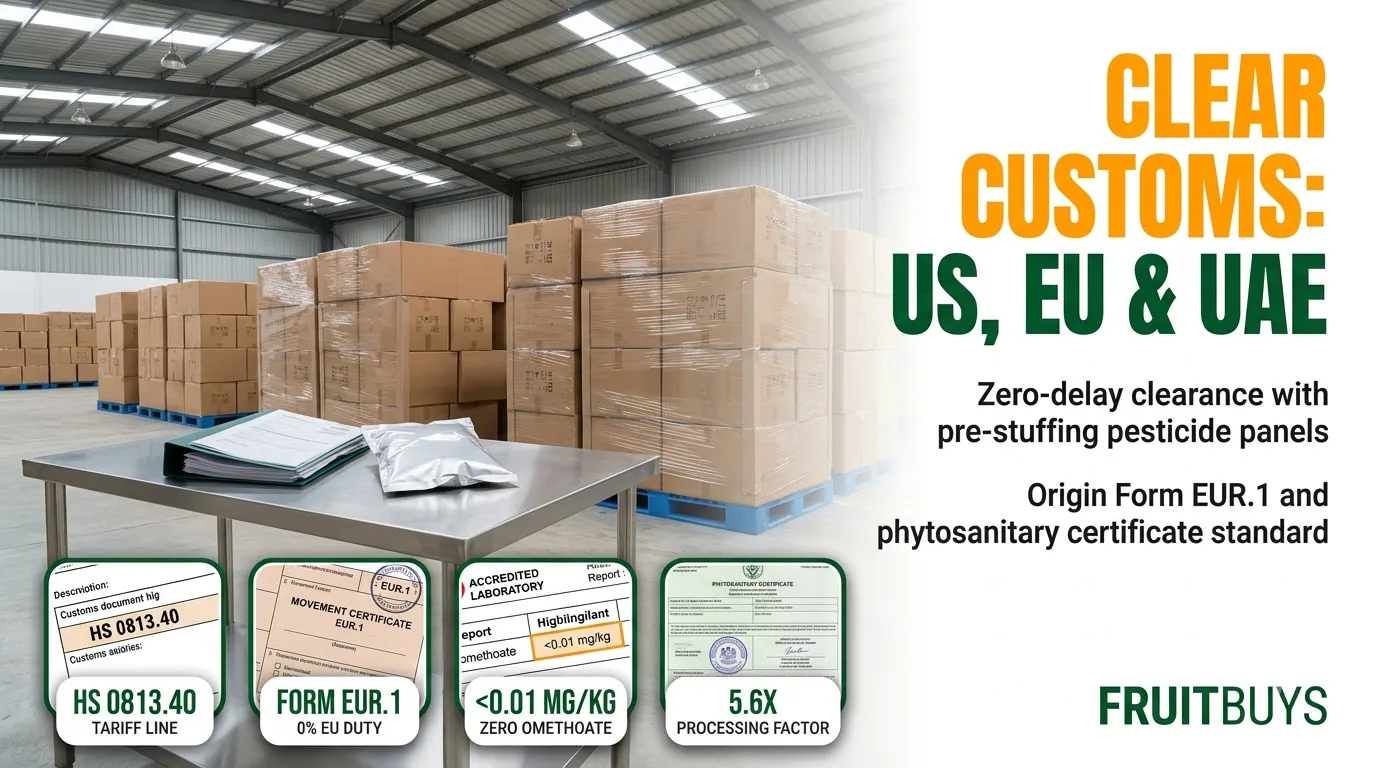
The paperwork is the easy part: an HS code under 0813.40, a commercial invoice and packing list, a COA, a Certificate of Origin Form EUR.1 for the EU and UK, and a phytosanitary certificate, which FruitBuys includes with every shipment. The part that decides whether an EU container clears without a hold is pesticide residues. In official EU controls in 2024, 15 of 47 samples of Vietnamese passion fruit exceeded EU limits, mostly for omethoate. That puts the fruit on the regulator’s watch list, and it is why every EU-bound container of FruitBuys passion fruit should leave with a multi-residue result already in hand.
Which HS code applies?
0813.40, “other dried fruit”, for freeze-dried passion fruit cubes with nothing added. The heading is set by the WCO Harmonized System; the national lines follow from it:
| Market | Code | Note |
|---|---|---|
| EU | CN 0813 40 95 (other) | Check the current line in TARIC before booking |
| UK | 0813 40 95 | UK Global Tariff follows the same structure |
| US | HTS 0813.40.80 (other) | Listed in the US Harmonized Tariff Schedule |
| UAE / GCC | 0813.40 | National suffix set by the GCC tariff |
Two things move the product out of this heading. Passion fruit powder belongs in 1106.30 (flour and powder of fruit), and pieces with added sugar are classified as prepared fruit under Chapter 20. Both carry different duties, so the ingredient line on the invoice has to match the product in the carton. Your customs broker confirms the final national line; a binding tariff ruling is worth it only if you plan a large annual programme.

How does Form EUR.1 cut your EU and UK duty?
Freeze-dried passion fruit is wholly obtained in Vietnam, so it qualifies for preferential duty under the EU–Vietnam Free Trade Agreement and the UK–Vietnam agreement. FruitBuys issues Form EUR.1 with the shipment. Present it at entry and the preference applies; leave it out and the container pays the standard third-country duty. Keep the EUR.1 number on your entry records, because origin checks can come months after release.

Do you need a phytosanitary certificate for a seed-in product?
Not by law for the EU, and not for dried processed fruit in the US, UK or UAE either. The EU list of plant products that need a certificate, Annex XI of Regulation (EU) 2019/2072, covers fresh passion fruit, not dried fruit under 0813. The seeds in a freeze-dried cube are part of a processed food, not seeds for planting, so they do not change the classification.
FruitBuys includes a phytosanitary certificate with every shipment as part of its standard export dossier. That matters more for passion fruit than for most dried fruits. When an inspector opens a bag and sees whole black seeds, the first reflex is to ask whether they could still germinate and carry a plant pest. A certificate that identifies the consignment as freeze-dried, processed passion fruit answers that question on the spot, and the container moves on instead of waiting for a plant-health review.

What do EU authorities check on Vietnamese passion fruit?
Pesticide residues, and specifically omethoate. EU maximum residue levels are set under Regulation (EC) No 396/2005 and listed per crop in the EU Pesticides Database, where passion fruit sits under code 0162030. Omethoate and dimethoate are no longer approved in the EU, so their limit in passion fruit is set at the limit of quantification, 0.01 mg/kg. In practice that means any detectable residue is a violation.
Vietnamese dragon fruit is already listed for increased border checks under Regulation (EU) 2019/1793. Passion fruit was not on that list at the time of writing, but the 2024 results make it a likely candidate. If it is added to Annex I, a share of consignments will be sampled at the EU border; if it moves to Annex II, every consignment must travel with an official laboratory result issued before export. The list is revised twice a year. FruitBuys tracks each revision and tells you directly if the status of Vietnamese passion fruit changes, before your production slot is confirmed, so your compliance team does not have to watch the annexes.
The answer is to test before the container is stuffed, not after it lands. For every EU-bound full-container order, this is a standard FruitBuys release gate:
- Multi-residue panel on the lot, run at an ISO/IEC 17025 accredited laboratory in Vietnam, with omethoate and dimethoate reported explicitly.
- Result on file before loading, attached to the export documents.
- Facility lock-in, so the fruit that passed is the fruit you receive: one qualified processing facility per contract, with written notice and a new pre-shipment sample if it ever changes.
Lab turnaround is 3–5 working days, so the panel sits inside the 20–30 day production window rather than adding to it.
Compare that with a hold at the other end. As an illustration, demurrage and detention at major North European ports such as Rotterdam, Hamburg or Antwerp commonly run at around €150–300 per container per day once free time ends. A container held two to three weeks for a counter-analysis can burn €3,000–5,000 in port charges alone, before the cost of an empty shelf at your customer, and a failed result can still mean destruction or re-export. A pre-shipment panel in Vietnam costs a small fraction of that.

How do you read a residue result on dried fruit?
Divide by the processing factor. Freeze-drying concentrates residues along with everything else, because it takes out the water. EU law applies the fresh-fruit limit to dried products through a processing factor based on moisture: Pf = (100 − moisture of dried product) ÷ (100 − moisture of fresh pulp). For FruitBuys freeze-dried passion fruit, that is about 5.6.
A result of 0.03 mg/kg on the dry cubes is therefore about 0.005 mg/kg on a fresh-fruit basis. Ask your lab to report both the measured figure and the moisture of the sample, so your QA team can apply the factor without guessing. For omethoate the factor does not help: the limit and the limit of quantification are both 0.01 mg/kg, so any detection on the dry product is a failure. That is why FruitBuys releases EU-bound passion fruit only on a non-detect result for omethoate and dimethoate, rather than on a calculation.

What else does each market ask for?
| Market | Before shipment | At or after arrival |
|---|---|---|
| US | Facility holds a US FDA food facility registration; importer files FDA Prior Notice | Importer runs its Foreign Supplier Verification Program; FruitBuys supplies the COA, baseline reports and facility documents for it |
| EU | EUR.1, COA, phytosanitary certificate; multi-residue panel with omethoate and dimethoate non-detect, run before stuffing | Possible border sampling for residues; labelling under EU 1169/2011 |
| UK | EUR.1 for UKVFTA preference; COA | UK labelling and residue rules mirror EU retained law |
| UAE | COA, Certificate of Origin, phytosanitary certificate | Product registration and Arabic labelling arranged with your importer before the first shipment |
Every shipment from FruitBuys carries the same core dossier: commercial invoice, packing list, bill of lading, COA, Certificate of Origin (EUR.1 where it applies) and phytosanitary certificate.
Use this checklist before you book
| Item | Who | Done when |
|---|---|---|
| HS line confirmed for your market | Your broker, with FruitBuys spec | Code on the purchase order |
| Ingredient line matches 100% passion fruit | FruitBuys | Same wording on spec, invoice and label |
| EUR.1 ordered (EU/UK) | FruitBuys | Issued with the shipping documents |
| Phytosanitary certificate | FruitBuys | Standard with every shipment |
| Multi-residue panel incl. omethoate (EU) | FruitBuys, standard release gate | Non-detect result on file before stuffing |
| 2019/1793 status tracked | FruitBuys | You are notified of any change before the production slot is confirmed |
| Labelling for destination | Your team, nutrition data from FruitBuys | Artwork approved |
Nutrition and claim rules for the label are covered in freeze-dried passion fruit nutrition per 100 g, and the release limits behind the COA in what moisture and water activity freeze-dried passion fruit should meet.
When is a pre-shipment panel not enough?
When the fruit behind it changes. A clean result covers the lot it was run on. If a supplier switches growing areas or processing facilities between your sample and your container, the result no longer describes what you are buying. This is the check every buyer should make, including with us: match the lot number on the residue report to the lot number on the COA and the cartons.
Get the export document set for your market
Send your destination and first-order volume. FruitBuys returns the document list for that market, a sample COA, and the residue panel scope we run before stuffing. Product details are on the freeze-dried passion fruit page, and the full buyer checklist is in what to check before buying freeze-dried passion fruit in bulk.
FAQ
What is the HS code for freeze-dried passion fruit? 0813.40 (other dried fruit): EU CN 0813 40 95, US HTS 0813.40.80. Powder falls under 1106.30.
Does freeze-dried passion fruit need a phytosanitary certificate? Not by law for dried processed fruit in the EU, US, UK or UAE. FruitBuys includes one with every shipment anyway.
Why is the EU checking Vietnamese passion fruit? EU controls in 2024 found 15 of 47 samples above residue limits, mostly for omethoate. FruitBuys releases EU-bound lots only on a non-detect result for omethoate and dimethoate, tested before stuffing.
How do residue limits apply to dried fruit? Through a processing factor of about 5.6 for this product: divide the dry-product result by 5.6 to compare with the fresh-fruit limit.
Which documents come with each shipment? Commercial invoice, packing list, bill of lading, COA, Certificate of Origin (EUR.1 for EU/UK) and a phytosanitary certificate.