What moisture, water activity and microbial limits should freeze-dried banana meet?
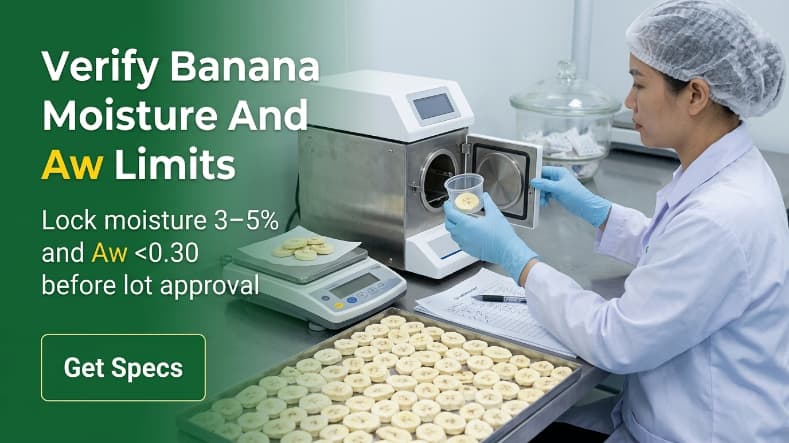
Four lines in the contract decide whether your freeze-dried banana arrives crisp or as a soft brick: moisture ≤5.0%, water activity (aw) ≤0.30, total plate count ≤10⁴ CFU/g and Salmonella not detected in 25 g. FruitBuys partner facilities pull lots from the dryer at 2–4% moisture and release them against those limits, so every container leaves with a buffer below the contract line. On banana, one of them carries more weight than the rest. With about 65 g of natural sugar per 100 g, freeze-dried banana is among the most moisture-hungry fruits on the market, and water activity is the number that tells you whether a slice will still snap when your customer opens the pack in Dubai in August.
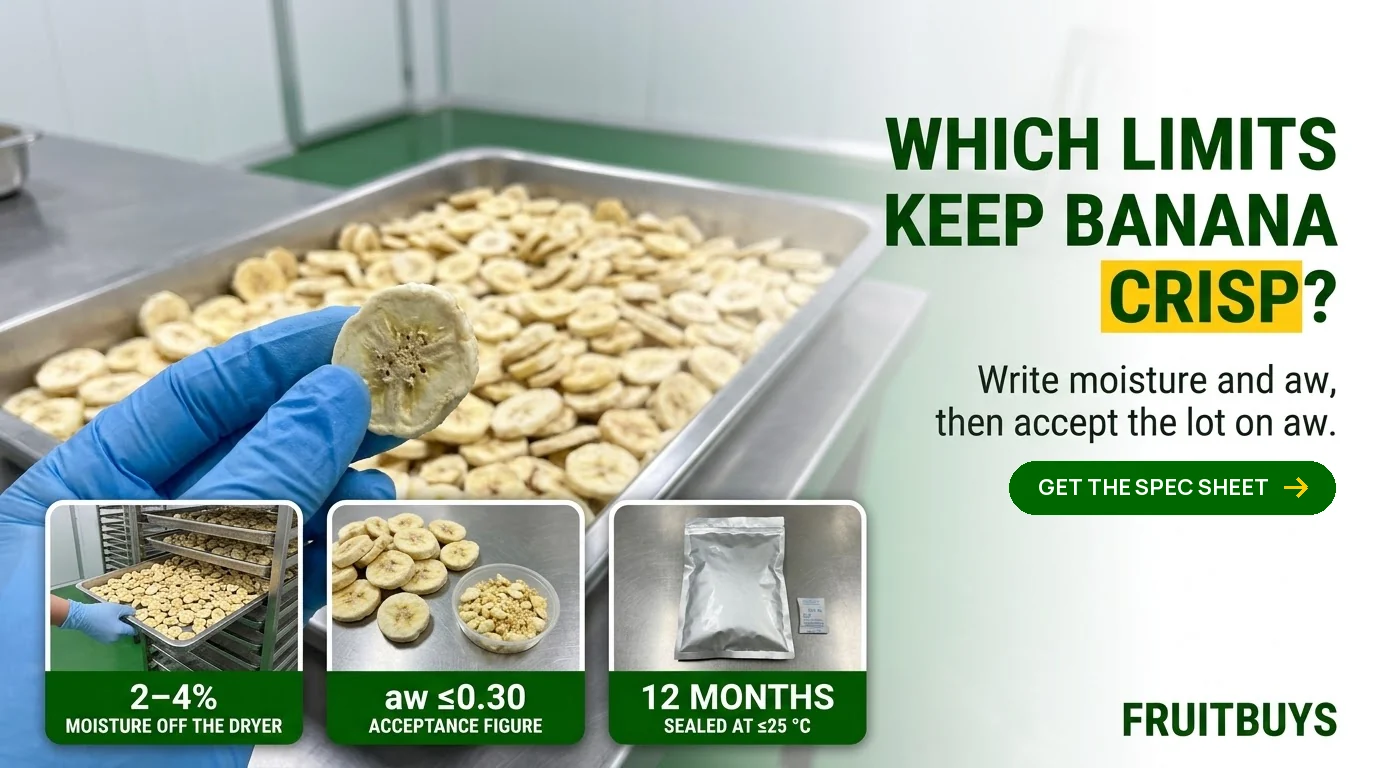
Moisture or water activity: which one do you sign on?
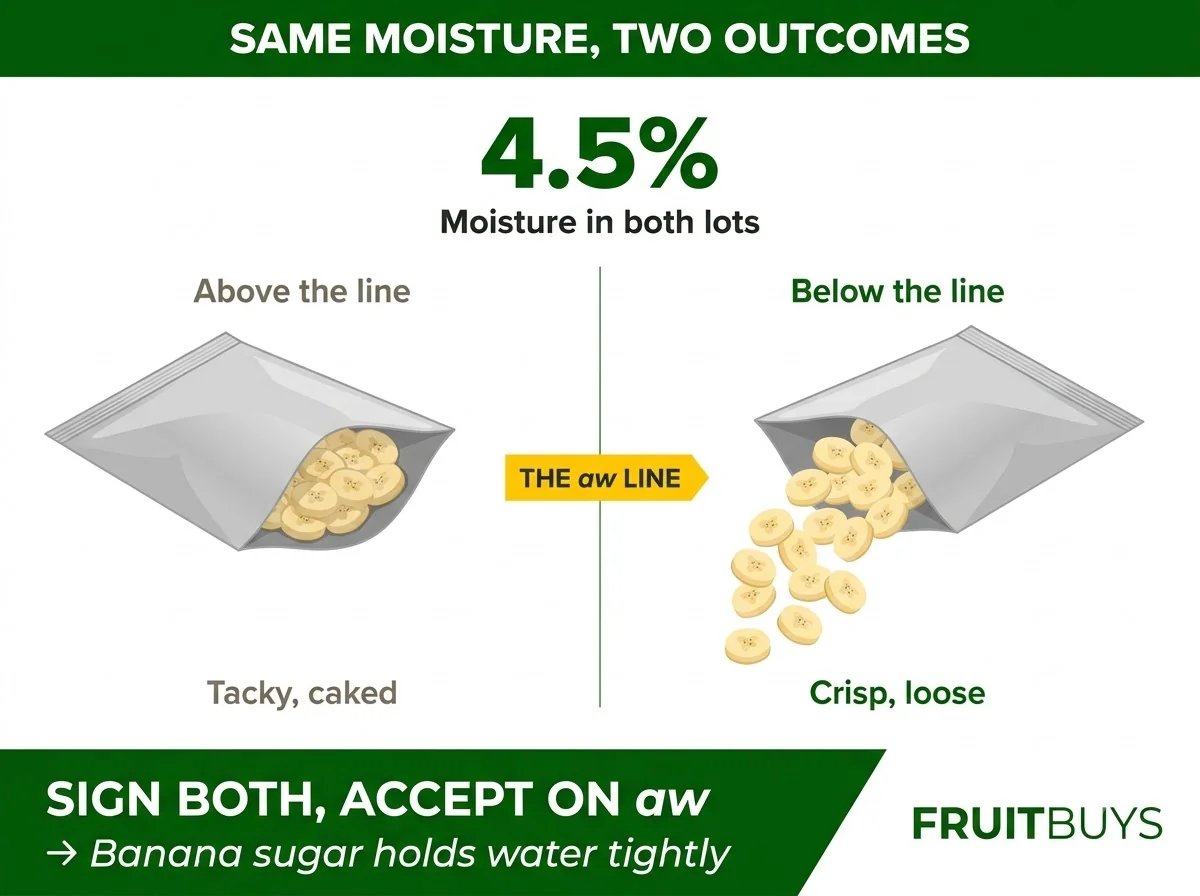
Write both, accept on water activity. Moisture measures how much water is left in the slice. Water activity measures how free that water is to move, and that is what decides texture and whether microbes can grow. Sugar holds water tightly, so on a sweet fruit like banana two lots at the same 4.5% moisture can land on either side of aw 0.30.
| Parameter | Limit | What it protects |
|---|---|---|
| Moisture | ≤5.0% | You pay for banana solids, not shipped water |
| Water activity | ≤0.30 | Slices stay crisp and loose, not tacky or caked |
| Total plate count | ≤10⁴ CFU/g | Ready-to-eat use as snack or topping |
| Yeasts & moulds | ≤10² CFU/g | No spoilage after the pack reaches the shelf |
| E. coli | <10 CFU/g | Hygiene of peeling, slicing and dipping |
| Salmonella | Not detected / 25 g | Release condition for ready-to-eat food |
| Foreign matter | Visual sorting + metal detection | Consumer safety |
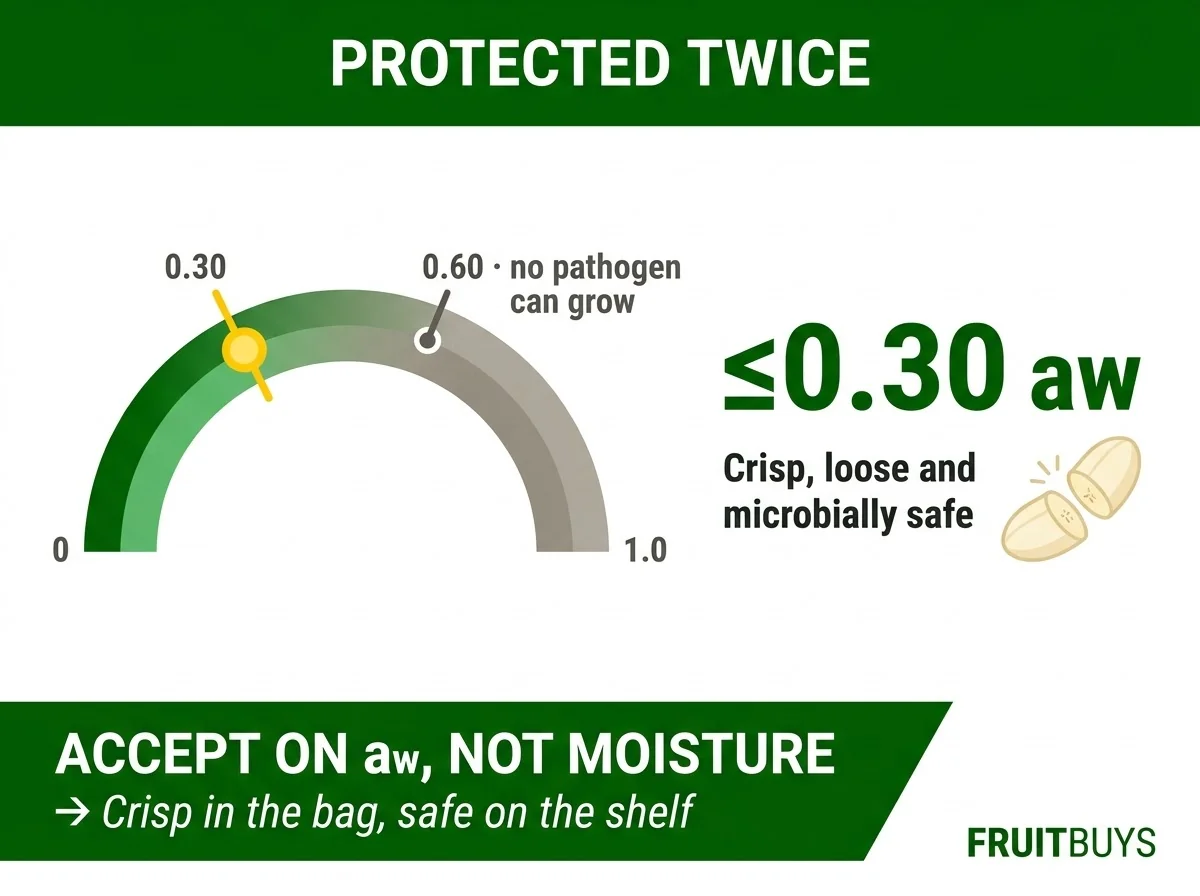
Water activity is measured to ISO 18787:2017. Below aw 0.60 no pathogen can grow, so at 0.30 the slice is protected twice: microbially safe and physically crisp.
The commercial reason is easier to see on a dock than in a lab. At aw ≤0.30 a banana slice keeps its open, porous structure: it rattles in the bag, breaks cleanly and melts on the tongue. Let a lot through at 0.35 and within weeks the surface turns tacky, slices weld into clumps, and a dosing hopper that ran smoothly on the sample starts to bridge. The gap between a reorder and a credit note is one line in the contract.
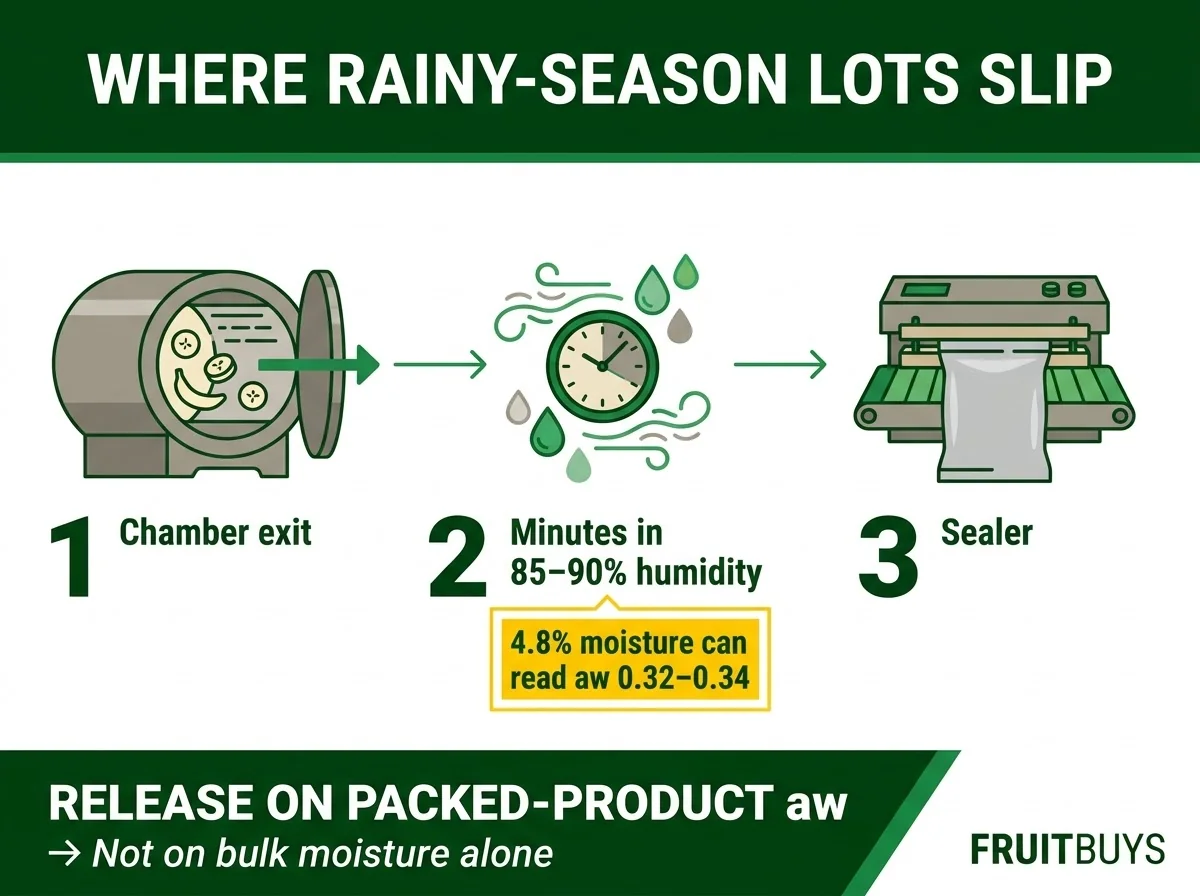
The risk peaks in Vietnam’s southern rainy season, when outdoor humidity sits at 85–90%. A facility that times its cycles by the clock, or checks only bulk moisture, can release a batch at 4.8% that already reads aw 0.32–0.34, because the slices pick up water in the minutes between the drying chamber and the sealer. That is why FruitBuys releases banana on aw ≤0.30, measured on the packed product, not on moisture alone. A spec that only says “moisture ≤5%” lets that batch through. A spec that says “aw ≤0.30” stops it at the facility.
Which tests travel with every container?
On full-container orders, every lot ships with a third-party COA for moisture, water activity, total plate count, yeasts & moulds, E. coli and Salmonella. The methods are the ones your lab already runs: ISO 6579-1 for Salmonella and ISO 16649-2 for E. coli, at independent ISO/IEC 17025 accredited laboratories in Vietnam.
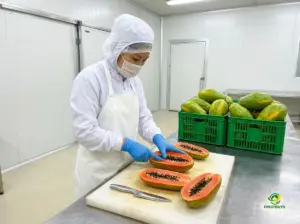
Banana passes through more hands than most freeze-dried fruits: peeling, slicing and a 10–20 minute dip in a vitamin C and citric acid bath before freezing. That dip is what keeps the slices cream-coloured with no added sulfites, and its hygiene sits in the process standard FruitBuys sets for the partner facility. The E. coli and plate count on every lot COA show the chain working, container after container.
Trial and LCL orders carry the in-house release log (moisture, aw and sensory per batch) plus the surveillance report, so a 200 kg trial is not loaded with lab fees. If your QA policy needs an independent COA on a trial lot, FruitBuys arranges it at net lab cost and credits the fee in full against your first container. Lab turnaround is 3–5 working days; plan it into the booking date.
One request worth making of any supplier, including us: ask for aw as a measured number on the COA, not “pass”. That number tells your QA team more about warehouse behaviour than anything else on the sheet.
What does the surveillance report cover?
Heavy metals and mycotoxins reflect growing area and process rather than the individual lot, so they are covered by periodic third-party surveillance: lead, arsenic and aflatoxin (total and B1). In the most recent baseline report on FruitBuys freeze-dried banana, from an independent ISO/IEC 17025 accredited laboratory:
| Parameter | Result | What it means for you |
|---|---|---|
| Lead and arsenic | Not detected | Clear of the EU maximum levels your QA team checks |
| Aflatoxin total and B1 | Not detected | No mycotoxin question at the border |
| E. coli / Salmonella | <10 CFU/g / not detected in 25 g | Ready-to-eat hygiene confirmed |
| Water activity | 0.195 | Wide headroom under the 0.30 limit |
European QA teams read the metal and mycotoxin results against the EU maximum levels for contaminants in food; the full report, with methods and detection limits, is shared with your QA team on request.
An aw of 0.195 is the headroom that carries a container through four to six weeks at sea and a humid devanning. Your consumer feels it too: the slice keeps its honeycomb structure, breaks with a clean snap, melts on the tongue and does not pack into the teeth. Gummy, tooth-packing banana is the defect that stops a shopper buying the second bag.
If your market or customer needs cadmium, a pesticide multi-residue panel or extended microbiology such as Listeria, FruitBuys coordinates it with an accredited laboratory before the container is stuffed. Banana-specific border checks by market are covered in what freeze-dried banana needs to clear US, EU, UK and UAE customs.
Why does freeze-dried banana soften faster than other fruit once opened?
Because it is sweeter than almost anything else you buy freeze-dried. Banana enters the facility at 20–22 °Brix; once the water is gone, sugar makes up about two-thirds of the slice. Sugar pulls water from the air, and a porous slice gives humid air a huge surface to work on. Sealed in foil with a silica gel desiccant, that is a non-event. In an open bag on a humid production floor, the surface softens in hours.
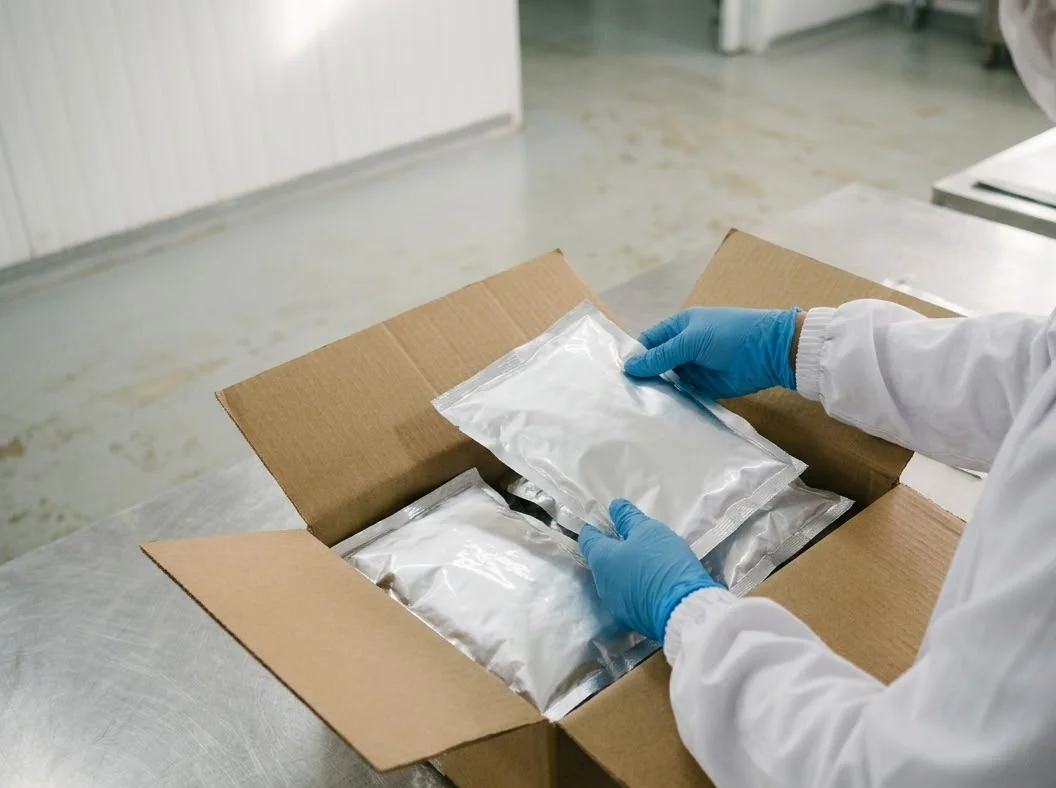
Two habits keep it under control. Bulk bags of 1–5 kg are sized to one production batch, so your line opens a bag and uses the whole bag. Stock held in the original sealed bulk bag at ≤18 °C, RH ≤50% runs 18–24 months; once repacked into retail pouches and held at ≤25 °C, RH ≤60%, it keeps 12 months. Bag, carton and container detail is in how freeze-dried banana is packed and loaded. In milk or yogurt, any freeze-dried slice softens whatever its aw at release; the format guide shows how R&D teams keep it crisp.
How do you read a freeze-dried banana COA?
Five lines tell your QA team whether a COA is worth filing:
- Lot code matches the cartons and the pre-shipment sample pouch.
- Water activity is a number, not “pass”, with the method (ISO 18787).
- Moisture sits under 5.0%, and makes sense next to the aw figure.
- Salmonella is reported per 25 g, the ready-to-eat basis, not per gram.
- Laboratory is independent and ISO/IEC 17025 accredited, and the report is signed and dated after packing.
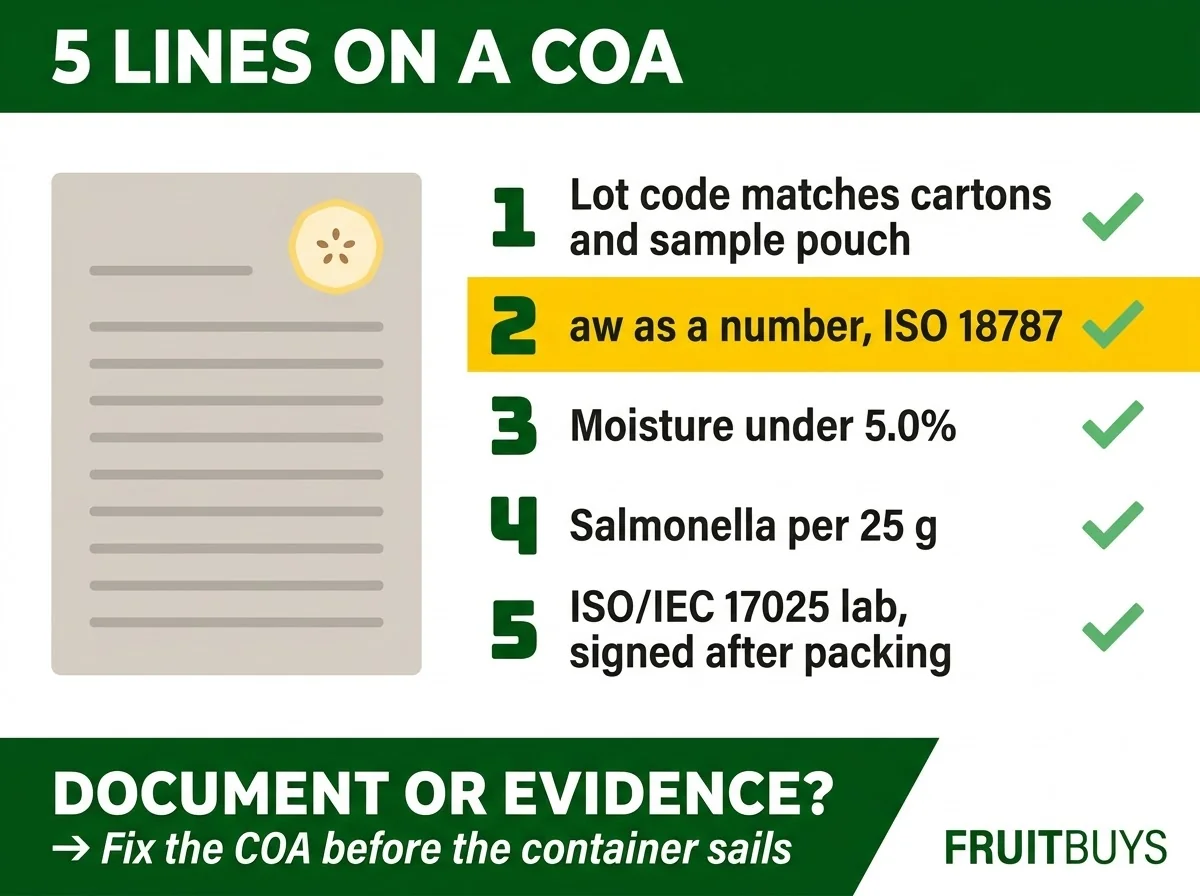
A COA that misses any of these is a document, not evidence. Ask any supplier, including us, to fix it before the container sails.
How do you check water activity in 10 minutes when the container lands?
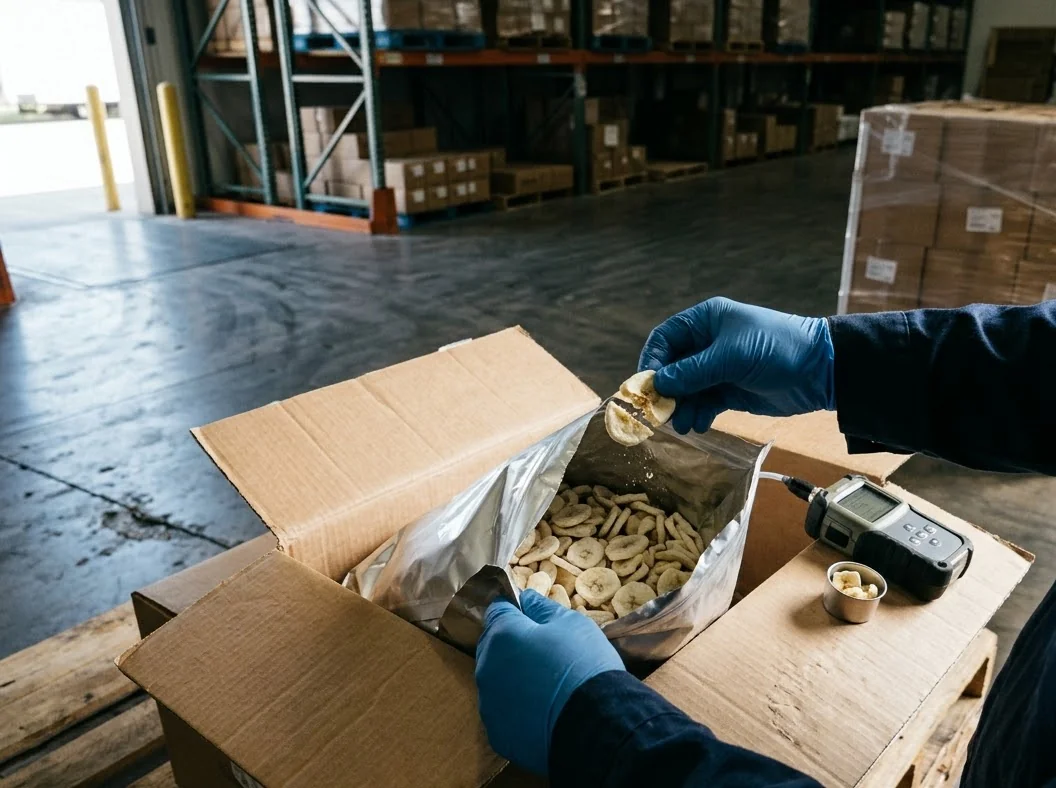
Pull one carton from the middle of the load, open one sealed bag and read aw on a handheld meter; a reading takes about 10 minutes. At or below 0.30 the lot is as it left Vietnam. While the meter runs, bite a slice: it should snap cleanly and melt, not pack into the teeth. Compare the colour against the second sealed pouch of the pre-shipment sample. The full arrival routine is in the freeze-dried banana RFQ and sample-to-bulk checklist.
Set your specification with this table
| Your situation | What to write into the spec |
|---|---|
| Retail snack, ready to eat | All six COA parameters per lot; aw ≤0.30 as the acceptance figure |
| Cereal, granola or bakery inclusion | Same limits; micro still applies because pieces are handled dry in your plant |
| Hot, humid destination (Gulf, Southeast Asia) | Accept on aw, and store at ≤25 °C, RH ≤60% from devanning |
| Single-ingredient label (banana only) | No-dip line from 500 kg; same limits, natural honey-gold colour |
| EU destination | Add a pesticide multi-residue panel before stuffing |
| Private label with a long printed date | Add an accelerated shelf-life study on your final pack |
| Trial or LCL order | Release log + surveillance report; independent COA at net lab cost, credited to your first container |
On arrival, your QA team checks the second sealed pouch of the pre-shipment sample against the same acceptance figure: aw at or below 0.30. Read it against the limit, not the COA decimal, because aw shifts slightly with instrument and room temperature between laboratories.
Check appearance, breakage and aw within 14 days of devanning, on unopened bags; laboratory claims run 30 days. The window is set by the fruit, not by paperwork. At two-thirds sugar, banana starts drawing moisture from local air the moment a bag is opened, so a reading taken weeks later in a humid store measures the warehouse, not the shipment. Testing early, on sealed bags, gives both sides a clean answer about what arrived. Colour and breakage limits have their own article: why freeze-dried banana turns brown or breaks.
When is a different route the better fit?
If your brief is really about pesticide residues and the risk of a rejected container, the answer is a destination multi-residue panel run on your own lot before the container is stuffed, from managed growing areas in Dong Nai, Binh Duong, the Mekong Delta and Lam Dong. If your label must read banana and nothing else, the no-dip line delivers it from 500 kg at the same release limits. If your plant runs only a few kilos a month, a local distributor’s stock will cost less than an independent COA on a trial shipment; from a 200 kg line trial upward, the release log and surveillance report cover you.
FAQ
What water activity should freeze-dried banana have?
At or below 0.30 at release. Above that, the sugar-rich slices turn tacky and stick together.
Is moisture or water activity more important?
Water activity. A sweet banana lot can pass on moisture while aw drifts above 0.30.
Which tests come with each container?
A third-party COA for moisture, water activity, total plate count, yeasts & moulds, E. coli and Salmonella. Lead, arsenic and aflatoxin are covered by periodic surveillance testing.
Is freeze-dried banana ready to eat?
Yes. It is released against ready-to-eat microbial limits, including Salmonella not detected in 25 g.
Are sulfites added?
No. Colour is held with a vitamin C and citric acid dip. A sulfite test can be added as an optional panel for your QA file.
How do I check water activity when the container arrives?
Open one sealed bag, read aw on a handheld meter in about 10 minutes, and compare against 0.30. Do it within 14 days of devanning.
How long does it keep?
18–24 months in the unopened bulk bag in cool storage at ≤18 °C and RH ≤50%; 12 months once repacked into retail pouches at ≤25 °C and RH ≤60%.
Get the specification for your QA file
Send your destination market and application. FruitBuys returns the full product specification, a COA template for a container lot and the latest surveillance report, so your QA team can approve the supplier before the sample lands. Product details are on the freeze-dried banana page; the sourcing guide is freeze-dried banana wholesale and bulk. Prefer to talk it through? Email [email protected] or WhatsApp +84 919 739 589.