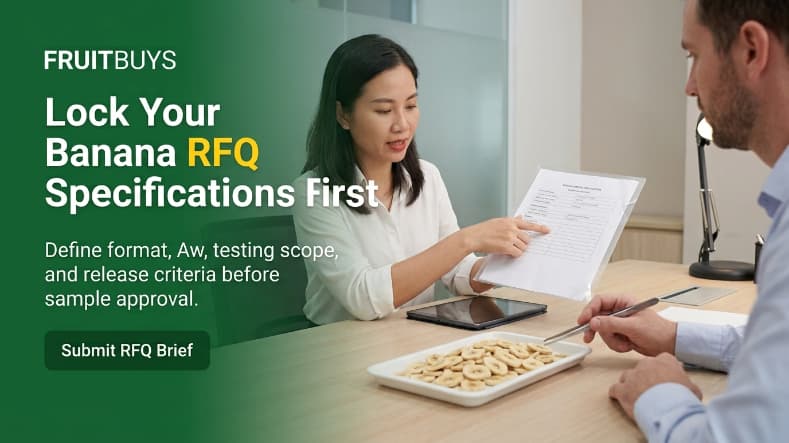
How do you take a freeze-dried banana order from RFQ to a container that matches the sample?
Write the sample into the contract, and make the supplier send it from the lot you are about to receive. The beautiful showroom bag that won the tender proves a facility can make good freeze-dried banana. It does not prove that the 560 cartons in your container are the same product. The route below takes a buyer from the first RFQ to a container that matches what was approved, in six steps, with four tools that close the gap: a pre-shipment sample drawn from the packed lot, a retained sample from every container, one partner facility locked to your contract, and claim windows that give both sides a clean answer on arrival. On banana this matters more than on most fruits, because ripeness and colour move from batch to batch if nobody holds them.
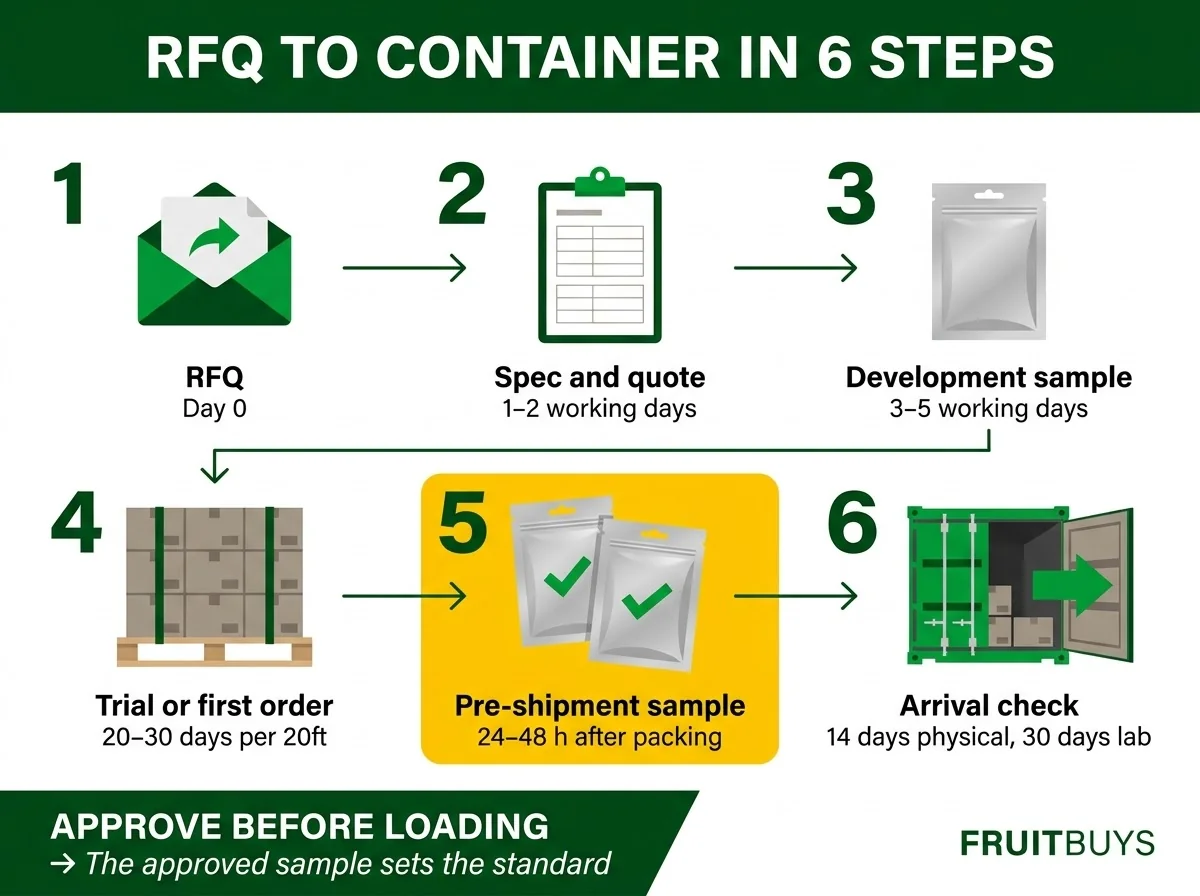
What are the six steps from RFQ to container?
| Step | What happens | Who decides | Typical time |
|---|---|---|---|
| 1. RFQ | You send the eight lines below | Buyer | Day 0 |
| 2. Specification and quote | FruitBuys returns a spec sheet, container plan and terms | FruitBuys | 1–2 working days |
| 3. Development sample | Production-lot slices, dice or powder for your R&D and line trial | Buyer approves | Prepared in 3–5 working days plus courier |
| 4. Trial or first order | 200 kg line trial, LCL or first container | Buyer | 20–30 days per 20ft after deposit |
| 5. Pre-shipment sample | 100–200 g from the packed lot, written approval before loading | Buyer approves | Couriered within 24–48 hours of packing |
| 6. Arrival check | Physical and aw checks against the retained pouch; lab results | Both sides | 14 days physical, 30 days lab |
Which supplier to put through this route is a separate question; the ten shortlist questions are in the freeze-dried banana wholesale and bulk guide.
What should a freeze-dried banana RFQ include?
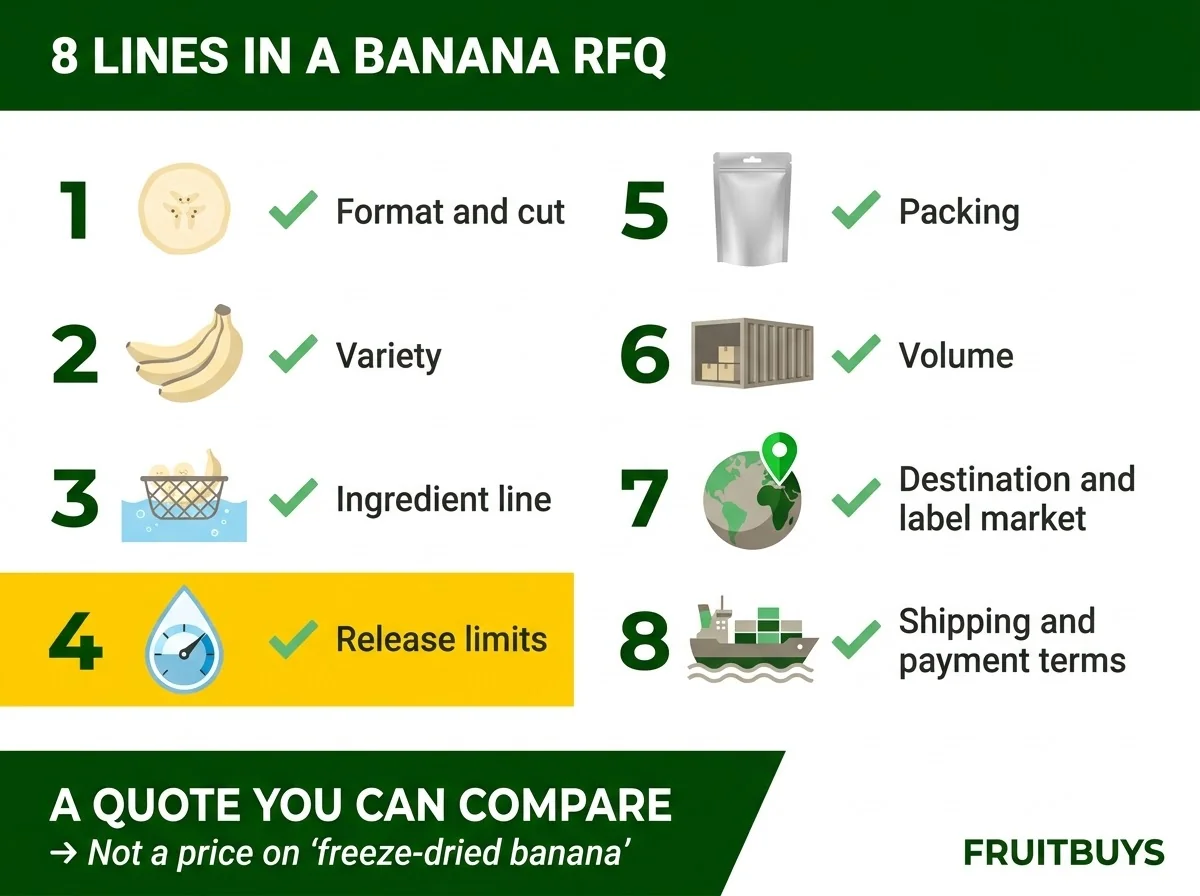
Eight lines get you a quote you can compare, instead of a price on “freeze-dried banana”:
- Format and cut: slices 5–7 mm, dice size, crumbles or powder.
- Variety: Cavendish G9 for steady ingredient volume, or Laba for a stronger banana aroma.
- Ingredient line: standard (vitamin C and citric acid dip) or no-dip (banana only, honey-gold colour, from 500 kg).
- Release limits: moisture ≤5.0%, aw ≤0.30, fines limit for your cut.
- Packing: bulk bag size (1–5 kg) or retail pouch; carton weight.
- Volume: trial, LCL, 20ft or 40ft HC, and annual volume with delivery months.
- Destination and label market: port, country, and any residue panel your customer requires.
- Shipping and payment terms: FOB Cat Lai, CIF or DDP; T/T or L/C.
What makes one banana lot differ from the next?
Three things, and all three can be written down.
| Variable | What changes | How it is held |
|---|---|---|
| Ripeness at intake | Greener fruit dries chalky and pale; riper fruit sweeter, darker and stickier | Intake at stage 5–6, 20–22 °Brix (Laba 24–26 °Brix) |
| Colour | Minutes between cutting and freezing decide how much the slices brown | Vitamin C and citric acid dip; release limit L* >70, browning index <0.60 |
| Breakage and moisture | Brittle slices crack in handling; moisture decides crispness | Fines ≤8–10% slices, ≤3–5% dice; typically 2–4% off the dryer, released at ≤5.0% moisture, aw ≤0.30 |
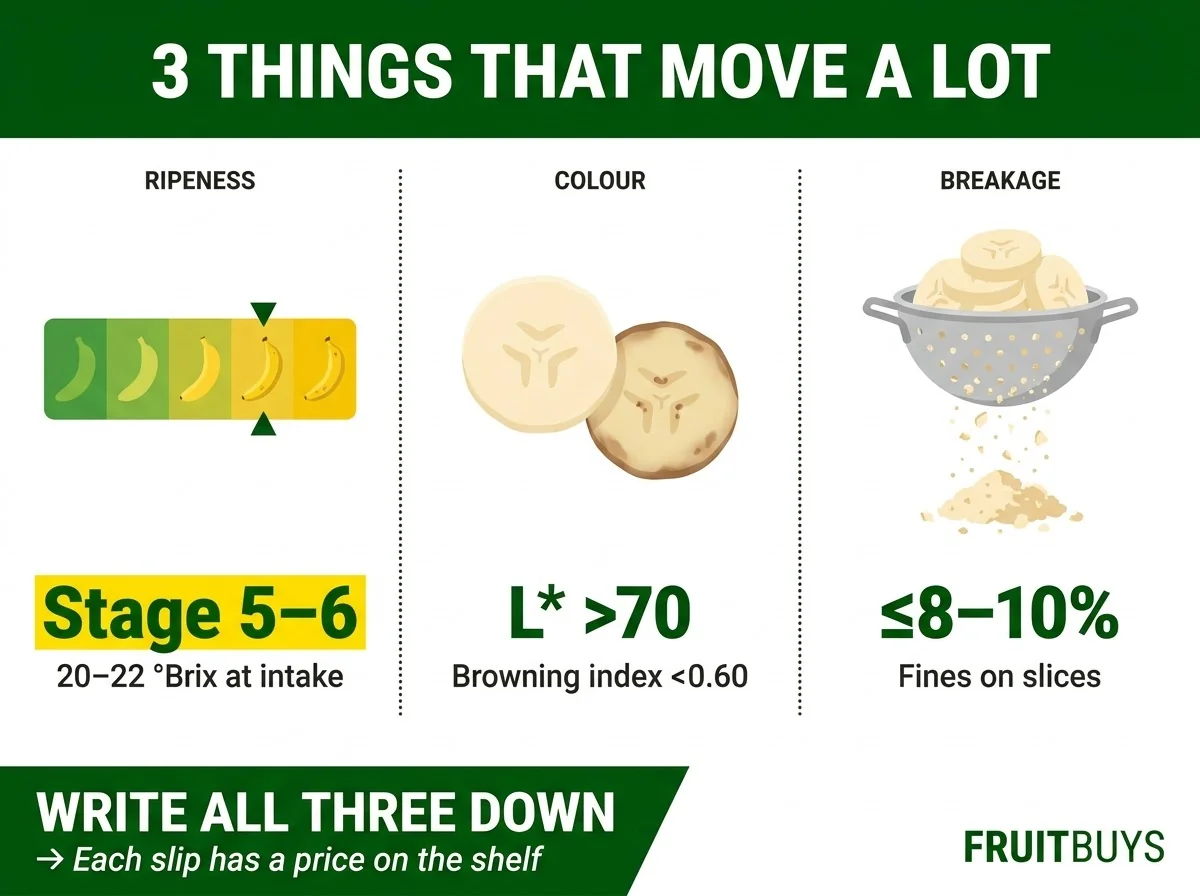
Each line has a price when it slips. Fruit cut too green, at stage 4, dries white and pretty and then tastes chalky and astringent, and a consumer who bites into that does not buy the second bag. Fruit left to stage 7 bleeds sugar onto the drying trays, caramelises, and arrives as slices welded together that bridge your packing hopper. Fines are the same story on the shelf: open a 50 g snack pouch and find a fifth of it as dust at the bottom, and the shopper reads the brand as second grade. Screening fines before the foil bag is sealed is how that impression is stopped at the facility, not argued about at destination.
The variety is the fourth line. Cavendish G9 and Laba look, taste and smell different, so the contract names one. A lot of Laba in a programme built on Cavendish is a different product, even if both are good. How each variable is controlled at the facility is set out in why freeze-dried banana turns brown or breaks.
What is the pre-shipment sample, and why from the packed lot?
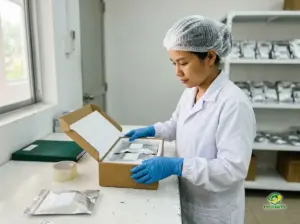
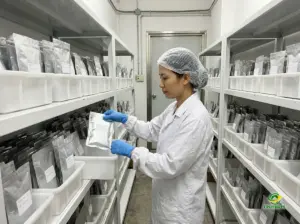
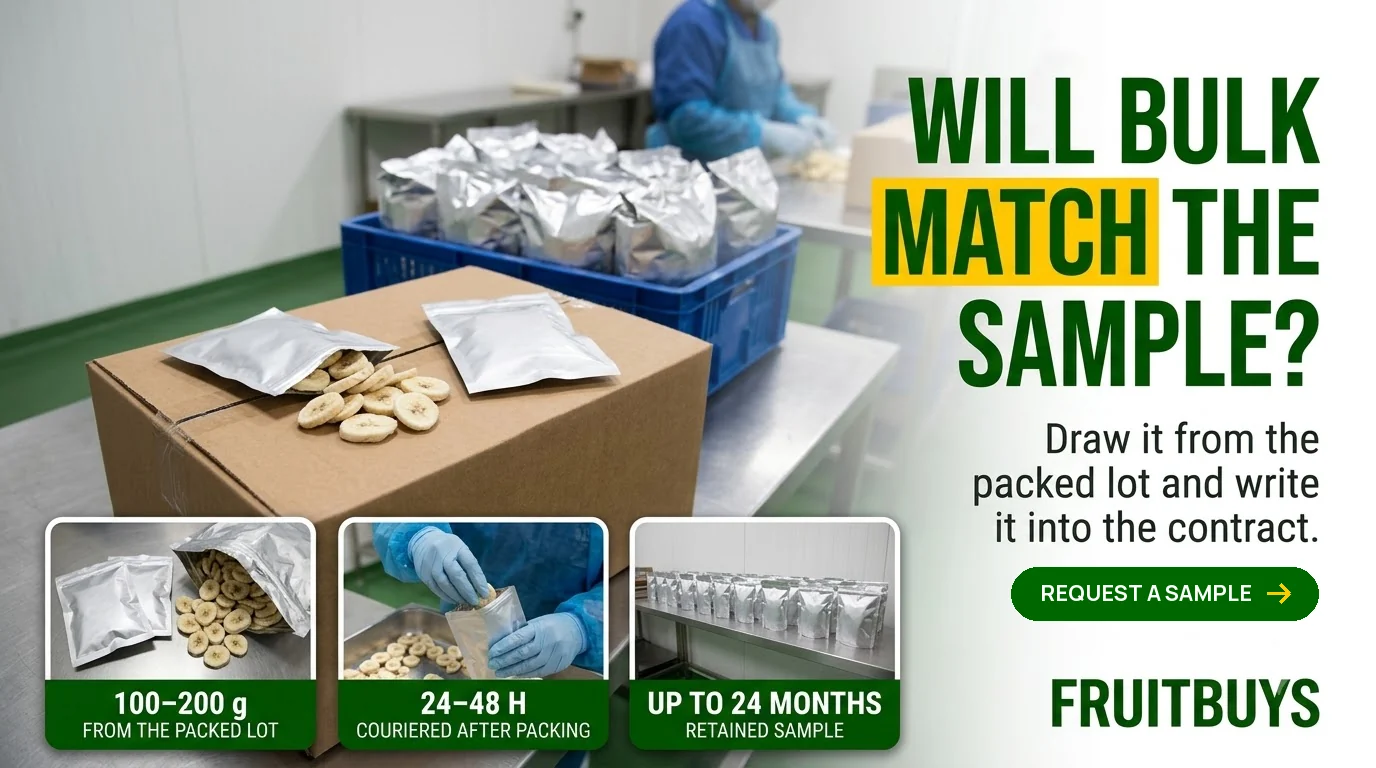
It is 100–200 g of your actual production, taken from the packed bags after the lot is finished, split into two sealed foil pouches with desiccant, and couriered within 24–48 hours. Drawing from the packed lot is the point: the sample has been through the same dip, the same drying cycle, the same packing room and the same sealer as the container behind it.
- Pouch one is for your team. Compare the colour with your reference, tip it onto a tray and look at the fines, then run three quick field checks:
- The bite. A slice should break with a sharp snap, melt within a few seconds and leave nothing packed into the teeth. Gummy, tooth-packing banana means moisture left in the core.
- The smell. Tear the pouch and you should smell ripe banana straight away, stronger again on Laba. A sour or chemical note is a reason to stop.
- The open-air test. Leave a few slices on a plate at room temperature for 15–20 minutes. A lot well inside aw 0.30 stays dry and crisp; a lot near or over the limit turns tacky on the surface almost at once. It is not a substitute for a water activity meter, but it tells you in a quarter of an hour whether the meter will agree.
- Pouch two stays sealed with its lot code. Your QA keeps it as the reference for the container, or sends it to your own lab for moisture and water activity.
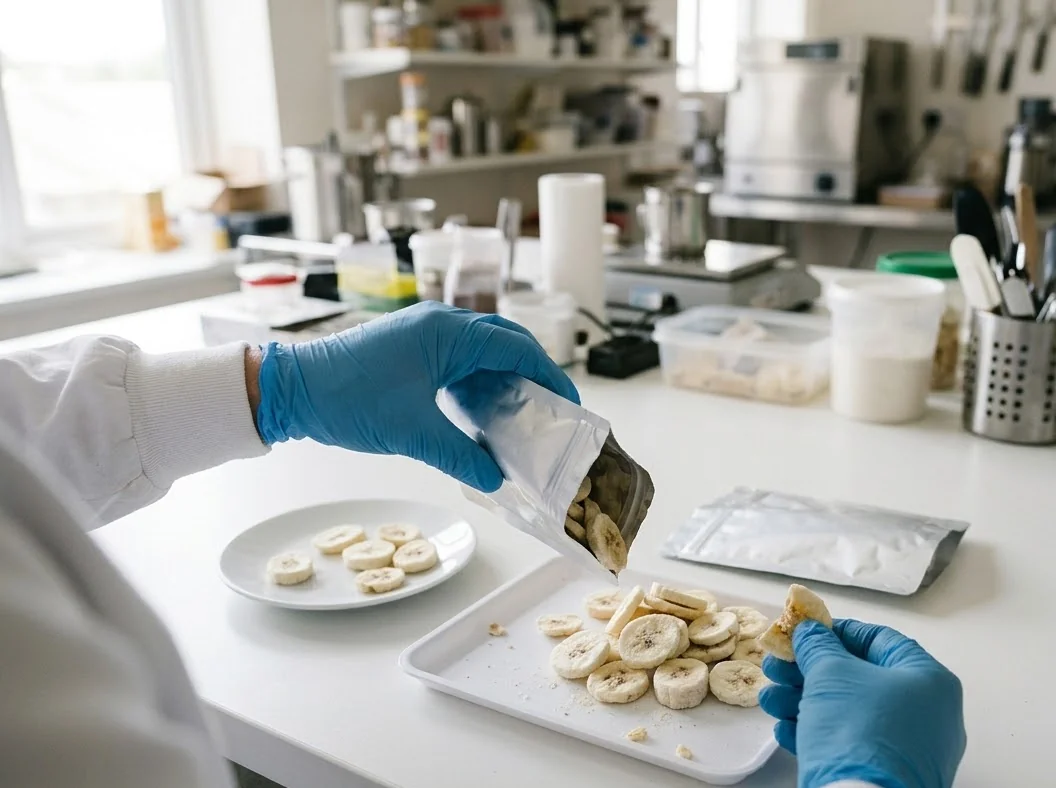
Approve the sample in writing and it becomes the standard the container is loaded against. If something is off, you say so before the container is stuffed, when fixing it costs a conversation instead of a claim.
What is kept after the container leaves?
A retained sample from every container lot, sealed and stored for the full shelf life of the lot, up to 24 months. It is not there for FruitBuys to win arguments; it is neutral evidence for both sides. If a question comes up in month nine, there is physical proof of exactly what shipped. If your result and ours disagree, the retained sample goes to an independent accredited laboratory agreed by both sides, and the data settles it. Nobody argues from memory.
Who controls the facility?
FruitBuys locks one qualified processing facility to your contract. The same intake standard, the same dip, the same drying cycle, the same packing room, lot after lot. Any change of facility needs prior written notice and re-approval of a pre-shipment sample before your next order runs there. Once under contract, you have on-site audit access, so your QA can stand on the line where your banana is sliced.
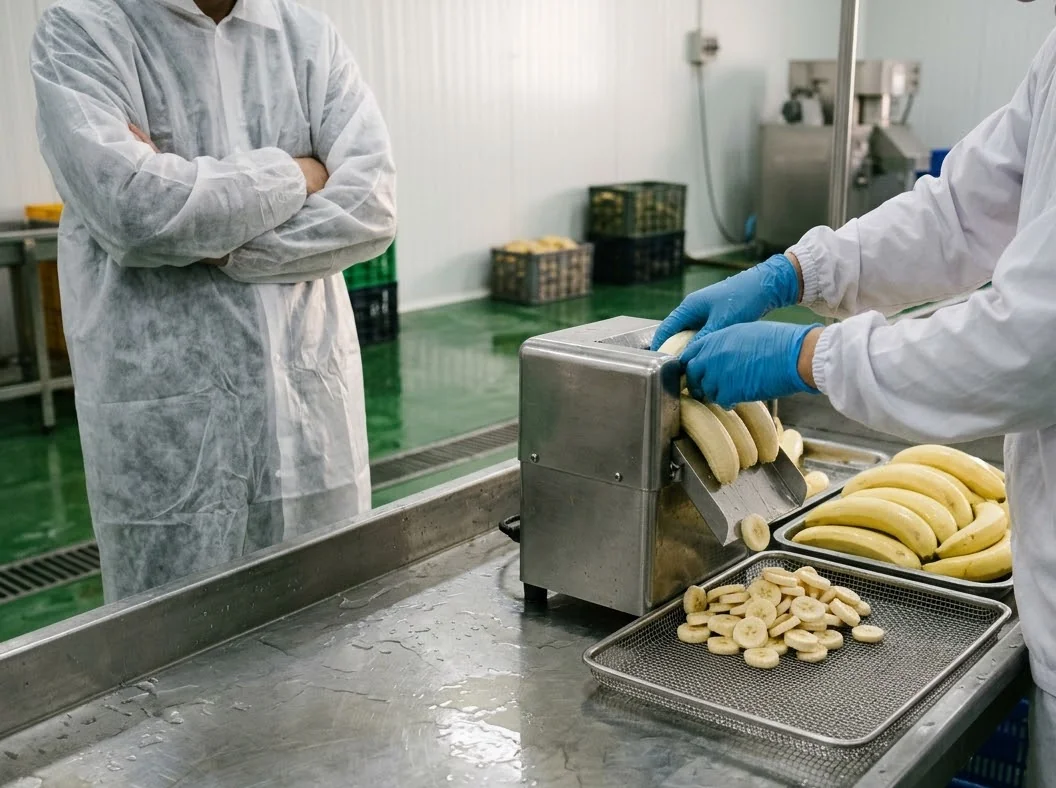
This is the clause buyers most often skip and most often regret. The common shortcut in the trade is not a change of facility between orders; it is split batching within one order. To hit a vessel date, one container is divided between two or three subcontracted dryers. At devanning the same 560 cartons hold cream slices and darker ones, thin and thick cuts, crisp bags and softer bags, all under one specification and one invoice. One locked facility means one intake standard, one dip, one freezing step at −35 to −40 °C, one drying cycle and one humidity-controlled packing room for the whole lot. Ask every supplier, including us, which facility your container comes from and whether any of it is subcontracted.
How do trial and LCL orders work?
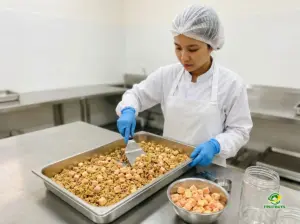
A trial is the right first step, and for a cereal, bar or snack plant it is a line trial, not a tasting. 200 kg is enough to run banana through your dosing hopper and see whether it bridges, to seal it into your own film on your own packer, and to check crispness after mixing into the real recipe. It should not be loaded with lab fees. A 200 kg trial ships with the facility’s in-house release log, with moisture, water activity and sensory per batch, plus the periodic third-party surveillance report. If your QA policy needs an independent COA on the trial, FruitBuys arranges it at net laboratory cost, takes 3–5 working days, and credits the fee back in full against your first container. Full containers carry a third-party lot COA as standard. Lab limits and tests are in what limits freeze-dried banana should meet.
When is a different route the better fit?
If you need a few hundred retail pouches on a shelf within weeks, a dedicated print run and a trial shipment add fixed cost to every pouch; finished stock from a local distributor serves that first launch better. When the volume reaches a 500 kg private-label run, a line trial or a container, this route is what protects the margin.
What do you check on arrival, and by when?
| Check | Against | Window |
|---|---|---|
| Cartons and bags intact, seals closed, desiccant in place | Packing list | On devanning |
| Colour, crispness, fines | Retained pouch two and your reference | 14 days from devanning |
| Water activity on unopened bags | ≤0.30 | 14 days from devanning |
| Laboratory results | Lot COA and specification | 30 days from devanning |
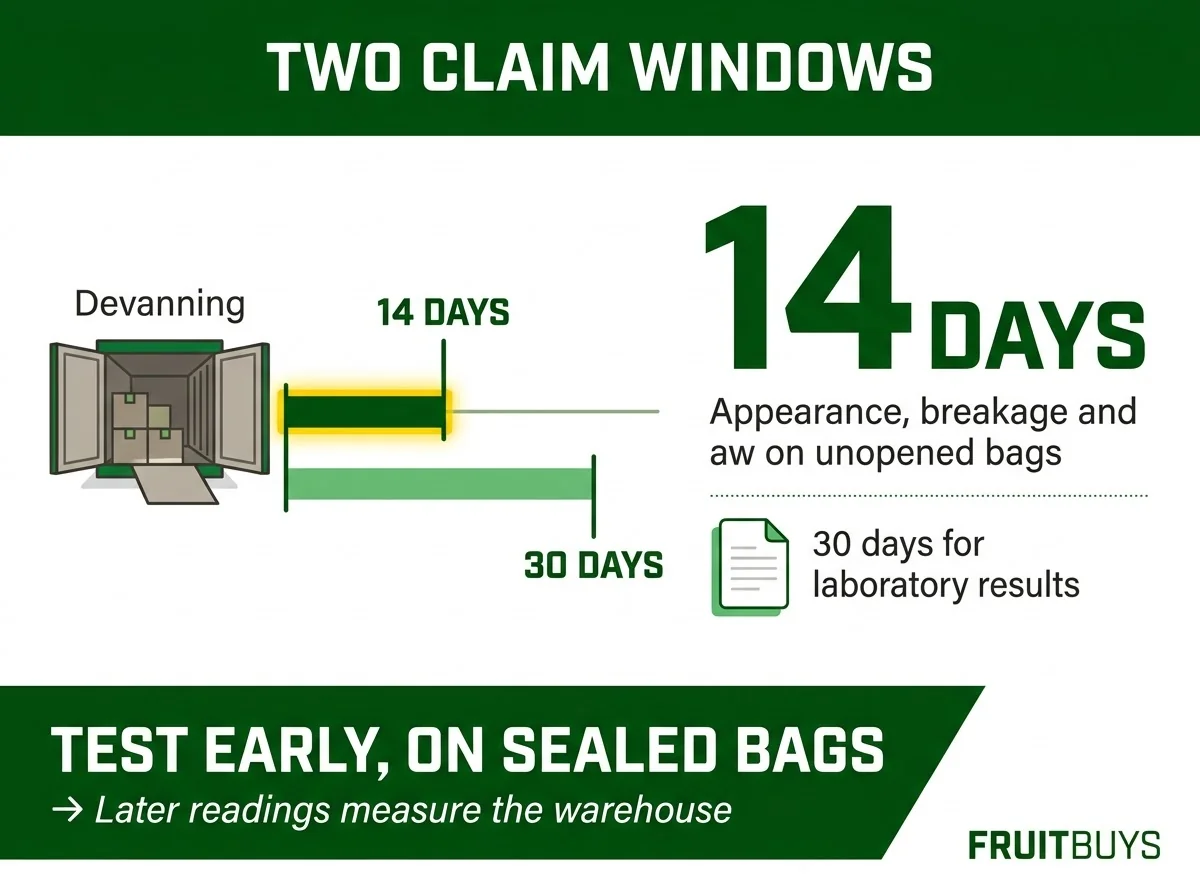
Both windows protect you as much as us. The 14-day check is set by the fruit: banana is about two-thirds sugar once dried, and while the foil is still sealed its water activity is exactly what left Vietnam. Weeks later, in a humid store or a half-open bag, the reading measures the warehouse, not the shipment. The 30-day window gives laboratory work the time it needs: microbiological cultures for plate count, yeasts and moulds and Salmonella take several working days before results are signed. Testing early, on sealed bags, gives both sides a clear answer about what arrived.
Your RFQ-to-container checklist
| Contract line | Write |
|---|---|
| Variety and ingredient line | Cavendish G9 or Laba; standard or no-dip |
| Cut and fines | Slices 5–7 mm, fines ≤8–10%; or dice size, fines ≤3–5% |
| Colour | Approved sample as reference; L* >70 at release |
| Moisture and aw | ≤5.0% (typically 2–4% off the dryer); aw ≤0.30 |
| Pre-shipment sample | 100–200 g from the packed lot, two sealed pouches, written approval before loading |
| Retained sample | Every container lot, full shelf life |
| Facility | Named facility; change only with written notice and new sample approval |
| Claims | 14 days physical and aw; 30 days laboratory |
FAQ
Is the pre-shipment sample from the actual production lot?
Yes. It is drawn from packed bags of the finished lot, not made separately.
How big is the pre-shipment sample?
100–200 g, in two sealed foil pouches with desiccant.
Can FruitBuys switch my order to another facility?
Only with prior written notice and your re-approval of a new pre-shipment sample.
How long are retained samples kept?
For the full shelf life of each container lot, up to 24 months.
Will every lot look identical?
Within the contract limits for colour, fines, moisture and aw. Banana is a natural product, and those limits are what keep lot-to-lot variation inside what your customers will notice.
What should I include in a freeze-dried banana RFQ?
Format and cut, variety, ingredient line, release limits, packing, volume, destination and label market, and shipping and payment terms.
How long from RFQ to the first container?
A specification in 1–2 working days, samples in 3–5 working days plus courier, and production of 20–30 days per 20ft after deposit.
What are the claim windows?
14 days from devanning for packaging, appearance, breakage and water activity; 30 days for laboratory results.
Send your RFQ
Send the eight RFQ lines above. FruitBuys returns the specification, a trial plan and the pre-shipment sample schedule, so the first lot you receive is the standard every container after it is measured against. Full product details are on the freeze-dried banana page. Prefer to talk it through? Email [email protected] or WhatsApp +84 919 739 589.