
Freeze-Dried Banana Browning, Slice Thickness and Breakage Control
Freeze-dried banana browning control starts before the buyer sees the first sample. A clean slice photo cannot prove maturity control, pretreatment disclosure, slice-thickness tolerance, moisture stability or bulk breakage behavior. Importers, QA managers, retail snack brands and private label buyers need a measurable physical specification because banana slices naturally vary in color, diameter and structure.
The buyer loses control when “natural color” replaces a defined acceptance range. FruitBuys treats color, brown-center tolerance, thickness, intact ratio, broken pieces and fines as sample-to-bulk release criteria, not cosmetic preferences. The goal is not to remove every natural variation. The goal is to define which variation the buyer accepts, which variation the application can tolerate and which variation triggers review before bulk release.
Why Freeze-Dried Banana Slices Change Color
Banana color depends on maturity, oxygen exposure, pretreatment and process timing.
Brown centers may occur naturally, but uncontrolled variation creates a sample-to-bulk problem.
Buyers should define an approved color range rather than request “natural color” alone.
Banana browning comes from several linked controls. Raw fruit maturity affects sugar level, softness and sensitivity to handling damage. Cutting exposes tissue to oxygen. Time between peeling, slicing, pretreatment, freezing and drying changes how fast the exposed surface reacts. The product may still look natural, but the buyer needs to decide how much variation can enter the final pouch or ingredient pack.

Research on freeze-dried banana slices has shown that ascorbic acid and quince seed mucilage pretreatment can inhibit enzymatic browning and support quality in banana chips before drying. That research supports the general technical point that pretreatment and handling conditions affect browning. It does not prove that FruitBuys uses any specific pretreatment for any lot. (PubMed)
This article belongs under the freeze-dried banana wholesale guide. The hub qualifies the complete product route. This spoke narrows the decision to color, browning, thickness, breakage and the physical controls that protect sample-to-bulk consistency.
Maturity and Raw Material Effects
Banana maturity shapes the entire physical specification. Under-ripe fruit may produce a firmer bite and less sweetness. Over-ripe fruit can soften during preparation, increase handling damage and create a higher risk of browning or irregular slice structure. The right maturity depends on the application, not on a generic ideal.
For freeze-dried banana slices, raw-material governance should define:
- Accepted maturity range
- Visual defect tolerance before peeling
- Bruising rejection rule
- Maximum time from peeling to freezing
- Pretreatment declaration
- Trimming policy
- Suitability for slices, bites, cubes or powder
FruitBuys connects this stage with Raw Material Sourcing Governance. The buyer should not treat raw banana as a commodity input once the project targets export-ready slices or private label pouches. A weak raw-material gate turns into color drift, soft texture, higher breakage and inconsistent finished yield.
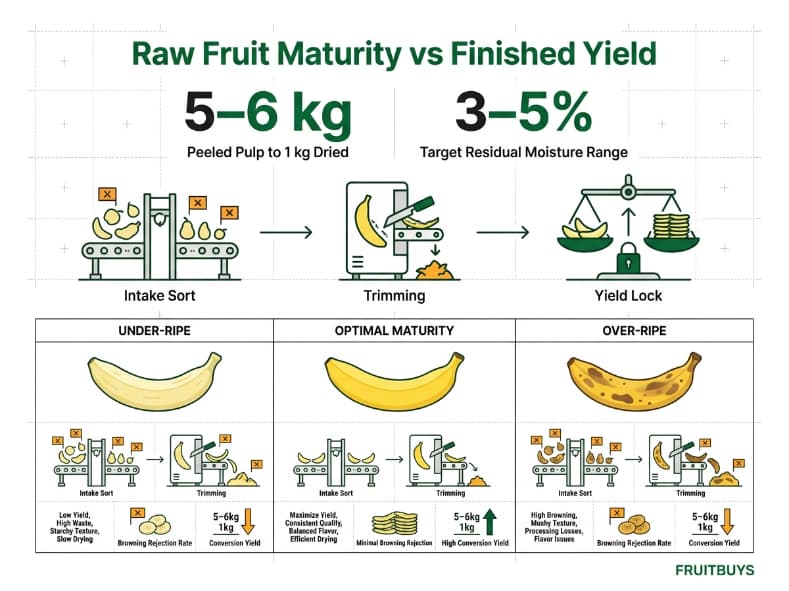
This directly affects the fresh-to-dry conversion ratio. A batch can lose more material through trimming, browning rejection or broken slices. Yield looks like a production number, but it starts with maturity and intake control.
Pretreatment and Ingredient Disclosure
Pretreatment can influence browning, color and surface quality. Some banana processes use anti-browning controls such as ascorbic acid or acid-based treatment. Other product briefs require a simpler ingredient declaration. The buyer must know which route applies before approving labels, specifications or retail claims.
Do not assume “100% banana” from a product photo. A visual sample cannot show whether a processing aid or ingredient treatment was used. The ingredient statement must reflect the real process, the destination-market rules and the final pack claim.
Buyer questions should be direct:
| Question | Why it matters |
|---|---|
| Is any anti-browning treatment used? | It affects ingredient and label review |
| Does the treatment remain in the final product? | It may affect declaration requirements |
| Does the buyer require banana-only formulation? | It narrows the process route |
| Does the destination market require specific label handling? | It changes documentation review |
| Does the approved sample match the declared ingredient route? | It prevents label and bulk mismatch |
FruitBuys should not publish a strong banana-only claim until the ingredient statement, process flow and product file support it. The correct status remains when the pretreatment route is not locked.
Slice Thickness Controls Drying and Texture
Slice thickness looks like a simple cutting parameter. It controls much more than appearance. Thicker slices can dry more slowly, hold different residual moisture and break differently during handling. Thinner slices may feel crisp but fracture more easily in packing, repacking or carton movement.
A workable slice specification should define:
- Target thickness
- Tolerance
- Measurement method
- Number of pieces measured
- Acceptance rule
- Diameter range where relevant
- Treatment of edge slices
- Treatment of broken pieces
- Photo or reference sample standard
The buyer should avoid vague terms such as “regular slices” or “standard thickness.” Those terms shift control back to the supplier. A measurable specification protects both sides.
The slice-thickness decision connects to freeze-dried banana moisture and Aw. If thickness varies too widely, moisture and Aw may also vary across pieces. A single sample result may not represent the whole production distribution.
Brown Centers: Natural Variation or Reject?
Brown centers do not automatically mean product failure.
The problem appears when the buyer and supplier never define the acceptable range.
A reference sample should show what passes, what triggers review and what fails.
Many freeze-dried banana slices show some brown or darker center tones. That can reflect natural fruit structure, maturity, oxidation or process timing. The buyer should not demand impossible visual uniformity unless the project can support the necessary sorting and rejection rules. At the same time, the buyer should not approve unlimited variation under the word “natural.”

A color standard can use several tools:
- Approved reference sample
- Controlled product photos
- Color-card comparison where practical
- Brown-center acceptance range
- Maximum percentage of darker slices
- Defect examples
- Reject examples
- Sample-to-bulk photo record
Retail snack buyers usually need tighter visual control because the consumer sees the product directly. Cereal and granola manufacturers may tolerate more variation if the piece size and texture remain stable.
Powder buyers may care more about overall powder color, browning intensity and flavor stability than individual slice appearance. The format decision should link to banana slices, cubes, bites and powder comparison. Each format carries a different visual-risk profile.
Breakage and Fines Must Be Defined Separately
Breakage belongs in the physical specification. It should not appear only as a complaint after arrival.
Freeze-dried banana has a porous, brittle structure. That makes it attractive as a crisp snack, but it also increases handling sensitivity. The product can break during discharge from trays, sorting, weighing, pouch filling, bulk packing, sampling, repacking or shipment. A buyer who approves only “banana slices” may receive a carton that contains intact slices, half slices, small fragments and powder-like fines.
The specification should separate:
| Physical category | Meaning | Buyer decision |
|---|---|---|
| Intact slices | Whole slices meeting size and appearance criteria | Required for retail snack identity |
| Partial slices | Broken but recognizable slice pieces | May fit snack mixes or toppings |
| Broken pieces | Fragments below whole-slice standard | Must have limit or alternate use |
| Fines | Small particles and dust | Must have limit unless powder route applies |
| Intended powder | Milled and specified powder product | Must not be confused with uncontrolled fines |

The strongest control is not a beautiful sample. It is a measurable distribution. The buyer should request a breakage limit, fines limit and inspection method before approving bulk.
Moisture, Aw and Breakage Work Together
Moisture and Aw influence texture. Texture influences breakage. The chain is direct. When freeze-dried banana absorbs moisture, it can lose crispness, become sticky, soften or collapse. Research on freeze-dried apple and banana slices links water activity and glass transition with mechanical and optical properties, including important texture and appearance changes. (ScienceDirect)
That does not allow a universal shelf-life claim. It confirms the buyer’s operational issue: water control affects how freeze-dried banana looks and behaves.
FDA defines water activity as a ratio of vapor pressure under identical conditions and notes that water activity changes with temperature. That means the buyer should review Aw method and test conditions, not only the final number. (U.S. Food and Drug Administration)
For this dataset, the working targets remain:
- Moisture: 3–5%;
- Aw: <0.30.
Those are targets, not lot results. The buyer needs COA confirmation. Physical acceptance should connect to water control because softened slices may break differently from correctly dried brittle slices.
Hand-Selected Samples Create Bulk Risk
A supplier can build a strong first impression by sending hand-selected slices. The buyer receives attractive pieces, approves the sample and assumes the bulk lot will match. That assumption fails when the buyer never locks the measurable release standard.
A sample should establish:
- Product format
- Color range
- Brown-center tolerance
- Thickness
- Diameter range where relevant
- Intact ratio
- Acceptable partial pieces
- Broken-piece limit
- Fines limit
- Moisture target
- Aw target
- Packaging condition
- Sensory reference
The buyer should treat the sample as a reference standard, not a decoration. If the sample contains only the best pieces, it cannot represent bulk distribution. If the sample includes realistic variation and the buyer approves it with measurable criteria, both sides gain a usable release target.
This is the core bridge to sample-to-bulk consistency. The approved sample must become measurable release criteria before bulk production begins.
COA Cannot Replace Physical Inspection
A COA can confirm moisture, Aw, microbiology and other tested parameters for an identified lot. It cannot fully replace physical inspection of color, thickness, breakage and fines unless the COA or inspection report includes those criteria and methods.
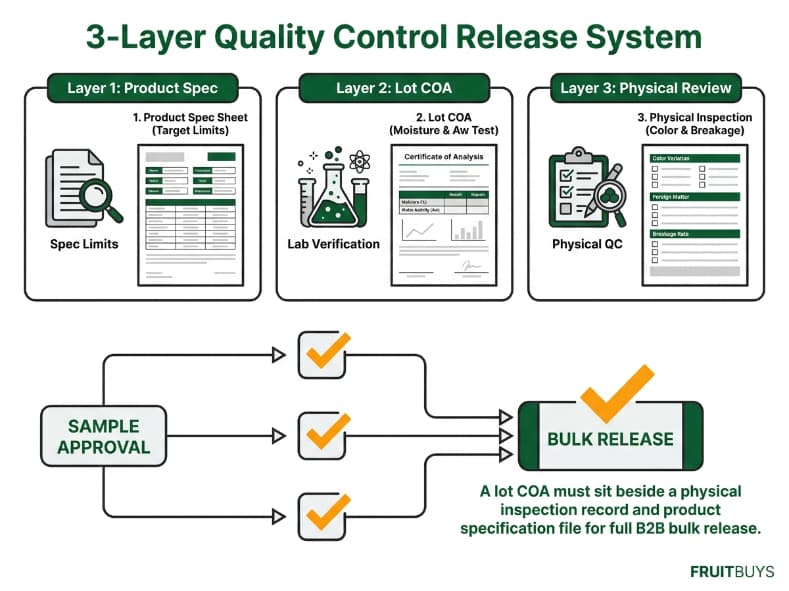
The buyer should separate three files:
| File | What it should control |
|---|---|
| Product specification | Approved limits for format, color, size, moisture, Aw and defects |
| COA | Lot-specific tested results and pass/fail criteria |
| Physical inspection record | Thickness, visual acceptance, breakage, fines and sample comparison |
FDA’s draft guidance for low-moisture ready-to-eat foods focuses on sanitation programs and corrective actions, and it warns against relying only on product testing to verify that pathogen contamination has been eliminated.
This supports a broader QA principle: a single file rarely proves the whole product-control system (U.S. Food and Drug Administration). For banana slices, the buyer still needs lot-specific COA and laboratory testing, but the COA should sit beside physical acceptance records.
Packaging and Handling Affect Final Appearance
A product may meet physical specification after drying and fail after poor handling. Packaging becomes part of physical quality control because breakage can happen after production.
Freeze-dried banana slices need:
- Correct inner bag structure
- Controlled fill weight
- Carton strength
- Limited headspace movement where practical
- Careful handling during sealing and cartoning
- Defined bulk-pack or retail-pack route
- Moisture protection
- Lot code and packing record
Powder needs different protection. It needs moisture control, caking control and flow protection. Cubes and bites need distribution control. Retail slices need stronger visual and crush-risk review.
The buyer should link this section with freeze-dried banana packaging and shelf-life control. Shelf life does not only mean time. It means the product still meets the promised physical and sensory condition after storage under the approved package system.
Highest-Risk Buyer Shortcut
The highest-risk shortcut is approving freeze-dried banana with the phrase “same as sample.”
That phrase does not define color tolerance, thickness, breakage, fines, moisture, Aw or inspection method.
Buyers should approve a measurable physical specification before bulk release.
“Same as sample” fails because bulk is a distribution, not one selected handful. The sample may show the target. The production lot shows the range. The buyer must approve the range.
A weak approval creates predictable consequences:
- More brown-centered slices than expected
- Wider thickness variation
- Higher broken-piece ratio
- More fines at the bottom of the pouch
- Inconsistent fill appearance
- Unstable crunch
- Dispute during bulk inspection
- Delayed release because no one defined the standard
This is preventable. The buyer should convert visual preference into measurable acceptance criteria before production.
Application Mapping
| Buyer Type | Application | Required Format | Proof Needed | FruitBuys Delivery |
|---|---|---|---|---|
| Retail snack brand | Crunchy banana pouch | Slices or bites | Color range, intact ratio, breakage limit, Aw | Approved reference sample and physical release criteria |
| Cereal manufacturer | Breakfast inclusion | Bites or cubes | Size distribution, fines limit, moisture control | Format control and lot-based QC |
| Granola producer | Mixed inclusion | Bites, cubes or partial slices | Breakage after mixing, visual tolerance | Application-matched sample route |
| Dessert brand | Topping | Slices or bites | Brown-center tolerance, texture, storage behavior | Sample-to-bulk comparison |
| Beverage developer | Powder formulation | Powder | Color, mesh, moisture, caking and microbiology | Powder specification route |
| Private label buyer | Branded retail pack | Slices or bites | Product spec, pouch fit, label and release file | OEM / Private Label Delivery |
| Importer | Bulk resale | Multiple formats | Physical specification, COA and packing record | Documentation and export readiness review |
Why FruitBuys Delivers This
FruitBuys supplies freeze-dried banana as one configured product under an Integrated Product Supply Model. The buyer does not purchase a loose factory introduction. The buyer receives a product route where raw material direction, production partner selection, QC, packaging, documentation and shipment readiness connect under one accountable supplier relationship.
For browning, thickness and breakage, FruitBuys applies four controls.
Raw Material Sourcing Governance aligns maturity, intake condition and suitability for the target format. A retail slice program needs a different raw-material and sorting discipline than a powder program.
Quality Control turns visual preference into measurable acceptance criteria: color range, brown-center tolerance, thickness, intact ratio, broken pieces, fines, moisture and Aw.
Documentation connects the specification, COA, physical inspection record, sample reference and lot identity. A claim without a file does not support buyer approval.
OEM/Private Label Delivery aligns product appearance with pack size, pouch visibility, label input and retail shelf expectation. A private label pouch magnifies every physical inconsistency.
Buyers preparing a structured request should use the freeze-dried banana buyer RFQ checklist.
Buyer Checklist
Before approving a freeze-dried banana sample, request:
- Target product format
- Reference sample
- Color range
- Brown-center tolerance
- Maximum dark or defective pieces
- Slice thickness and tolerance
- Diameter range where relevant
- Cube or bite dimensions where relevant
- Intact-slice ratio
- Partial-slice allowance
- Broken-piece limit
- Fines limit
- Moisture target
- Aw target
- Pretreatment declaration
- Ingredient statement
- Physical inspection method
- Photo standard
- Packaging structure
- Sample-to-bulk release rule
- Deviation-handling rule
Do not approve bulk production from image review alone. Product photos assist discussion, but they do not define a release specification.
Summary
Freeze-dried banana browning, slice thickness and breakage require measurable QA controls. Banana color depends on maturity, oxygen exposure, pretreatment and process timing. For buyer approval, “natural color” should become a defined color range with brown-center tolerance.
Slice thickness affects drying, texture and breakage behavior. Breakage and fines should be measured separately from intact slices. FruitBuys connects these controls through Raw Material Sourcing Governance, Quality Control, Documentation and OEM/private label release management.
FAQ
Why do freeze-dried banana slices turn brown?
Banana slices can brown because maturity, oxygen exposure, pretreatment and process timing affect exposed fruit tissue. Buyers should define an acceptable color range.
Are brown centers acceptable?
They can be acceptable when the buyer approves a defined tolerance. They become a problem when the bulk lot exceeds the approved visual standard.
What slice thickness should buyers request?
The buyer should request a target thickness, tolerance and measurement method. The exact value requires product-format data and application requirements.
Should broken slices count as defects?
They count as defects when the approved format requires intact slices. For bites, inclusions or powder routes, the acceptance rule may differ.
Can a COA prove breakage control?
Only if it includes physical inspection criteria and methods. Standard COA results usually do not replace visual and breakage inspection.
Does low Aw prevent breakage?
No. Aw supports water-control review, but breakage also depends on slice thickness, structure, handling and packaging.
What should buyers approve before bulk production?
Approve color range, brown-center tolerance, thickness, breakage limit, fines limit, moisture, Aw, packaging and sample-to-bulk criteria.
Conclusion
Freeze-dried banana quality depends on more than a clean sample photo. Browning, thickness and breakage shape the buyer’s real commercial product. A retail pouch, cereal inclusion and powder formulation each need a different physical standard. Without measurable limits, the buyer approves an impression and receives a distribution. That gap causes disputes, rework and weak product consistency.
Submit the target color, thickness and acceptable breakage limits before approving the reference sample.
References
- Milani, A. et al. Production and characterization of freeze-dried banana slices pretreated with ascorbic acid and quince seed mucilage: Physical and functional properties. PubMed, 2020. (PubMed)
- Milani, A. et al. Production and characterization of freeze-dried banana slices pretreated with ascorbic acid and quince seed mucilage: Physical and functional properties. Food Science & Nutrition, full text via PMC, 2020. (PMC)
- Moraga, G. et al. Implication of water activity and glass transition on the mechanical and optical properties of freeze-dried apple and banana slices. Journal of Food Engineering, 2011. (ScienceDirect)
- U.S. Food and Drug Administration. Water Activity (aw) in Foods. (U.S. Food and Drug Administration)
- U.S. Food and Drug Administration. Draft Guidance for Industry: Establishing Sanitation Programs for Low-Moisture Ready-to-Eat Human Foods and Taking Corrective Actions Following a Pathogen Contamination Event. January 2025. (U.S. Food and Drug Administration)