Which freeze-dried banana supplier can deliver to spec, and what should you check before buying in bulk?
In 2026, fresh banana became Vietnam’s second-largest fruit export after durian, and export prices for fresh fruit ran about 30% above the year before. The best bunches now have buyers waiting in China, Korea and Japan before they reach a dryer. So the first question for any freeze-dried banana supplier is not the price per kilo. It is where their fruit comes from, and whether the same fruit will be in your bag next quarter.
Every supplier can send a good sample. The ones worth shortlisting can tell you, in numbers, how the 560 cartons behind that sample will match it. Ten questions separate the two, and they are in the checklist at the end of this guide. Ask them of every supplier on your list, including FruitBuys.
What are you actually buying when you buy freeze-dried banana?
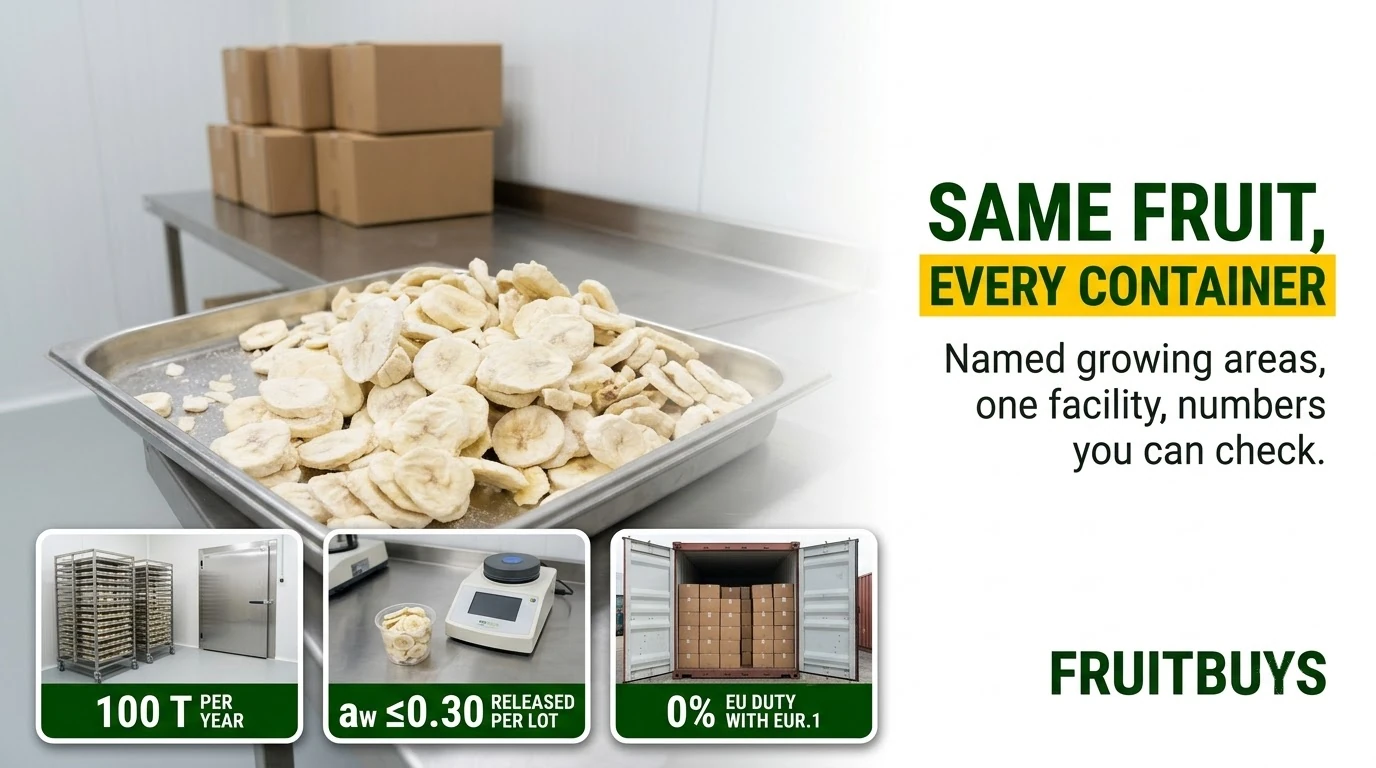
Freeze-dried banana is ripe banana that is sliced or diced, given a vitamin C and citric acid dip, frozen at −35 to −40 °C and dried under vacuum. It is released at ≤5.0% moisture and water activity ≤0.30, with no added sugar and no added sulfites. That makes it crisp, light and shelf-stable: 12 months at ≤25 °C in a standard dry warehouse, 18–24 months in cool storage at ≤18 °C. Full specifications are on the freeze-dried banana product page.
For an ingredient buyer, the question is usually which banana format to buy:
| Freeze-dried banana | Frozen banana purée or pieces | Sweetened soft-dried banana | |
|---|---|---|---|
| Storage | Dry warehouse, ambient | Freezer at −18 °C | Ambient |
| Shipping | Standard dry container | Reefer container | Standard dry container |
| Texture in product | Crisp, melts; or powder that disappears | Wet; for smoothies and bakery fillings | Chewy, sticky |
| Label | Banana + vitamin C + citric acid; 0 g added sugar | Banana | Often sugar or syrup added |
| Fits | Cereal, granola, snack packs, chocolate, premixes | Juice bars, frozen desserts, bakeries with freezer space | Trail mix and snack bars that want chew |
| Buffer stock | 12–24 months on a shelf | Freezer cost every day it waits | Shorter crisp life, softens further |
The last row is the one procurement teams now care about. Ecuador’s 2026 drought cut harvests for weeks, Fusarium wilt (TR4) was found on an Ecuadorian farm, and fresh banana prices swing with weather and freight. A year’s worth of freeze-dried banana sitting quietly on a dry shelf is a supply buffer that frozen fruit cannot give you without paying the freezer bill.
Who is FruitBuys, and why does a supply chain orchestrator matter for banana?
FruitBuys is a Vietnam-based supply chain orchestrator for freeze-dried fruit. Buyers searching for a “freeze-dried banana manufacturer” usually want to know who controls the product, and the difference from a trader is worth spelling out. A trader shops each order to whichever dryer is cheapest that week, does not control the process, and when a container goes wrong points at the factory.
FruitBuys works the other way round:
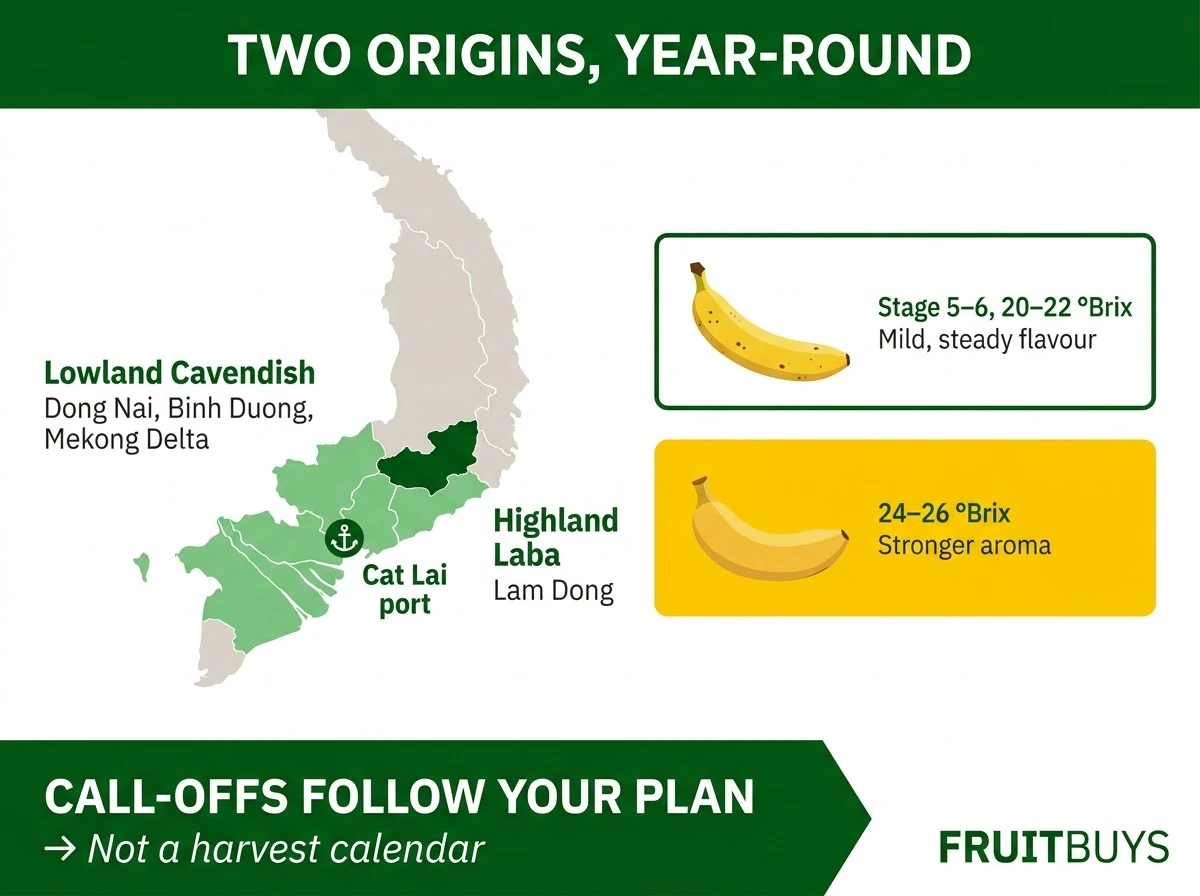
- Coordinates the growing areas. Lowland Cavendish comes from Dong Nai, Binh Duong and the Mekong Delta, close to Cat Lai port. Highland Laba comes from Lam Dong. Two regions, harvested year-round, so your call-offs follow your production plan, not a harvest calendar. Variety and region detail is in Vietnamese bananas for freeze-drying.
- Sets the process standard the qualified partner facility works to: ripeness at intake, the anti-browning dip, freezing at −35 to −40 °C, release on water activity.
- Locks one facility to your contract, with written change-control and audit access for your QA.
- Carries the export file and the quality claim from intake to bill of lading.
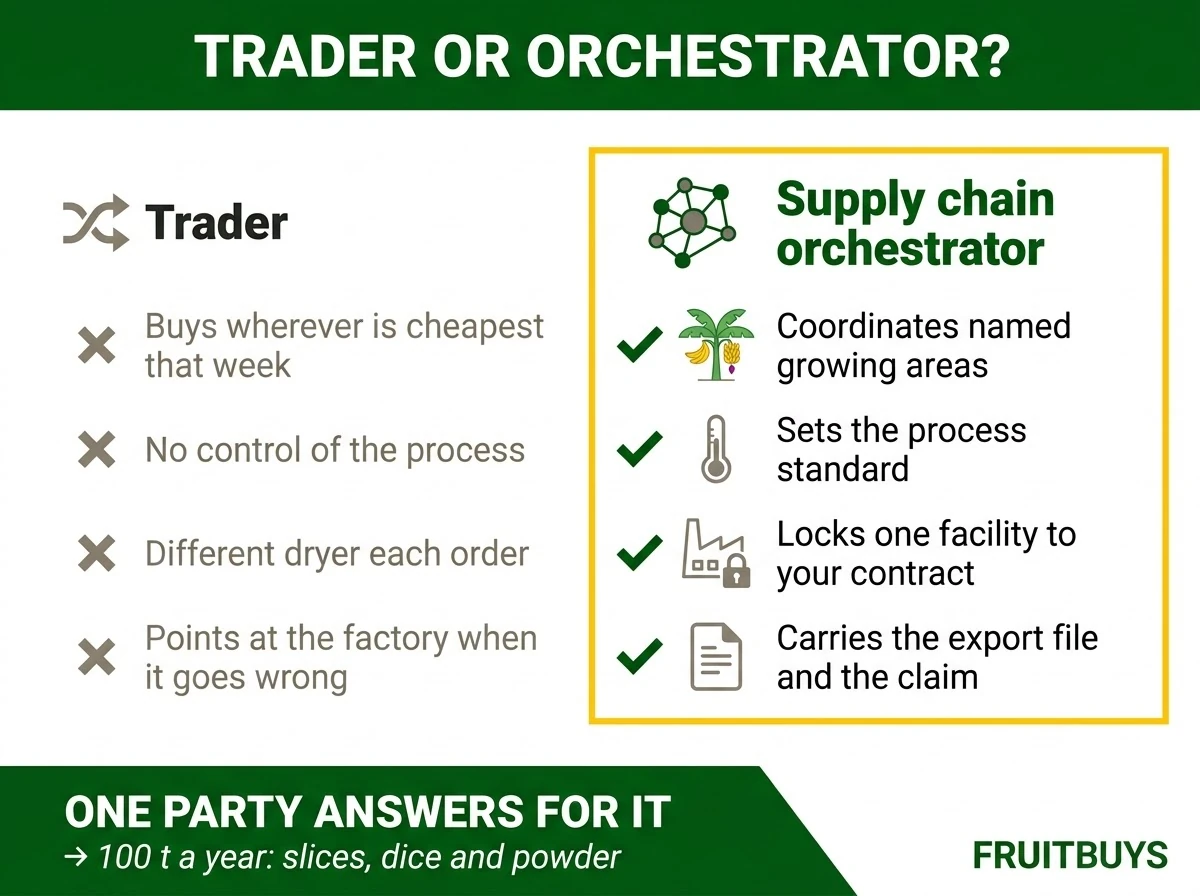
Capacity is 100 tons a year of finished freeze-dried banana across slices, dice and powder.
Does the price add up?
Start with the fruit. It takes 5–6 kg of peeled banana flesh, about 8–10 kg of whole fruit, to make 1 kg of export-grade freeze-dried banana. Drying alone would need under 4 kg. The rest goes to the sort table, where broken slices, trim, off-colour pieces and fines come out before packing.
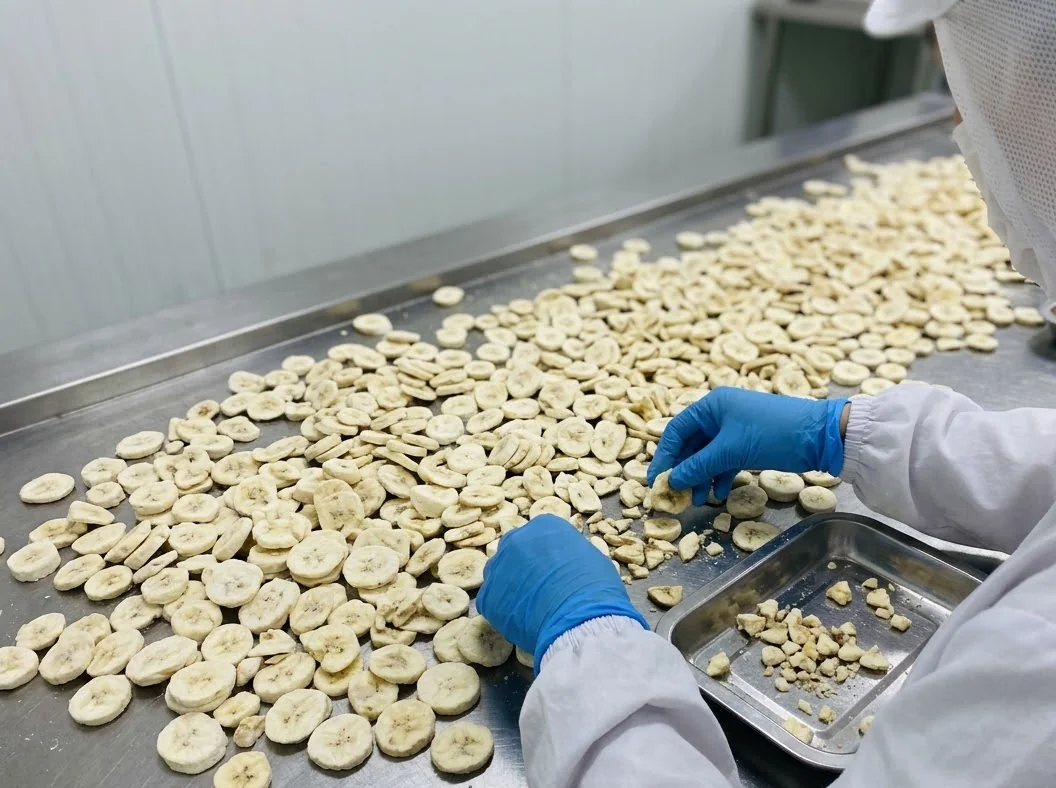
A quote that only works at 4 kg is a looser sort, a sugar-infused product or a blend with something cheaper. With fresh banana export prices up in 2026, that gap has widened: the fruit cost behind an honest kilo has risen, and a price that has not moved deserves a second question. The full arithmetic, and a cost floor you can build from the farm-gate price of whole bananas, is in how many kilos of banana make 1 kg of freeze-dried.
Will it stay crisp all the way to your warehouse?
It will if water activity is in the contract. Banana is about two-thirds natural sugar once dried and pulls moisture from the air faster than most fruits. Lots leave the dryer at 2–4% moisture and are released against ≤5.0% and aw ≤0.30, measured on the packed product. That gap is the buffer that carries the slices through four to six weeks at sea, warm ports and cold nights.
Every full container ships with a third-party lot COA for moisture, aw, total plate count, yeasts and moulds, E. coli and Salmonella. Lead, arsenic and aflatoxin are covered by periodic surveillance at an independent ISO/IEC 17025 accredited laboratory. Limits and tests are in what limits freeze-dried banana should meet.
Will it stay cream-coloured, and what goes on the label?
Colour is decided in the minutes between the knife and the freezer. Partner facilities buy at stage 5–6, 20–22 °Brix, dip the slices in vitamin C and citric acid, freeze them at −35 to −40 °C, and check every lot against L* >70 before packing. No sulfites are added at any step, so your EU pack carries no sulfite allergen line.
That is the difference your consumer sees. They open a box of granola and find cream-white banana that smells of ripe fruit, not grey chips that look a year old. For brands that want a single ingredient on the pack, the no-dip line is made to order from 500 kg: the slices dry to a natural honey-gold and the ingredient list reads simply banana. Ripeness, colour and breakage control are in why freeze-dried banana turns brown or breaks.
Which cut, and how much breakage should you accept?
Slices 5–7 mm sell on sight. Dice 5×5 to 10×10 mm doses cleanly and ships at 10 kg per carton instead of 7, which cuts freight per kilo by about 30%. Fines are held to ≤8–10% for slices and ≤3–5% for dice at packing. Broken pieces are milled into powder rather than left at the bottom of your bag.
For shakes, dairy and chocolate, freeze-dried banana powder is a separate product with its own dedicated production run for container orders; see what to specify before buying freeze-dried banana powder in bulk. Matching the cut to your line is in slices, dice or crumbles.
Will the bulk shipment match the sample?
It will if four things are in the contract:
- A pre-shipment sample of 100–200 g drawn from the packed lot, in two sealed foil pouches.
- A retained sample from every container, kept for its full shelf life.
- One named facility, with written change-control and your audit access.
- Claim windows of 14 days from devanning for physical checks and aw, and 30 days for laboratory results.
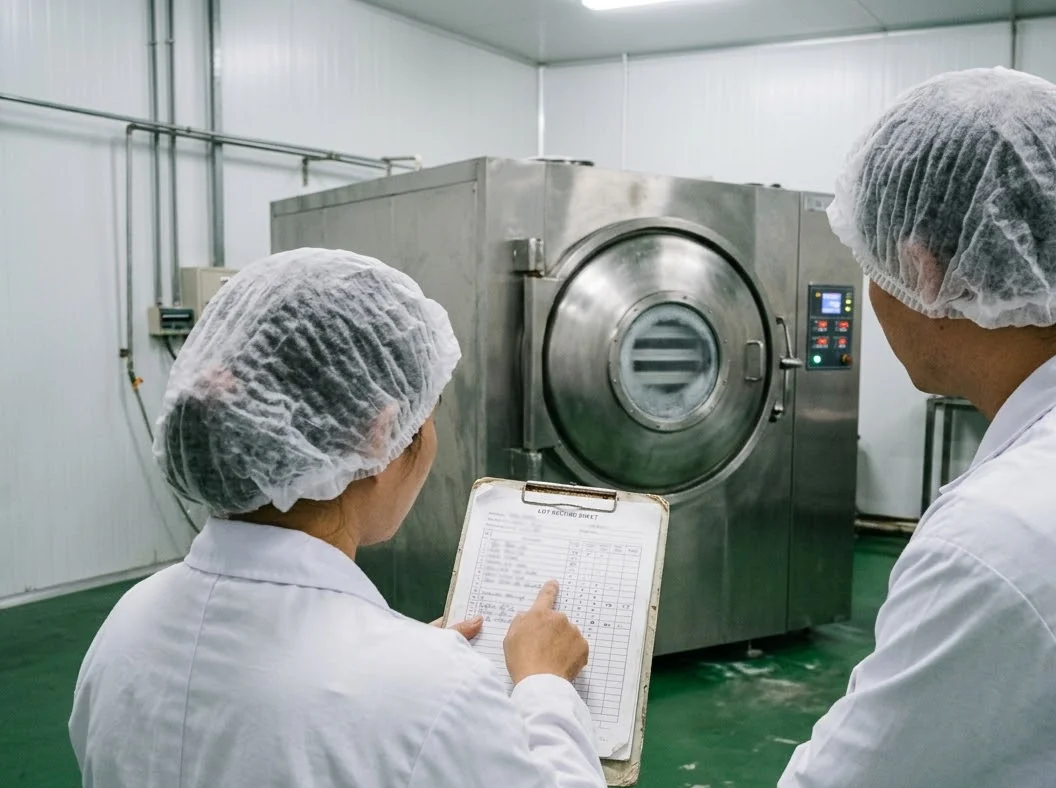
The shortcut to ask about is split batching: one container divided between several subcontracted dryers, with mixed colour and texture in the same load. The full approval route is in the freeze-dried banana RFQ and sample-to-bulk checklist.
How does it ship, and how much fits?
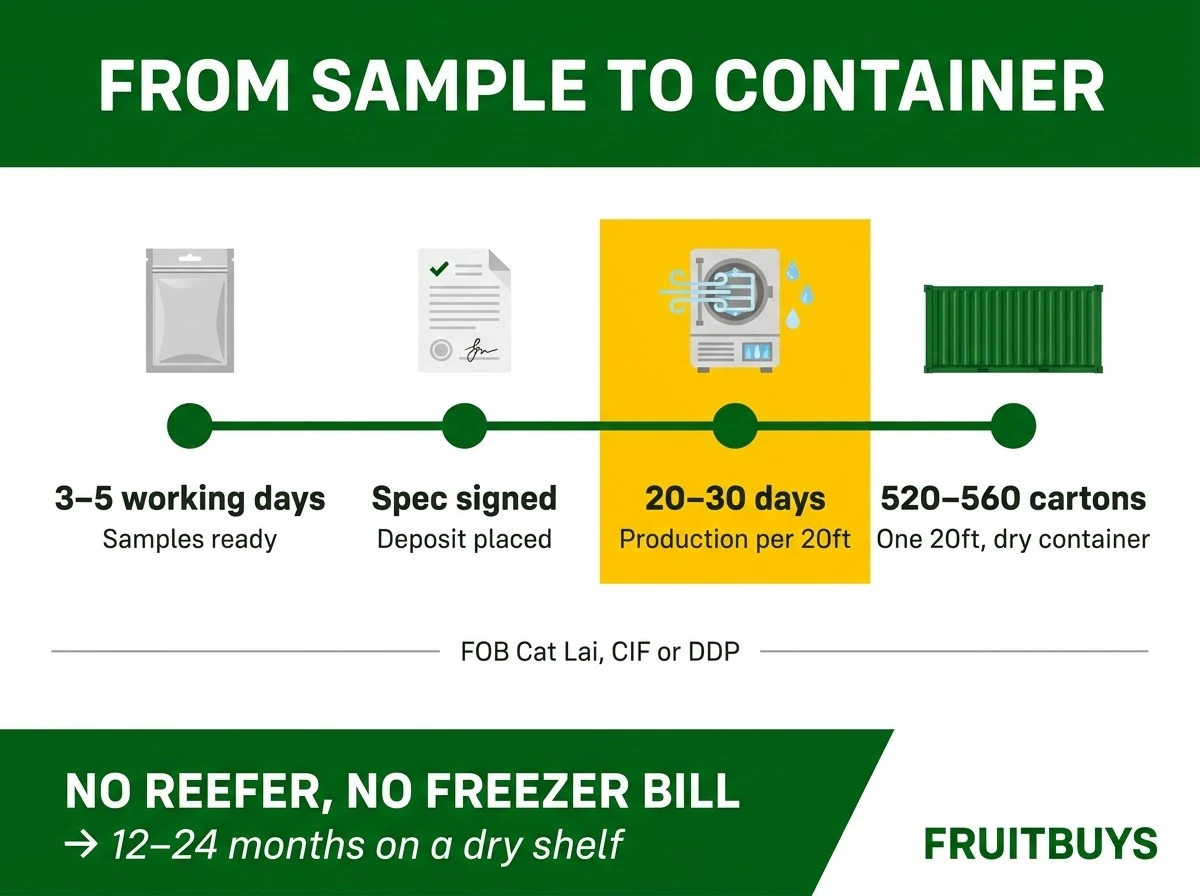
Soft-vacuum foil bags of 1–5 kg with silica gel go into 58 × 28 × 34 cm cartons, floor-loaded in a standard dry container with no reefer.
| Container | Cartons | Slices | Dice |
|---|---|---|---|
| 20ft | 520–560 | 3.6–3.9 t | 5.2–5.6 t |
| 40ft HC | 1,050–1,150 | 7.4–8 t | 10.5–11.5 t |
Production runs 20–30 days per 20ft after deposit, and samples are ready in 3–5 working days. Shipping terms are FOB Cat Lai, CIF or DDP, by sea from Cat Lai or by air from Tan Son Nhat. Container rain on cold-weather routes is handled with foil bags and desiccant in every carton, wall lining, container desiccants and a cover over the top layer. Loading plans are in how freeze-dried banana is packed and loaded.
Will it clear customs first time?
Declare it under HS 0803.90, the heading for bananas fresh or dried, not 0813. In the EU the third-country duty on dried bananas is 16%; with a Form EUR.1 under the EU–Vietnam agreement, Vietnamese origin enters at 0%. Because 0803 is shared with fresh bananas, port systems check plant-health documents on that code by default. The phytosanitary certificate in every FruitBuys dossier lets your broker clear the container without explaining fresh versus dried.
For EU contracts, a pre-shipment residue panel including ethephon and post-harvest fungicides is coordinated before stuffing. For the US, our export file is built so your broker can claim the best duty treatment open to Vietnamese bananas. Market by market, it is all in what freeze-dried banana needs to clear US, EU, UK and UAE customs.
Can you launch it under your own brand?
Yes, from 500 kg per SKU, packed in your 30 g to 500 g pouch at the partner facility, with digital print in 7–10 working days for a first run. Custom tropical blends can pair banana with other FruitBuys freeze-dried fruits such as mango, strawberry, jackfruit or dragon fruit, and can incorporate freeze-dried coconut sourced to your formulation. Nutrition data for your label, from 370 kcal and 1,600 mg potassium per 100 g, comes in US or EU format. See can you private-label freeze-dried banana from Vietnam and freeze-dried banana nutrition facts.
The 10-line RFQ checklist
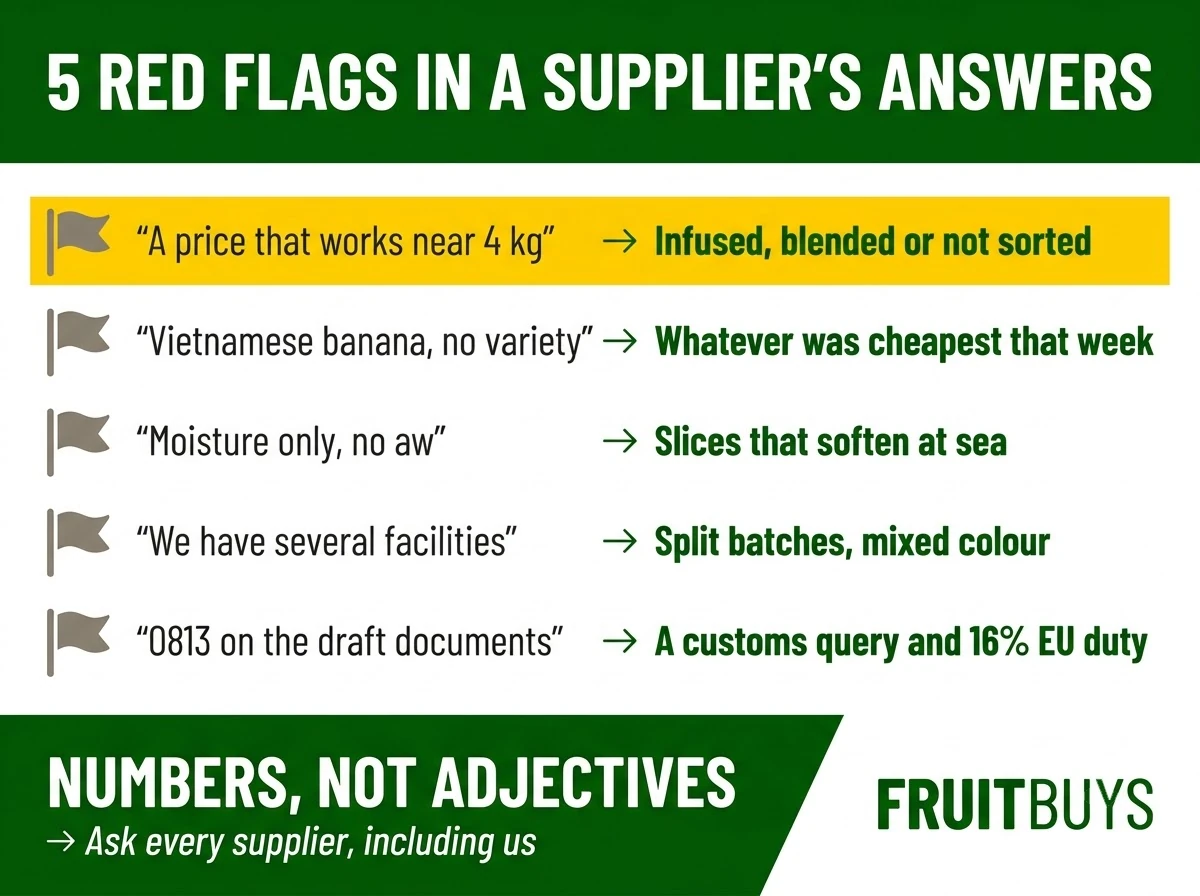
Send this to every supplier on your shortlist. Credible answers come back as numbers, not adjectives. The third column is what an evasive answer usually means.
| # | Ask | A credible answer | Red flag |
|---|---|---|---|
| 1 | Kilos of fresh banana behind 1 kg of product? | 5–6 kg peeled flesh, 8–10 kg whole fruit | A price that only works near 4 kg: sugar infusion, a blend with cheaper dried banana, or no sorting of fines and ends |
| 2 | Variety and growing area? | Named variety (e.g. Cavendish G9 or Laba) and region | “Vietnamese banana”, no variety: whatever was cheapest at the market that week |
| 3 | Ripeness at intake? | Stage 5–6, a stated °Brix range | Photos instead of a number: green fruit dries pale and tastes chalky |
| 4 | How is colour held, and are sulfites used? | Named method; sulfites yes or no in writing | No answer on sulfites: an allergen line you discover at the EU border |
| 5 | Release moisture and water activity? | ≤5.0% and aw ≤0.30, measured per lot | Moisture only, no aw: slices that soften and cake weeks into the voyage |
| 6 | Which tests travel with each container? | Third-party lot COA with named parameters | “Tested on request” with no list: no lot COA at all |
| 7 | Fines limit for your cut? | A percentage per cut, screened at packing | No number: dust at the bottom of every bag |
| 8 | Which facility makes my container? Any subcontracting? | One named facility, change only with notice and new sample approval | “We have several facilities”: split batching, mixed colour and texture in one container |
| 9 | Pre-shipment and retained samples? | From the packed lot; retained for full shelf life | A showroom sample with no lot code: nothing to hold the container against |
| 10 | HS code, origin document, phyto? | 0803.90, EUR.1 for EU/UK, phyto with every shipment | 0813 on the draft documents, or no EUR.1: a customs query and the 16% EU duty instead of 0% |
When is a different route the better fit?
When the numbers work against you. If you need a few hundred kilos of retail packs on a shelf next month, a dedicated print run, a packing set-up and air freight would load fixed costs onto every pouch. Finished stock from a local distributor protects your margin better for that first launch, and that is the advice we give. When your volume grows into a 500 kg private-label run or a container, FruitBuys makes the numbers work.
If your brief is really about pesticide residues and the risk of a rejected container, the answer is a destination multi-residue panel on your own lot before the container is stuffed, from managed growing areas. If the pack must read banana and nothing else, the no-dip line delivers it. Tell us which at RFQ stage and the specification is built around it.
FAQ
Where can I buy freeze-dried bananas in bulk?
Directly from a Vietnamese supplier that controls the growing areas and the facility. FruitBuys ships slices, dice and powder by the carton, LCL or container.
What is the minimum order for freeze-dried banana?
Bulk orders have no fixed minimum; trial and LCL lots are welcome. Private-label packing and the no-dip line start at 500 kg per SKU.
Why are freeze-dried bananas so expensive?
Because 8–10 kg of whole fruit goes into each kilo, and a freeze-drying cycle runs 48–72 hours under vacuum. You are paying for fruit, energy and the sort table, not for water.
What do freeze-dried bananas taste like?
Like a ripe banana in crisp form: sweet, aromatic, light and crunchy, then melting on the tongue. Laba from the highlands tastes noticeably stronger than Cavendish.
How fast can you ship a container?
Production runs 20–30 days per 20ft after deposit; samples are prepared in 3–5 working days.
Which certifications does the facility hold?
HACCP, ISO 22000, BRC (qualified processing facility) and US FDA Facility Registration, with Halal certification available on request.
Put your shortlist to the test
Send us your RFQ with the ten questions above, your cut, volume and destination. FruitBuys returns a specification, a container plan and a sample schedule, so you can compare suppliers on the same numbers. Full product details are on the freeze-dried banana page, within our freeze-dried fruit range. Prefer to talk it through? Email [email protected] or WhatsApp +84 919 739 589.