How is freeze-dried banana packed, and how long does it keep?
Freeze-dried banana ships in 1–5 kg foil bags with a silica gel desiccant, 7–10 kg per carton, in a standard dry container. In the sealed bulk bag it keeps 18–24 months in cool storage at ≤18 °C and RH ≤50%, and 12 months once repacked into retail pouches at ≤25 °C and RH ≤60%. No reefer, no freezer. The one thing it cannot tolerate is humid air, and every step of the pack is built around keeping it out.
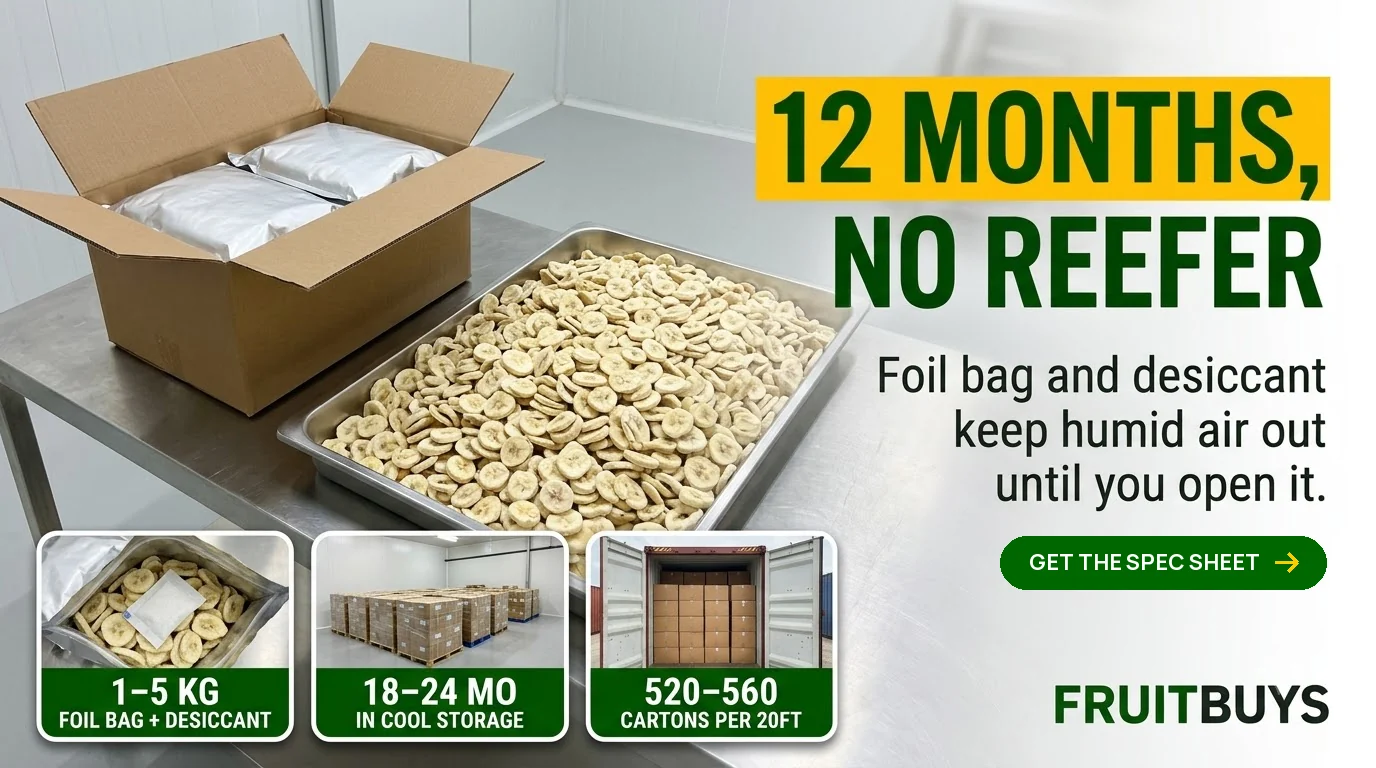
How long do freeze-dried bananas last?
As long as the bag stays sealed and the store stays dry. The shelf life is set by moisture, not by microbes, so the pack and the store decide the date:
| Pack and store | Shelf life | Who it suits |
|---|---|---|
| Original sealed bulk bag, cool store ≤18 °C, RH ≤50% | 18–24 months | Ingredient buyers holding buffer stock, private-label brands with long printed dates |
| Original sealed bulk bag, ≤25 °C, RH ≤60% | 12 months | Importers and distributors turning stock within the year |
| Retail pouch after repacking, ≤25 °C, RH ≤60% | 12 months | Private-label brands and distributors selling packed goods |
| Opened bulk bag on a production floor | One shift | Cereal, bakery and confectionery lines dosing from 1–5 kg bags |
| Opened retail pouch, resealed | Days in a dry kitchen, hours in a humid one | Consumers snacking from a zip pouch |
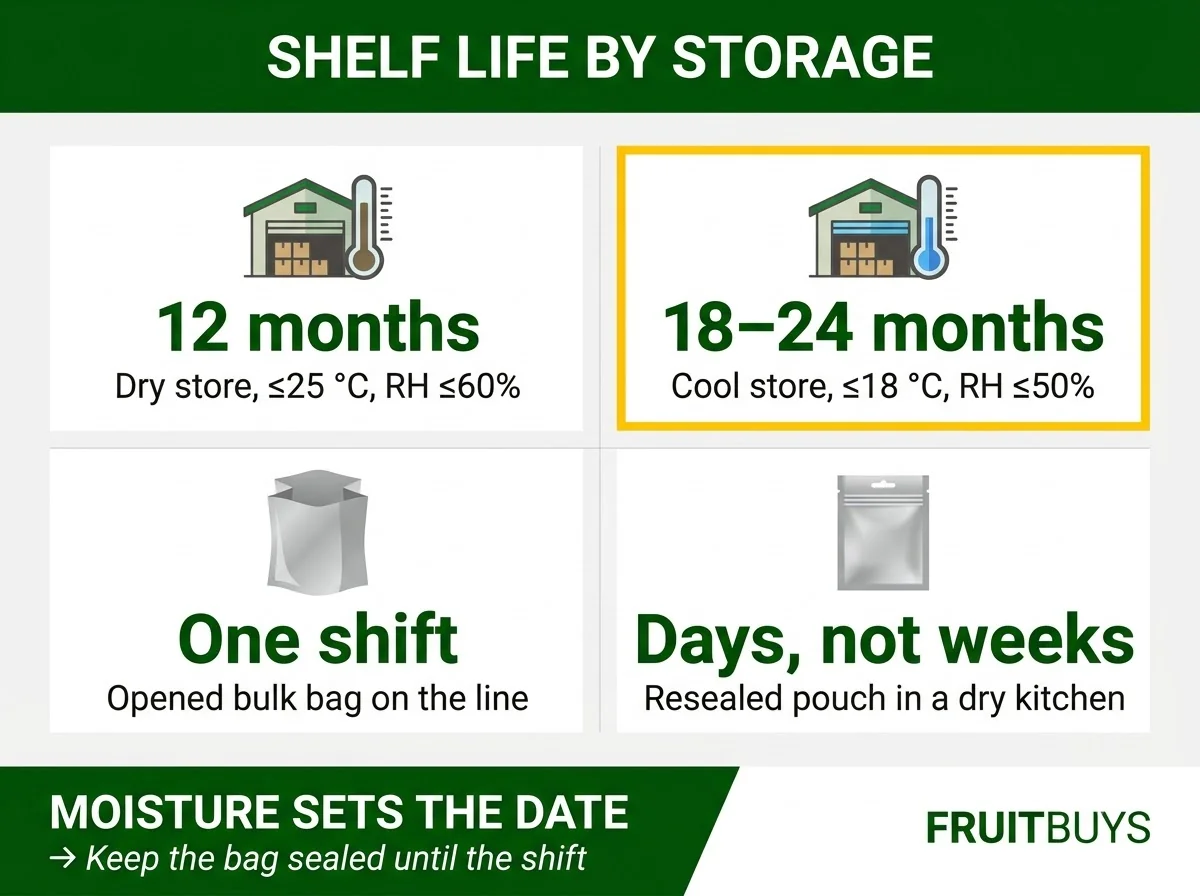
The pallet you put in a cool store today is still crisp and cream-coloured when your sales team needs it in month 20. That is time to move stock through several channels without short-dated pressure.
Can freeze-dried bananas go bad?
Sealed and stored as above, they do not spoil in the way fresh fruit does. At water activity ≤0.30, set out in what limits freeze-dried banana should meet, bacteria, yeasts and moulds cannot grow. What happens instead is a slow loss of quality, and banana shows it earlier than most fruits because about two-thirds of a dry slice is natural sugar, and sugar pulls water from the air.
Your QA team will see four signs, in this order:
- Slices stop rattling. They feel heavy and tacky when you shake the bag.
- The bite turns chewy. The slice bends before it breaks and packs into the teeth.
- Colour darkens. Cream turns to beige, then light brown.
- Aroma fades. The ripe-banana smell gives way to a flat, cardboard note.
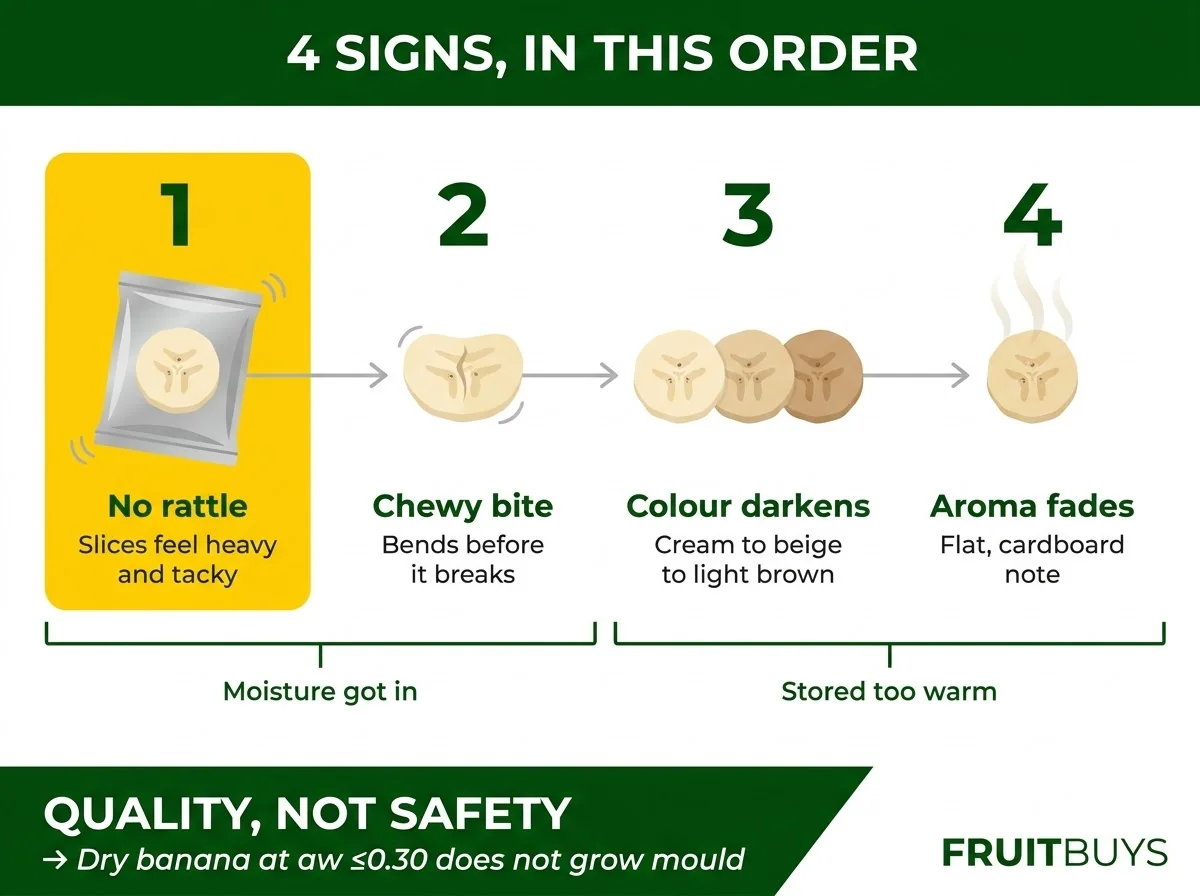
Signs 1 and 2 mean moisture got in, usually through an open or damaged bag. Signs 3 and 4 alone, in a sealed bag, mean the stock sat too warm for too long. None of them is a food-safety problem while the product stays dry, but none of them will earn a reorder. Mould appears only if banana is left open in a damp place long enough to absorb a lot of water; that product should be discarded.
What is in each bag and carton?
| Layer | What FruitBuys uses | Why it matters to you |
|---|---|---|
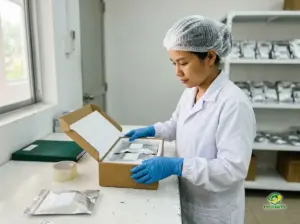
| Bulk bag | 1–5 kg aluminium-foil PE bag, soft vacuum | Blocks light and moisture; flat bag holds the slices still at sea |
| Inside the bag | Food-grade silica gel desiccant, dust-free type | Absorbs the moisture that gets in when bags are handled and sealed |
| Carton | 58 × 28 × 34 cm, 5-ply: slices 7 kg, dice and crumbles 10 kg | Slices packed lighter so bags at the bottom are not crushed |
| Retail (OEM) | 30 g, 50 g, 100 g, 500 g opaque foil zip pouches printed in full colour, or custom | Packed at source, sealed in a dehumidified packing room |
Bags are soft-vacuumed rather than nitrogen-flushed. On banana the threat is moisture, not oxygen, and the desiccant deals with moisture directly. A gentle vacuum keeps the bag tight around the slices, so they do not grind against each other for 30–45 days at sea, and you do not pay to ship a pillow of gas in every carton.
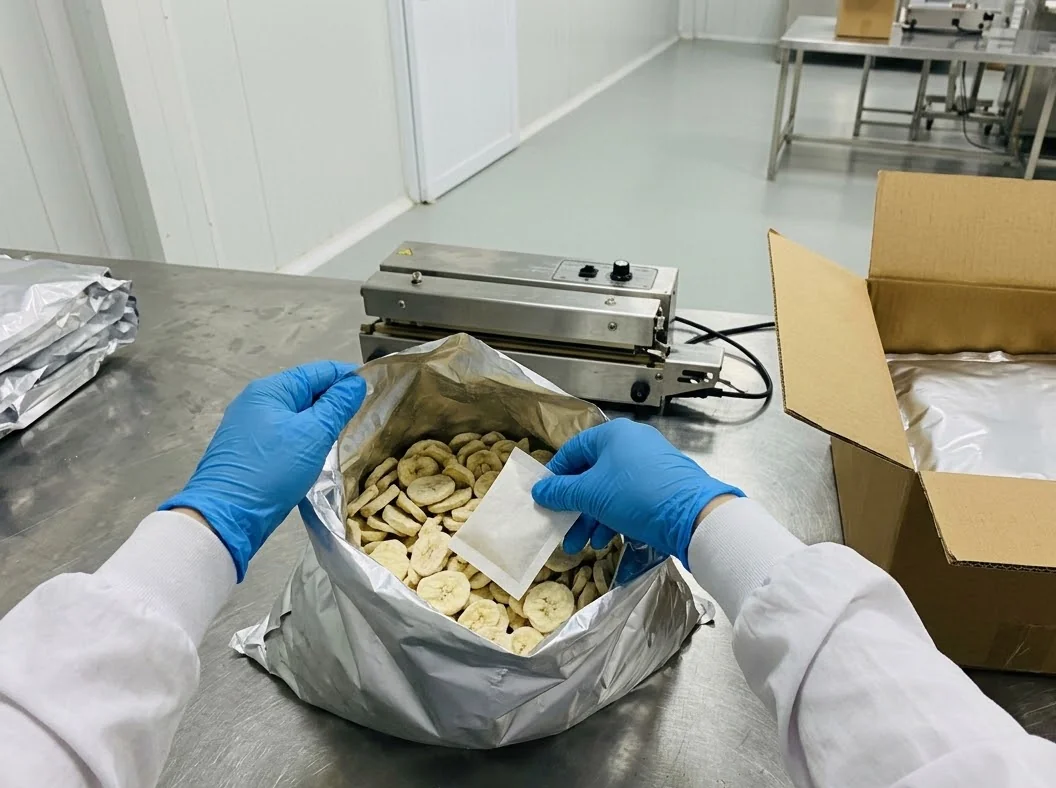
Bulk bags are sized to the batch your line runs in one shift. Open a bag, use the whole bag, and nothing sits half-open next to a steaming kettle or a proofing room. If your recipe calls for less, ask for 1 kg bags; the price of a few more bags is lower than the cost of one soft batch.
How much fits in a container?
| Container | Cartons, floor-loaded | Slices | Dice and crumbles |
|---|---|---|---|
| 20ft | 520–560 | 3.6–3.9 t | 5.2–5.6 t |
| 40ft HC | 1,050–1,150 | 7.4–8.0 t | 10.5–11.5 t |
| 20ft, palletised (1,200 × 1,000 mm, 24 cartons per pallet) | about 240 | on request | on request |
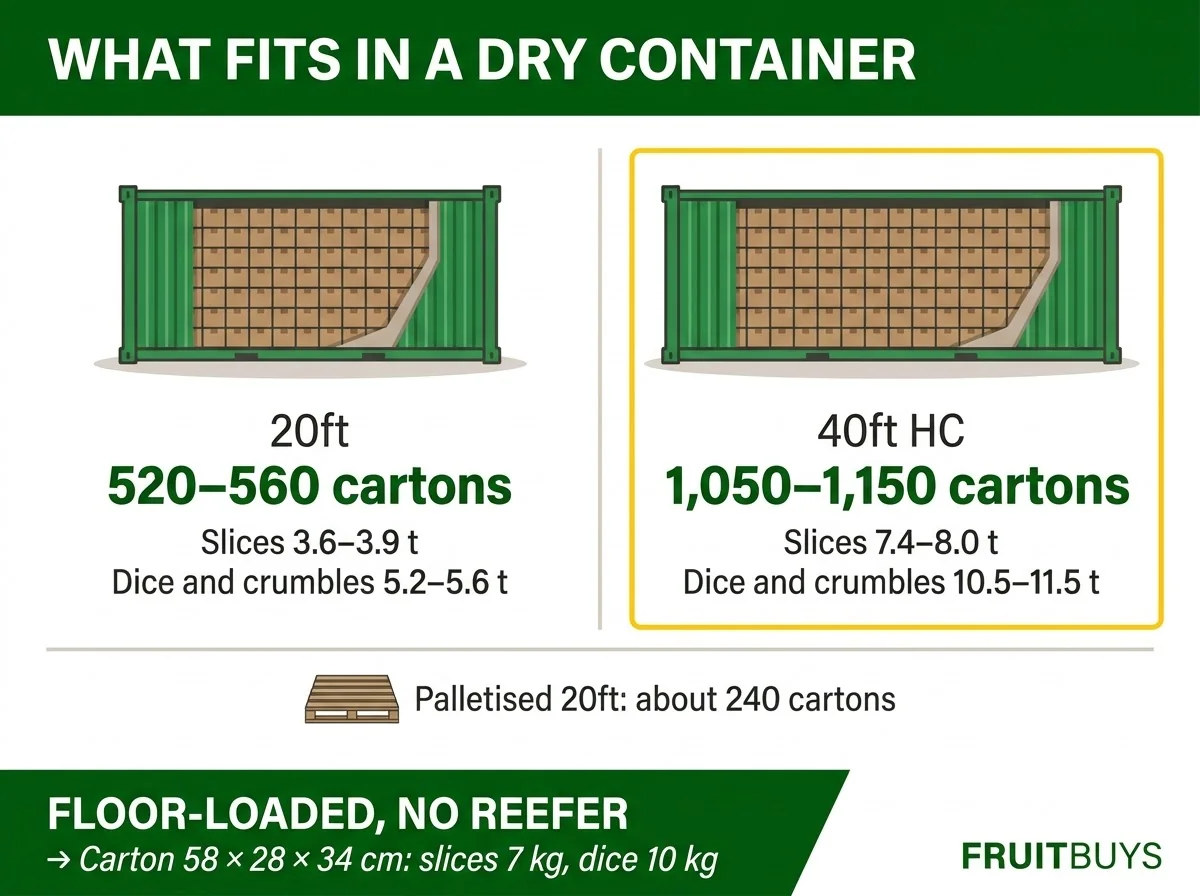
Cartons are floor-loaded 8 across and 10 deep along the container. Floor loading carries more than twice the cartons of a palletised load, which is why most ingredient buyers take it and devan by hand or with a conveyor. If your warehouse only receives on pallets, say so in the RFQ and the loading plan is built around it.
A standard dry container does the job. Freeze-dried banana does not need a reefer, which keeps freight lower and frees you from reefer equipment shortages in peak season. Dice ships at 10 kg per carton against 7 kg for slices, so freight per kilo drops by about 30%; how to choose the cut is in freeze-dried banana slices, dice or powder.
How do you stop container rain?
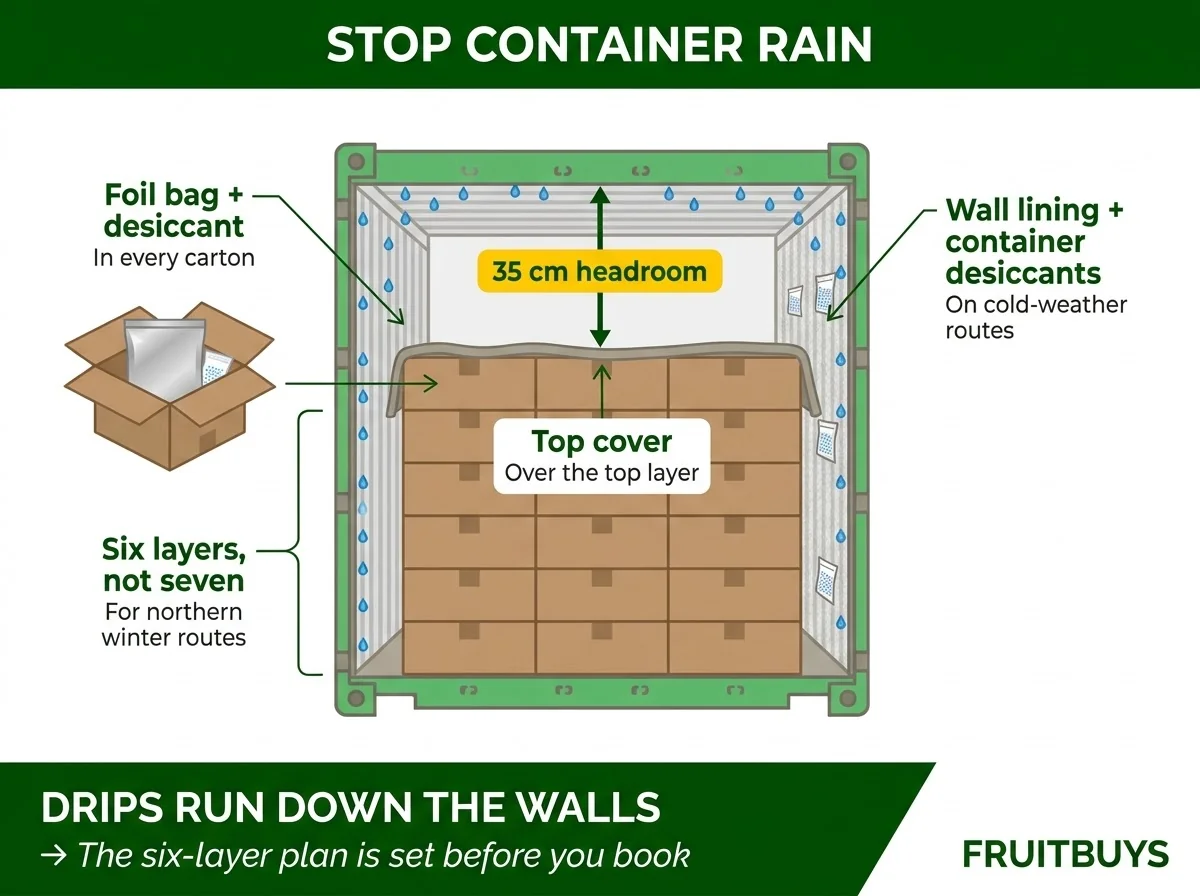
Container rain is the one transit risk worth planning for. A container stuffed in humid Ho Chi Minh City air sails into a cold northern winter; the steel walls and roof cool at night, the moisture in the air condenses on them and drips onto the top cartons. On a sugar-rich product, a wet carton means softened bags.
FruitBuys handles it in layers:
- Foil bag and desiccant in every carton. Even a damp carton leaves the banana inside dry.
- Wall lining and container desiccants on cold-weather routes.
- A cover over the top layer of cartons.
- Headroom when it matters. Seven layers fill the container to the roof. Six layers leave about 35 cm of air above the cartons, so condensate runs down the walls instead of dripping onto the load. Ask for the six-layer plan if your route crosses a northern winter; it carries fewer cartons, so the trade-off is set out in the loading plan before you book.
Summer has its own risk. A container standing in the sun at a Gulf port in August heats up fast. Ask your forwarder to devan promptly and move the cartons straight into a store at ≤25 °C; a sealed foil bag rides out a hot week, but not a hot month on the quay.
How should your warehouse store it?
Treat freeze-dried banana like a dry ingredient that hates humidity:
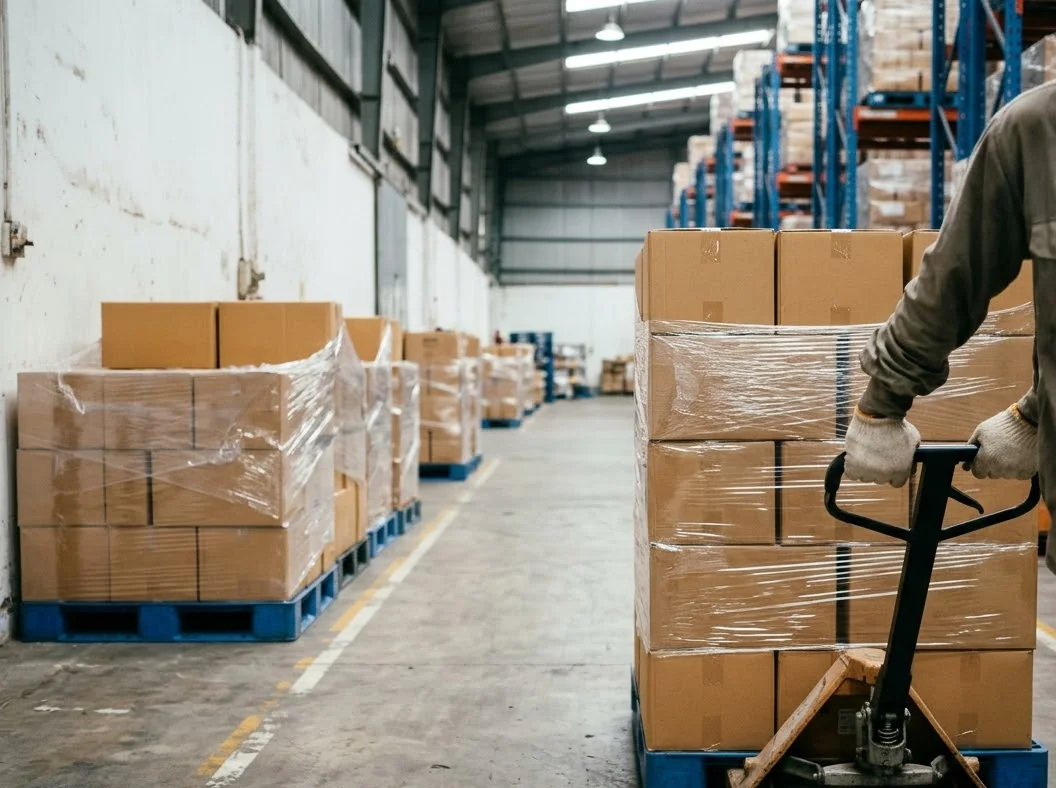
- Keep cartons off the floor on pallets and away from outside walls.
- Hold retail pouches at ≤25 °C, RH ≤60% for their 12 months; original sealed bulk bags at ≤18 °C and RH ≤50% run 18–24 months.
- Run first in, first out by lot code.
- Leave bags sealed until the shift that uses them. A half-used bag goes back in the carton only if it is pressed flat, closed with a heat sealer or a strong clip, and used within a day or two.
You do not need to refrigerate or freeze it. Moving banana out of a freezer into a warm room puts condensation on the bag and into the product the moment it is opened, which is the opposite of what you want.
Can you hold freeze-dried banana as buffer stock?
Yes, and in 2026 more ingredient buyers are doing exactly that. A long drought cut Ecuador’s banana output this year, and Fusarium wilt (TR4) has been found on an Ecuadorian farm. For a cereal, bakery or baby-food line that runs banana every week, one bad season at the main origin turns into a reformulation or an out-of-stock.
Freeze-dried banana is the simplest hedge to hold. It needs a dry warehouse, not the −18 °C cold chain that frozen puree or frozen slices demand, and it keeps 12 months in that warehouse, longer in cool storage. A year’s volume can be produced and shipped in staggered containers, so the stock arrives as you need it and Vietnam becomes a working second origin rather than an emergency plan. Where Vietnam fits in banana supply is covered in freeze-dried banana wholesale and bulk.
When is a different pack the better fit?
If your product sits in open bins, unwrapped trays or a non-air-conditioned shop in a humid market, bulk freeze-dried banana loses its crunch faster than your customers will forgive. Two better routes: retail pouches filled and sealed at source, so the banana is never exposed until the consumer opens it; or powder, which goes into a closed recipe and does not need to stay crisp. For private-label packs with a long printed date, FruitBuys can arrange an accelerated shelf-life study on your final pouch, so the date on the pack comes from your packaging, not from a bulk bag. The pouch options are in private-label freeze-dried banana, and the powder route in what to specify for freeze-dried banana powder.
Before you book: your packing checklist
| Write into the order | Why |
|---|---|
| Bag size per format, sized to one production batch | No half-open bags on the line |
| Desiccant in every bag | Moisture control from packing to opening |
| Carton weight: 7 kg slices, 10 kg dice | Protects slices; lowers freight on dice |
| Floor-loaded or palletised, and pallet size | Matches your receiving dock |
| Six or seven layers, wall lining and cover | Set by route and season |
| Storage condition on arrival and the shelf life it gives | Sets your stock plan and printed date |
| Arrival checks within 14 days of devanning on unopened bags | Clean answer on what arrived |
Arrival checks, breakage and colour limits are covered in the freeze-dried banana RFQ and sample-to-bulk checklist and why freeze-dried banana turns brown or breaks.
FAQ
Can freeze-dried bananas go bad?
Sealed and stored dry, they do not spoil. If moisture gets in, they turn chewy, darker and lose aroma; mould appears only if they absorb a lot of water.
How long do freeze-dried bananas last?
18–24 months in the unopened bulk bag in cool storage at ≤18 °C and RH ≤50%; 12 months once repacked into retail pouches at ≤25 °C and RH ≤60%.
How long do freeze-dried bananas last once opened?
In a production bag, use it within the shift. A resealed retail pouch stays crisp for days in a dry kitchen, but only hours in a humid one.
Do freeze-dried bananas need to be refrigerated?
No. A dry store at ≤25 °C is enough. Cool storage at ≤18 °C extends the shelf life.
Why are my freeze-dried bananas chewy?
They have absorbed moisture, usually from an open or damaged bag. Banana is two-thirds natural sugar and pulls water from humid air quickly.
Does freeze-dried banana need a reefer container?
No. It ships in a standard dry container.
Why no nitrogen in the bag?
On banana the risk is moisture, which the desiccant handles. Soft vacuum keeps the slices still and avoids shipping gas.
Get the packing and loading plan
Send your format, volume, route and how your warehouse receives. FruitBuys returns the packing specification and a container loading plan, with bag size, carton weight, layers and rain protection written in for your route and season. Full product details are on the freeze-dried banana page. Prefer to talk it through? Email [email protected] or WhatsApp +84 919 739 589.