Freeze-Dried Banana Slices vs Cubes vs Bites vs Powder
Freeze-dried banana format selection decides whether a product works as a snack, cereal inclusion, dessert topping, beverage ingredient or private label SKU. Buyers often start with slices because they look recognizable. That is not enough. A beautiful slice can break in bulk packing. A powder can cake before formulation. A bite can lose size consistency in a granola blend. A cube can fail if the dimension tolerance is vague.

The right format is not the best-looking format. It is the format that survives the buyer’s application, packaging route and QA release criteria. FruitBuys treats slices, cubes, bites and powder as different product configurations. Each one needs its own specification, moisture and Aw proof, physical limits, packaging file and sample-to-bulk release control.
Which Freeze-Dried Banana Format Should a Buyer Choose?
The correct format depends on the intended application, handling conditions and acceptable breakage.
Slices maximize visual identity, while cubes, bites and powder provide different levels of dosing and formulation control.
Buyers should define application requirements before approving the format.
Freeze-drying removes water in the form of ice under low pressure by sublimation, and process parameters can affect structure, color, texture and density in finished foods. This explains why format is not a cosmetic decision. Cutting style, drying endpoint, post-drying handling and packaging all shape final product behavior. (AGRIS)
This article sits under the freeze-dried banana wholesale guide. The hub covers the full qualification route. This spoke focuses on the buyer’s format decision: slices, cubes, bites or powder.

The buyer should start with one question: what must the banana do inside the final product? A snack pouch needs visual identity. A cereal blend needs controlled distribution. A beverage powder needs particle control. A private label product needs the format, pouch, label and release file to work together.
Freeze-Dried Banana Slices
Slices give the strongest banana identity. The consumer sees a recognizable fruit piece. That makes slices suitable for retail snack pouches, dessert toppings, premium visual inclusions and product photography.
Slices also carry the highest physical-risk burden. They break more easily than smaller pieces. They show browning more clearly. They expose thickness variation. They also make sorting standards more visible to the buyer and consumer.
A slice specification should define:
| Control point | Buyer decision |
|---|---|
| Slice thickness | Target and tolerance |
| Diameter range | Sorting and visual consistency |
| Color range | Accepted natural variation |
| Brown-center tolerance | Pass, review and reject standard |
| Intact ratio | Minimum acceptable whole-slice share |
| Broken pieces | Maximum accepted level |
| Fines | Maximum accepted level |
| Moisture and Aw | Crispness and stability controls |
| Packaging | Crush and moisture protection |
Research on freeze-dried banana slices shows that pretreatment can affect browning and quality. A published study reported that ascorbic acid and quince seed mucilage pretreatment helped inhibit enzymatic browning and maintain banana chip quality before drying.
This supports the need to verify pretreatment and color control, but it does not prove any specific FruitBuys lot uses that treatment (PubMed). Buyers reviewing slices should continue with banana browning and breakage control.
Freeze-Dried Banana Cubes
Cubes work when the buyer needs more uniform dosing than slices can provide. They fit cereal, granola, confectionery, bakery inclusions, dessert mixes and ingredient packs where piece count and distribution matter.
The main cube risk is unclear dimension control. A supplier may call a product “cubes” even when the output contains uneven chunks. That creates problems in blending, dosing and final pack appearance.
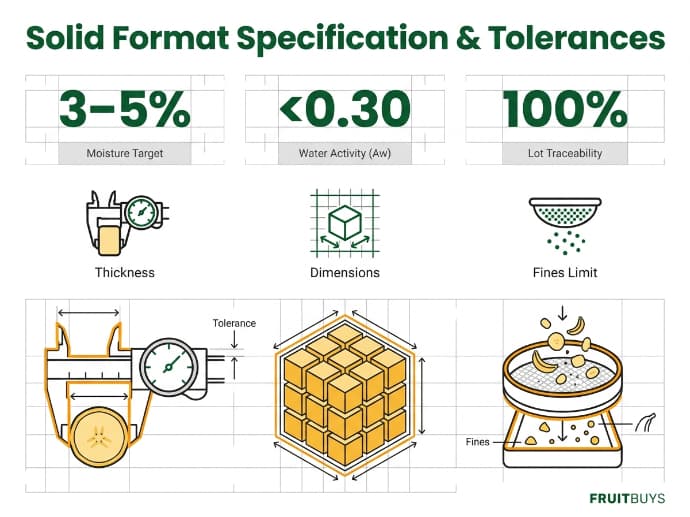
A cube specification should define:
- Target cube size
- Size tolerance
- Oversize limit
- Undersize limit
- Edge damage limit
- Moisture target
- Aw target
- Breakage and fines
- Bulk density where required
- Packaging route
Cubes can reduce whole-slice breakage risk, but they do not remove QA risk. If dimensions vary widely, the buyer receives a mixed-particle product, not a cube format.
Cubes should connect to freeze-dried banana moisture and Aw because uneven dimensions can affect drying and texture consistency.
Freeze-Dried Banana Bites
Bites sit between slices and cubes. They support snack mixes, granola, cereal, trail-style blends and retail formats where full-slice visual identity is not required.
The buyer must define the difference between an intentional bite and a broken piece. That line matters. A controlled bite format has an approved size range. A broken-piece lot reflects damage or loose sorting. They are not the same product.
A bite specification should include:
- Target bite-size range
- Maximum fines
- Allowed partial pieces
- Texture reference
- Color range
- Moisture and Aw limits
- Breakage after packing
- Distribution across pack
Bites may give the buyer a more practical format when slices break too easily during handling. They also give R&D teams more flexibility in mixed products. The risk appears when the supplier uses “bites” as a soft word for uncontrolled fragments.
Buyers should link bite approval to sample-to-bulk consistency. The approved sample must represent the actual production distribution.
Freeze-Dried Banana Powder
Powder specification requires more than a mesh declaration.
Moisture, Aw, caking, particle distribution, bulk density and microbiology affect how the powder performs.
Buyers should qualify powder against the intended formulation.
Powder is the correct format when the banana must function as an ingredient rather than a visible piece. It can fit beverage mixes, dessert powders, bakery formulations, flavor systems, smoothie bases and dry blends.
Powder has a different risk profile from slices, cubes and bites. It does not fail through visible broken pieces. It fails through caking, clumping, poor flow, inconsistent particle distribution, weak dispersion or moisture drift.

A powder specification should define:
| Specification area | Required buyer control |
|---|---|
| Mesh or particle distribution | Dosing and mouthfeel |
| Moisture | Caking and stability |
| Aw | Water availability and storage behavior |
| Bulk density | Filling and formulation control |
| Color | Batch comparison |
| Flavor and aroma | Sensory consistency |
| Microbiology | Lot release |
| Packaging | Moisture protection and resealing |
FDA defines water activity as the ratio between vapor pressure of a food and vapor pressure of distilled water under identical conditions. FDA also notes that temperature affects Aw, so buyers should review test conditions before comparing results. (ScienceDirect)
Powder buyers should continue with freeze-dried banana powder specification. Powder should never be treated as leftover fines unless the project intentionally defines and approves that route.
Format Comparison Table
| Decision Factor | Slices | Cubes | Bites | Powder |
|---|---|---|---|---|
| Visual banana identity | High | Medium | Medium | Low |
| Dosing control | Low | High | Medium | High |
| Breakage sensitivity | High | Medium | Medium | Not applicable as slices, but caking risk applies |
| Best-fit application | Snack, topping | Inclusion, bakery, cereal | Granola, snack mix | Beverage, bakery, powder blends |
| Critical QA proof | Thickness, color, intact ratio | Dimensions, distribution | Size range, fines | Mesh, moisture, Aw, bulk density |
| Packaging priority | Crush and moisture protection | Particle protection | Fines and clumping control | Moisture and caking control |
| Sample risk | Hand-selected attractive pieces | Loose dimension definition | Broken pieces disguised as bites | Fines sold as powder without spec |
| Main release file | Physical inspection + COA | Size distribution + COA | Size/fines record + COA | Powder spec + lab file |
The buyer should not select a format because it is available. The buyer should select the format that fits the application and can be verified during bulk release.
Application Mapping
| Buyer Type | Application | Required Format | Proof Needed | FruitBuys Delivery |
|---|---|---|---|---|
| Retail snack brand | Standalone banana pouch | Slices or bites | Color, intact ratio, breakage, Aw | Approved sample and release specification |
| Cereal manufacturer | Breakfast inclusion | Cubes or bites | Size distribution, fines, moisture | Format control and lot-based QC |
| Granola producer | Mixed inclusion | Bites, cubes or partial slices | Breakage after mixing, particle distribution | Application-matched sample route |
| Bakery manufacturer | Dough, filling or topping | Powder or cubes | Mesh, moisture behavior, flavor stability | R&D sample and product specification |
| Confectionery developer | Coated inclusion | Cubes or bites | Aw, size, texture and storage behavior | Application-matched format control |
| Beverage developer | Powdered drink or smoothie mix | Powder | Mesh, dispersion, caking, microbiology | Powder specification and QA file |
| Private label buyer | Branded retail pouch | Slices, bites or powder | Pack fit, label file, release criteria | OEM/Private Label Delivery |
| Ingredient distributor | Multi-application resale | Multiple formats | Standardized spec, COA and pack data | Consolidated product and document file |
For application-level product development, continue with food and beverage applications for freeze-dried banana.
Moisture and Aw Affect Every Format
Moisture and Aw decide whether the selected format can hold its intended texture and function. Slices need crispness. Cubes and bites need stable texture and distribution. Powder needs flow and caking control.
Research on freeze-dried apple and banana slices links water activity and glass transition with mechanical and optical properties. For buyers, the practical meaning is direct: water control affects how freeze-dried banana looks and behaves during storage and use. (ScienceDirect)
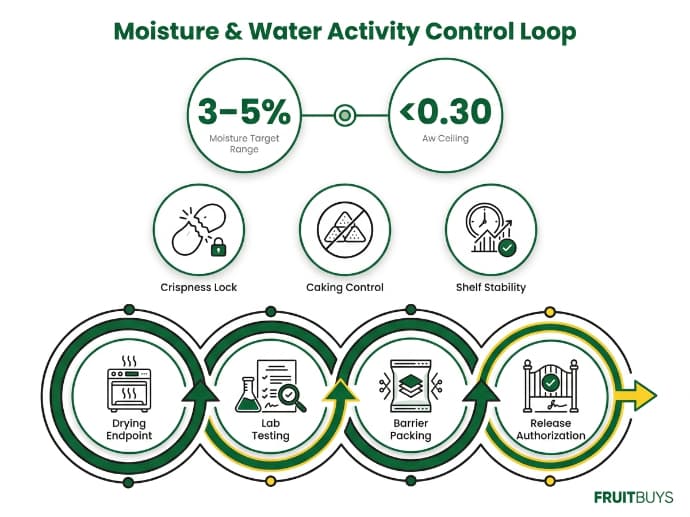
For this dataset, FruitBuys uses working targets of 3–5% moisture and Aw below 0.30. These are target specifications until confirmed by lot-specific COA.
Format selection should therefore connect with:
- Freeze-dried banana moisture and Aw
- Lot-specific COA and laboratory testing
- Packaging and shelf-life validation
A buyer who selects the right shape but ignores water control has not selected a controlled product.
Packaging Differences by Format
Packaging must follow format risk. Slices need protection from crushing and humidity. Bites and cubes need packaging that limits excessive movement and fines generation. Powder needs strong moisture protection and handling discipline because caking can damage formulation performance.
Packaging questions should include:
- What product format will be packed?
- What pack size applies?
- What inner bag or pouch structure protects moisture sensitivity?
- What seal method applies?
- What carton configuration reduces breakage?
- How will powder caking be monitored?
- How will open-pack handling be managed?
- Does the packaging file support the shelf-life direction?
Shelf life should remain conditional until the final product and package configuration supports it. Packaging evidence belongs in freeze-dried banana packaging and shelf-life control.
Sample Approval Risk by Format
A sample can look correct while failing to represent the production distribution.
Each format needs measurable bulk-release criteria before approval.
Buyers should approve the format, tolerance, packaging and COA scope together.
The sample risk changes by format.
For slices, the sample may contain hand-selected intact pieces. Bulk may contain more broken slices and brown centers.
For cubes, the sample may look uniform in a small pouch. Bulk may include wider size variation.
For bites, the sample may look practical, but the bulk lot may contain excessive fines.
For powder, the sample may flow well on arrival, then cake after poor storage or weak packaging.
The buyer should not approve any format only from a photo or tasting note. The sample must become a measurable standard through sample-to-bulk consistency.
OEM and Private Label Format Decisions
Private label buyers face a sharper version of the format problem. The product must work in the pouch, on the label, in the consumer’s hand and inside the QA file.
A private label snack pouch may need slices or bites. A smoothie mix may need powder. A cereal-inclusion product may need cubes or bites. Each route changes packaging, label data, nutrition-file basis, lot testing and release criteria.
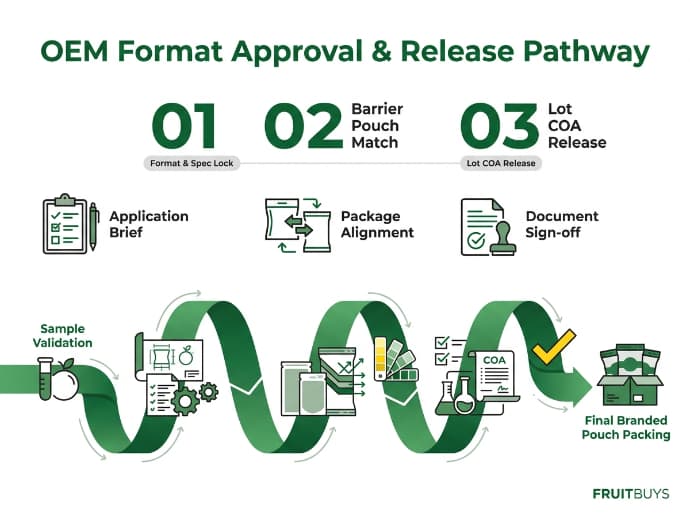
OEM/private label briefs should define:
- Target market
- Intended use
- Product format
- Pack size
- Visual standard
- Moisture and Aw targets
- Breakage or caking limits
- Ingredient statement
- Nutrition Facts route
- Packaging structure
- COA scope
- Artwork and coding requirements
- Release rule
The buyer should continue with OEM and private label delivery before moving from sample to branded production.
Highest-Risk Buyer Shortcut
The highest-risk shortcut is choosing the format from the best-looking sample.
Samples can hide breakage, size variation, caking risk, moisture drift and packaging weakness.
Buyers should choose the format from the application and proof file, not from appearance alone.
This shortcut creates different failures in different channels. Retail packs show broken slices. Granola blends reveal poor size distribution. Powdered beverages expose caking or weak dispersion. Private label projects expose every mismatch because label, pack and product all reach the consumer together.
The buyer should not ask, “Which format is best?” That question is too vague. The better question is, “Which format can meet my application, packaging route and release file with measurable proof?”. FruitBuys uses that question to build the product configuration before sample approval.
Why FruitBuys Delivers This
FruitBuys supplies freeze-dried banana as one configured product under an Integrated Product Supply Model. The buyer does not receive a loose product list. The buyer receives a selected format, approved sample route, locked specification, packaging direction and lot-based documentation under one accountable supplier relationship.
For format selection, FruitBuys applies five controls.
Raw Material Sourcing Governance aligns banana maturity and intake condition with the target format. Slices need different raw-material discipline than powder.
Quality Control defines thickness, size distribution, moisture, Aw, breakage, fines, sensory reference and lot-release criteria.
Documentation connects the approved specification, COA, laboratory report, physical inspection record and packaging file.
OEM/Private Label Delivery aligns the product format with pack size, label input, coding and retail presentation.
Export Logistics Coordination protects the selected format through carton configuration, handling discipline and document handover.
Buyers preparing a full supplier request should use the freeze-dried banana buyer RFQ checklist.
Buyer Checklist
Before approving freeze-dried banana format, request:
- Intended application
- Target format: slices, cubes, bites or powder
- Slice thickness or cube/bite dimension
- Powder mesh or particle distribution
- Moisture target
- Aw target
- Color range
- Brown-center tolerance
- Intact ratio where applicable
- Broken-piece limit
- Fines limit
- Bulk density where required
- Caking review for powder
- Packaging structure
- Seal method
- COA template
- Laboratory testing scope
- Sample-to-bulk comparison rule
- Retained sample plan
- Deviation-handling rule
Do not approve the format only from a product photo. Photos show surface appeal. They do not prove size distribution, moisture, Aw, packaging performance or bulk-release control.
Summary
Freeze-dried banana formats include slices, cubes, bites and powder. Slices provide the strongest visual banana identity but carry higher breakage and appearance-control risk. Cubes and bites support inclusions where size distribution matters.
Powder supports beverages, bakery and dry blends but requires mesh, moisture, Aw, caking and bulk-density review. For this FruitBuys dataset, working targets are 3–5% moisture and Aw below 0.30. FruitBuys connects format selection to Quality Control, Documentation, OEM/private label delivery and sample-to-bulk release.
FAQ
Which freeze-dried banana format is best for snacks?
Slices or bites usually fit snack pouches. Slices give stronger visual identity, while bites can reduce breakage risk.
Which format works best for cereal or granola?
Cubes or bites usually work better because they support more even distribution and reduce dependence on whole-slice appearance.
Is banana powder the same as fines?
No. Powder should be intentionally milled and specified. Fines are uncontrolled small particles generated by breakage or handling.
What should buyers check for slices?
Check thickness, color range, brown-center tolerance, intact ratio, breakage limit, moisture, Aw and packaging protection.
What should buyers check for powder?
Check mesh, particle distribution, moisture, Aw, caking, bulk density, microbiology and moisture-barrier packaging.
Can one COA cover all formats?
No. Each format needs a COA and inspection file that match the actual product format and lot.
Should buyers choose format before application?
No. Buyers should define the application first, then select the format that can pass the required release criteria.
Conclusion
Freeze-dried banana format selection is a technical decision, not a catalog choice. Slices, cubes, bites and powder solve different buyer problems and create different risks. The buyer must connect format to application, moisture, Aw, size control, breakage, caking, packaging and COA scope. A good sample can start the decision, but it cannot finish it. The approved format must become a measurable release standard.
Submit the intended application and required format before approving size, breakage and packaging criteria.
References
- Dorota Nowak and Ewa Jakubczyk. The Freeze-Drying of Foods: The Characteristic of the Process Course and the Effect of Its Parameters on the Physical Properties of Food Materials. Foods, 2020. (AGRIS)
- A. Milani et al. Production and Characterization of Freeze-Dried Banana Slices Pretreated with Ascorbic Acid and Quince Seed Mucilage: Physical and Functional Properties. Food Science & Nutrition, 2020. (PubMed)
- U.S. Food and Drug Administration. Water Activity (aw) in Foods. (ScienceDirect)
- G. Moraga et al. Implication of Water Activity and Glass Transition on the Mechanical and Optical Properties of Freeze-Dried Apple and Banana Slices. Journal of Food Engineering, 2011. (ScienceDirect)