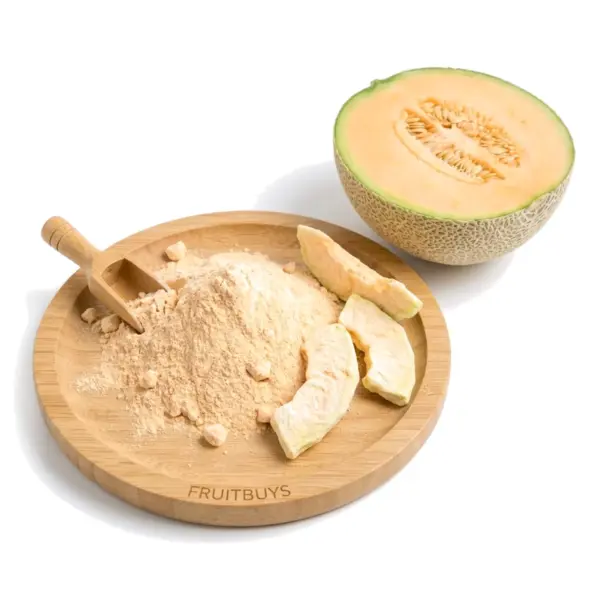
Freeze-Dried Cantaloupe Powder
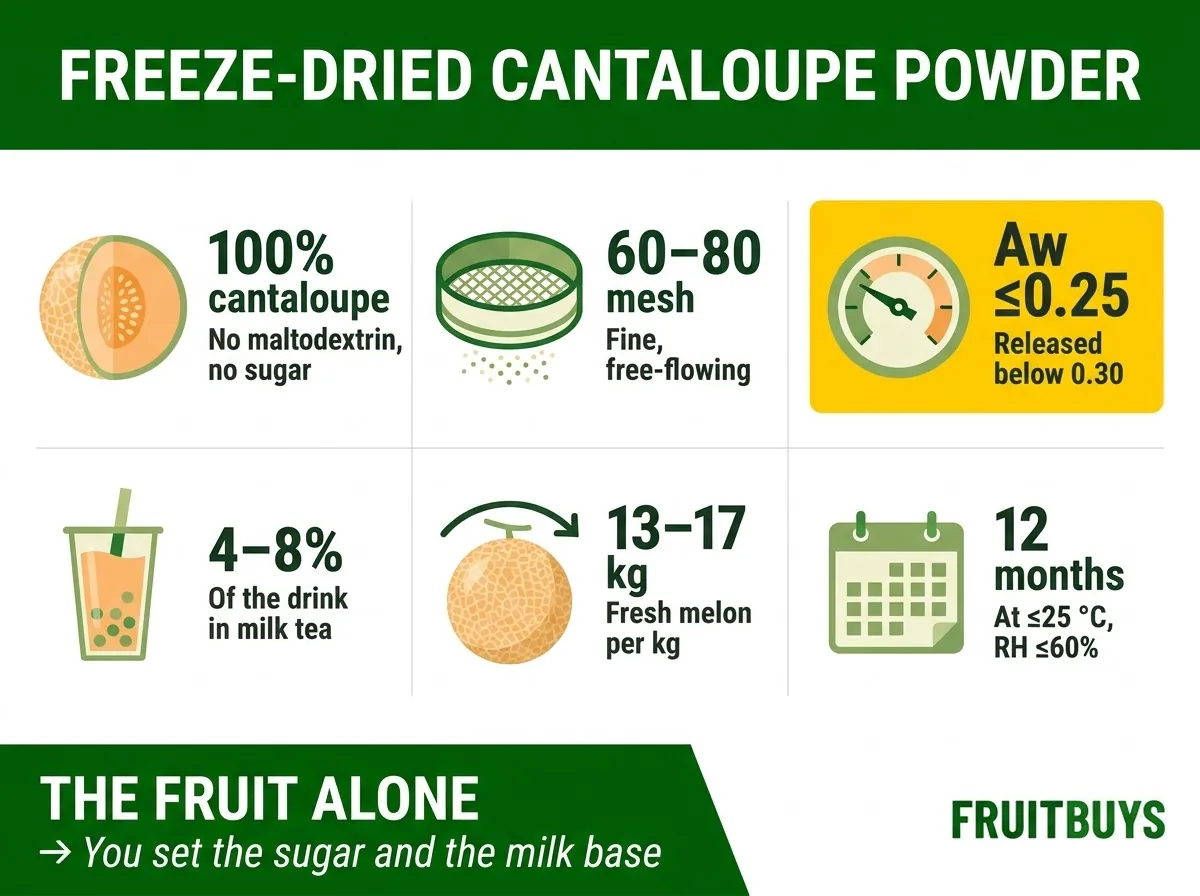
Freeze-dried cantaloupe powder from FruitBuys is 100% orange-flesh cantaloupe, milled from freeze-dried cantaloupe to 60–80 mesh, with ≤5.0% moisture and water activity ≤0.30. There is no maltodextrin, no anti-caking agent and nothing else in the bag, so your ingredient list reads one word: cantaloupe.
At 20–30 g per 500 ml cup, one 10–12 kg carton makes 330–600 cups of cantaloupe milk tea. The colour is the fruit’s own light orange, and the aroma is the musky-sweet note of ripe melon, because the fruit was dried cold and milled dry.
FruitBuys is an established Vietnamese B2B exporter specialising in freeze-dried fruits. FruitBuys sets the processing protocol, approves the pre-shipment sample and releases each lot against its certificate of analysis.
Product specification
| Parameter | Specification |
|---|---|
| Product | Freeze-dried cantaloupe powder, orange flesh (Cucumis melo L., reticulatus group) |
| Ingredients | 100% cantaloupe. No maltodextrin, anti-caking agent, sugar, colour, flavouring or preservative; processed without sulphites |
| Particle size | 60–80 mesh; mesh check on request |
| Moisture | ≤4.0% at release · ≤5.0% contract limit |
| Water activity (Aw) | ≤0.25 at release · ≤0.30 contract limit |
| Colour | Natural light orange, from the fruit’s beta-carotene |
| Flavour | Sweet, musky-floral cantaloupe; no cooked or fermented notes |
| Behaviour in liquid | Disperses in cold water or milk with stirring or shaking; the fruit fibre gives a natural, smoothie-like body |
| Microbiology | TPC ≤10⁴ CFU/g · yeasts and moulds ≤10² CFU/g · E. coli <10 CFU/g · Salmonella not detected/25 g · inclusion grade (e.g. TPC <1,000 CFU/g) on request |
| Fresh-to-powder | 1 kg powder carries the flesh of 13–17 kg whole fresh melon |
| Shelf life | 18–24 months in the original sealed bulk foil bag with desiccant, stored cool at ≤18 °C, RH ≤50%; 12 months for the sealed bulk bag at ≤25 °C, RH ≤60%, and once repacked into retail pouches. |
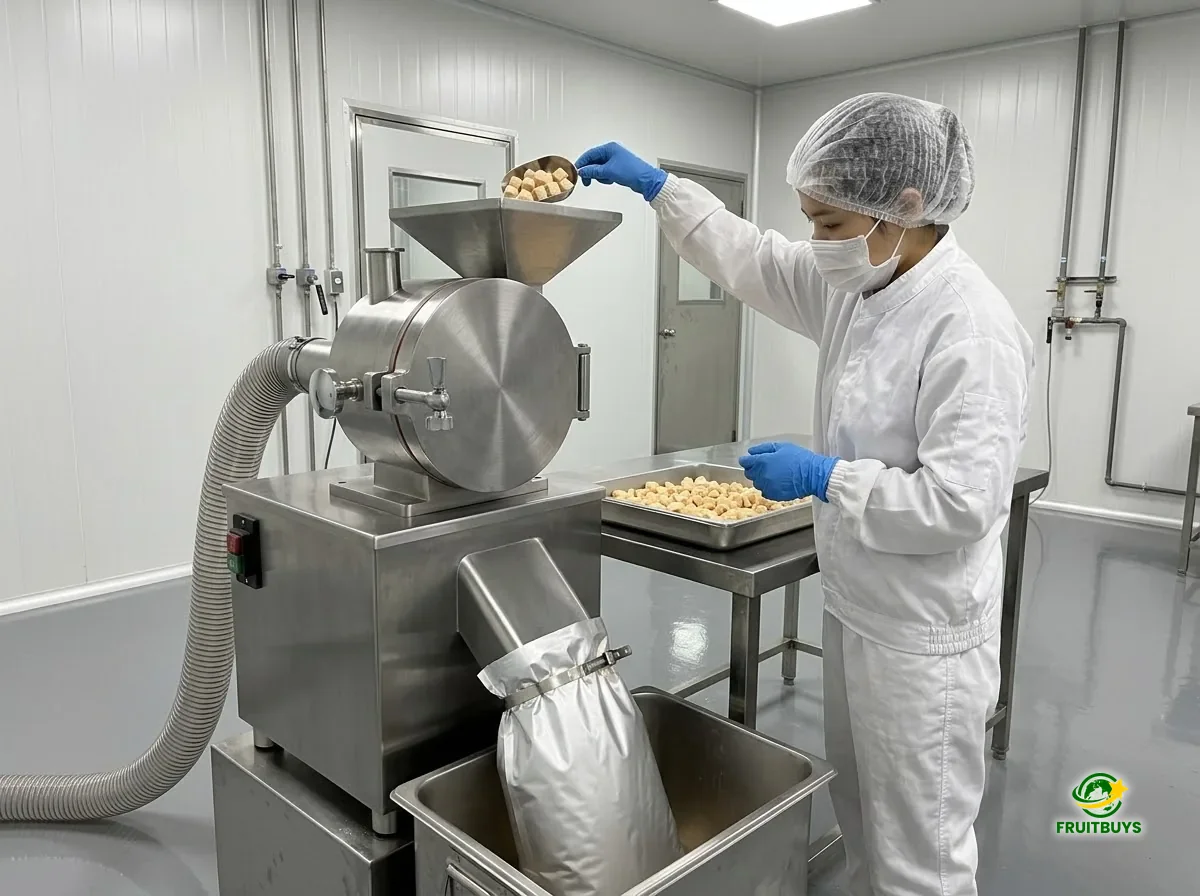
Guaranteed specifications: moisture ≤5.0% and Aw ≤0.30 on every lot COA; no maltodextrin carrier, no added sugar, no added colour.
The fruit is selected at ≥12 °Brix, and lots from Vietnam’s dry season, December to April, run sweetest and most aromatic. For drinks where the melon note carries the product, FruitBuys can reserve dry-season lots for your SKU.
How does real cantaloupe powder behave in a drink?
It disperses quickly in cold milk or water with a shaker or a few seconds of stirring, and it makes a cloudy, smoothie-like drink. That body comes from the fruit’s own fibre, which is why the cup looks and tastes like blended melon.
Two habits keep the result right. First, add the powder after any heat step: cantaloupe aroma starts to fade above about 70 °C, so in ice cream it goes in after pasteurisation, and in hot drinks it goes in at serving temperature. Second, pair it with ingredients that let the melon lead. Milk, coconut milk, lime and mint all work; strong tea or coffee bases cover it.
A clear iced tea needs a different method. Steep 10 mm freeze-dried cantaloupe dice in the tea and strain, or stir the powder in, let it settle for a few minutes and pour off the clear upper layer. Both give a light, clear melon tea from the same fruit.
Starting doses by application
| Application | Starting dose | When to add | What 1 kg of powder makes |
|---|---|---|---|
| Bubble tea, milk tea, melon milk | 4–8% of the drink, or 20–30 g per 500 ml cup | Shake into the cold base | 33–50 cups of 500 ml |
| Smoothies, agua fresca, drink mixes | 3–6% (15–30 g per 500 ml) | Blend or shake cold | 33–67 servings of 500 ml |
| Ice cream, frozen yogurt, popsicles | 5–10% of the mix | After pasteurisation | 10–20 kg of mix |
| Creams, fillings, frostings, macarons, mochi | 5–10% | After cooking, or in cold-set fillings | 10–20 kg of filling |

These doses are starting points to fine-tune by taste in your first trial batch. The cantaloupe bubble tea and drinks guide covers mixing, pairings and holding times in the cup.
Why does a high-sugar powder ship in 10–12 kg cartons?
Cantaloupe powder is about 70% natural sugar. Sugar-rich powders turn sticky when they warm up and pick up humidity, and pressure from the cartons stacked above presses sticky powder into lumps. A standard export stack puts six cartons on top of the bottom one: at 10–12 kg per carton that is 60–72 kg of load, against 90–120 kg with 15–20 kg cartons. Lighter cartons keep the powder free-flowing through a hot port and a long voyage.
Inside each carton the powder sits in 2 × 5 kg or 10 × 1 kg aluminium-foil PE bags, sealed under a light vacuum with a food-grade silica gel sachet. There is no nitrogen flush and no iron-based oxygen absorber in powder bags. Blending plants with climate-controlled intake can order 15–20 kg cartons.
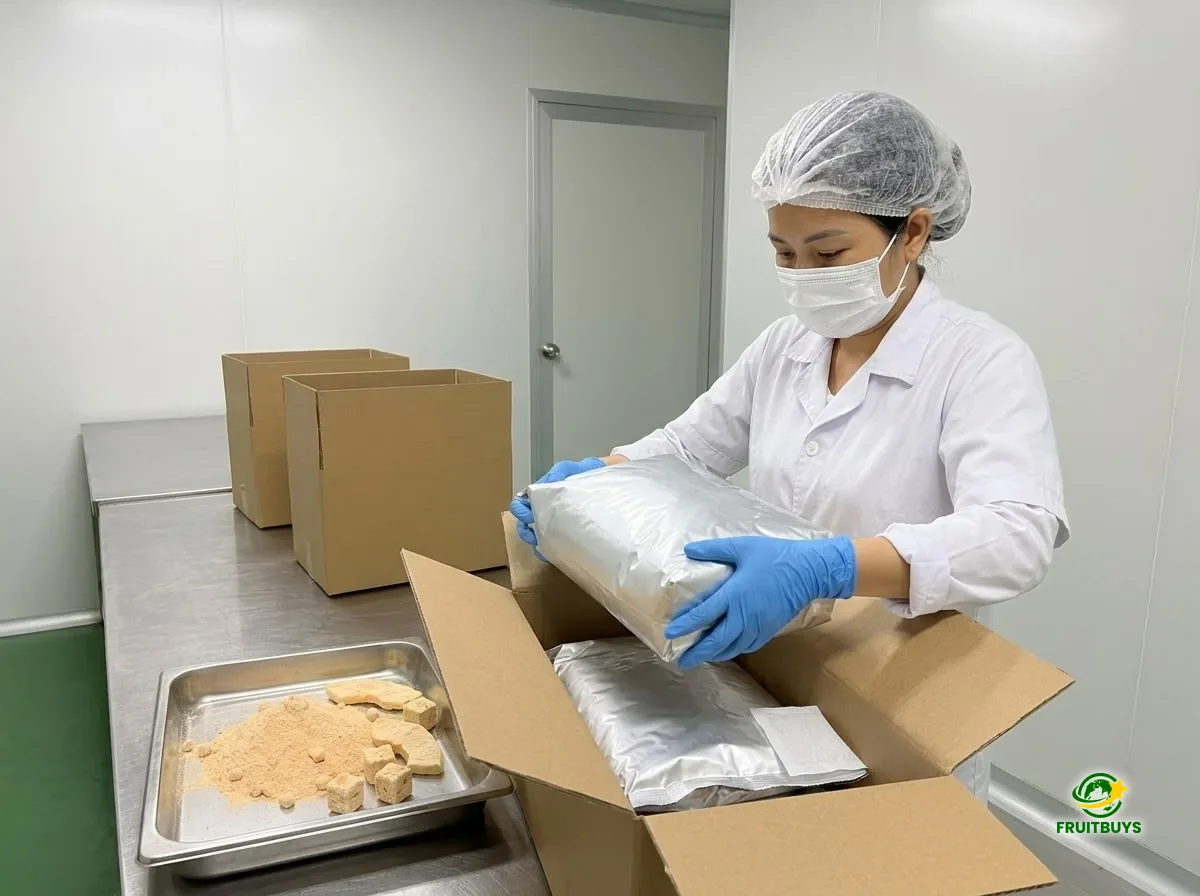
The bag size matches how powder is used. Your team opens one bag for one batch and uses it through, while every other bag stays sealed. If a bag must be reopened, reseal it at once with a fresh desiccant sachet. Soft lumps that form after opening break up by hand or through a sieve and do not change the quality. More on storage in hot, humid warehouses is in the packaging and shelf-life guide.
Real cantaloupe powder, extract or flavouring?
The words “melon powder” cover several different products. Many powders sold to bubble tea shops are ready-mixed bases of sugar, creamer and melon flavouring; others are juice powders built on a carrier. FruitBuys powder is the fruit alone, so you set the sugar, milk base and sweetness at your own ratio, and the label can say “cantaloupe” with nothing in front of it. The real powder vs flavouring guide shows how to tell them apart from the ingredient list in 30 seconds.
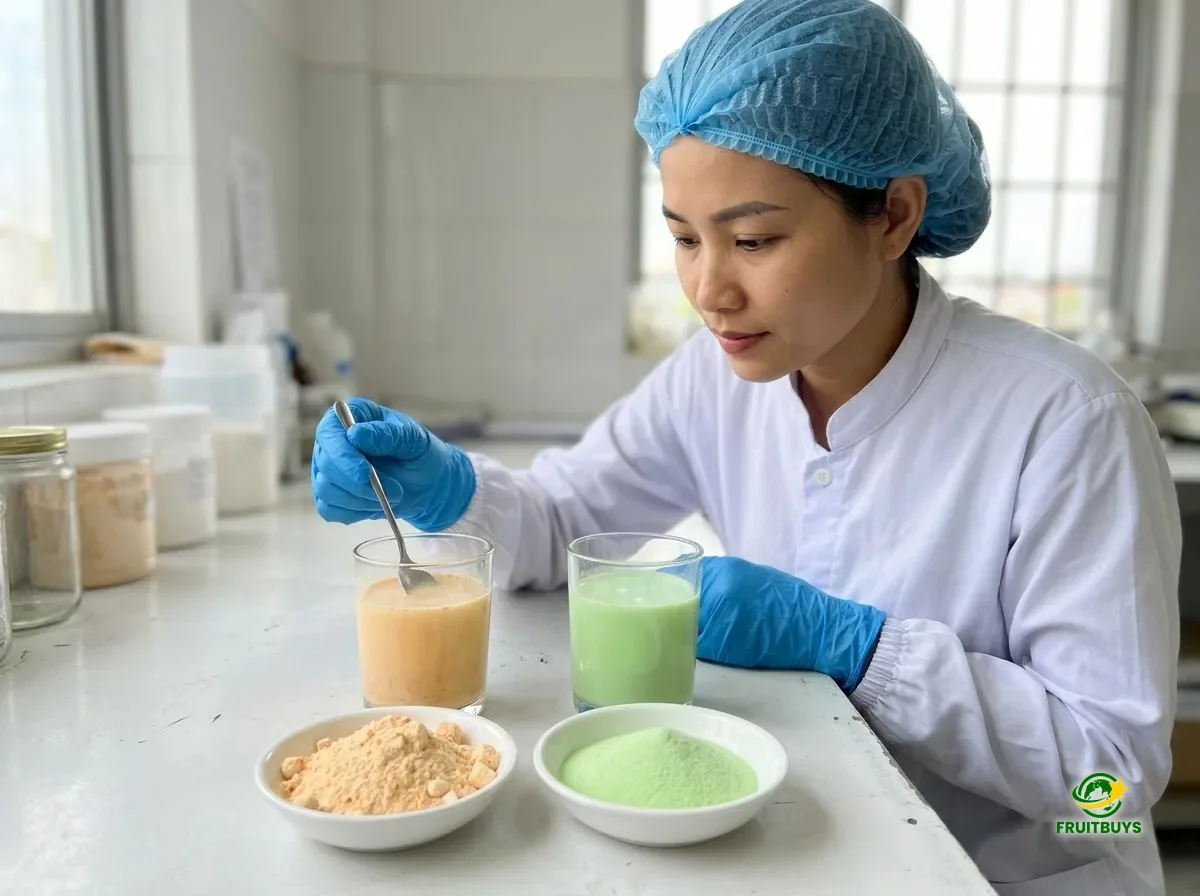
People also search for “Hami melon powder”. Hami melon is a different melon type, grown mainly in China’s Xinjiang, with crisper, juicier flesh. FruitBuys supplies orange-flesh netted cantaloupe, which colours the cup light orange without added colour; see cantaloupe vs honeydew vs Hami melon.
Nutrition
| Per 100 g | US format | EU format |
|---|---|---|
| Energy | 350 kcal | 1,480 kJ / 350 kcal |
| Fat | 2 g (saturated 0.5 g, trans 0 g) | 1.9 g (saturates 0.5 g) |
| Carbohydrate | 80 g total | 71 g |
| Sugars | 70 g, includes 0 g added sugars | 70 g |
| Fibre | 9 g | 8.8 g |
| Protein | 8 g | 8.2 g |
| Sodium / salt | 160 mg | 0.4 g salt |
| Potassium | 2,620 mg | 2,620 mg (131% NRV) |
Typical values for 100% freeze-dried cantaloupe; natural variation by origin, season and ripeness applies. Lot nutrition panel available for label artwork.
A 25 g dose in one cup adds about 88 kcal, 17.5 g of the fruit’s own sugars and 655 mg of potassium, with no added sugar. The powder also carries vitamin C (typically 200–350 mg per 100 g) and vitamin A from beta-carotene (typically 1,000–1,600 µg RAE). Typical values reach the EU “high fibre”, “high in potassium”, “high in vitamin C” and “high in vitamin A” levels; FruitBuys arranges a nutrition panel on your commercial lot before you print.
Two US label points help a drink or mix brand. Fruit with nothing added qualifies automatically for the “healthy” claim under FDA’s updated rule, with mandatory compliance from 25 February 2028; your label team confirms the final wording. FDA’s proposed front-of-package Nutrition Info box rates added sugars rather than total sugars, so a powder with 0 g added sugars would rate Low on that line.
Commercial terms
| Item | Terms |
|---|---|
| Carton | 58 × 28 × 34 cm, 5-ply · 10–12 kg standard, 15–20 kg on request |
| 20 ft container, floor-loaded | About 550 cartons, 5.5–6.6 t net |
| 40 ft HC, floor-loaded | About 1,100 cartons, 11–13.2 t net |
| Palletised (1,200 × 1,000 mm, 30–36 cartons per pallet) | About 10 pallets / 300–360 cartons per 20 ft · 20–21 pallets / 600–750 cartons per 40 ft HC |
| Container type | Dry container, no reefer |
| Capacity | 100 tonnes per year of freeze-dried cantaloupe |
| Sample | 3–5 working days to dispatch; courier time depends on the carrier |
| Production | 20–30 days for a 20 ft container after deposit |
| OEM / private label | MOQ 500 kg; retail pouch printing from 3,000–5,000 pouches per SKU (digital, 7–10 working days) or from 500 kg per SKU (rotogravure, 15–20 working days) |
| Payment | T/T 40% deposit, 60% before shipment or against copy of B/L; L/C at sight |
| Shipping terms | FOB Cat Lai, CIF · sea, or air from Tan Son Nhat |
For orders below a full container, FruitBuys combines cantaloupe powder with other freeze-dried fruit powders in one container, which typically saves 15–20% of logistics cost per kilogram against LCL shipping. Supply runs all year from net-house melons in four climate zones of Vietnam.
Quality and documents
Every lot ships with a COA from an independent ISO/IEC 17025 accredited third-party laboratory covering moisture, water activity, total plate count, yeasts and moulds, E. coli and Salmonella. Lead and cadmium are monitored through routine third-party surveillance, with results below EU and US limits; pesticide-residue and heavy-metal testing to your market’s limits is completed before stuffing when your contract calls for it. Available for each lot on request, before the container is sealed: Listeria monocytogenes, Enterobacteriaceae, sulphite, gluten, a mesh analysis and an inclusion grade for dairy and confectionery lines. Under FruitBuys’ processing protocol the melon rind is washed and sanitised before the fruit is cut; the cantaloupe COA guide sets out each limit.
The partner facility holds HACCP, ISO 22000, US FDA Facility Registration and BRC (qualified processing facility); Halal certification available on request. FruitBuys locks one partner facility for each contract, notifies any change in writing with a new pre-shipment sample for approval, and gives you audit access. Each lot is traceable to its harvest region and raw-material intake batch, and a retained sample from every container lot is kept for the full shelf life, up to 24 months.
Every shipment carries the standard export dossier: commercial invoice, packing list, bill of lading, certificate of origin (Form EUR.1 for the EU and UK, Form CEPA for the UAE), phytosanitary certificate and COA. Trial lots ship with a release QC log, and a third-party COA is available for each trial lot on request.
Import and labeling
Cantaloupe powder ships under HS 1106.30, flour, meal and powder of Chapter 8 fruit: US HTS 1106.30.40.00 and EU CN 1106 30 90.
- United States: the general (MFN) duty on 1106.30.40.00 is 9.6% in the US Harmonized Tariff Schedule, against 2.5% for freeze-dried cantaloupe pieces under 0813.40.90.00. Additional Chapter 99 duties may apply, and your broker confirms the final duty at entry. If your plant has a cold mill and a dry room, importing freeze-dried cantaloupe dice and milling on site removes that 7.1-point duty gap.
- EU and UK: CN 1106 30 90 enters the EU at 0% with C/O Form EUR.1 under EVFTA, against the 8.3% MFN rate, and Form EUR.1 claims the UKVFTA preference for the UK. The rate that applies is set by the code declared at entry, shown in the EU TARIC tariff database.
- UAE: Form CEPA travels with every lot under the Vietnam–UAE CEPA.
- FDA traceability: freeze-dried cantaloupe powder is not on the FDA Food Traceability List, which names fresh melons, so the extra FSMA 204 records required for fresh melon do not attach to it.
On the label, the ingredient line is “cantaloupe”. In the US the panel shows 0 g added sugars; in the EU a “no added sugars” claim carries the line “contains naturally occurring sugars”. The HS code and import guide compares duty for powder and pieces by market.
Verify the sample
Your pre-shipment sample arrives as 100–200 g from the packed lot in two sealed foil pouches with desiccant: one to test in your kitchen, one kept sealed for your laboratory. Five checks take under an hour:
- Water activity: measure within an hour of opening, at 25 °C. Expect ≤0.30.
- Flow: press a pinch between your fingers. It should crumble back to powder, with no hard lumps.
- Dispersion: shake 25 g into 500 ml of cold milk for ten seconds. Expect an even, cloudy drink with no dry clumps floating.
- Colour and aroma: expect even light orange and a musky melon smell straight from the pouch, with no cooked note.
- Particle size: sieve against the 60–80 mesh range agreed in your specification.
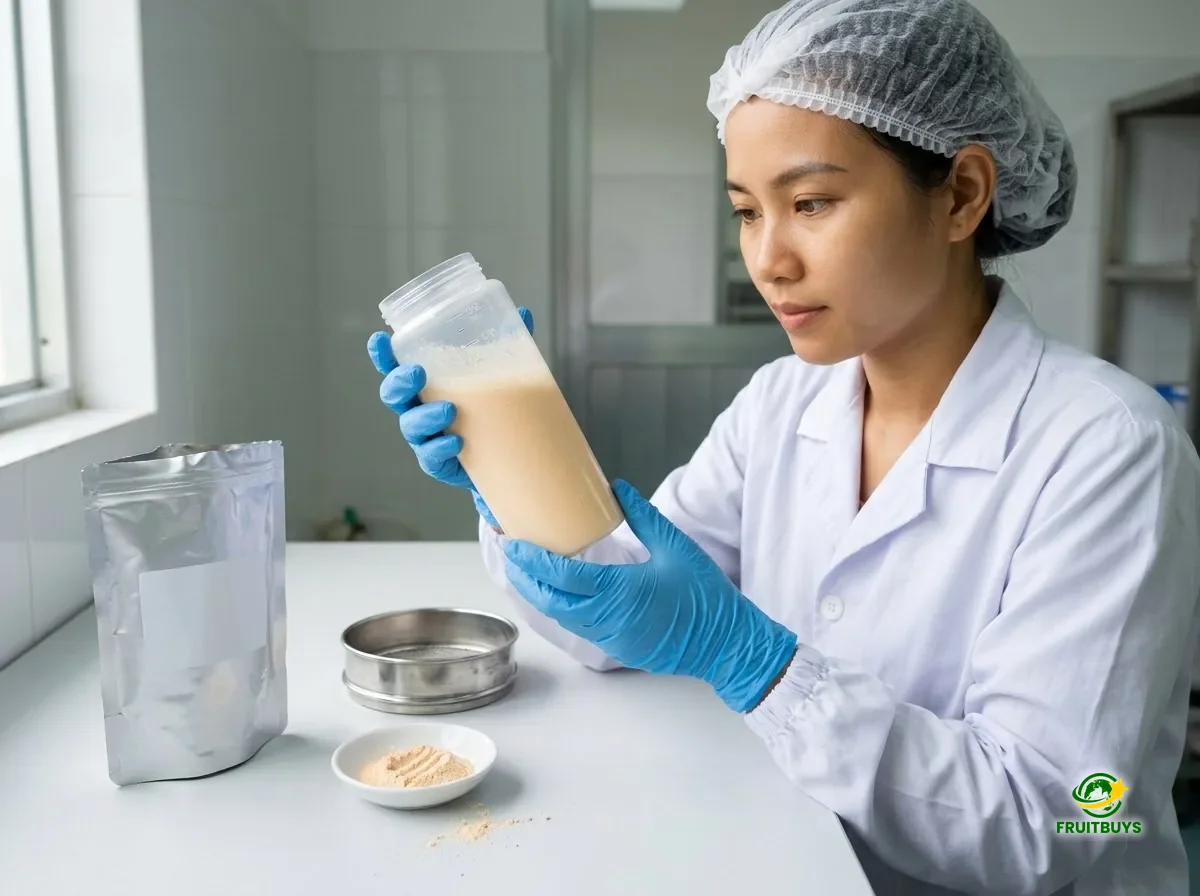
The approved sample becomes the reference for your bulk lot.
FAQ
Is this the same as Hami melon powder?
No. Hami melon is a different melon type with crisper flesh. This powder is milled from orange-flesh netted cantaloupe, which gives the cup a natural light orange colour.
Does it contain maltodextrin or an anti-caking agent?
No. The powder is 100% freeze-dried cantaloupe with no carrier, anti-caking agent, sugar or colour.
Will it dissolve completely?
It disperses fully but keeps the fruit’s fibre, so drinks turn cloudy and smooth, like blended melon. For a clear tea, steep freeze-dried dice and strain, or let the powder settle and pour off the clear layer.
Can I use it in hot drinks or baked goods?
Yes, added at serving temperature or after the heat step. The melon aroma fades above about 70 °C, and long bakes brown the fruit sugars.
Does it qualify as “healthy” on a US label?
Fruit with nothing added qualifies automatically under FDA’s updated “healthy” rule. Your label team confirms the final wording before mandatory compliance on 25 February 2028.
Can you supply 15–20 kg cartons?
Yes, for blending plants with climate-controlled intake. The 10–12 kg standard carton is the safer choice for hot ports and warehouses without air conditioning.
How should I store an opened bag?
Use it through in one batch if you can. Otherwise reseal it straight away with a fresh desiccant sachet and keep it cool and dry.
Request a sample
Tell us how you will use the powder and FruitBuys sends a sample with a matching starting dose:
- Application: milk tea, smoothie, drink mix, ice cream, bakery or other
- Target dose or cup size, if you have one
- Expected volume per order and per year
- Carton size: 10–12 kg standard or 15–20 kg
- Destination market and port
- Incoterm: FOB Cat Lai or CIF
- Extra tests your market or customer requires
- Private label: number of SKUs and pouch format