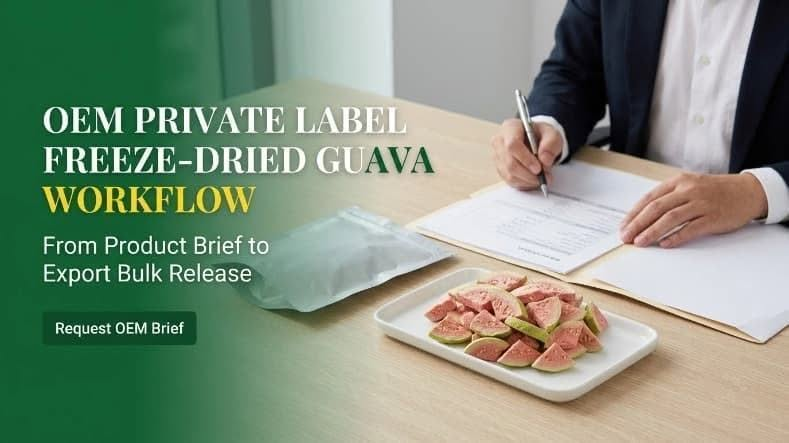
OEM Private Label Freeze-Dried Guava: Retail Pouch and Bulk Release Guide
OEM private label freeze-dried guava fails when the buyer starts with artwork before locking the product. A pouch can look ready while the SKU remains undefined: pink or white guava, seed-on or deseeded, wedge or powder, fruit-only or carrier-supported, retail snack or beverage base. Each decision affects Nutrition Facts, ingredient statement, COA scope, packaging, shelf-life support and sample-to-bulk release.
Powder adds more risk because carrier status, mesh, caking and sediment can change the label and application file. Private label approval should begin with a locked product specification, not a pouch mockup. This article is for importers, retail snack brands, distributors, R&D teams and QA managers that need FruitBuys freeze-dried guava delivered as one controlled OEM/private label SKU.
OEM Private Label Starts With SKU Control
OEM private label freeze-dried guava should be built from a locked SKU file.
The SKU file must define format, ingredient route, seed policy, packaging, Nutrition Facts basis, COA scope and sample-to-bulk release criteria.
FruitBuys aligns the product, pouch, documentation and release file before bulk approval.
Private label development is not only packaging. It is the alignment of product identity, technical specification, artwork data, release testing and commercial execution under one supplied SKU. FruitBuys treats OEM/private label delivery as a controlled product route, not a design-only service.

A private label file should define:
| Private Label Field | Buyer Decision |
|---|---|
| Product name | Freeze-Dried Guava, Freeze-Dried Pink Guava, Guava Powder or formulated SKU |
| Format | Wedge, slice, cube, bite, granule, powder or molded bite |
| Ingredient route | Fruit-only, carrier-supported powder or formulated bite |
| Seed policy | Seed-on, reduced-seed or deseeded |
| Pack size | 50g, 100g, 500g, 1kg or approved custom route |
| Moisture/Aw | Working targets: moisture 3–5%; Aw <0.30 |
| Nutrition Facts | Final SKU and market-specific basis |
| COA | Lot-based proof for release |
| Packaging | Barrier, seal, storage and shelf-life route |
| Change control | Defines when artwork or product approval must reopen |
Buyers who need the full supply route should start with freeze-dried guava supplier in Vietnam. This article owns the OEM/private label decision.
Choose the Private Label Product Format Before Artwork
A private label pouch should not decide the product. The application should decide the format, then the format should decide the pouch, label and release file. FruitBuys can structure freeze-dried guava into slices, wedges, cubes, dices, sticks, bites, chunks, granules, powder, molded or compressed guava bites and custom sizes. Each route changes the buyer’s approval file.
| Format | Private Label Use | Control Risk |
|---|---|---|
| Round Slice | Visual snack pouch, garnish concept | Seed center, edge breakage, diameter variation |
| Triangle/Wedge | Retail tropical snack | Broken tips, seed bite, thickness variation |
| Cube/Dice | Snack mix, cereal, yogurt topping | Size tolerance, fines, moisture migration |
| Stick | Differentiated snack SKU | Fracture and carton handling |
| Bite/Chunk | Natural snack pouch | Irregular size and sensory consistency |
| Granule | Topping, chocolate, bakery inclusion | Dust, particle drift, segregation |
| Powder | Beverage, bakery, dairy, retail powder pouch | Mesh, carrier, caking, sediment |
| Molded Bite | OEM snack concept | Binder, formula, texture, Aw, label basis |
Format selection belongs in freeze-dried guava formats and custom cut sizes. If the buyer wants powder, the next file should be freeze-dried guava powder specification, because powder requires mesh, carrier, seed-particle and caking controls before label approval.
Ingredient Route Controls the Label
The ingredient statement must match the actual private label SKU.
A fruit-only wedge, carrier-supported powder and molded guava bite cannot share the same ingredient declaration.
Buyers should lock ingredient route before Nutrition Facts, artwork and claims are approved.
For U.S. packaged food, FDA guidance explains that a food made from two or more ingredients must declare each ingredient by its common or usual name, except for limited categories such as spices, flavorings and colors (U.S. Food and Drug Administration). This matters for private label freeze-dried guava because a carrier, binder, sweetener or supporting ingredient changes the ingredient statement.

The buyer should separate three routes:
| Route | Ingredient Control |
|---|---|
| Fruit-only pieces | Ingredient statement can remain simple if no added ingredients are used |
| Carrier-supported powder | Carrier must be declared and reviewed |
| Molded/compressed bite | Binder or added ingredient route must be declared and validated |
The label file should not use “100% guava” if the product contains carrier or binder. It should not use “no added sugar” until the formula and added-sugar basis are confirmed. It should not use vitamin C or fiber language without a final SKU review.
Raw-material and seed choices connect directly to pink guava variety, maturity and seed policy. Ingredient identity should be settled before any claim language appears on the pouch.
Nutrition Facts Must Be Built From the Final SKU
Private label artwork cannot be released from a copied sample panel. The Nutrition Facts must match product format, serving size, pack size, ingredient statement and target market.

For U.S. packaged food, 21 CFR 101.9 governs nutrition labeling requirements, while 21 CFR 101.12 provides reference amounts customarily consumed that support serving-size decisions. (U.S. Food and Drug Administration) FDA also explains that updated Nutrition Facts labels include added sugars and require vitamin D and potassium declarations, while vitamins A and C are no longer mandatory but may be declared voluntarily. (U.S. Food and Drug Administration)
Private label guava review should define:
| Label Field | Buyer Check |
|---|---|
| Serving size | Does it match product use and market route? |
| Servings per container | Does it match net weight and pack size? |
| Added sugars | Does the formula include added sugars or sweetened ingredients? |
| Dietary fiber | Is the value validated before claim use? |
| Potassium | Does the label format require declaration? |
| Vitamin C | Is it declared or claimed, and is testing available? |
| Calories | Does the value match final SKU and rounding? |
| Powder carrier | Does it change the nutrient basis? |
For a full label-control path, use freeze-dried guava Nutrition Facts. Do not print artwork until the final nutrition basis is locked.
Packaging Must Protect the Approved Product
Private label packaging must protect the product condition approved by sample, COA and retained reference. A 50g snack pouch does not behave like a 1kg pouch. Powder packaging does not behave like wedge packaging. A molded bite may need a different breakage and texture review.

FruitBuys can support retail pack routes such as 50g/100g/500g/1kg high-barrier zipper pouch or custom, subject to product route, packaging validation and buyer approval.
A packaging file should define:
| Packaging Field | Private Label Risk |
|---|---|
| Pack structure | Moisture, odor and handling protection |
| Pack size | Serving count, open-pack exposure and label layout |
| Seal method | Moisture ingress and shelf-life risk |
| Zipper route | Reseal and consumer-use exposure |
| Carton protection | Breakage and arrival condition |
| Lot code | Connects pouch to COA and retained sample |
| Storage statement | Supports shelf-life basis |
| Shelf-life evidence | Must match product, package and storage route |
FDA defines water activity as the ratio of water vapor pressure in the food to that of distilled water under the same conditions, and links Aw to food stability and microbial growth conditions. (U.S. Food and Drug Administration) FruitBuys uses moisture 3–5% and Aw <0.30 as working targets for freeze-dried guava, so the pouch must protect the low-moisture product state after release.
Packaging and shelf-life review belongs in freeze-dried guava packaging and shelf life. Moisture and Aw interpretation belongs in freeze-dried guava moisture and water activity.
COA and Laboratory Testing Must Match the Private Label SKU
A private label buyer should not approve the pouch unless the COA scope matches the final SKU. A COA for wedges does not automatically release powder. A moisture result from a sample does not automatically release bulk. A laboratory report without lot code, method or product identity cannot carry full release confidence.
A private label release file should include:
| Proof File | Why It Matters |
|---|---|
| Product specification | Defines the SKU and acceptance limits |
| Approved sample | Shows sensory and format target |
| Retained sample | Supports bulk comparison |
| COA | Releases the actual lot |
| Laboratory reports | Support microbiology, moisture, Aw and required tests |
| Nutrition file | Supports artwork and claim review |
| Packaging file | Supports shelf-life and storage condition |
| Change-control file | Defines when re-approval is required |
The test panel may include moisture, Aw, microbiology, pesticide residues, contaminants, powder mesh, carrier status, added sugar or nutrition testing depending on market, format and buyer requirements. COA logic belongs in freeze-dried guava COA and laboratory testing. Process proof belongs in freeze-dried guava processing controls.
Market Route: U.S., EU and Other Private Label Files
Private label freeze-dried guava should be reviewed by destination market before artwork printing.
U.S., EU and other retail routes can require different nutrition format, ingredient declaration, language, claim and registration review.
Buyers should align market files before packaging production.
A U.S. label route should review statement of identity, ingredient list, Nutrition Facts, serving size, net quantity, claims, allergen status where applicable and importer responsibilities. FDA’s label-claims page identifies three label-claim categories for foods and dietary supplements: health claims, nutrient content claims and structure/function claims (U.S. Food and Drug Administration).

This is why a private label brand should not add “high vitamin C,” “source of fiber” or similar claim language without legal and lab support. For EU prepacked food, the European Commission states that Regulation (EU) No 1169/2011 sets mandatory food information, including items such as the name of the food, ingredient list, net quantity, date marking, storage conditions, operator information, origin information where applicable, instructions for use where needed, alcoholic strength where relevant, and nutrition declaration (Food Safety).
The European Commission also states that most prepacked food must bear a nutrition declaration (Food Safety). Private label market review should connect to freeze-dried guava HS code and import compliance. FruitBuys can align the product and document package, while the buyer or importer confirms destination-market obligations.
Application Route Changes the Private Label Product
Private label freeze-dried guava can enter different retail and ingredient pathways. The application affects format, packaging, label, COA and testing.
| Application | Private Label Format | Required Proof |
|---|---|---|
| Retail snack pouch | Wedge, slice, bite or stick | Seed bite, breakage, moisture/Aw, pouch file |
| Kids snack concept | Bite, cube or controlled wedge | Seed policy, size, choking-risk review by buyer, label file |
| Tropical snack mix | Wedge, cube, bite or granule | Blend compatibility, moisture migration, breakage |
| Guava powder pouch | Fine or custom mesh powder | Mesh, carrier, caking, sediment, Nutrition Facts |
| Beverage mix | Powder | Serving use, dispersibility, added sugar and carrier review |
| Bakery ingredient pouch | Powder or granule | Heat-use trial, label route and pack protection |
| Molded guava bite | Powder-based formed piece | Binder, formula, Aw, texture and ingredient statement |
Application mapping belongs in freeze-dried guava food applications. Do not approve private label artwork from fruit identity alone. Approve it from real use.
Fresh-to-Dry Ratio Supports Planning, Not Label Approval
FruitBuys uses 6–8 kg whole incoming fresh guava → 1 kg finished freeze-dried guava as the working commercial conversion range. This helps buyers understand raw-material planning, recovery pressure and SKU comparison. It does not replace Nutrition Facts testing, COA or specification approval.
Private label buyers should use conversion only for product planning:
| Planning Question | Conversion Use |
|---|---|
| Is the product fruit-dense? | Shows drying concentration direction |
| Does format affect recovery? | Wedges, dice and powder can recover differently |
| Does deseeding affect basis? | Seed policy can change input and output basis |
| Does molded bite change formula? | Binder and powder route require separate calculation |
| Can conversion prove nutrition? | No, final nutrition requires SKU-specific basis |
Conversion review belongs in freeze-dried guava conversion ratio. It should not be used as artwork proof.
The Highest-Risk Mistake: Printing Before Change Control
The highest-risk mistake is printing retail pouches before defining change-control triggers. Once packaging is printed, a small technical change can create a major label and release mismatch.
Re-approval should be required when any of these change:
| Change Trigger | What Must Reopen |
|---|---|
| Guava route changes | Product identity, color, sensory and label basis |
| Seed policy changes | Bite, sediment, powder and Nutrition Facts |
| Format changes | Pouch size, serving, breakage, COA and application |
| Powder mesh changes | Flow, sediment, caking and label claims |
| Carrier or binder changes | Ingredient statement, added sugar and nutrition basis |
| Moisture/Aw target changes | COA, shelf-life and pack review |
| Pack size changes | Serving count, net content and artwork layout |
| Market changes | Label language, nutrition format and document route |
| Claim changes | Lab support and regulatory review |
| Lot changes | COA, retained sample and release proof |
This is where FruitBuys’ Integrated Product Supply Model matters. Raw material, production partners, QC, packaging, documentation and logistics must support one approved product file. The buyer should not manage private label work as separate fragments. Change-control review belongs in sample-to-bulk consistency. Final briefing belongs in freeze-dried guava RFQ checklist.

Application Mapping
| Buyer Type | Application | Required Format | Proof Needed | FruitBuys Delivery |
|---|---|---|---|---|
| Private label snack brand | Retail pouch | Wedge, slice, bite or stick | Product spec, pouch file, Nutrition Facts, COA and retained sample | OEM/Private Label Delivery, Documentation |
| Importer | Private label market entry | Market-specific SKU | Label route, HS direction, COA, packaging and document file | Documentation, Export Logistics Coordination |
| Distributor | Retail-ready category SKU | 50g, 100g, 500g or 1kg pouch route | Lot code, carton marks, shelf-life support and arrival inspection | Export Logistics Coordination, Documentation |
| Beverage brand | Guava powder pouch | Fine or custom mesh powder | Mesh, carrier status, serving basis, caking and sediment review | Quality Control, OEM/Private Label Delivery |
| R&D developer | Market trial SKU | Wedge, bite, powder or granule | Application sample, format control, COA scope and packaging sample | MOQ Flexibility/Market Trial Support |
| QA manager | Artwork and lot approval | Any final format | Ingredient statement, Nutrition Facts, COA, methods and change-control rule | Quality Control, Documentation |
| Compliance manager | Multi-market review | Market-specific retail pack | Label language, nutrition route, claims, import document scope | Documentation, Export Logistics Coordination |
Why FruitBuys Delivers This
FruitBuys supplies OEM/private label freeze-dried guava through an Integrated Product Supply Model that connects raw-material governance, production partners, QC, packaging, documentation and export logistics coordination under one accountable supplier relationship.
Under OEM/Private Label Delivery, FruitBuys aligns format, pack size, pouch route, artwork inputs, label data and release criteria. Under Quality Control, FruitBuys verifies seed policy, cut size, texture, moisture, Aw, powder behavior, breakage, caking risk and retained-sample alignment. Under Documentation, FruitBuys connects specification, COA, laboratory reports, Nutrition Facts input, ingredient statement, packaging file and lot code.
Under Raw Material Sourcing Governance, FruitBuys keeps pink or white guava route, maturity, peel policy and seed policy tied to the final private label SKU. Under MOQ Flexibility/Market Trial Support, buyers can test format, pouch, application and label direction before broader release. Under Export Logistics Coordination, FruitBuys connects carton marks, packing record, document handover and arrival inspection to the same supplied product.
FruitBuys supplies the private label SKU as one documented product, not a pouch separated from product proof.
Buyer Checklist
Confirm these points before artwork approval, packaging production or bulk release:
- Brand owner
- Product name
- Pink or white guava route
- Maturity direction
- Peel policy
- Seed-on, reduced-seed or deseeded route
- Format: wedge, slice, cube, bite, granule, powder or molded bite
- Target size or mesh
- Fruit-only or formulated route
- Carrier status
- Binder status for molded bites
- Added sugar status
- Target application
- Pack size
- Retail pouch structure
- Seal method
- Zipper or closure route
- Shelf-life target
- Storage statement
- Moisture target
- Aw target
- COA scope
- Microbiology panel
- Pesticide and contaminant tests where required
- Nutrition Facts basis
- Serving-size route
- Claims intended for front label
- Destination market
- Label language
- Barcode or retail coding requirement
- Carton mark
- Lot code
- Retained sample
- Packing record
- Change-control triggers
- Supplier review through freeze-dried guava supplier qualification
- Final request alignment through freeze-dried guava RFQ checklist
Do not approve pouch artwork before the product, label, COA and packaging route are locked.

Summary
OEM private label freeze-dried guava requires a locked SKU file covering product name, guava route, peel policy, seed policy, format, ingredient statement, pack size, Nutrition Facts basis, COA scope, packaging and change-control triggers.
FruitBuys uses moisture 3–5% and Aw <0.30 as working targets. Formats may include wedges, slices, cubes, bites, granules, powder and molded bites. FruitBuys aligns OEM/private label delivery with QC, Documentation, packaging, retained sample, lot code and export logistics coordination.
FAQ
What is OEM private label freeze-dried guava?
It is a freeze-dried guava SKU supplied under the buyer’s brand with approved format, package, label inputs, COA, retained sample and bulk-release criteria.
What should be locked before pouch artwork?
Lock product name, format, seed policy, ingredient route, pack size, Nutrition Facts basis, claims, COA scope, shelf-life support and destination market.
Can guava powder use the same label as guava wedges?
No. Powder may differ in mesh, carrier status, serving use, ingredient statement, caking risk, sediment and Nutrition Facts basis.
Can FruitBuys support retail pouch formats?
Yes. FruitBuys can align retail pouch routes such as 50g, 100g, 500g, 1kg or custom packs when product, packaging and release criteria are approved.
Does private label require a COA?
Yes. Private label approval should include lot-based COA scope matched to the exact SKU, format, package and destination-market requirements.
When should artwork be revised?
Revise artwork when format, ingredient route, carrier status, pack size, serving size, market route, claims, Nutrition Facts or COA scope changes.
What should buyers send before OEM sampling?
Send brand brief, target application, format, seed policy, pack size, ingredient route, market, claim direction, COA scope and artwork requirements.
Conclusion
Submit the private label brief, final format, pack size, ingredient route, target market and COA scope so FruitBuys can align the OEM freeze-dried guava release file.
References
- U.S. Food and Drug Administration. Guidance for Industry: Questions and Answers Regarding Food Allergen Labeling (Edition 5). FDA guidance on ingredient declaration and allergen-labeling context. (U.S. Food and Drug Administration)
- U.S. Food and Drug Administration. What’s on the Nutrition Facts Label. FDA nutrition label overview, including added sugars and required nutrient context. (U.S. Food and Drug Administration)
- U.S. Food and Drug Administration. Changes to the Nutrition Facts Label. FDA update on Nutrition Facts label changes. (U.S. Food and Drug Administration)
- U.S. Food and Drug Administration. Industry Resources on the Changes to the Nutrition Facts Label. FDA industry guidance context for serving-size and label implementation. (U.S. Food and Drug Administration)
- U.S. Food and Drug Administration. Label Claims for Food & Dietary Supplements. FDA overview of health claims, nutrient content claims and structure/function claims. (U.S. Food and Drug Administration)
- European Commission. Mandatory Food Information. EU food information and labelling requirements under Regulation (EU) No 1169/2011. (Food Safety)
- European Commission. Nutrition Labelling. EU nutrition declaration requirements for prepacked foods. (Food Safety)