Freeze-Dried Guava Packaging and Shelf Life: What Buyers Must Verify
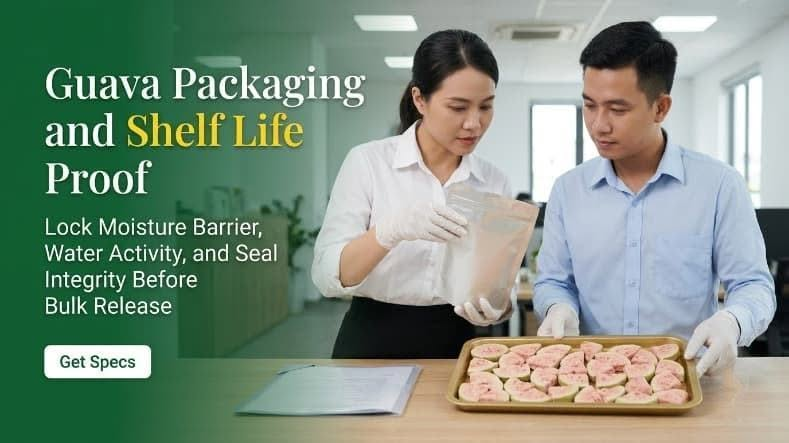
Freeze-dried guava packaging and shelf life should not be approved from a sample pouch alone. A pink guava wedge can leave the dryer crisp, then soften if the inner bag does not protect the low-moisture state. A guava powder can pass initial aroma and color review, then cake after humid handling or repeated opening.
A private label pouch can look finished while the shelf-life basis remains unsupported by the final film, seal, pack size and storage condition. The package must protect the product condition that moisture, Aw and COA testing are designed to release. This article is for importers, QA managers, R&D teams, distributors and private label buyers who need FruitBuys freeze-dried guava packed, documented and released as one controlled SKU.
Packaging Is Part of the Product Specification
Freeze-dried guava packaging must be specified with the product format, not after sample approval.
Pieces, powder, molded bites and retail pouches carry different moisture, breakage, caking and label risks.
Buyers should approve the package together with the sample, COA and shelf-life basis.
Packaging is not a final decoration step. It is a technical control that protects crispness, particle integrity, moisture condition, odor protection, lot identity and shelf-life support. For FruitBuys freeze-dried guava, packaging must connect to the approved product route: pink or white guava, peel policy, seed policy, format, moisture, Aw, COA and intended application.
FruitBuys uses moisture 3–5% and Aw <0.30 as working targets for freeze-dried guava. FDA defines water activity as the ratio of water vapor pressure in a food to the vapor pressure of distilled water under the same conditions, and connects Aw to food stability and microbial growth conditions (U.S. Food and Drug Administration).
A packaging file should define:
| Packaging Field | Buyer Decision |
|---|---|
| Product format | Wedge, slice, dice, stick, granule, powder or molded bite |
| Pack type | Retail pouch, bulk inner bag or custom pack |
| Pack size | 50g, 100g, 500g, 1kg, 1–5kg or buyer-approved route |
| Barrier requirement | Moisture, odor and handling protection |
| Seal method | Seal consistency and inspection requirement |
| Lot code | Pack-to-COA traceability |
| Retained sample | Same or approved-equivalent pack condition |
| Shelf-life basis | Format, package, seal, storage and validation evidence |
Buyers who need the full commercial supply route should begin with freeze-dried guava supplier in Vietnam. This page owns packaging and shelf-life control.

Why Freeze-Dried Guava Needs Moisture-Protective Packaging
Freeze-dried guava is porous and moisture-sensitive. The drying process can create a crisp structure, but that structure must be protected after drying, during sorting, packing, storage and shipment.

Utah State University Extension explains that freeze-dried food exposed to moisture or humidity through damaged packaging or improper storage can see water activity rise again. (Utah State University Extension) The National Center for Home Food Preservation also notes that dried foods can spoil if moisture is reabsorbed during storage and that reopening packages exposes dried foods to air and moisture. (Home Food Preservation)
For B2B buyers, this creates a direct approval rule: do not approve shelf life without packaging proof.
| Risk | What Can Fail |
|---|---|
| Moisture pickup | Product softens or powder cakes |
| Seal weakness | Aw may rise after packing |
| Pack puncture | Inner bag loses protection |
| Odor transfer | Product absorbs warehouse or carton odors |
| Excess headspace or movement | Fragile pieces break |
| Repeated opening | Powder or pieces absorb moisture faster |
| Poor lot coding | COA and product identity disconnect |
| Wrong storage condition | Shelf-life statement becomes weak |
This control connects to freeze-dried guava moisture and water activity. The packaging file protects the moisture and Aw result after the COA is issued.
Retail Packaging: Pouch Size, Seal and Label Route
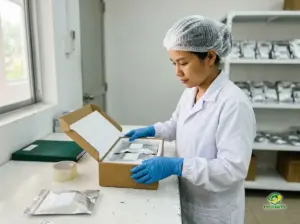
Retail packaging creates the highest visible risk because the package carries product, label, shelf-life statement and consumer-use condition together. FruitBuys can support retail pack routes such as 50g/100g/500g/1kg high-barrier zipper pouches or buyer-approved custom packaging, subject to packaging validation and artwork alignment.

The buyer should not approve a retail pouch only by design. The pouch must protect the product format.
| Retail Pack Question | Why It Matters |
|---|---|
| Is the product wedge, slice, bite, powder or molded bite? | Each format breaks or cakes differently |
| Is the pouch size appropriate for opening frequency? | Larger packs face more repeated exposure |
| Does the zipper function after filling? | Reseal affects in-use moisture exposure |
| Is the seal inspected? | Seal failure can create texture drift |
| Does the pouch protect color and aroma? | Guava identity depends on storage condition |
| Does the label match the SKU? | Ingredient and Nutrition Facts must match format |
| Is the shelf-life statement supported? | Shelf life must match package and storage file |
For private label projects, packaging must connect to OEM private label freeze-dried guava and freeze-dried guava Nutrition Facts. A retail pouch is not ready when the artwork looks ready. It is ready when the product, package, label input and release file match.
Bulk Packaging: Inner Bag, Carton and Lot Identity
Bulk packaging has a different approval logic from retail packaging. It protects larger quantities and supports ingredient buyers, distributors, R&D teams and repackers. FruitBuys can support 1–5kg high-barrier inner bags packed inside 5-ply export cartons or buyer-approved custom packaging, subject to the final format and packing file.

Bulk approval should define:
| Bulk Packaging Field | Buyer Review |
|---|---|
| Inner-bag material | Moisture and odor protection |
| Inner-bag weight | Handling and open-pack exposure |
| Seal method | Moisture ingress control |
| Carton type | Compression and puncture protection |
| Lot code | COA, packing file and retained-sample traceability |
| Carton mark | Warehouse and shipment identification |
| Fines and breakage | Arrival condition control |
| Storage instruction | Protects shelf-life basis |
Bulk pack size should follow use condition. A food manufacturer using powder frequently may accept a larger inner bag. A distributor repacking smaller quantities may need a pack size that reduces open-pack exposure.
A fragile wedge format may need more attention to carton movement and compression. Bulk packaging must also connect to freeze-dried guava container loading plan. The carton plan should protect product condition, not only carton count.
Powder Packaging Needs Stricter Caking Control
Guava powder packaging needs stricter review than large pieces.
Powder has more exposed surface area and can cake, clump, absorb odor or change flow after opening.
Buyers should approve powder packaging through moisture, Aw, caking, seal and open-pack handling review.
Freeze-dried guava powder is not simply another pack style. It is a separate SKU route. Powder needs its own packaging logic because particle size, carrier status, seed-particle tolerance, caking behavior and open-pack handling can all affect application performance.

A powder packaging file should define:
| Powder Pack Field | Control Point |
|---|---|
| Powder route | Pure guava powder or carrier-supported powder |
| Mesh/particle range | Affects caking and flow |
| Pack size | Controls open-pack exposure |
| Inner-bag closure | Protects after opening where applicable |
| Seal condition | Prevents moisture ingress |
| Desiccant decision | Use only when approved and technically justified |
| Nitrogen flushing | Use only where format and process route support it |
| Caking limit | Defines rejection and review criteria |
| Retained sample | Must match powder package route |
USU’s practical freeze-drying guidance emphasizes clean handling, complete drying and immediate packaging to reduce contamination and moisture reabsorption risk (Utah State University Extension). This is especially relevant to powder because grinding and filling can increase exposure before sealing.
Powder buyers should review freeze-dried guava powder specification before approving packaging. Powder should not be packed under a piece-format assumption.
Shelf Life: 12–24 Months Requires a Package-Specific Basis
FruitBuys uses 12–24 months as a working shelf-life range for freeze-dried guava, but only when the exact format, packaging, seal integrity, storage condition and validation evidence support that range. It should not be stated as an unconditional promise across every format and pack.

Shelf life can change with:
- Product format
- Piece thickness
- Powder mesh
- Peel and seed policy
- Final moisture
- Aw
- Package barrier
- Seal quality
- Pack size
- Storage condition
- Carton protection
- Handling route
- Open-pack behavior
- Retained-sample condition
A shelf-life file should connect product proof and package proof:
| Shelf-Life Input | Required Evidence |
|---|---|
| Product specification | Defines the SKU |
| Moisture and Aw | Confirms low-moisture release basis |
| COA | Connects actual lot result to release |
| Packaging structure | Supports moisture and odor protection |
| Seal inspection | Confirms package closure condition |
| Retained sample | Supports later comparison |
| Storage instruction | Defines intended holding condition |
| Stability evidence | Supports the shelf-life statement |
The COA route belongs in freeze-dried guava COA and laboratory testing. Packaging supports shelf life, but it does not replace laboratory and retained-sample review.
Format Changes Packaging Risk
Different formats need different packaging controls. A single packaging rule cannot cover every freeze-dried guava SKU.

| Format | Packaging Risk | Buyer Control |
|---|---|---|
| Round Slice | Edge breakage and seed-center fragility | Pack movement, carton protection |
| Triangle/Wedge | Broken tips and moisture pickup | Inner-bag protection and breakage limit |
| Cube/Dice | Fines and moisture migration | Size tolerance and seal review |
| Stick | Fracture in bulk handling | Carton movement and short-piece limit |
| Granule | Dust and segregation | Particle range and inner-bag control |
| Powder | Caking, clumping and odor pickup | High-barrier pack, seal and open-pack rule |
| Molded Bite | Texture and binder-related moisture behavior | Formula, Aw and pack validation |
This decision belongs in freeze-dried guava formats and custom cut sizes. Packaging should be selected after the buyer locks the format, not before. Raw-material route also matters.
Pink guava wedges, peel-on slices and deseeded powder can require different protection and label review. Buyers should connect packaging back to pink guava variety, maturity and seed policy.
Packaging Must Match Application
The buyer’s application determines how the pack will be opened, handled and evaluated. A product used as a retail snack has different packaging risk from a powder used in beverage formulation or a dice used in cereal production.
| Application | Packaging Requirement | Proof Needed |
|---|---|---|
| Retail snack pouch | Visual protection, reseal, breakage control | Packed sample and shelf-life basis |
| Mixed fruit pouch | Moisture compatibility with other fruits | Blend trial and pack review |
| Cereal/granola inclusion | Particle stability and low fines | Bulk pack review and application trial |
| Yogurt topping | Controlled opening and dry storage | Texture and rehydration trial |
| Chocolate inclusion | Moisture discipline before use | COA, Aw and application trial |
| Bakery ingredient | Powder or granule handling | Open-pack and mixing review |
| Beverage powder | Caking and sediment control | Powder pack and dispersion test |
| Private label SKU | Retail pack, label and shelf-life alignment | OEM file and release checklist |
Application review belongs in freeze-dried guava food applications. Packaging should support the buyer’s real use, not only the shipment condition.
The Highest-Risk Mistake: Approving Shelf Life Without the Final Pack
The highest-risk mistake is approving shelf life from a sample that uses a different package from bulk or retail release.
A small sample pouch may protect the product differently from a 1kg retail pouch, 5kg bulk inner bag or powder pack.
Buyers should approve shelf life only after the final pack, seal, storage condition and retained-sample route are defined.
This failure is common because early samples are often packed carefully, sealed quickly and reviewed within a short time. Bulk and retail packs face different realities: larger fill weight, more product movement, longer storage, carton pressure, route humidity, repeated opening and more handling points.
The buyer should reopen packaging review when any of these changes:
| Change Trigger | Why It Matters |
|---|---|
| Pack size changes | Open-pack exposure and headspace change |
| Film structure changes | Moisture and odor protection may change |
| Seal method changes | Moisture ingress risk may change |
| Format changes | Breakage and caking risk change |
| Powder mesh changes | Flowability and caking change |
| Carrier status changes | Ingredient and moisture behavior change |
| Storage statement changes | Shelf-life basis changes |
| Destination route changes | Arrival condition and document needs change |
| Retail artwork changes | Label and shelf-life statement may need review |
This control belongs in sample-to-bulk consistency. Buyers should not approve shelf life as a static claim. They should approve it as a documented package-specific condition.
Application Mapping
| Buyer Type | Application | Required Format | Proof Needed | FruitBuys Delivery |
|---|---|---|---|---|
| Importer | Bulk freeze-dried guava supply | Wedge, slice, dice, granule or powder | Packaging file, COA, moisture/Aw, retained sample and carton marks | Quality Control, Documentation |
| Distributor | Multi-channel inventory | Retail pouch or bulk inner bag | Storage instruction, lot code, shelf-life basis and arrival inspection | Export Logistics Coordination, Documentation |
| Private label brand | Retail pouch SKU | Wedge, bite, powder or molded bite | Pack structure, artwork input, Nutrition Facts basis and release checklist | OEM/Private Label Delivery |
| Beverage developer | Guava powder | Fine or custom mesh powder | Caking limit, seal review, Aw, moisture and open-pack test | Quality Control, MOQ Flexibility/Market Trial Support |
| Cereal manufacturer | Dry inclusion | Cube, dice or granule | Fines limit, pack protection, moisture migration and application trial | Quality Control, Documentation |
| QA manager | Shelf-life approval | Any approved format | COA, packaging validation, retained sample and storage condition | Quality Control, Documentation |
| Compliance manager | Market file review | Market-specific SKU | Ingredient statement, label, shelf-life support and packaging record | Documentation, Export Logistics Coordination |
Why FruitBuys Delivers This
FruitBuys supplies freeze-dried guava through an Integrated Product Supply Model that connects raw-material governance, production partners, QC, packaging, documentation and export logistics coordination under one accountable product relationship.
Under Quality Control, FruitBuys aligns moisture, Aw, texture, breakage, caking risk, retained sample and release status with the approved format. Under Documentation, FruitBuys connects the packaging file, COA, laboratory reports, storage instruction, lot code, shelf-life basis and packing record. Under OEM/Private Label Delivery, FruitBuys aligns pouch size, label inputs, artwork version and release criteria for private label SKUs.
Under Export Logistics Coordination, FruitBuys connects carton configuration, lot segregation, document handover and arrival inspection to the same released goods. Under MOQ Flexibility/Market Trial Support, FruitBuys can structure sample routes for buyers comparing pack sizes, powder behavior or application formats before broader approval.
FruitBuys supplies the packaged, documented freeze-dried guava SKU, not a loose sample separated from packaging proof.
Buyer Checklist
Confirm these items before sample approval, retail artwork or bulk release:
- Product format
- Pink or white guava route
- Peel policy
- Seed policy
- Powder carrier or binder status where applicable
- Pack type
- Pack size
- Inner-bag structure
- Retail pouch structure
- Seal method
- Reseal requirement where applicable
- Desiccant decision if used
- Nitrogen flushing decision if used
- Moisture target
- Aw target
- COA scope
- Packaging validation route
- Shelf-life target
- Storage instruction
- Retained sample pack
- Breakage limit
- Fines limit
- Powder caking limit
- Open-pack handling rule
- Carton size and strength review
- Lot code
- Carton mark
- Packing record
- Arrival inspection criteria
- Supplier review through freeze-dried guava supplier qualification.
- Final request alignment through freeze-dried guava RFQ checklist.
Do not approve a shelf-life number alone. Approve the product, package, seal, COA, storage condition and retained-sample route together.
Summary
Freeze-dried guava packaging and shelf life depend on product format, moisture, Aw, pack structure, seal integrity, storage condition and validation evidence. FruitBuys uses moisture 3–5%, Aw <0.30 and a working shelf-life range of 12–24 months when the format and packaging file support it.
Retail pouches, bulk inner bags and powder packs carry different breakage, caking and moisture-pickup risks. FruitBuys aligns packaging, COA, retained sample, lot code and export logistics through one controlled product file.
FAQ
What packaging is used for freeze-dried guava?
FruitBuys can support retail zipper pouches and bulk high-barrier inner bags in export cartons, subject to the approved format, pack size, seal method and packaging validation.
What is the shelf life of freeze-dried guava?
FruitBuys uses 12–24 months as a working range when product format, moisture, Aw, packaging, seal integrity, storage condition and validation evidence support it.
Why does powder need stricter packaging?
Powder can cake, clump and absorb moisture faster than large pieces. It needs pack-size, seal, caking and open-pack handling review.
Can a sample pouch prove bulk shelf life?
No. A sample pouch may not represent the final retail pouch or bulk inner bag. The final package must be reviewed separately.
What should buyers check before approving packaging?
Check pack size, barrier route, seal method, lot code, moisture, Aw, COA, retained sample, storage instruction, breakage limit and arrival inspection.
Does low Aw replace packaging validation?
No. Low Aw supports release control, but packaging must protect the product after drying, packing, storage and shipment.
When should packaging review reopen?
Reopen review when pack size, film structure, seal method, format, powder mesh, carrier status, storage condition or destination route changes.
Conclusion
Submit the target format, pack size, packaging route, shelf-life target and arrival inspection criteria so FruitBuys can prepare the correct freeze-dried guava packaging file.
References
- U.S. Food and Drug Administration. Water Activity (aw) in Foods. Inspection Technical Guide. (U.S. Food and Drug Administration)
- Utah State University Extension. Can I Freeze-Dry That? A Practical Guide to Safe and Effective Freeze-Drying. January 2026. (Utah State University Extension)
- Utah State University Extension. Ask an Expert – Freeze-Drying Food at Home: Tips for Safe, Successful Results. May 2026. (Utah State University Extension)
- National Center for Home Food Preservation, University of Georgia. Packaging and Storing Dried Foods. (Home Food Preservation)
- U.S. Food and Drug Administration. Draft Guidance for Industry: Establishing Sanitation Programs for Low-Moisture Ready-to-Eat Human Foods and Taking Corrective Actions Following a Pathogen Contamination Event. January 2025. (U.S. Food and Drug Administration)