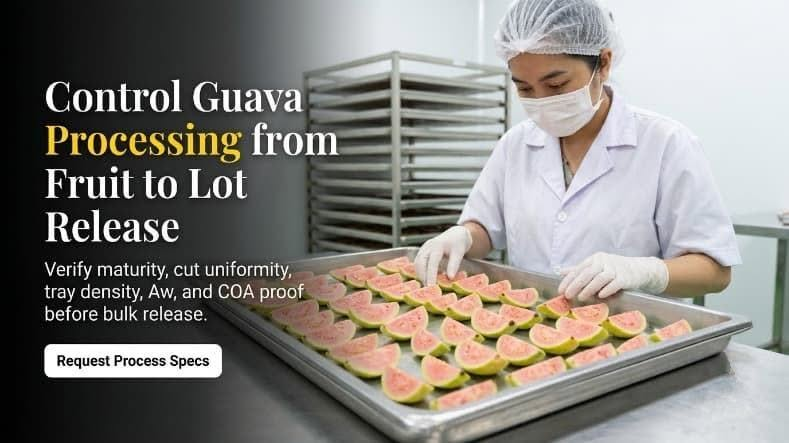
Freeze-Dried Guava Processing Controls: From Fresh Fruit to Export-Ready Lot
Freeze-dried guava processing controls decide whether a buyer receives the same product that was approved at sample stage. A bright pink wedge can still fail if raw guava maturity shifts, cut thickness varies, seed policy is not executed, drying is uneven, post-drying handling exposes the product to humidity or the COA does not match the released lot.
Powder creates even more risk because mesh, carrier status, caking and sediment depend on the exact processing route. The process must protect the approved SKU from fresh-fruit intake to packed export-ready lot. This article is for importers, QA managers, procurement teams, R&D developers and private label buyers who need freeze-dried guava controlled by specification, not by sample appearance alone.
Processing Control Starts Before Drying
Freeze-dried guava processing control begins with raw-material approval, not with the dryer.
Guava route, maturity, peel policy, seed policy and cut format must be locked before the product enters freezing and drying.
FruitBuys uses process control to connect the approved sample, COA, packaging file and bulk release.
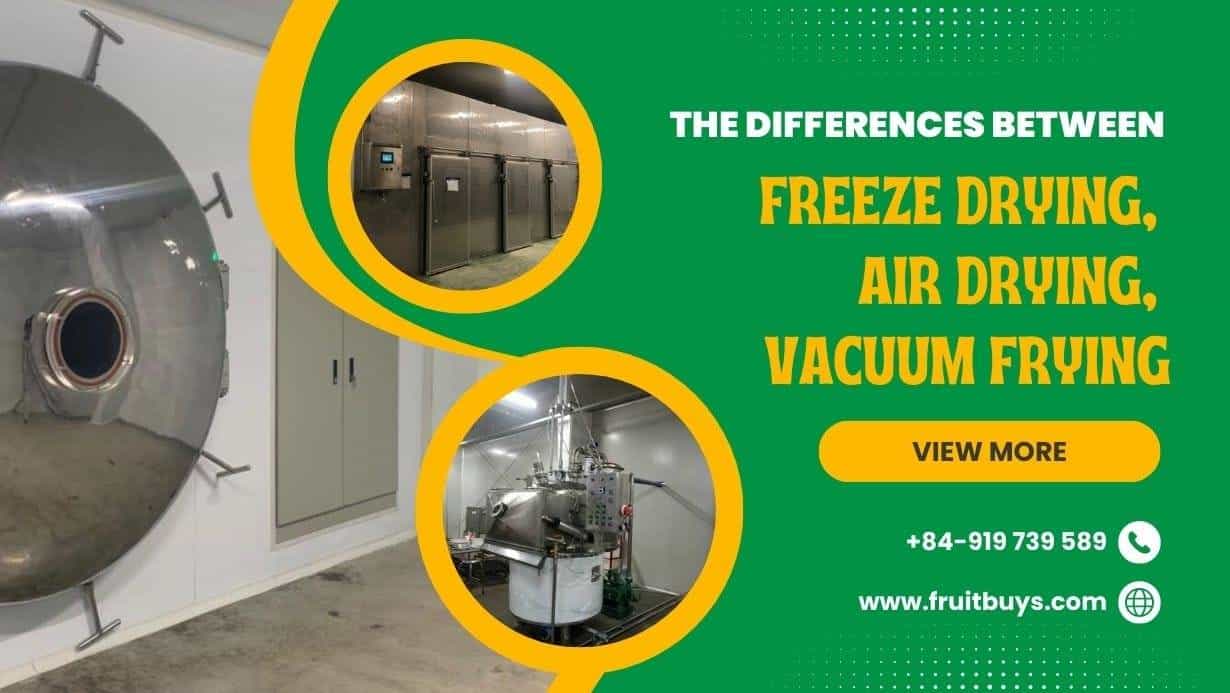
Freeze-drying removes water from frozen food by sublimation, meaning ice changes directly into vapor under the drying process. Utah State University Extension describes freeze drying as a process that removes ice from frozen food as water vapor through sublimation. (Utah State University Extension)
That process principle explains the technology, but it does not prove product consistency. The buyer still needs controls around raw fruit, cutting, freezing, drying, sorting, packaging and documentation.

A basic freeze-dried guava process file should include:
| Stage | Control Point | Buyer Risk if Missing |
|---|---|---|
| Raw guava intake | Variety, maturity, defect sorting | Weak color, poor aroma, uneven drying |
| Washing and trimming | Surface condition, peel route, defect removal | Visual defects, residue concern, inconsistent prep |
| Cutting | Format, thickness, size tolerance | Uneven drying, breakage and off-size pieces |
| Seed-policy execution | Seed-on, reduced-seed or deseeded route | Hard bite, powder sediment, label mismatch |
| Pre-freezing | Piece spacing and structure control | Collapse, deformation or clumping |
| Freeze-drying | Drying endpoint, chamber load, cycle discipline | Moisture deviation, wet centers, texture drift |
| Post-drying handling | Low-humidity handling and quick sealing | Moisture pickup and soft texture |
| Sorting and grading | Color, size, broken pieces, fines | Sample-to-bulk mismatch |
| Packing | Barrier, seal, carton and lot code | Shelf-life, traceability and arrival risk |
| Release | COA, retained sample and document check | Unverified bulk approval |
Buyers who need the full supplier route should begin with freeze-dried guava supplier in Vietnam. This article focuses on the process-control layer that turns raw guava into a released product file.
Raw-Material Intake: Guava Route, Maturity and Defect Control
Raw-material intake is the first process-control gate. A dryer cannot correct unsuitable maturity, inconsistent fruit, weak sorting or an undefined seed route.
UC Davis lists guava quality indices including firmness, gritty texture from stone cells, amount of seeds, soluble solids, acidity, flesh color and aroma intensity. (UC Postharvest) These variables matter because freeze-dried guava depends on cut stability, aroma, color, bite and drying uniformity.
A qualified supplier should lock the intake profile around the buyer’s SKU:
- Pink guava or white guava
- Maturity direction
- Peel-on or peel-off policy
- Seed-on, reduced-seed or deseeded route
- Defect rejection criteria
- Intended format
- Application route
- Lot identity and raw-material traceability

| Raw-Material Variable | Process Impact |
|---|---|
| Maturity | Affects cutting, aroma, texture and drying behavior |
| Firmness | Controls deformation during cutting and loading |
| Flesh color | Affects pink-guava visual identity |
| Seed amount | Affects bite, trimming, powder sediment and yield |
| Soluble solids and acidity | Affect flavor balance and application fit |
| Surface condition | Affects washing, trimming and peel-on review |
| Size profile | Affects slice diameter, wedge yield and cutting consistency |
The raw-material decision belongs in pink guava variety, maturity and seed policy. Processing control cannot start after this decision is left vague.
Washing, Trimming and Preparation
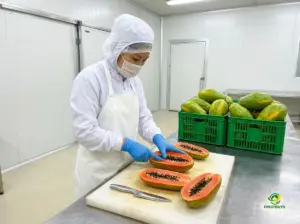
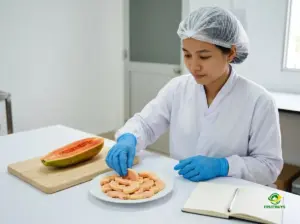
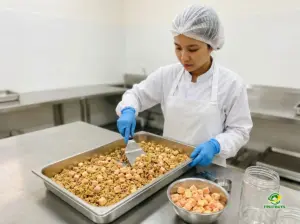
Washing and trimming must match the final SKU. Peel-on, peel-off, seed-on, reduced-seed and deseeded routes require different preparation discipline. A peel-on wedge needs surface control and visual sorting. A deseeded powder route needs seed removal or seed-particle management. A cube route needs stable flesh before cutting.

Preparation should define:
| Preparation Item | Buyer Control Question |
|---|---|
| Washing | Is the fruit cleaned under the approved process route? |
| Trimming | Are defects, bruises and unsuitable areas removed? |
| Peel route | Is peel retained, removed or controlled by format? |
| Seed route | Is the SKU seed-on, reduced-seed or deseeded? |
| Size sorting | Is the fruit suitable for the selected cut? |
| Pre-cut inspection | Are unsuitable fruits removed before cutting? |
| Traceability | Is the prepared batch linked to the raw-material lot? |
Preparation affects conversion. FruitBuys uses 6–8 kg whole incoming fresh guava → 1 kg finished freeze-dried guava as the working commercial range, but the final yield depends on maturity, trimming, peel policy, seed policy, format, drying endpoint and saleable recovery. Buyers should review freeze-dried guava conversion ratio before comparing process efficiency.
Cutting Control: Thickness, Size and Format Discipline
Cutting is where many bulk failures begin. Uneven thickness can produce uneven drying. Oversized pieces can create wet-center risk. Thin pieces can break, crumble or create more fines. Seed-heavy sections can create a harder bite in snack formats.
FruitBuys can structure freeze-dried guava into:
- Round Slices
- Triangle/Wedges
- Cubes/Dices
- Sticks
- Bites/Chunks
- Granules
- Powder
- Molded or Compressed Guava Bites
- Custom dimensions

Each format needs a measurable cutting standard.
| Format | Processing Control |
|---|---|
| Round Slice | Diameter, thickness and seed-center review |
| Triangle/Wedge | Thickness, broken-tip risk and seed distribution |
| Cube/Dice | Nominal size, oversize and undersize limits |
| Stick | Length range and fracture control |
| Bite/Chunk | Natural shape range and sensory acceptance |
| Granule | Particle range and dust control |
| Powder | Grinding route, mesh and seed-particle control |
| Molded Bite | Powder base, binder route, shape and Aw control |
This decision belongs in freeze-dried guava formats and custom cut sizes. Powder buyers should also review freeze-dried guava powder specification because powder needs separate controls for mesh, carrier, caking and sediment.
Pre-Freezing and Dryer Loading
Pre-freezing and dryer loading affect structure, drying uniformity and final texture.
The buyer does not need proprietary cycle settings, but the buyer should know that piece thickness, spacing and load discipline are controlled.
A good sample is not enough unless the bulk process uses the same control logic.
Freeze-drying depends on freezing before water removal by sublimation. Utah State University Extension explains that freeze-drying uses sublimation and vacuum to remove ice from frozen food as water vapor. (Utah State University Extension)
For freeze-dried guava, the process-control issue is not only whether freezing occurs. It is whether the frozen pieces enter drying in a condition that supports uniform water removal.

The buyer should confirm:
- Pieces are cut to the approved size range
- Thick and thin pieces are not mixed beyond tolerance
- Pieces are arranged to avoid clumping
- Dryer loading does not crush delicate formats
- The same format route is not mixed with powder or fines unless approved
- Pre-freezing and dryer loading protect the intended shape
- Trial sample logic can scale to bulk loading
A sample tray can look ideal because pieces are selected carefully. Bulk production needs process discipline across larger volumes. This is why process control must be linked to sample-to-bulk consistency.
Drying Endpoint: Moisture and Aw Must Be Measured
FruitBuys uses moisture 3–5% and Aw <0.30 as working targets for freeze-dried guava. These targets must be checked against the actual finished product. Texture alone is not enough.
FDA defines water activity as the ratio of the vapor pressure of water in a food to the vapor pressure of distilled water under the same conditions. FDA also explains that water activity relates to microbial growth and food stability. (U.S. Food and Drug Administration)
Moisture and Aw answer different questions:
| Control | What It Shows | Buyer Risk if Missing |
|---|---|---|
| Moisture | Total remaining water | Soft texture, wet centers, inconsistent drying |
| Aw | Water availability | Stability and microbial growth risk context |
| Piece thickness check | Uniformity of drying | Thick sections may fail even when thin pieces pass |
| Powder Aw | Caking and stability direction | Powder may clump after handling |
| Lot-specific COA | Documented release evidence | Generic sample result may not match bulk |
Post-Drying Handling: Protect the Product After Drying
The buyer should not approve a drying claim without a lot-specific or representative release file. Moisture and Aw controls belong in freeze-dried guava moisture and water activity. Lot proof belongs in freeze-dried guava COA and laboratory testing.
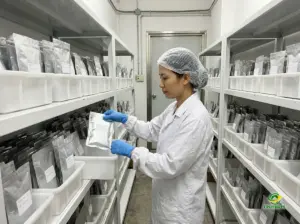
Freeze-dried guava is most vulnerable after drying and before sealing. The product has a porous, low-moisture structure. If handling exposes it to humidity, open air, weak staging control or delayed packing, the product can soften, cake or lose the crisp condition that the buyer approved.
Utah State University Extension’s practical freeze-drying guidance notes that freeze-dried food exposed to moisture or humidity through damaged packaging or improper storage can see water activity rise again. (Utah State University Extension)
A qualified supplier should control post-drying handling through:
- Short exposure time before packing
- Clean, dry handling area
- Protection from humidity
- Controlled transfer from tray to sorting
- No unnecessary open-air staging
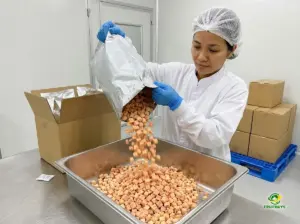
- Immediate packing into approved inner bags
- Seal inspection
- Lot coding
- Retained sample collection
This stage connects directly to freeze-dried guava packaging and shelf life. A perfect drying endpoint can still fail if the product is exposed or packed poorly.
Sorting, Grading and Foreign-Material Control
Sorting and grading convert dried output into buyer-approved product. They also separate off-size pieces, broken pieces, fines and visual defects. This step protects the difference between “dried output” and “saleable finished product.”
A process-control file should define:
| Sorting Area | Buyer Control |
|---|---|
| Color | Approved range against retained sample |
| Shape | Matches selected format |
| Size | Within agreed tolerance |
| Broken pieces | Maximum allowed level |
| Fines | Maximum allowed level or separate SKU use |
| Seed-heavy pieces | Controlled by seed policy and format |
| Off-odor | Rejection standard |
| Foreign material | Inspection and removal route |
| Powder route | Mesh and particle control where applicable |

Foreign-material control should be part of supplier qualification, but it should not be presented as a lot-specific result unless the actual inspection record supports it. For supplier-level review, connect this article to freeze-dried guava supplier qualification.
Low-Moisture Food Safety and Sanitation Discipline
Low moisture does not remove the need for hygiene control. Freeze-dried guava may enter snack pouches, cereal, yogurt toppings, beverage blends or ready-to-eat ingredient systems. That means sanitation, post-drying handling and environmental discipline remain important.
FDA’s 2025 draft guidance for low-moisture ready-to-eat human foods gives FDA’s current thinking on routine sanitation programs that help prevent pathogen contamination events and recommends corrective actions if prevention fails; FDA identifies the document as draft guidance. (U.S. Food and Drug Administration)
For B2B buyers, the practical point is clear: do not treat low moisture as a replacement for sanitation and COA review.
A processing-control review should include:
- Personnel hygiene
- Cleaning and sanitation program
- Food-contact surface control
- Post-drying handling protection
- Foreign-material control
- Environmental risk awareness
- Corrective-action procedure
- Finished-product microbiology panel
- Lot hold and release logic
This proof should feed into the buyer’s COA scope and supplier qualification checklist, not sit separately from the product file.
Powder Processing Controls
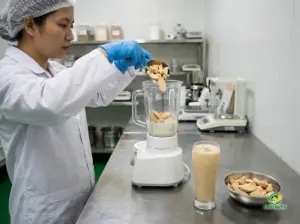
Powder is not simply broken guava. It is a separate product route. A powder SKU can be pure fruit powder, carrier-supported powder or powder used to form molded bites. Each route changes processing, label, Nutrition Facts, caking behavior and application performance.
Powder controls should define:
| Powder Control | Buyer Question |
|---|---|
| Raw-material route | Pink, white, peel-on, peel-off or pulp-based? |
| Seed route | Seed-on, reduced-seed or deseeded? |
| Grinding method | Is the particle range suitable for application? |
| Mesh | What mesh or particle range is targeted? |
| Carrier | Is any carrier used? |
| Caking | How is moisture pickup controlled? |
| Sediment | Is beverage sediment acceptable? |
| Packaging | Is powder packed to protect flowability? |
| COA | Does the report match powder, not pieces? |
Powder buyers should not approve the same COA, Nutrition Facts or packaging file used for wedges unless the proof actually matches powder. Use freeze-dried guava powder specification and freeze-dried guava Nutrition Facts before artwork or application approval.
Packaging and Lot Release
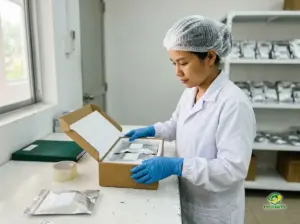
Packaging is part of the processing-control system because it protects the product condition after drying. A weak inner bag, poor seal, oversized pack, bad carton or unclear lot code can undo earlier process controls.
A release-ready package should align:
- Product name
- Format
- Inner-pack type
- Net weight
- Seal method
- Lot code
- Carton mark
- Storage instruction
- COA
- Retained sample
- Packing record
Bulk or retail packing should not change after sample approval unless the buyer reviews the change. A sample in a small high-barrier pouch does not automatically prove a 5 kg bulk inner bag or retail zipper pouch.
For OEM and private label projects, the package also connects to artwork and label approval. Use OEM private label freeze-dried guava when the process file must support retail pack development. Use freeze-dried guava container loading plan when carton configuration and arrival condition matter.
The Highest-Risk Mistake: Approving Process Without Release Evidence
The highest-risk mistake is accepting a process description without release evidence.
A process flow tells the buyer what should happen; COA, retained sample, packaging record and lot code show what was actually released.
Buyers should approve the finished product file, not only the processing narrative.
A supplier can describe freeze-drying correctly and still fail sample-to-bulk control. The buyer needs evidence that the finished lot matches the approved route.
Release evidence should include:
| Evidence | Why It Matters |
|---|---|
| Product specification | Defines the approved SKU |
| Process route summary | Shows how the product is prepared and dried |
| Retained sample | Physical comparison against bulk |
| COA | Confirms actual release data |
| Moisture and Aw results | Proves core low-moisture condition |
| Microbiology panel | Supports ready-to-eat or ingredient review |
| Packaging record | Links pack to product condition |
| Lot code | Connects product, COA and shipment |
| Change-control rule | Protects repeat orders |
The release evidence should move into freeze-dried guava RFQ checklist before sample approval. If the buyer wants formal vendor approval, the process file should also support freeze-dried guava supplier qualification.

Application Mapping
| Buyer Type | Application | Required Format | Proof Needed | FruitBuys Delivery |
|---|---|---|---|---|
| Importer | Bulk freeze-dried guava sourcing | Wedge, slice, dice, granule or powder | Process route, COA, moisture/Aw and retained sample | Quality Control, Documentation |
| QA manager | Lot release review | Any approved format | Process-control file, COA, lab method and release checklist | Quality Control, Documentation |
| R&D developer | Application trial | Powder, dice, granule, wedge or bite | Application-specific sample and process consistency | MOQ Flexibility/Market Trial Support |
| Private label brand | Retail pouch SKU | Wedge, bite, slice, powder or molded bite | Product brief, process route, packaging file and Nutrition Facts input | OEM/Private Label Delivery |
| Beverage developer | Guava powder | Fine or custom mesh powder | Seed route, mesh, carrier, caking, sediment and COA | Quality Control, Documentation |
| Cereal manufacturer | Dry inclusion | Dice, cube or granule | Size tolerance, fines, Aw and mixing-trial sample | Quality Control, Documentation |
| Compliance manager | Market review | Market-specific SKU | Ingredient statement, process identity, COA and label route | Documentation, Export Logistics Coordination |
Why FruitBuys Delivers This
FruitBuys supplies freeze-dried guava through an Integrated Product Supply Model that connects raw-material sourcing, production partners, QC, packaging, documentation and export logistics coordination under one accountable product relationship.
Under Raw Material Sourcing Governance, FruitBuys locks guava route, maturity, peel policy and seed policy before processing. Under Quality Control, FruitBuys verifies cutting, drying endpoint, texture, breakage, moisture, Aw, sorting and retained-sample alignment. Under Documentation, FruitBuys connects process route, specification, COA, laboratory data, packaging file, lot code and release status.
For development buyers, MOQ Flexibility/Market Trial Support allows controlled comparison of format and seed-policy routes. Under OEM/Private Label Delivery, FruitBuys aligns the process-control file with pack type, Nutrition Facts input, artwork and sample-to-bulk approval. Under Export Logistics Coordination, FruitBuys connects carton condition, lot marks, packing record and document handover with the released product.
FruitBuys supplies the finished export-ready product file, not a loose description of a drying process.
Buyer Checklist
Confirm these items before sample approval or bulk release:
- Pink or white guava route
- Maturity direction
- Peel-on or peel-off
- Seed-on, reduced-seed or deseeded
- Defect sorting logic
- Washing and trimming route
- Format and cut dimensions
- Size tolerance
- Broken-piece limit
- Fines limit
- Pre-freezing and loading discipline
- Drying endpoint
- Moisture target
- Aw target
- Post-drying exposure control
- Sorting and grading rule
- Foreign-material inspection route
- Powder mesh where applicable
- Carrier or binder status where applicable
- Packaging structure
- Seal method
- COA scope
- Microbiology panel
- Pesticide and contaminant tests where required
- Retained sample
- Lot code
- Change-control triggers
- Final request alignment through freeze-dried guava RFQ checklist.
Do not approve processing from a flowchart alone. Approve the process only when the finished lot can be verified through specification, retained sample, COA and packaging record.
Summary
Freeze-dried guava processing controls cover raw-material intake, maturity, peel policy, seed policy, washing, trimming, cutting, pre-freezing, freeze-drying, post-drying handling, sorting, packaging, COA and lot release.
FruitBuys uses working targets of moisture 3–5% and Aw <0.30, with 6–8 kg whole incoming fresh guava for 1 kg finished freeze-dried guava as the working conversion range. Buyers should approve process controls with retained sample, COA, packaging file and sample-to-bulk release criteria.
FAQ
What are the main processing controls for freeze-dried guava?
Main controls include raw-material approval, maturity, peel policy, seed policy, cut size, pre-freezing, drying endpoint, moisture, Aw, sorting, packaging, COA and retained sample.
Why does seed policy affect processing?
Seed policy affects cutting, bite, powder sediment, yield, Nutrition Facts and sample-to-bulk consistency. Seed-on, reduced-seed and deseeded routes should be treated as different process routes.
What moisture and Aw targets should buyers request?
FruitBuys uses moisture 3–5% and Aw <0.30 as working targets. Buyers should request actual lot-specific results through the COA or laboratory report.
Is a process flow enough for supplier approval?
No. A process flow shows intended steps. Buyers also need specification, retained sample, COA, packaging record, lot code and change-control rules.
Does powder need different process control from pieces?
Yes. Powder needs seed-particle, mesh, carrier, caking, sediment, packaging and label controls separate from wedges, slices or cubes.
Where does packaging fit in the process?
Packaging protects the low-moisture product after drying. Seal quality, barrier structure, carton condition and lot code are part of release control.
What should buyers send before requesting processing confirmation?
Send application, format, seed policy, moisture/Aw target, packaging route, COA scope, destination market and sample approval criteria.
Conclusion
Submit target format, seed policy, moisture/Aw target, packaging route and COA scope so FruitBuys can prepare the correct freeze-dried guava processing-control file.
References
- Utah State University Extension. Freeze Drying. Accessed August 2026. (Utah State University Extension)
- University of California, Davis Postharvest Research and Extension Center. Guava Produce Fact Sheet. Accessed August 2026. (UC Postharvest)
- U.S. Food and Drug Administration. Water Activity (aw) in Foods. Inspection Technical Guide. Accessed August 2026. (U.S. Food and Drug Administration)
- Utah State University Extension. Can I Freeze-Dry That? A Practical Guide to Safe and Effective Freeze-Drying. 2026. (Utah State University Extension)
- U.S. Food and Drug Administration. Draft Guidance for Industry: Establishing Sanitation Programs for Low-Moisture Ready-to-Eat Human Foods and Taking Corrective Actions Following a Pathogen Contamination Event. January 2025; comment period reopened May 29, 2025. (U.S. Food and Drug Administration)