Freeze-Dried Guava Sample-to-Bulk Consistency: How Buyers Prevent Bulk Drift
Freeze-dried guava sample-to-bulk consistency is where many B2B approvals fail. A sample can show clean pink color, crisp bite and attractive wedges, but bulk production may drift if the guava route, maturity, seed policy, cut size, drying endpoint, packaging and COA are not locked before release.
Powder creates a separate risk because mesh, carrier status, sediment, caking and moisture pickup can change between small sample and bulk packing. A sample is not a bulk approval until it is tied to a specification, retained sample, COA, packaging file and change-control rule. This article is for importers, QA managers, R&D developers, procurement teams and private label buyers that need FruitBuys freeze-dried guava supplied as the same controlled SKU from sample review to bulk lot release.
Sample Approval Must Become a Product File
Sample-to-bulk consistency means the approved sample and bulk lot match the same product specification.
The buyer must lock guava route, seed policy, format, moisture, Aw, COA, packaging and retained sample before release.
FruitBuys uses the approved sample as the starting reference for Quality Control and Documentation.
A good sample is useful because it lets the buyer evaluate color, format, aroma, texture, seed bite and application fit. It is not enough by itself. A sample shows one controlled moment. A bulk lot needs repeatable raw-material selection, process discipline, sorting, packing and release documentation.
FruitBuys treats sample approval as a product-control step, not a visual acceptance step. The buyer should approve a complete file:
| Approval Item | What It Controls |
|---|---|
| Product specification | Defines the SKU and release limits |
| Approved sample | Shows the physical target |
| Retained sample | Preserves comparison reference |
| Guava route | Locks pink or white guava direction |
| Peel and seed policy | Controls bite, texture, powder and label basis |
| Format | Controls cut size, broken pieces, fines and application fit |
| Moisture and Aw | Controls release condition and stability logic |
| COA | Connects lot proof to actual product |
| Packaging file | Protects low-moisture product condition |
| Change-control rule | Defines when re-approval is required |
Buyers who need the full commercial route should begin with freeze-dried guava supplier in Vietnam. This article owns the sample-to-bulk control gate.
What Bulk Drift Looks Like in Freeze-Dried Guava
Bulk drift happens when the approved sample and production lot are no longer the same product in practical terms. The label may still say “freeze-dried guava,” but the buyer receives a different eating experience, technical behavior or proof file.
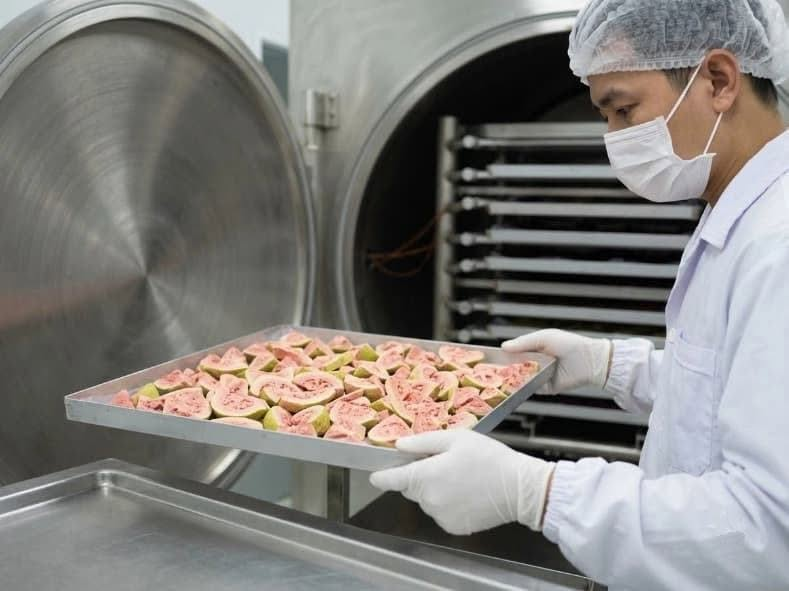
Drift can appear in visible and invisible ways:
| Drift Type | What Buyer Sees |
|---|---|
| Color drift | Pink guava becomes paler, darker or uneven |
| Seed-bite drift | Seed texture becomes harder or more noticeable |
| Cut-size drift | Wedges, slices or cubes are thicker, smaller or less uniform |
| Breakage drift | Bulk contains more broken pieces than sample |
| Fines drift | Dice, granules or powder show excessive dust |
| Powder drift | Mesh, sediment, caking or carrier status changes |
| Moisture drift | Product softens or carries uneven drying condition |
| Aw drift | Stability condition no longer matches approval file |
| Packaging drift | Sample pouch differs from bulk bag or retail pouch |
| COA drift | Report does not match lot, format, method or product form |
| Label drift | Nutrition Facts or ingredient statement does not match final SKU |
A buyer should treat any of these as a release-control issue. Bulk drift is not always a supplier intention problem. It often starts when the buyer approves only a sample and not the operating file behind it.
Lock Guava Route, Maturity and Seed Policy First
Sample-to-bulk control starts with raw material. Pink guava and white guava do not carry the same visual identity. Peel-on and peel-off products do not carry the same texture, residue-review and label basis. Seed-on, reduced-seed and deseeded routes do not behave the same in snack, powder, beverage or yogurt applications.
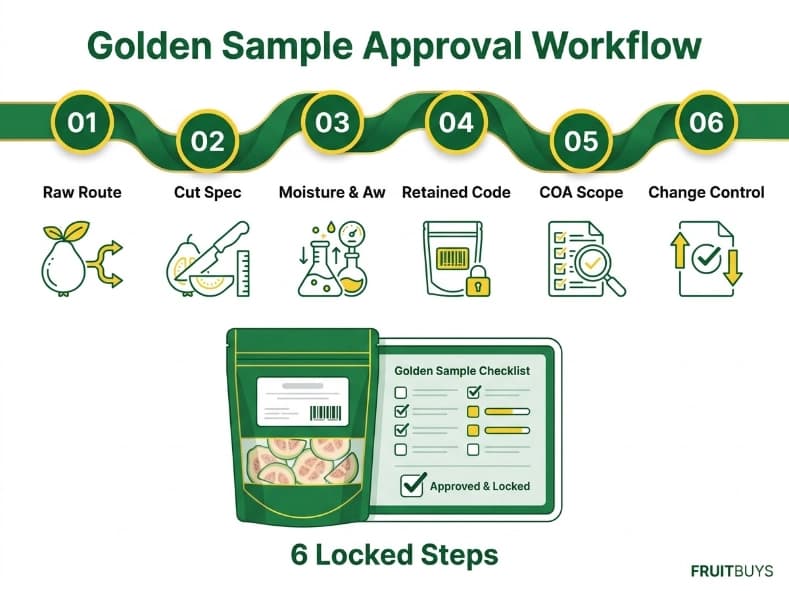
The buyer should lock:
- Pink guava, white guava or approved route
- Maturity direction
- Peel-on or peel-off policy
- Seed-on, reduced-seed or deseeded policy
- Defect rejection rule
- Raw-material change-control trigger
- Retained sample comparison method
A sample with acceptable seed bite does not prove that bulk seed distribution will stay acceptable unless the seed policy and grading standard are specified. A powder with acceptable sediment does not prove the next powder lot will behave the same if the seed route changes.
This decision belongs in pink guava variety, maturity and seed policy. FruitBuys uses Raw Material Sourcing Governance to keep the supplied product route aligned with the buyer’s approved SKU.
Format and Cut Size Must Be Measurable
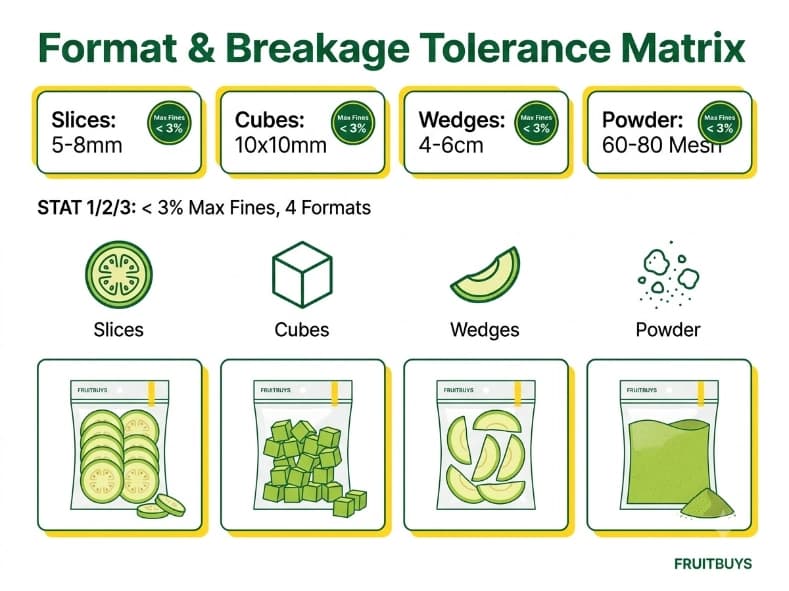
A product cannot remain consistent if the format is described only by name. “Wedges,” “slices,” “cubes,” “granules” and “powder” need measurable acceptance criteria.
A bulk-release format file should define:
| Format Field | Buyer Requirement |
|---|---|
| Format name | Slice, wedge, dice, stick, granule, powder or molded bite |
| Target dimension | Thickness, diameter, length, cube size or particle range |
| Tolerance | What counts as acceptable variation |
| Oversize limit | Prevents thick pieces and uneven drying |
| Undersize limit | Controls fines and dust |
| Broken-piece limit | Prevents visual and application drift |
| Seed-particle tolerance | Important for powder, beverage and yogurt |
| Retained sample | Physical comparison reference |
A visually attractive wedge sample does not define the bulk lot. The buyer should approve dimension, tolerance and rejection criteria before production. Format selection belongs in freeze-dried guava formats and custom cut sizes.
Powder buyers should move into freeze-dried guava powder specification because powder needs mesh, carrier, caking, sediment and packaging controls.
Moisture and Aw Are Bulk Release Gates
Moisture and Aw must match the bulk product, not only the sample.
FruitBuys uses moisture 3–5% and Aw <0.30 as working targets for freeze-dried guava.
Buyers should request actual release data through COA or supporting laboratory report.
Moisture and Aw are different controls. Moisture measures total remaining water. Aw measures water availability under equilibrium conditions. FDA defines water activity as the ratio between water vapor pressure in the food and water vapor pressure of distilled water under the same conditions, and FDA links Aw to food stability and microbial growth conditions (U.S. Food and Drug Administration).
This matters for sample-to-bulk consistency because a sample may feel crisp while the bulk lot has thicker pieces, more variable drying or different post-drying exposure. A powder sample may flow well in a small pouch but cake in bulk if moisture pickup occurs during grinding, packing or storage.
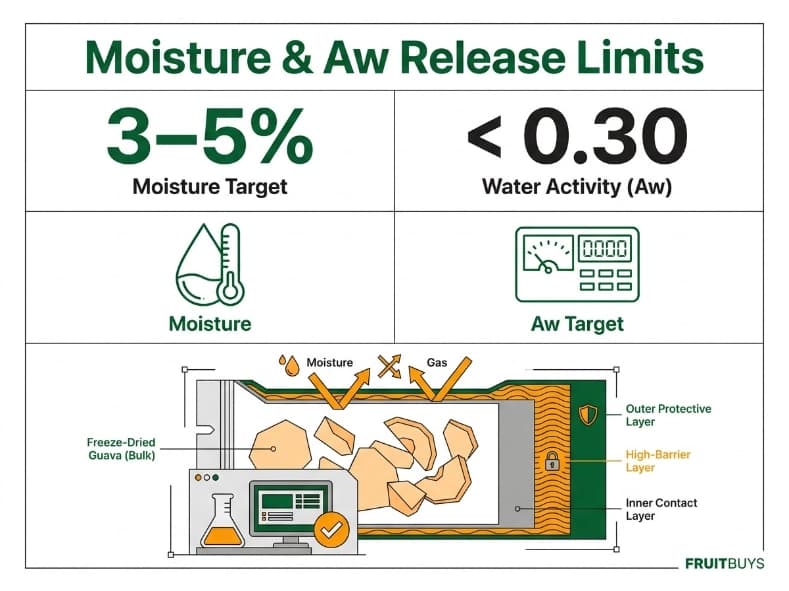
A bulk-release moisture/Aw file should include:
| Release Field | Buyer Check |
|---|---|
| Moisture target | Working range: 3–5% |
| Aw target | Working target: Aw <0.30 |
| Sampling point | Final product, not unclear in-process sample |
| Product format | Wedge, slice, cube, granule, powder or molded bite |
| Method | Stated where required |
| Actual result | Numeric value where buyer requires it |
| COA connection | Lot code and product name match |
| Packaging connection | Package protects low-moisture state |
The technical review belongs in freeze-dried guava moisture and water activity. Lot proof belongs in freeze-dried guava COA and laboratory testing.
Process Controls Must Scale From Trial to Bulk
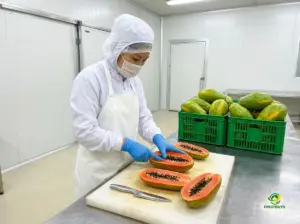
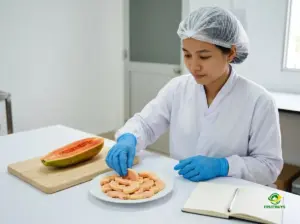
The process that creates the sample must be realistic for bulk release. A sample can be prepared from selected pieces, handled with extra care and packed quickly. Bulk production introduces larger volumes, more sorting, longer handling windows, carton pressure and shipment exposure.
Freeze-drying removes water from frozen food through sublimation, but that process principle alone does not prove product consistency. Bulk control also needs raw-material intake, washing, trimming, cutting, seed-policy execution, drying endpoint, post-drying handling, sorting, packing and release documentation.
The process file should define:
| Process Area | Sample-to-Bulk Control |
|---|---|
| Intake | Same guava route and maturity direction |
| Preparation | Same peel and seed policy |
| Cutting | Same size and thickness range |
| Drying | Same release targets for moisture and Aw |
| Sorting | Same broken-piece and fines limits |
| Powder route | Same mesh and carrier status |
| Packing | Same approved or reviewed package |
| Release | Same COA scope and retained sample rule |
For low-moisture ready-to-eat foods, FDA’s 2025 draft guidance discusses sanitation programs and corrective actions intended to help prevent pathogen contamination events. FDA identifies the document as draft guidance (U.S. Food and Drug Administration).
That supports a practical buyer rule: low-moisture status does not remove the need for process discipline and release evidence. Process review belongs in freeze-dried guava processing controls.
Packaging Must Match the Approved Sample Route
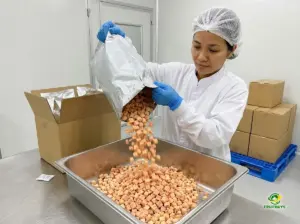
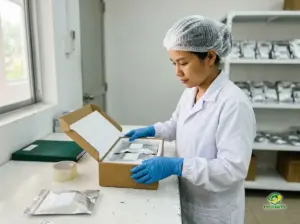
Packaging is a major source of sample-to-bulk drift. A sample may be packed in a small high-barrier pouch, while bulk moves in larger inner bags or retail packs with different headspace, seal condition and handling exposure. The product can be the same at drying, then become different after packing.
The packaging file should lock:
- Retail or bulk pack route
- Inner-bag structure
- Pack size
- Seal method
- Reseal requirement where applicable
- Carton configuration
- Lot code
- Storage instruction
- Shelf-life basis
- Retained sample pack
- Arrival inspection criteria
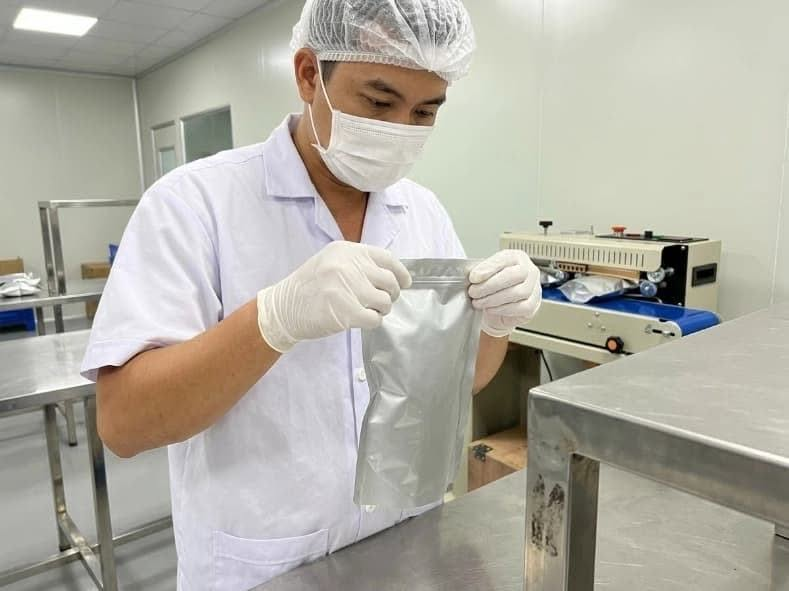
FruitBuys uses 12–24 months as a working shelf-life range only when product format, packaging, seal integrity, storage condition and validation evidence support it. The buyer should not approve shelf life from a sample pouch alone.
Packaging and shelf-life control belongs in freeze-dried guava packaging and shelf life. Container and carton planning belongs in freeze-dried guava container loading plan.
COA Must Release the Same SKU
A COA supports sample-to-bulk control only when it matches the exact product and lot. The buyer should check product name, format, lot code, sample date, test date, method, specification limit, actual result and laboratory identity.
A useful COA for freeze-dried guava should cover:
| COA Area | Why It Matters |
|---|---|
| Product name | Confirms the report belongs to the SKU |
| Format | Prevents using piece data for powder or molded bites |
| Lot code | Connects report to cartons and retained sample |
| Moisture | Confirms dry-product release condition |
| Aw | Confirms water-availability target |
| Microbiology | Supports risk-based food-safety review |
| Pesticides | Needed where buyer or market requires |
| Heavy metals/contaminants | Needed where buyer or market requires |
| Powder mesh | Needed for powder release |
| Carrier status | Needed for powder and label alignment |
ISO describes ISO/IEC 17025:2017 as the international standard for testing and calibration laboratories, focused on competence, impartiality and consistent laboratory operation. (ISO) For buyer review, this means laboratory identity and scope can matter, but they do not replace checking whether the report matches the exact freeze-dried guava lot.
COA review belongs in freeze-dried guava COA and laboratory testing. Do not accept a COA file name as proof. Read the report.
Nutrition, Label and Artwork Must Not Drift From the Sample
Sample-to-bulk consistency also affects label data. A buyer may approve a fruit-only pink guava wedge sample, then shift to powder with carrier or molded bites with binder. The product name may still contain “guava,” but the ingredient statement and Nutrition Facts basis can change.
Label drift appears when:
- Wedge label is used for powder
- Seed-on values are used for deseeded powder
- Fruit-only claim remains after carrier is added
- Vitamin C claim is printed before final-product testing
- Added sugar status is not confirmed
- Pack size changes but serving count does not
- COA and Nutrition Facts file refer to different SKU routes
Private label projects need tighter control because artwork can lock a mistake into packaging inventory. Nutrition and label validation belong in freeze-dried guava Nutrition Facts. Branded SKU development belongs in OEM private label freeze-dried guava.
Change-Control Triggers Must Be Written Before Bulk Release
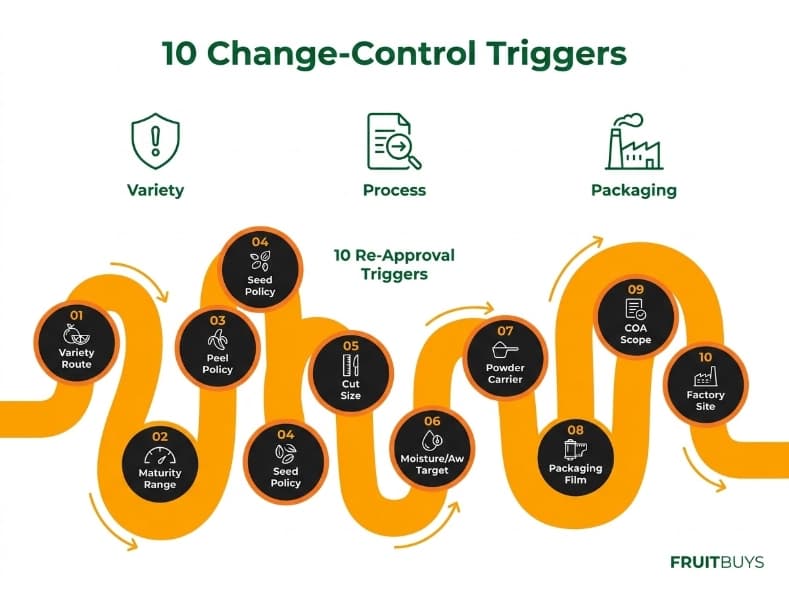
The highest-risk mistake is approving a sample without defining what changes require re-approval.
If guava route, seed policy, format, moisture target, packaging, COA scope or label basis changes, the buyer may no longer be approving the same product.
The release file should state change-control triggers before bulk production.
A change-control rule protects the buyer from silent drift. It tells procurement, QA, R&D and FruitBuys which changes require review before the next lot is released.
Re-approval should be required when these change:
| Change Trigger | What Must Reopen |
|---|---|
| Pink to white guava | Color, sensory, label and application review |
| Maturity direction | Cutting, aroma, texture and yield review |
| Peel policy | Texture, residue review, label and Nutrition Facts basis |
| Seed policy | Bite, sediment, powder and application review |
| Format | Size, breakage, packaging, COA and application trial |
| Powder mesh | Beverage, caking, flow and sediment review |
| Carrier or binder | Ingredient statement, Nutrition Facts and claim review |
| Moisture or Aw target | Release, COA and shelf-life review |
| Packaging route | Shelf life, caking, breakage and arrival inspection |
| COA scope | QA release and market-readiness file |
| Destination market | Label, document, residue and contaminant review |
Codex lists General Principles of Food Hygiene CXC 1-1969 as a Code of Practice, with the current listing showing the 2022 version. (FAOHome) For B2B buyers, that reinforces a practical operating principle: product control should be systematic, documented and tied to hygiene and release discipline, not left as an informal sample promise.
Application Mapping
| Buyer Type | Application | Required Format | Proof Needed | FruitBuys Delivery |
|---|---|---|---|---|
| Importer | Bulk freeze-dried guava supply | Wedge, slice, dice, granule or powder | Approved sample, retained sample, COA, moisture/Aw and packaging file | Quality Control, Documentation |
| QA manager | Bulk lot release | Any approved format | Specification, lot code, lab result, method, release limit and change-control rule | Quality Control, Documentation |
| R&D developer | Application scale-up | Powder, dice, granule, wedge or bite | Application trial, format tolerance, seed policy and moisture/Aw | MOQ Flexibility/Market Trial Support |
| Private label brand | Retail pouch SKU | Wedge, bite, slice, powder or molded bite | Artwork input, Nutrition Facts basis, packaging file and retained sample | OEM/Private Label Delivery |
| Beverage developer | Guava powder | Fine or custom mesh powder | Mesh, carrier status, sediment, caking, COA and pack review | Quality Control, Documentation |
| Cereal manufacturer | Dry inclusion | Cube, dice or granule | Size distribution, fines limit, Aw, blend trial and packing record | Quality Control, Documentation |
| Compliance manager | Market file review | Market-specific SKU | COA, label route, ingredient statement and destination document checklist | Documentation, Export Logistics Coordination |
| Distributor | Repeat order control | Stable format by channel | Lot comparison, carton marks, retained sample and arrival inspection | Export Logistics Coordination, Documentation |
Why FruitBuys Delivers This
FruitBuys supplies freeze-dried guava through an Integrated Product Supply Model that connects raw-material governance, production partners, QC, packaging, documentation and export logistics coordination under one accountable supplier relationship.
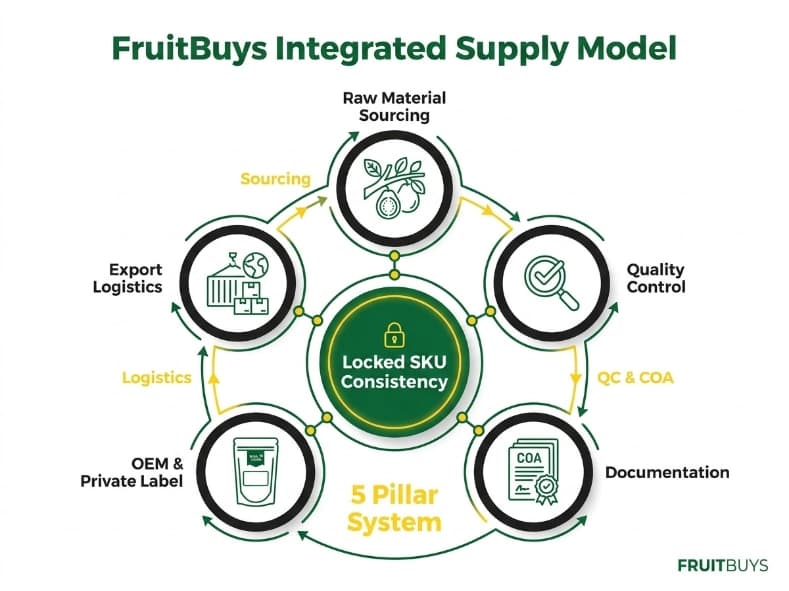
Under Raw Material Sourcing Governance, FruitBuys aligns pink or white guava route, maturity, peel policy and seed policy with the approved sample. Under Quality Control, FruitBuys checks format, cut size, seed bite, texture, moisture, Aw, broken pieces, fines, powder behavior and retained-sample alignment.
Under Documentation, FruitBuys connects specification, COA, laboratory report, packaging file, lot code, change-control rule and market-readiness document set. Under MOQ Flexibility/Market Trial Support, buyers can compare formats and application routes before broader approval. Under OEM/Private Label Delivery, FruitBuys aligns the approved product with pouch size, Nutrition Facts input, artwork version and retail release file.
Under Export Logistics Coordination, FruitBuys connects carton condition, lot marks, packing record and document handover with the same released goods. FruitBuys supplies one controlled freeze-dried guava SKU, not a loose sample separated from bulk proof.
Buyer Checklist
Confirm these items before converting a freeze-dried guava sample into bulk approval:
- Approved sample code
- Retained sample
- Product specification
- Product name
- Pink or white guava route
- Maturity direction
- Peel policy
- Seed-on, reduced-seed or deseeded route
- Format name
- Target dimension
- Size tolerance
- Broken-piece limit
- Fines limit
- Powder mesh where applicable
- Carrier status where applicable
- Binder status for molded bites where applicable
- Moisture target
- Aw target
- COA scope
- Microbiology panel
- Pesticide panel where required
- Heavy-metal or contaminant panel where required
- Packaging structure
- Pack size
- Seal method
- Shelf-life basis
- Storage instruction
- Lot code
- Carton marks
- Packing record
- Nutrition Facts basis where required
- Ingredient statement
- Destination-market document needs
- Change-control triggers
- Arrival inspection criteria
- Supplier review through freeze-dried guava supplier qualification
- Final input alignment through freeze-dried guava RFQ checklist
Do not approve “same as sample” unless the sample is tied to a written specification, retained reference, COA and packaging file.
Summary
Freeze-dried guava sample-to-bulk consistency means the approved sample and bulk lot match the same guava route, peel policy, seed policy, format, moisture, Aw, COA, packaging and retained-sample file.
FruitBuys uses moisture 3–5% and Aw <0.30 as working targets. Buyers should define change-control triggers for format, powder mesh, carrier status, packaging, label data and destination market before bulk release. FruitBuys aligns sample approval, QC, Documentation, OEM/private label delivery and export logistics around one supplied SKU.
FAQ
What does sample-to-bulk consistency mean?
It means the approved freeze-dried guava sample and the bulk lot match the same specification, retained sample, moisture/Aw targets, packaging file, COA and release criteria.
Why is a good sample not enough?
A sample shows one review point. Bulk needs repeatable raw-material control, processing, sorting, packaging, COA and lot documentation.
What should buyers compare between sample and bulk?
Compare color, seed bite, format, cut size, broken pieces, fines, moisture, Aw, packaging, COA, lot code and retained sample.
Does powder need separate sample-to-bulk approval?
Yes. Powder needs mesh, carrier status, seed-particle tolerance, caking, sediment, moisture, Aw, packaging and COA review separate from pieces.
When should buyers require re-approval?
Require re-approval when guava route, seed policy, format, powder mesh, carrier, packaging, moisture/Aw target, COA scope, market route or label basis changes.
Can one retained sample control repeat orders?
It can support comparison, but repeat orders still need lot-specific release proof and change-control review.
What should buyers send before bulk approval?
Send approved sample details, target specification, pack route, COA scope, label requirements, destination market and change-control criteria.
Conclusion
Submit the approved sample, target specification, packaging route, COA scope and change-control criteria so FruitBuys can build the freeze-dried guava bulk-release file.
References
- U.S. Food and Drug Administration. Water Activity (aw) in Foods. FDA Inspection Technical Guide. (U.S. Food and Drug Administration)
- U.S. Food and Drug Administration. Draft Guidance for Industry: Establishing Sanitation Programs for Low-Moisture Ready-to-Eat Human Foods and Taking Corrective Actions Following a Pathogen Contamination Event. January 2025. (U.S. Food and Drug Administration)
- International Organization for Standardization. ISO/IEC 17025:2017 — General requirements for the competence of testing and calibration laboratories. (ISO)
- Codex Alimentarius / FAO-WHO. Codes of Practice: CXC 1-1969 General Principles of Food Hygiene. Listed as 2022 version. (FAOHome)