
Freeze-Dried Guava Container Loading Plan: Cartons, Payload and Shipment Readiness
Freeze-dried guava container loading plan decisions should not begin with a maximum carton number. A buyer may calculate the cube of a 20ft or 40ft HC container, then miss the real controls: product fragility, inner-bag protection, carton strength, stack height, moisture exposure, palletized versus floor-loaded method, lot separation, VGM, packing list and arrival inspection.
A pink guava wedge, guava powder, granule or molded bite does not carry the same breakage and moisture risk in shipment. The useful loading plan is not the highest theoretical carton count; it is the carton count that protects the approved product file through arrival. This article is for importers, logistics managers, QA teams, distributors and private label buyers planning FruitBuys freeze-dried guava shipments with carton, payload, packaging and documentation control.
Container Loading Starts With the Carton File
Freeze-dried guava loading should start with carton size, net weight, inner pack, product format and loading method.
FruitBuys uses 60 × 39 × 39 cm / 10 kg net as the working carton basis for freeze-dried guava planning.
Buyers should confirm whether the shipment is floor-loaded or palletized before approving container count.
A carton count is useful only when it connects to the product file. FruitBuys uses a working carton of 60 × 39 × 39 cm with 10 kg net. That carton equals:
0.60 m × 0.39 m × 0.39 m = 0.09126 CBM/carton
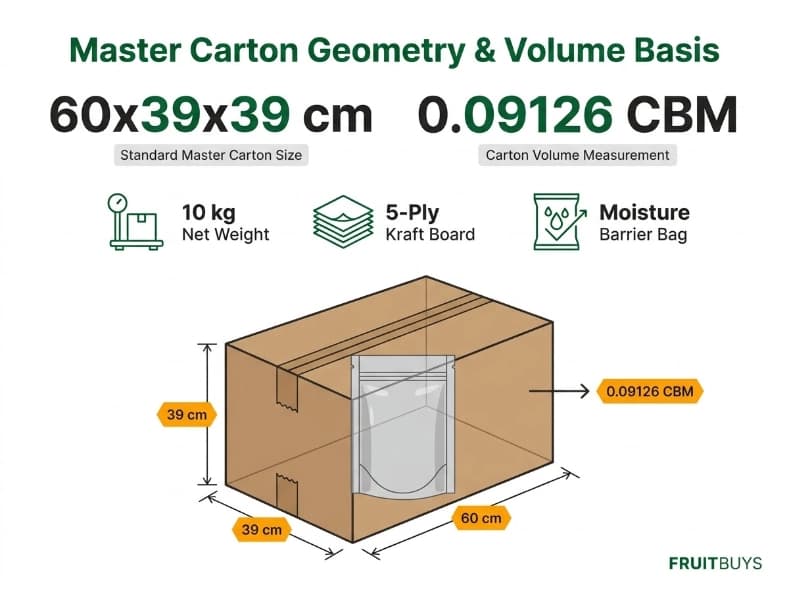
This number allows a planning calculation, but it is not a release commitment by itself. Loading performance also depends on carton strength, product format, inner-bag structure, stack height, pallet use, container condition and arrival-risk tolerance.
| Planning Item | Working Input |
|---|---|
| Carton dimension | 60 × 39 × 39 cm |
| Carton volume | 0.09126 CBM |
| Net weight per carton | 10 kg |
| 20ft working plan | 250–300 cartons |
| 20ft net payload | 2.5–3.0 MT |
| 40ft HC working plan | 600–680 cartons |
| 40ft HC net payload | 6.0–6.8 MT |
Buyers who need the full product route should begin with freeze-dried guava supplier in Vietnam. This page owns the container and payload planning gate.
20ft Container Planning: 250–300 Cartons as Working Range
FruitBuys uses 250–300 cartons as the practical planning range for a 20ft dry container when the working carton is 60 × 39 × 39 cm/10 kg net. That gives a net product payload of 2.5–3.0 MT before route-specific deductions.
The geometric ceiling can be higher. With a 60 × 39 × 39 cm carton, a tightly arranged theoretical plan can reach up to 324 cartons in a 20ft dry container. But the geometric ceiling is not the buyer’s release plan.
| 20ft Planning Layer | Cartons | Net Product |
|---|---|---|
| Practical working range | 250–300 cartons | 2.5–3.0 MT |
| Geometric ceiling reference | Up to 324 cartons | Up to 3.24 MT |
| Release condition | Shipment-level confirmation | Shipment-level confirmation |
The gap between practical range and ceiling protects real loading conditions. Buyers may need deductions for carton compression, air circulation, lot separation, loading access, palletization, container-wall clearance, packing-photo requirements or fragile format control. For format-specific breakage risk, review freeze-dried guava formats and custom cut sizes. Wedges, sticks and slices may need stricter breakage review than powder or granules.
40ft HC Planning: 600–680 Cartons as Working Range
FruitBuys uses 600–680 cartons as the practical planning range for a 40ft HC dry container with the same working carton basis. That gives a net product payload of 6.0–6.8 MT before shipment-level confirmation.
The geometric ceiling reference can reach up to 720 cartons. That ceiling assumes tight arrangement and does not automatically account for palletization, carton protection, stack-risk limits, mixed lots, loading access or buyer-required arrival condition.
| 40ft HC Planning Layer | Cartons | Net Product |
|---|---|---|
| Practical working range | 600–680 cartons | 6.0–6.8 MT |
| Geometric ceiling reference | Up to 720 cartons | Up to 7.2 MT |
| Release condition | Shipment-level confirmation | Shipment-level confirmation |
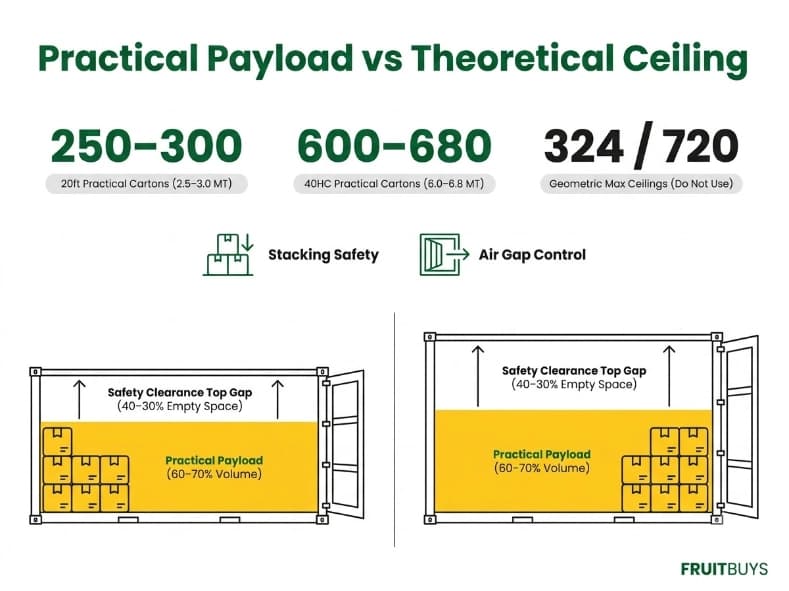
A 40ft HC plan is often volume-sensitive for freeze-dried products. The product is light relative to container weight capacity, so the limiting factor is usually carton cube, carton stability and product protection rather than net product weight.
Carrier equipment can vary. Maersk notes that maximum cargo weight limits vary by container type and size and directs users to confirm accurate information through the relevant local office. (Maersk) FruitBuys therefore treats container planning as a shipment file, not a universal payload promise.
Floor-Loaded vs Palletized Loading
Floor-loaded and palletized shipments should not use the same carton-count assumption.
Floor loading usually supports higher carton utilization, while palletization can improve handling discipline but reduces usable carton space.
Buyers should choose the method based on product fragility, warehouse process, lot separation and arrival inspection.
Floor-loaded cartons may maximize the use of container volume, but they require stronger control over carton stacking, loading sequence, carton marks, unloading labor and arrival inspection. Palletized loading can improve warehouse handling and lot separation, but pallet height, pallet footprint and stretch-wrapping reduce the number of cartons that fit.
| Loading Method | Strength | Risk |
|---|---|---|
| Floor-loaded | Better container cube utilization | More manual handling, stack pressure and unloading discipline needed |
| Palletized | Better warehouse handling and lot separation | Lower carton count and pallet-dimension dependency |
| Mixed-lot floor loading | Can consolidate SKUs | Requires strict carton marks and loading map |
| Mixed-lot pallet loading | Easier lot segregation | Lower utilization and higher pallet-planning need |
The IMO/ILO/UNECE CTU Code is a non-mandatory global code of practice for handling and packing cargo transport units for sea and land transport, and it gives advice to people responsible for packing and securing cargo (International Maritime Organization).
For FruitBuys shipments, that principle supports a practical rule: the loading method must protect the cartonized product, not only fill the container.
Packaging Protection Comes Before Container Utilization
Container utilization should never override packaging protection. Freeze-dried guava can leave production with a correct moisture and Aw profile, then lose product condition if cartons are compressed, inner bags are punctured or packaging allows moisture pickup.
FruitBuys uses moisture 3–5% and Aw <0.30 as working targets for freeze-dried guava. FDA defines water activity as the ratio of water vapor pressure in a food to that of distilled water under the same conditions, and FDA connects Aw to food stability and microbial-growth conditions. (U.S. Food and Drug Administration)
Utah State University Extension explains that freeze-dried food exposed to moisture or humidity through damaged packaging or improper storage can see water activity rise again. (U.S. Food and Drug Administration)

This means loading must protect:
- Inner-bag seal
- Carton shape
- Carton compression limit
- Product crispness
- Powder flowability
- Breakage tolerance
- Lot identity
- Arrival inspection criteria
Packaging and shelf-life review belongs in freeze-dried guava packaging and shelf life. Moisture and Aw control belongs in freeze-dried guava moisture and water activity.
Product Format Changes the Loading Plan
A loading plan should match the format. Freeze-dried guava pieces and guava powder do not carry the same shipment risk.
| Product Format | Loading Risk | Buyer Control |
|---|---|---|
| Round slice | Edge breakage and visual damage | Lower compression, breakage limit |
| Triangle/wedge | Broken tips and uneven pieces | Carton stack review |
| Cube/dice | Fines and dust from movement | Fines limit and carton handling |
| Stick | Fracture during loading and unloading | Short-piece and broken-stick limit |
| Granule | Dust and segregation | Particle range and inner-bag seal |
| Powder | Caking, clumping and odor pickup | High-barrier pack and caking review |
| Molded bite | Texture and shape damage | Formula, Aw and carton protection |
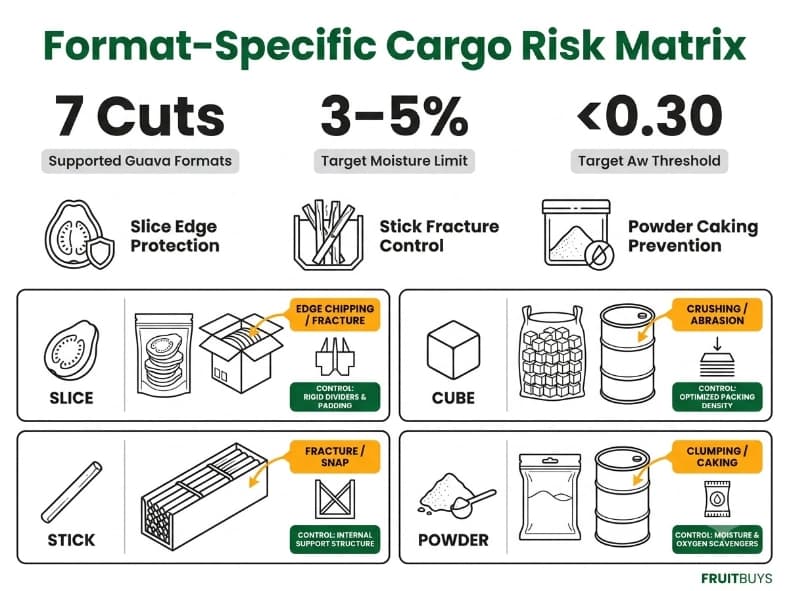
Powder shipments need stricter attention to caking and seal protection. A powder sample can flow well in a small pouch and still cake in bulk if the inner bag, seal or storage route is not aligned. Powder buyers should review freeze-dried guava powder specification before approving container plans.
Application also matters. A cereal manufacturer may tolerate a different broken-piece profile than a retail snack pouch buyer. Review freeze-dried guava food applications before deciding whether the load plan protects the finished-use requirement.
VGM, Gross Weight and Document Alignment
A container loading plan must connect to verified weight and documents. IMO states that SOLAS was amended to require mandatory verification of the gross mass of packed containers, and the VGM guidelines were approved to support that requirement. (International Maritime Organization)
For freeze-dried guava, the net product weight may be low compared with dry-container payload capacity, but VGM still matters because the container record must match the packed container.
A shipment file should align:
| Document/Record | Must Match |
|---|---|
| Packing list | Carton count, net weight, gross weight, lot code |
| Carton marks | Product name, SKU, lot and count |
| COA | Product, lot code, test date and release status |
| Loading map | Carton sequence, lot separation and count |
| VGM record | Packed container gross mass |
| Seal record | Container seal identity |
| Retained sample | Same released product file |
| Arrival inspection | Same carton and lot structure |
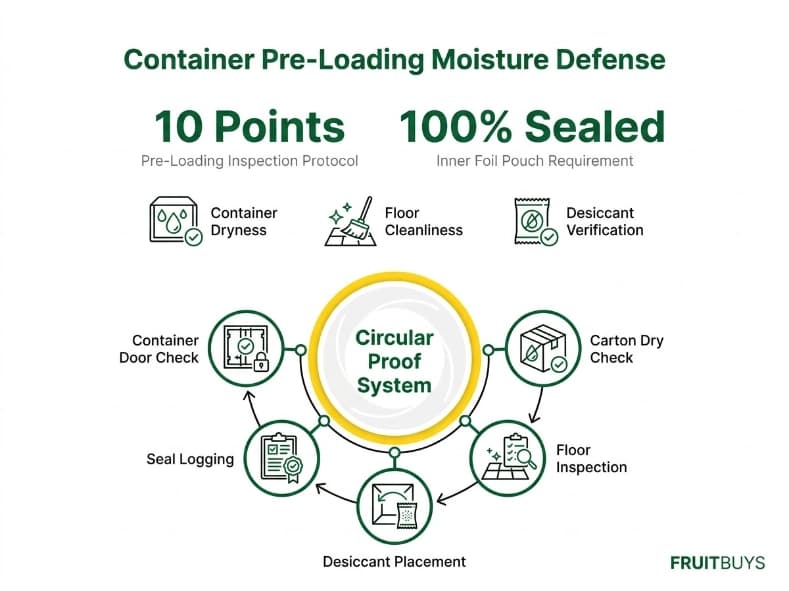
COA alignment belongs in freeze-dried guava COA and laboratory testing. Import document alignment belongs in freeze-dried guava HS code and import compliance.
Lot Separation and Sample-to-Bulk Control
Loading should protect sample-to-bulk consistency. A buyer may approve a sample from one production lot and then receive a mixed load where carton marks, COA, retained sample and packing list do not clearly connect.
A loading plan should define:
- One SKU or mixed SKU
- One lot or multiple lots
- Carton count per lot
- Lot position in container
- Carton mark format
- COA per lot
- Retained sample per lot
- Loading photos where required
- Arrival inspection rule
If multiple guava formats are shipped together, the risk increases. Powder, wedges and cubes need clear carton marks and separate release evidence. A single mixed container can still be controlled, but only if the packing list and loading map are precise.
Sample-to-bulk release belongs in sample-to-bulk consistency. Buyer inputs should be consolidated through freeze-dried guava RFQ checklist.
The Highest-Risk Mistake: Treating the Geometric Ceiling as the Shipment Plan
The highest-risk mistake is treating the highest theoretical carton count as the approved shipment plan.
The geometric ceiling does not prove carton strength, breakage control, pallet fit, seal protection, VGM alignment, lot separation or arrival condition.
Buyers should approve container loading only after the final carton, pack and product file are locked.
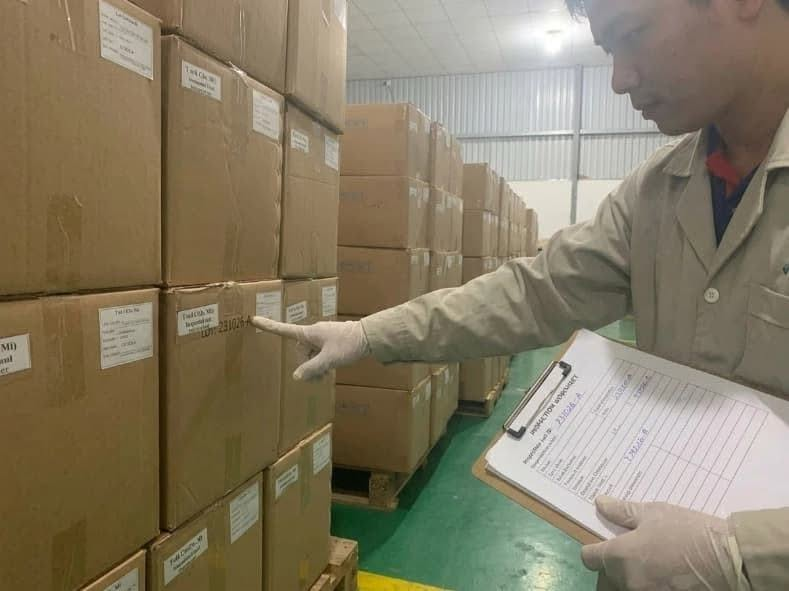
A 20ft plan can show up to 324 cartons on paper. A 40ft HC plan can show up to 720 cartons on paper. Those numbers are useful as ceiling references, but they do not answer the buyer’s real questions.
The buyer still needs to know:
| Question | Why It Matters |
|---|---|
| Is the product wedge, powder, dice or molded bite? | Format changes breakage and moisture risk |
| Is the shipment floor-loaded or palletized? | Carton count and handling differ |
| Is the carton strong enough for the stack? | Compression can damage product and packs |
| Are lots separated clearly? | COA and traceability must match |
| Does the packing list match carton marks? | Arrival inspection depends on it |
| Is VGM aligned? | Required for packed-container shipping records |
| Are arrival criteria defined? | Prevents disputes over breakage and softening |
FruitBuys treats container loading as part of Export Logistics Coordination and Documentation. The plan should protect the released product, not maximize a spreadsheet.
Application Mapping
| Buyer Type | Application | Required Format | Proof Needed | FruitBuys Delivery |
|---|---|---|---|---|
| Importer | Bulk container shipment | Wedge, slice, dice, granule or powder | Carton count, packing list, COA, loading plan and lot code | Export Logistics Coordination, Documentation |
| Distributor | Multi-SKU inventory | Floor-loaded or palletized cartons | Lot separation, carton marks, arrival inspection and retained samples | Documentation, Export Logistics Coordination |
| QA manager | Arrival approval | Any approved format | Breakage limit, moisture/Aw, COA, carton condition and retained sample | Quality Control, Documentation |
| Private label brand | Retail pouch cartons | Wedge, bite, powder or molded bite | Pack protection, carton marks, artwork version and lot traceability | OEM/Private Label Delivery |
| Beverage developer | Guava powder bulk | Fine or custom mesh powder | Inner-bag seal, caking review, COA and powder-specific carton plan | Quality Control, Documentation |
| Cereal manufacturer | Inclusion supply | Cube, dice or granule | Fines limit, particle integrity, packing record and lot identity | Quality Control, Export Logistics Coordination |
| Procurement manager | Replenishment planning | Stable SKU route | Carton range, payload plan, document file and change-control criteria | Documentation, Export Logistics Coordination |
Why FruitBuys Delivers This
FruitBuys supplies freeze-dried guava through an Integrated Product Supply Model that connects raw-material governance, production partners, QC, packaging, documentation and export logistics coordination under one accountable supplier relationship.
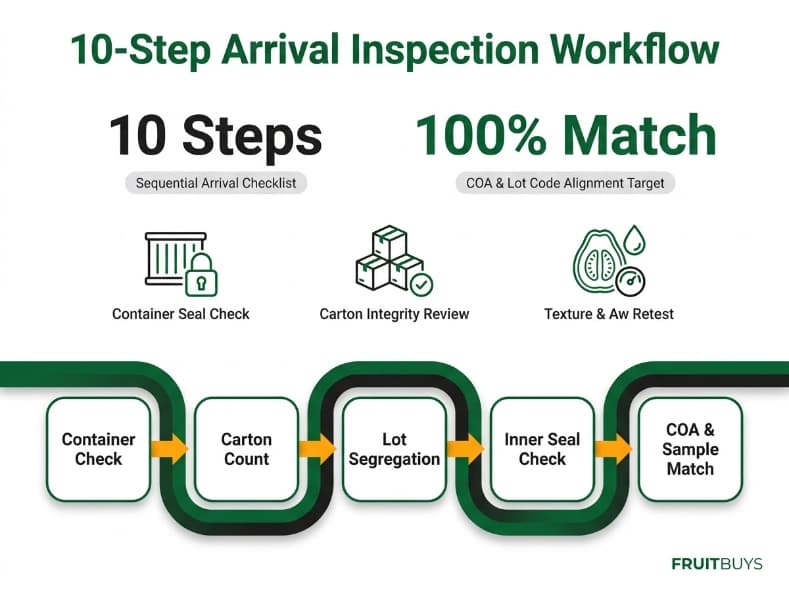
Under Export Logistics Coordination, FruitBuys aligns carton configuration, container loading, packing record, lot marks, seal information and document handover with the released goods. Under Documentation, FruitBuys connects packing list, COA, laboratory reports, carton marks, lot identity and shipment documents.
Under Quality Control, FruitBuys checks that moisture, Aw, format, breakage, fines, powder behavior and retained sample match the approved product file. Under OEM/Private Label Delivery, FruitBuys aligns retail pouch cartons with artwork version, pack size and label inputs.
Under Raw Material Sourcing Governance, FruitBuys keeps guava route, maturity, peel policy and seed policy tied to the same product identity used in logistics documents. FruitBuys supplies the loaded, documented freeze-dried guava shipment file, not a disconnected carton-count estimate.
Buyer Checklist
Confirm these points before approving a freeze-dried guava loading plan:
- Product name
- Product format
- Pink or white guava route
- Peel policy
- Seed policy
- Powder carrier status where applicable
- Carton dimension
- Carton net weight
- Gross carton weight
- Inner-bag structure
- Seal method
- Retail pouch or bulk inner-bag route
- Carton strength review
- Stack height
- Floor-loaded or palletized method
- Pallet dimension where applicable
- 20ft or 40ft HC container type
- Target carton range
- Lot code
- Carton marks
- Packing list
- COA per lot
- Retained sample per lot
- Loading map
- Loading photos where required
- Seal number record
- VGM method and record
- Arrival inspection criteria
- Breakage limit
- Powder caking limit where applicable
- Moisture and Aw targets
- Storage instruction
- Destination document requirements
- Supplier review through freeze-dried guava supplier qualification
- Final input alignment through freeze-dried guava RFQ checklist
Do not approve loading from carton count alone. Approve it from carton structure, product format, loading method, COA, VGM and arrival criteria.
Summary
Freeze-dried guava container loading depends on carton size, inner pack, product format, loading method, lot separation, VGM, packing list and arrival inspection. FruitBuys uses a working carton of 60 × 39 × 39 cm with 10 kg net and 0.09126 CBM per carton.
Practical planning ranges are 250–300 cartons for a 20ft dry container and 600–680 cartons for a 40ft HC dry container. Geometric ceilings are planning references, not shipment commitments. FruitBuys aligns loading through Export Logistics Coordination, Documentation and QC.
FAQ
How many cartons of freeze-dried guava fit in a 20ft container?
FruitBuys uses 250–300 cartons as the working range for a 20ft dry container with 60 × 39 × 39 cm / 10 kg net cartons. Final count depends on loading method and product protection.
How many cartons fit in a 40ft HC container?
FruitBuys uses 600–680 cartons as the working range for a 40ft HC dry container with the same carton basis. Final approval needs carton, pallet, lot and arrival checks.
Why not use the geometric maximum?
The geometric maximum does not prove carton strength, breakage control, pallet fit, moisture protection, lot separation, VGM alignment or arrival condition.
Does palletized loading reduce carton count?
Yes. Palletized loading usually reduces carton utilization because pallet footprint, height and wrapping consume space. It may improve handling and lot separation.
Why does powder need a different loading review?
Powder can cake, clump or absorb odor if inner bags, seals and carton handling are weak. Powder requires caking, seal and packaging review.
What documents should match the loading plan?
Packing list, COA, lot code, carton marks, loading map, seal record, retained sample and VGM record should align with the packed goods.
What should buyers send before requesting a loading plan?
Send carton size, pack type, loading method, container type, lot structure, target format, COA scope and arrival inspection criteria.
Conclusion
Submit carton size, pack type, loading method, target container type, lot structure and arrival inspection criteria so FruitBuys can prepare the correct freeze-dried guava loading file.
References
- IMO / ILO / UNECE. Code of Practice for Packing of Cargo Transport Units (CTU Code). 2014 Edition. (International Maritime Organization)
- International Maritime Organization. Verification of the gross mass of a packed container. (International Maritime Organization)
- U.S. Food and Drug Administration. Water Activity (aw) in Foods. FDA Inspection Technical Guide. (U.S. Food and Drug Administration)
- Utah State University Extension. Can I Freeze-Dry That? A Practical Guide to Safe and Effective Freeze-Drying. 2026. (U.S. Food and Drug Administration)
- Maersk. Cargo weight limit. Container support guidance. (Maersk)



