Freeze-Dried Guava Conversion Ratio: How Many kg Fresh Guava Make 1 kg Freeze-Dried Guava?
Freeze-dried guava conversion ratio is not just a production number. It affects raw-material planning, format selection, sample approval, Nutrition Facts logic, COA review and bulk consistency. A buyer may hear “5:1,” “6:1” or “8:1” and compare suppliers too quickly, without checking whether the ratio starts from whole incoming fruit, prepared edible guava, dryer output or saleable finished goods.

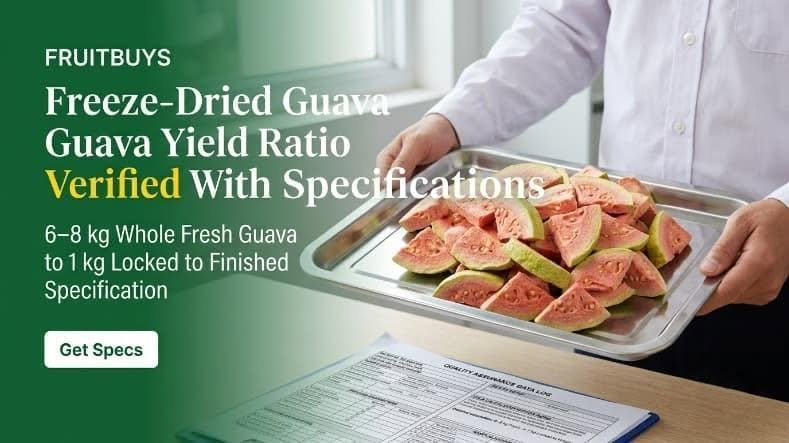
That mistake can create wrong expectations before the first sample is approved. For FruitBuys freeze-dried guava, the working commercial basis is 6–8 kg of whole incoming fresh guava to produce 1 kg of finished freeze-dried guava. This article explains what that ratio means, what changes it and how B2B buyers should use it before approving samples, OEM SKUs or bulk release.
The Working Conversion Ratio for Freeze-Dried Guava
FruitBuys uses 6–8 kg whole incoming fresh guava → 1 kg finished freeze-dried guava as the working commercial conversion range.
This number should be read as a whole-fruit planning basis, not a universal dryer-output claim.
The final ratio depends on maturity, sorting, peel policy, seed policy, format, final moisture and saleable recovery.
Guava is a high-moisture fruit. A USDA-derived FoodData Central listing for common raw guava reports the fruit at about 81.9% water per 100 g. This supports the basic conversion logic: most of the fresh fruit weight is water that must be removed or lost through processing before a stable freeze-dried product is released. (My Food Data)

Freeze-drying removes ice from frozen food by sublimation, meaning water moves from solid ice to vapor under the drying process. Utah State University Extension describes freeze-drying as removing ice from frozen food as water vapor through sublimation. (Utah State University Extension)
For buyers, the practical question is not only “how many kilograms of guava are needed?” The better question is:
| Ratio Question | Why It Matters |
|---|---|
| Is the ratio based on whole incoming fruit? | Includes sorting, trimming, peel and seed decisions |
| Is the ratio based on prepared edible guava? | Shows processing-side yield after preparation |
| Is the ratio based on dryer output? | May include broken pieces and fines |
| Is the ratio based on saleable finished product? | Most relevant for buyer-approved SKU release |
| Does it include powder recovery? | Powder may use a different recovery route |
| Does it match final moisture? | Lower final moisture can reduce finished weight |
| Does it match the approved format? | Wedges, cubes and powder do not recover the same way |
For the full product route, start with freeze-dried guava supplier in Vietnam.
Whole Incoming Fruit vs Prepared Fruit Basis
A conversion ratio becomes useful only when the calculation basis is clear. FruitBuys separates whole incoming fruit from prepared edible fruit because buyers may otherwise compare incompatible numbers.
| Basis | Meaning | Working Interpretation |
|---|---|---|
| Whole incoming fresh guava | Fruit before full sorting, trimming, peel or seed decisions | 6–8 kg → 1 kg finished freeze-dried guava |
| Prepared edible guava | Usable fruit after sorting and preparation | May be closer to 5–6 kg → 1 kg finished product, depending on SKU |
| Dryer output | Dried product leaving drying stage | May include off-size pieces, fines or pieces not approved for final pack |
| Saleable finished product | Product that meets buyer-approved format and release criteria | Most relevant for B2B approval |

A low ratio may look attractive, but it may hide the basis. If one supplier states a prepared-fruit basis and another states whole-fruit basis, the numbers cannot be compared directly.
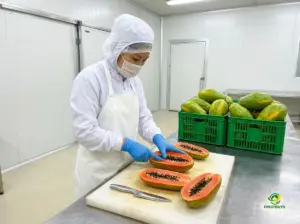
FruitBuys uses the whole incoming basis for commercial planning because it reflects the real supply chain: raw-material sourcing, sorting, preparation, freeze-drying, grading, packaging and finished-product release. That logic belongs inside Raw Material Sourcing Governance and Documentation, not only production calculation.
Why Guava Maturity Changes the Ratio
Guava maturity affects solids, water, aroma, texture, cutting behavior and saleable recovery. UC Davis lists guava quality indices including firmness, gritty texture due to stone cells, seed amount, soluble solids and acidity. These are not only fresh-market details; they influence how guava cuts, dries and performs after freeze-drying. (UC Postharvest)

Fruit that is too soft can increase handling loss and deformation. Fruit that is too firm can reduce sensory quality or create harder bite. Fruit with inconsistent maturity can produce uneven drying and more grading loss.
| Maturity Variable | Conversion Impact |
|---|---|
| Firmness | Affects cutting, shape retention and off-size pieces |
| Soluble solids | Affects solids concentration and sensory profile |
| Acidity | Affects flavor balance and application fit |
| Seed amount | Affects bite, trimming, powder behavior and recovery |
| Flesh color | Affects pink-guava visual identity and sorting |
| Defect level | Affects reject rate before drying |
This is why conversion ratio cannot be locked without raw-material policy. Buyers should review pink guava variety, maturity and seed policy before treating yield as a fixed number.
Peel Policy and Seed Policy Affect Yield
Peel and seed policy can change both the conversion ratio and the finished product identity.
Seed-on pieces, reduced-seed dices and deseeded powder should not be compared under one yield number.
Buyers should lock peel and seed decisions before requesting yield confirmation.
Guava naturally contains hard seeds. Kew’s Plants of the World Online describes guava fruit as having white or red pulp and numerous hard seeds. That botanical reality is a practical supply issue for freeze-dried guava because seed policy affects bite, yield, powder sediment, trimming and application performance. (UC Postharvest)
A seed-on wedge keeps more of the natural fruit structure, but the bite must be approved. A reduced-seed dice may improve sensory performance for yogurt or cereal, but it can reduce recovery. A deseeded powder may fit beverage or bakery applications better, but it changes process complexity, powder behavior and yield basis.
| Product Route | Yield Effect | Buyer Risk |
|---|---|---|
| Peel-on, seed-on wedges | Higher natural-fruit retention | Seed bite and visual variation |
| Peel-off pieces | More preparation loss | Lower visual fruit identity |
| Reduced-seed dices | More preparation and sorting work | Higher yield variability |
| Deseeded powder | Different processing route | Sediment, carrier and label basis must be checked |
| Molded guava bites | Formula-dependent | Binder, carrier and Aw must be declared |

Seed policy is not a small preference. It changes the real conversion. The buyer should lock this point in the RFQ before sample approval through freeze-dried guava RFQ checklist.
Format Changes Saleable Recovery
A supplier can dry guava successfully and still fail the buyer’s conversion expectation if the saleable format is not defined. The difference between dried output and approved finished product matters.
A wedge SKU may lose more saleable weight through broken tips. A stick format may fracture during handling. A dice format may generate more off-size pieces and fines. Powder may recover fines, but only if the buyer approves powder as the same product route or as a separate SKU.
| Format | Conversion Risk | Control Point |
|---|---|---|
| Round Slice | Diameter variation, seed center, breakage | Thickness and diameter tolerance |
| Triangle/Wedge | Broken tips and thickness variation | Cut size and breakage limit |
| Cube/Dice | Off-size pieces and fines | Size range and fines control |
| Stick | Fracture during sorting or packing | Length tolerance and carton protection |
| Granule | Dust and particle drift | Sieve range and fines limit |
| Powder | Mesh, caking and carrier issues | Powder specification and packaging |
| Molded Bite | Formula and binder loss | Ingredient statement and Aw control |

Buyers should decide whether off-size pieces can move into another SKU, powder route or rejected material. Without that decision, conversion claims can become unclear. For format selection, review freeze-dried guava formats and custom cut sizes. For powder, review freeze-dried guava powder specification.
Moisture and Aw Change the Finished Weight
Moisture and Aw are release controls, not just laboratory numbers. FruitBuys uses moisture 3–5% and Aw <0.30 as working targets for freeze-dried guava. A product dried to a lower final moisture can weigh less than a product released at the upper end of the moisture range. A product with uneven moisture may appear to improve yield but fail stability or texture review.
FDA defines water activity as the ratio between the vapor pressure of water in the food and the vapor pressure of distilled water under identical conditions. FDA also links Aw to food stability and microbial growth conditions. (U.S. Food and Drug Administration)
This means a buyer should not evaluate conversion ratio separately from moisture and Aw. A higher finished weight is not useful if the product fails the release condition.
| Release Factor | Buyer Question |
|---|---|
| Moisture | Does the finished product meet the agreed 3–5% range? |
| Aw | Does the product meet Aw <0.30? |
| Uniformity | Are thick pieces and center points fully dried? |
| COA | Does the lot-specific document show actual values? |
| Packaging | Does the package protect the low-moisture state? |
The deeper technical review belongs in freeze-dried guava moisture and water activity and freeze-dried guava COA and laboratory testing.
A Practical Conversion Model for Buyers
For B2B planning, FruitBuys uses this practical model:
| Stage | Example Control Logic | Buyer Meaning |
|---|---|---|
| 6–8 kg whole incoming fresh guava | Raw fruit received before full preparation | Commercial planning basis |
| Sorting and trimming | Defects, unsuitable maturity and damaged fruit removed | Raw-material governance matters |
| Peel/seed policy | Peel-on, peel-off, seed-on, reduced-seed or deseeded | Yield and product identity change |
| Cutting | Wedges, slices, cubes, sticks or custom size | Size affects drying and breakage |
| Freeze-drying | Water removed through controlled drying | Moisture and Aw must be reached |
| Grading | Off-size, broken pieces and fines separated | Saleable recovery changes |
| Packing | Retail, bulk or powder pack route | Packaging protects final condition |
| Release | COA, retained sample and specification alignment | Bulk approval depends on proof |
This model prevents a common buyer error: treating conversion as a single number instead of a controlled path. Conversion ratio is not separate from raw material, process, format, COA and packaging. It is the result of all of them.

The process stage belongs in freeze-dried guava processing controls. Packaging review belongs in freeze-dried guava packaging and shelf life.
Why Lower Conversion Claims Can Create Buyer Risk
A lower conversion ratio is not automatically better. If a supplier claims an unusually low ratio, the buyer should ask what changed.
Possible explanations include:
- Prepared-fruit basis instead of whole-fruit basis.
- Higher finished moisture.
- Less sorting loss included.
- Seed-on route versus deseeded route.
- More off-size pieces counted as accepted product.
- Powder recovery counted together with piece recovery.
- Different cultivar or maturity profile.
- Different quality threshold.
- Different packaging or breakage tolerance.
The buyer should not reject or accept a ratio without the basis. The correct procurement question is:
“Does this conversion ratio produce the exact SKU I approved?”
If the answer is not documented, the number is weak. This is especially important for private label goods, where the approved sample, Nutrition Facts, packaging, artwork and bulk product must match. That workflow belongs in OEM private label freeze-dried guava.
Conversion Ratio and Nutrition Label Risk
Conversion ratio affects how buyers think about nutrition concentration, but it does not replace laboratory testing. Because raw guava contains high water, drying concentrates fruit solids. However, final Nutrition Facts still depend on variety, peel, seed, moisture, powder carrier, binder and laboratory method.
A buyer should not calculate final Nutrition Facts only by multiplying fresh-guava data. Raw guava composition can support R&D thinking, but finished product data must come from the actual SKU.
This matters for:
- Calories
- Total carbohydrate
- Dietary fiber
- Total sugars
- Potassium
- Vitamin C
- Added sugar statement
- Fiber or vitamin claims
Final label logic belongs in freeze-dried guava Nutrition Facts. Conversion ratio can explain concentration, but it cannot prove a Nutrition Facts panel.
Conversion Ratio and Application Fit
Different applications tolerate different recovery results. A snack pouch may need large, visually intact wedges. A cereal manufacturer may accept controlled dice. A beverage developer may want powder with defined mesh and sediment behavior. A yogurt topping may need smaller pieces with controlled rehydration.
| Buyer Application | Conversion Concern |
|---|---|
| Retail snack | Higher loss from visual grading and broken pieces |
| Mixed fruit pouch | Needs format compatibility and breakage control |
| Cereal/granola | Needs size distribution and fines limits |
| Yogurt topping | Needs seed-bite and rehydration review |
| Beverage powder | Needs powder recovery, mesh and carrier status |
| Bakery | Needs powder or granule behavior after formulation |
| Molded bite | Needs formula yield and binder declaration |
Buyers should not ask for the same conversion expectation across every application. Application determines the approved format, and format determines saleable recovery. For use-case mapping, review freeze-dried guava food applications.
The Highest-Risk Mistake: Comparing Ratios Without a Specification
The highest-risk mistake is comparing conversion ratios before locking the product specification.
A 5:1 prepared-fruit ratio and an 8:1 whole-fruit ratio may both be reasonable under different assumptions.
Buyers should compare ratios only after format, peel policy, seed policy, final moisture, grading rules and saleable recovery are defined.
A conversion ratio without a specification can mislead procurement, QA and R&D at the same time. Procurement may expect a different output. QA may approve a sample that does not reflect bulk. R&D may build a formulation from a format that cannot scale. Private label teams may approve artwork before the product route is stable.
The buyer should lock:
- Whole-fruit or prepared-fruit basis
- Pink or white guava route
- Maturity direction
- Peel policy
- Seed policy
- Format
- Size tolerance
- Broken-piece limit
- Fines limit
- Moisture target
- Aw target
- COA scope
- Packaging route
- Retained sample
- Change-control triggers
This control bridge belongs in sample-to-bulk consistency and freeze-dried guava supplier qualification.
Application Mapping
| Buyer Type | Application | Required Format | Proof Needed | FruitBuys Delivery |
|---|---|---|---|---|
| Importer | Bulk freeze-dried guava sourcing | Wedge, slice, dice, granule or powder | Conversion basis, specification, COA, retained sample | Raw Material Sourcing Governance, Documentation |
| QA manager | Yield and release review | Any approved format | Moisture, Aw, actual lot result and grading rule | Quality Control, Documentation |
| Procurement manager | Supplier comparison | Same basis across suppliers | Whole-fruit vs prepared-fruit basis and saleable recovery | Documentation, Raw Material Sourcing Governance |
| R&D developer | Application trial | Powder, dice, granule or wedge | Format-specific sample and recovery explanation | MOQ Flexibility/Market Trial Support |
| Private label brand | Retail pouch SKU | Wedge, bite, slice or molded bite | Sample-to-bulk consistency, pack file and label basis | OEM/Private Label Delivery |
| Beverage developer | Guava powder | Fine or custom mesh powder | Powder yield, mesh, carrier, caking and sediment review | Quality Control, Documentation |
| Compliance manager | Market file review | Market-specific SKU | Ingredient statement, HS direction and label consistency | Documentation, Export Logistics Coordination |
Why FruitBuys Delivers This
FruitBuys supplies freeze-dried guava through an Integrated Product Supply Model that connects raw-material sourcing, production partners, QC, packaging, documentation and export logistics coordination under one accountable product relationship.
Under Raw Material Sourcing Governance, FruitBuys defines the guava route, maturity, peel policy and seed policy before yield is discussed. Under Quality Control, FruitBuys connects conversion to format, moisture, Aw, grading, breakage and retained sample. Under Documentation, FruitBuys records the conversion basis, product specification, COA scope and lot identity so buyers do not compare unsupported numbers.
For development buyers, MOQ Flexibility/Market Trial Support allows trial routes before wider approval. Under OEM/Private Label Delivery, FruitBuys aligns conversion with the final SKU, packaging, Nutrition Facts input and sample-to-bulk release. FruitBuys supplies the finished freeze-dried guava product file, not a loose yield estimate.
Buyer Checklist
Confirm these items before using any conversion number:
- Is the ratio based on whole incoming fruit?
- Is the ratio based on prepared edible fruit?
- Is sorting loss included?
- Is trimming loss included?
- Is peel-on or peel-off route defined?
- Is seed-on, reduced-seed or deseeded route defined?
- Is the format locked?
- Are broken pieces and fines counted?
- Is powder recovery counted separately?
- Is the final moisture target stated?
- Is Aw target stated?
- Is saleable recovery defined?
- Is the sample retained?
- Does the COA match the product route?
- Does the packaging protect the final low-moisture state?
- Does the ratio support the intended application?
- Is the final request aligned through freeze-dried guava RFQ checklist?
Do not approve a conversion ratio alone. Approve the specification behind the ratio.
Summary
FruitBuys uses 6–8 kg of whole incoming fresh guava to produce 1 kg of finished freeze-dried guava as the working commercial conversion range. Prepared edible guava may show a lower ratio, depending on trimming, peel policy, seed policy, format, final moisture and saleable recovery.
Guava is high in water, so weight reduction mainly reflects water removal and processing loss. Buyers should define whole-fruit basis, format, seed policy, moisture, Aw, COA, packaging and sample-to-bulk controls before comparing supplier ratios.
FAQ
How many kg of fresh guava make 1 kg of freeze-dried guava?
FruitBuys uses 6–8 kg whole incoming fresh guava → 1 kg finished freeze-dried guava as the working commercial range. The final number depends on fruit route, preparation, format and moisture endpoint.
Why do some suppliers quote a lower conversion ratio?
They may be using prepared edible fruit basis instead of whole incoming fruit basis. They may also count off-size pieces, powder recovery or higher final moisture differently.
Does seed removal change the conversion ratio?
Yes. Reduced-seed or deseeded routes can increase preparation loss and change recovery. Seed policy should be locked before yield is compared.
Does powder have the same conversion ratio as slices?
Not always. Powder may recover fines or follow a different processing route. Pure powder, carrier-supported powder and molded bites need separate yield review.
Does lower moisture reduce finished weight?
Yes. Lower final moisture can reduce finished product weight. Buyers should compare ratios only when moisture and Aw targets are defined.
Can conversion ratio prove Nutrition Facts?
No. Conversion can explain concentration logic, but final Nutrition Facts require testing of the actual finished SKU.
What should buyers send before asking for yield confirmation?
Send guava route, peel policy, seed policy, format, target application, moisture/Aw target, grading rule, packaging route and required COA scope.
Conclusion
Submit the target format, peel policy, seed policy, application and required yield basis so FruitBuys can prepare the correct freeze-dried guava sample and conversion explanation.
References
- MyFoodData, citing USDA FoodData Central Standard Release. Nutrition Facts for Guavas, Common, Raw. Accessed August 2026. (My Food Data)
- Utah State University Extension. Freeze Drying. Accessed August 2026. (Utah State University Extension)
- University of California, Davis Postharvest Research and Extension Center. Guava Produce Fact Sheet. Accessed August 2026. (UC Postharvest)
- U.S. Food and Drug Administration. Water Activity (aw) in Foods. Accessed August 2026. (U.S. Food and Drug Administration)