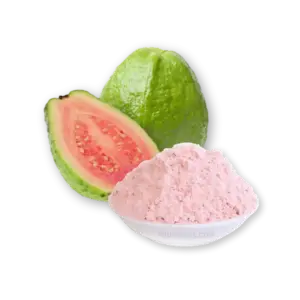

Freeze-Dried Guava
A freeze-dried guava supplier in Vietnam should not be judged by sample appearance alone. A pink guava wedge can look crisp and attractive, while the buyer still lacks a locked seed policy, format tolerance, moisture/Aw release file, COA, packaging structure, Nutrition Facts basis and destination-market document route. Powder creates another risk because mesh, carrier status, sediment, caking and label identity must be controlled separately from pieces.

The real supplier decision is whether one finished SKU can move from approved sample to documented bulk release without losing identity, texture, label readiness or shipment control. This guide is for importers, distributors, QA managers, R&D developers and private label buyers evaluating FruitBuys Vietnam for export-ready freeze-dried guava supply.
Start With the Product File, Not the Supplier Name
A freeze-dried guava supplier should be qualified through the exact SKU, not a broad product name.
Buyers should lock guava route, format, seed policy, moisture, Aw, COA, packaging, label basis and destination-market route before bulk release.
FruitBuys supplies one configured product under one accountable supplier relationship.
“Freeze-dried guava” can mean several different products. It can mean pink guava wedges for a retail snack pouch, dices for cereal, granules for toppings, pure guava powder for beverage development, carrier-supported powder for a dry mix, or molded guava bites for an OEM concept. Each product needs a different approval file.

A buyer should begin with one clean product identity:
| Decision | What Must Be Locked |
|---|---|
| Guava route | Pink, white or buyer-approved route |
| Maturity direction | Cutting, aroma, texture and drying suitability |
| Peel policy | Appearance, texture, residue review and label basis |
| Seed policy | Seed-on, reduced-seed or deseeded |
| Format | Slice, wedge, cube, stick, bite, granule, powder or molded bite |
| Application | Snack, cereal, yogurt, beverage, bakery, chocolate or private label |
| Proof | Moisture, Aw, COA, lab report and retained sample |
| Packaging | Retail pouch, bulk inner bag, carton and storage route |
| Market | USA, EU, UAE/GCC or buyer-defined destination |
FruitBuys supplies the finished freeze-dried guava product through an Integrated Product Supply Model. The buyer does not need separate conversations for raw fruit, drying, packing, laboratory files and shipment documents. The buyer needs one approved SKU and one accountable supply path.
Raw-Material Governance Controls Guava Identity
Guava route matters before processing starts. Pink guava and white guava do not create the same visual identity. Mature fruit, seed load, peel policy and defect sorting affect cut quality, drying behavior, seed bite, powder sediment and application fit. UC Davis lists guava quality indices such as firmness, gritty texture from stone cells, aroma intensity, seed amount, soluble solids, acidity and flesh color. These raw-fruit variables matter because they shape the finished freeze-dried product’s bite, color and sensory profile. (UC Postharvest Center)
For FruitBuys freeze-dried guava, the buyer should define:
| Raw-Material Field | Buyer Risk if Unclear |
|---|---|
| Pink or white guava | Color and product-name mismatch |
| Maturity direction | Soft, weak, uneven or inconsistent pieces |
| Peel-on or peel-off route | Texture, fiber basis and residue-review mismatch |
| Seed-on route | Hard seed bite in snack or yogurt |
| Reduced-seed route | Yield and texture expectation changes |
| Deseeded pulp route | Powder and beverage behavior changes |
| Defect sorting | Color, aroma and sensory drift |
The deeper raw-material decision belongs in pink guava variety, maturity and seed policy. FruitBuys handles this through Raw Material Sourcing Governance, where raw guava suitability is aligned with the intended format and buyer application.
Conversion Ratio Helps Planning, Not Product Release
FruitBuys uses 6–8 kg whole incoming fresh guava → 1 kg finished freeze-dried guava as the working commercial conversion range. This helps the buyer understand raw-material planning, trim loss, moisture removal and finished-product recovery. It does not release the SKU by itself.

A buyer should separate four bases:
| Basis | What It Means |
|---|---|
| Whole incoming fruit | Fruit before trim, peel decision, seed decision and sorting |
| Prepared edible fruit | Material after buyer-approved preparation route |
| Dryer output | Product leaving drying before final sorting and grading |
| Finished saleable product | Product after sorting, packing, COA and release review |
A lower conversion ratio is not automatically better. It may reflect a different fruit basis, moisture endpoint, seed route, trimming level, format, saleable recovery or reporting method. Compare only the same basis. The full conversion explanation belongs in freeze-dried guava conversion ratio. FruitBuys uses conversion as a planning input, while release control depends on product specification, retained sample, COA and packaging.
Processing Controls Must Protect Sample-to-Bulk Consistency
Freeze-drying removes water from frozen food under vacuum by turning ice into vapor through sublimation. Utah State University Extension explains that primary drying in freeze-drying involves sublimation, where ice changes directly into vapor under vacuum (Utah State University Extension).

For B2B buyers, the process principle is only the start. The supplier must also control intake, washing, trimming, cutting, seed-policy execution, pre-freezing, freeze-drying, post-drying handling, sorting, grading, packing and lot release.
A controlled process file should answer:
| Process Stage | Buyer Control Point |
|---|---|
| Intake | Guava route, maturity and defect sorting |
| Preparation | Peel and seed policy |
| Cutting | Format, thickness, dimension and tolerance |
| Freezing/drying | Moisture and Aw endpoint |
| Sorting | Broken-piece and fines limits |
| Powder route | Grinding, mesh, carrier and caking control |
| Packing | Inner bag, pouch, carton and seal route |
| Release | COA, retained sample, lot code and document handover |
The deeper process route belongs in freeze-dried guava processing controls. FruitBuys uses Quality Control and Documentation to connect the process route with the same approved sample and bulk release file.
Moisture and Aw Are Core Release Gates
Moisture and Aw are separate controls.
FruitBuys uses moisture 3–5% and Aw <0.30 as working targets for freeze-dried guava.
Buyers should request actual SKU and lot evidence before approving bulk release.
Moisture measures total remaining water. Aw measures water availability under equilibrium conditions. FDA defines water activity as the ratio of water vapor pressure in the food to the vapor pressure of distilled water under the same conditions, and FDA connects Aw to food stability and microbial growth conditions (U.S. Food and Drug Administration). This distinction matters for freeze-dried guava.

A wedge may feel crisp while the center retains more moisture than expected. A powder may pass an early sample test and later cake if exposed to humidity during grinding, packing or opening. A product may meet moisture target but still require microbiology and sanitation review. For the technical details, use freeze-dried guava moisture and water activity. For release documents, use freeze-dried guava COA and laboratory testing.
Format Selection Decides the Product Path
The format should follow the application. A retail snack pouch, cereal blend, yogurt topping, chocolate inclusion, bakery formula and beverage powder do not need the same freeze-dried guava format.
FruitBuys can supply:
| Format | Better Fit | Main Approval Risk |
|---|---|---|
| Round Slice | Visual retail pouch, garnish | Edge breakage and seed-center control |
| Triangle/Wedge | Snack pouch, mixed fruit pack | Broken tips, seed bite and thickness variation |
| Cube/Dice | Cereal, granola, yogurt topping | Size tolerance and fines |
| Stick | Retail snack differentiation | Fracture and pack movement |
| Bites/Chunks | Snack, topping, mixed fruit | Irregular size and bite consistency |
| Granules | Bakery, cereal, chocolate, toppings | Dust, segregation and moisture pickup |
| Powder | Beverage, bakery, dairy, dry mix | Mesh, carrier, caking and sediment |
| Molded/Compressed Bites | OEM snack concept | Binder, formula, Aw and label basis |
Format decisions belong in freeze-dried guava formats and custom cut sizes. Application decisions belong in freeze-dried guava food applications.

Powder Requires Its Own Specification
Freeze-dried guava powder is not simply broken guava pieces. It needs a separate specification because powder changes moisture exposure, flowability, caking, mouthfeel, beverage sediment, ingredient declaration and Nutrition Facts basis.
A powder file should define:
| Powder Field | Buyer Decision |
|---|---|
| Powder route | Pure fruit powder, reduced-seed powder, deseeded powder or carrier-supported powder |
| Mesh/particle range | Application-specific target |
| Seed-particle tolerance | Beverage sediment, grit and mouthfeel |
| Carrier status | Ingredient statement and Nutrition Facts basis |
| Caking limit | Storage and open-pack usability |
| Dispersibility | Beverage, dairy or dry-mix fit |
| Packaging | Seal, pack size and moisture protection |
| COA | Powder-specific result, not piece-format data |
Utah State University Extension notes that freeze-dried foods exposed to moisture or humidity through damaged packaging or improper storage can see water activity rise again (Utah State University Extension). Powder buyers should treat that as a caking and flowability risk. Powder specification belongs in freeze-dried guava powder specification. Do not approve guava powder from a wedge sample, a general product photo or a piece-format COA.
Packaging and Shelf Life Must Match the Final Pack
Packaging is part of the product specification. A small sample pouch does not prove a 1kg retail pouch, a 5kg bulk inner bag or a powder pack. Freeze-dried guava needs packaging that protects the low-moisture state, product texture, powder flowability, aroma, lot identity and arrival condition. FruitBuys can support retail routes such as 50g/100g/500g/1kg high-barrier zipper pouches or custom route, and bulk routes such as 1–5kg high-barrier inner bags in 5-ply export cartons or custom route, subject to final product and packaging validation.
A packaging file should define:
| Packaging Field | Buyer Control |
|---|---|
| Pack type | Retail pouch, bulk inner bag or custom |
| Pack size | Consumer-use or production-use exposure |
| Seal method | Moisture-ingress control |
| Storage statement | Shelf-life support |
| Retained sample pack | Complaint and comparison basis |
| Breakage limit | Pieces, wedges, slices and sticks |
| Caking limit | Powder and fine granules |
| Carton file | Shipment protection and lot identity |
Shelf-life should not be approved as a standalone number. It must connect to product format, moisture, Aw, package structure, seal integrity, storage condition and validation evidence. Packaging review belongs in freeze-dried guava packaging and shelf life. Container planning belongs in freeze-dried guava container loading plan.
COA, Laboratory Testing and Documentation Control
A COA is useful only when it matches the exact product, lot, method, result and release specification. A COA for powder cannot automatically release wedges. A sample report cannot automatically release bulk. A certificate logo cannot replace test scope, product identity or lot evidence.
A freeze-dried guava COA file should include:
| COA Field | Buyer Review |
|---|---|
| Product name | Matches the supplied SKU |
| Format | Piece, powder, granule or molded bite |
| Lot code | Matches carton marks and packing list |
| Sample date | Shows sampling basis |
| Test date | Shows laboratory timing |
| Method | Supports QA review where required |
| Actual result | Numeric or clear detected/not-detected result |
| Specification limit | Defines release basis |
| Laboratory identity | Supports report review |
| Retained sample | Supports physical comparison |
The buyer should also define microbiology, pesticide residues, heavy metals or contaminants where required by market, application or internal QA policy. Low Aw does not replace microbiological review. The full testing route belongs in freeze-dried guava COA and laboratory testing. Supplier-level review belongs in freeze-dried guava supplier qualification.
Nutrition Facts and Private Label Readiness
Private label freeze-dried guava should not move to artwork before the product file is locked. A label may look ready while the buyer still needs to confirm serving size, ingredient statement, added sugar status, powder carrier, Nutrition Facts basis, vitamin C claim support, pack size and market route.

For U.S. labels, FDA guidance describes serving size as based on the amount of food people customarily consume, not a recommendation of how much to eat (U.S. Food and Drug Administration). For EU prepacked food, the European Commission states that the vast majority of prepacked foods must bear a nutrition declaration under Regulation (EU) No 1169/2011 (Food Safety).
Private label buyers should define:
| Label Field | Risk if Unclear |
|---|---|
| Product name | Does not match format or ingredient route |
| Ingredient statement | Carrier or binder omitted |
| Serving size | Wrong Nutrition Facts logic |
| Nutrition values | Sample panel copied into final artwork |
| Vitamin C or fiber claim | Claim printed without SKU-specific proof |
| Added sugar status | Formula and label line mismatch |
| Market language | Label not ready for destination |
| Artwork version | Old data printed on final pack |
Nutrition review belongs in freeze-dried guava Nutrition Facts. Private label delivery belongs in OEM private label freeze-dried guava.
HS Code and Import Compliance Direction
Destination-market review should start before bulk release. Freeze-dried guava pieces, pure guava powder and formulated products can require different classification and documentation review. UNSD lists HS 0804.50 for edible guavas, mangoes and mangosteens, fresh or dried, which supports using 0804.50 as the working direction for freeze-dried guava pieces (UNSD). UNSD lists HS 1106.30 for flour, meal and powder of products of Chapter 8, which supports using 1106.30 as the working direction for pure guava powder (UNSD).

Final national classification must be confirmed by the importer or local declarant against the exact SKU and destination nomenclature. Carrier-supported powder, molded bites or mixed products need separate review. For USA-bound food, FDA states that imported human foods must be safe, produced under sanitary conditions and contain informative and truthful labeling in English. FDA also discusses Prior Notice in the import process (U.S. Food and Drug Administration).
FDA FSVP guidance states that importers must establish and follow a Foreign Supplier Verification Program to help ensure imported food meets applicable U.S. requirements and is not adulterated or, for human food, misbranded with respect to allergen labeling (U.S. Food and Drug Administration). HS and market-readiness review belongs in freeze-dried guava HS code and import compliance.
Sample-to-Bulk Consistency Is the Main Supplier Test
The highest-risk mistake is approving a supplier from a sample while leaving the SKU unqualified.
A sample does not prove bulk consistency unless it is tied to specification, retained sample, COA, packaging file and change-control triggers.
Buyers should approve the product file before approving bulk release.
Sample-to-bulk drift appears when the buyer approves one condition and receives another. The color shifts. Seed bite changes. Cut size becomes inconsistent. Powder cakes. Fines increase. Moisture and Aw values do not match the approved file. The label route changes after packaging is printed. The COA does not match the lot.
Re-approval should be required when any of these change:
| Change Trigger | Review That Must Reopen |
|---|---|
| Pink to white guava | Color, sensory and label route |
| Peel policy | Texture, residue review and Nutrition Facts basis |
| Seed policy | Bite, sediment, powder and application fit |
| Format | Size, breakage, packaging and COA |
| Powder mesh | Caking, sediment and beverage behavior |
| Carrier or binder | Ingredient statement and Nutrition Facts |
| Packaging | Shelf life, moisture pickup and arrival condition |
| Destination market | Label, documents and testing panel |
| COA scope | QA release and buyer acceptance |
The deeper release-control guide is sample-to-bulk consistency. Buyers should also prepare requests through freeze-dried guava RFQ checklist.
Application Mapping
| Buyer Type | Application | Required Format | Proof Needed | FruitBuys Delivery |
|---|---|---|---|---|
| Importer | Bulk freeze-dried guava sourcing | Wedge, slice, dice, granule or powder | Product specification, COA, laboratory reports, packaging and market file | Documentation, Quality Control |
| Distributor | Multi-channel dried fruit inventory | Pieces, powder and retail packs | SKU-level specification, lot code, carton marks and retained sample | Export Logistics Coordination, Documentation |
| QA manager | Supplier and lot approval | Any approved format | Moisture, Aw, COA, method, retained sample and change-control rule | Quality Control, Documentation |
| R&D developer | Food application testing | Powder, dice, granule, wedge or bite | Application trial, seed policy, size or mesh and sensory criteria | MOQ Flexibility/Market Trial Support |
| Private label brand | Retail pouch SKU | Wedge, bite, powder or molded bite | Pack size, artwork input, Nutrition Facts basis, COA and shelf-life file | OEM/Private Label Delivery |
| Beverage developer | Guava drink powder | Fine or custom mesh powder | Mesh, carrier status, sediment, caking, packaging and powder COA | Quality Control, Documentation |
| Cereal manufacturer | Dry fruit inclusion | Cube, dice or granule | Size tolerance, fines limit, moisture/Aw and blend trial | Quality Control, Documentation |
| Compliance manager | Destination-market review | Market-specific SKU | HS direction, ingredient statement, label route, COA and certificate scope where required | Documentation, Export Logistics Coordination |
| Logistics manager | Container planning | Bulk or retail cartons | Carton plan, loading method, lot separation, VGM and arrival inspection | Export Logistics Coordination |
Why FruitBuys Delivers This
FruitBuys supplies freeze-dried guava through an Integrated Product Supply Model connecting raw-material governance, qualified production partners, QC, packaging, documentation and export logistics coordination under one accountable supplier relationship. Under Raw Material Sourcing Governance, FruitBuys aligns guava route, maturity, peel policy, seed policy and raw-material suitability with the intended SKU.
Under Quality Control, FruitBuys verifies format, size tolerance, moisture, Aw, breakage, fines, powder behavior, retained sample and release criteria. Under Documentation, FruitBuys connects specification, COA, laboratory reports, ingredient statement, certificate scope, packaging file, lot identity and market-readiness documents. Under MOQ Flexibility/Market Trial Support, FruitBuys can structure sample routes for buyers comparing formats, applications or powder behavior before broader approval.
Under OEM/Private Label Delivery, FruitBuys aligns pack size, artwork inputs, Nutrition Facts basis, label information and release file. Under Export Logistics Coordination, FruitBuys connects carton marks, packing list, container loading plan and document handover with the released goods. FruitBuys supplies one export-ready freeze-dried guava product file, not a disconnected sample, pouch and document folder.
Buyer Checklist
Confirm these points before sample approval, private label artwork or bulk release:
- Target application
- Product name
- Pink or white guava route
- Maturity direction
- Peel policy
- Seed-on, reduced-seed or deseeded route
- Format: slice, wedge, cube, stick, bite, granule, powder or molded bite
- Target size, thickness or mesh
- Broken-piece limit
- Fines limit
- Powder carrier status where applicable
- Binder status for molded bites where applicable
- Fruit-only or formulated route
- Moisture target
- Aw target
- COA scope
- Microbiology panel
- Pesticide panel where required
- Heavy-metal or contaminant panel where required
- Packaging structure
- Retail pack size
- Bulk inner-bag route
- Shelf-life basis
- Storage instruction
- Nutrition Facts basis where required
- Ingredient statement
- Claim direction
- Destination market
- Working HS direction
- Import document route
- Carton size and loading method
- Retained sample
- Change-control triggers
- Supplier qualification route through freeze-dried guava supplier qualification
- Final brief alignment through freeze-dried guava RFQ checklist
Do not approve the supplier name alone. Approve the exact SKU, proof file, packaging route and bulk-release criteria.
Summary
FruitBuys is a freeze-dried guava supplier in Vietnam for B2B buyers requiring controlled product specification, sample-to-bulk consistency, QC, packaging, documentation and export logistics coordination. Freeze-dried guava formats include slices, wedges, cubes, sticks, bites, granules, powder and molded bites.
Working inputs include 6–8 kg whole incoming fresh guava for 1 kg finished freeze-dried guava, moisture 3–5% and Aw <0.30. Buyers should verify guava route, seed policy, COA, packaging, Nutrition Facts, HS direction and destination-market documents before bulk release.
FAQ
What should buyers check first when choosing a freeze-dried guava supplier in Vietnam?
Start with the exact SKU: guava route, format, seed policy, ingredient route, application, packaging, COA scope and destination market.
What is the working conversion ratio for freeze-dried guava?
FruitBuys uses 6–8 kg whole incoming fresh guava to produce 1 kg finished freeze-dried guava as a working commercial planning range.
What moisture and Aw targets does FruitBuys use?
FruitBuys uses moisture 3–5% and Aw <0.30 as working targets. Buyers should request actual lot evidence for release approval.
Which freeze-dried guava formats are available?
Formats include Round Slice, Triangle/Wedge, Cube/Dice, Stick, Bites/Chunks, Granules, Powder, Molded/Compressed Guava Bites and custom sizes.
Does guava powder need separate approval?
Yes. Powder needs mesh, seed-particle tolerance, carrier status, caking review, packaging, Nutrition Facts basis and powder-specific COA.
Can FruitBuys support private label freeze-dried guava?
Yes. FruitBuys aligns product format, pack size, artwork inputs, label information, COA, packaging and release criteria under OEM/private label delivery.
What should buyers send before requesting samples?
Send target application, format, seed policy, powder requirements if any, packaging route, COA scope, destination market and sample approval criteria.
Conclusion
Submit the product brief after locking target application, format, seed policy, packaging route, COA scope and destination-market requirements.
References
- University of California, Davis Postharvest Research and Extension Center. Guava Produce Fact Sheet. Guava quality indices and postharvest factors. (UC Postharvest Center)
- Utah State University Extension. Can I Freeze-Dry That? A Practical Guide to Safe and Effective Freeze-Drying. Freeze-drying process and moisture reabsorption guidance. (Utah State University Extension)
- U.S. Food and Drug Administration. Water Activity (aw) in Foods. FDA Inspection Technical Guide. (U.S. Food and Drug Administration)
- U.S. Food and Drug Administration. Importing Human Foods. FDA import process context for human foods. (U.S. Food and Drug Administration)
- U.S. Food and Drug Administration. Guidance for Industry: Foreign Supplier Verification Programs for Importers of Food for Humans and Animals. (U.S. Food and Drug Administration)
- United Nations Statistics Division. HS 080450 — Fruit, edible; guavas, mangoes and mangosteens, fresh or dried. (UNSD)
- United Nations Statistics Division. HS 110630 — Flour, meal and powder; of the products of Chapter 8. (UNSD)
- European Commission. Nutrition labelling – Food Safety. EU nutrition declaration information for prepacked foods. (Food Safety)