
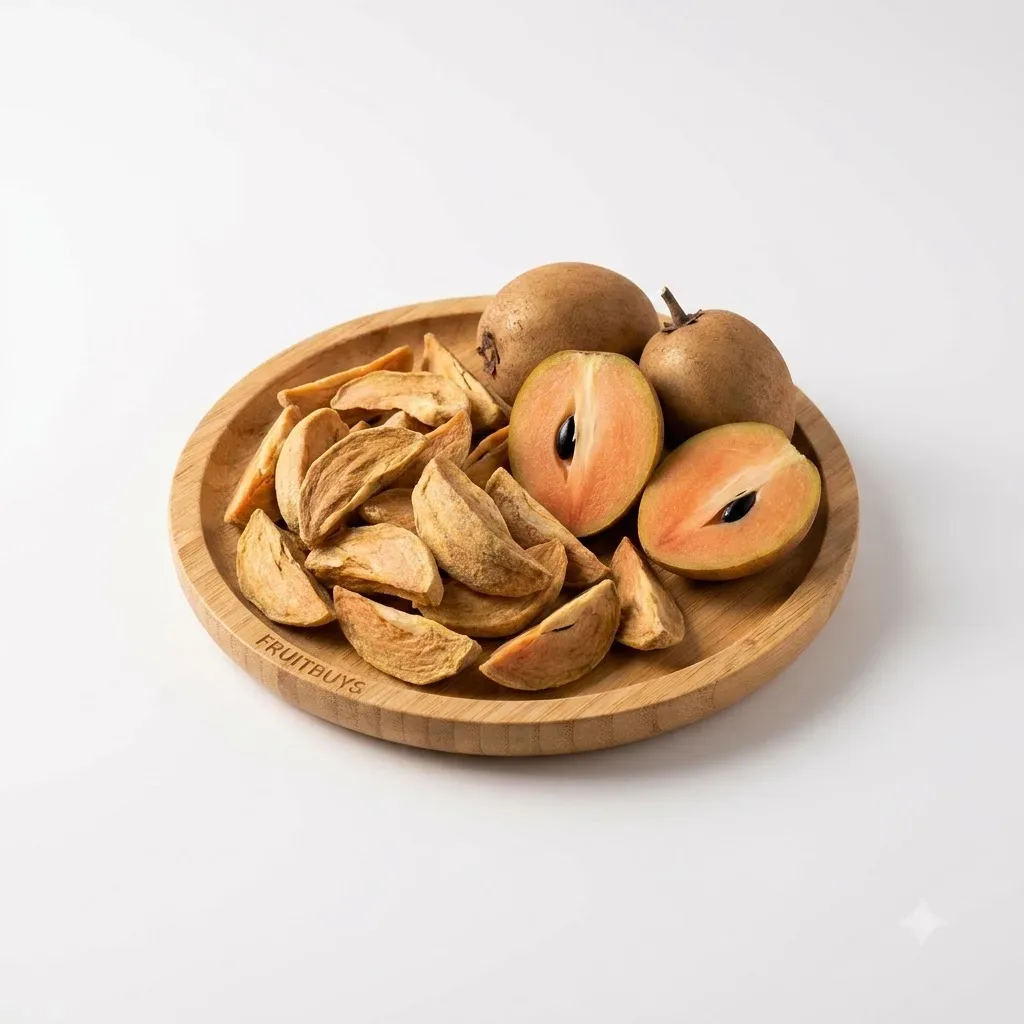
What nutrition numbers can you put on a freeze-dried sapodilla label?
Three numbers do the selling: 23 g of dietary fibre, 850 mg of potassium and 0 g of added sugar per 100 g. On a European pack, those values support “high fibre”, “high in potassium” and “no added sugars”; in the US, the fibre supports an “excellent source of fiber” claim per serving, so fibre leads the US pack. The table below gives typical values you can design with today. For the printed label, FruitBuys runs a nutrition panel on your commercial lot, so the numbers on the shelf come from the product in the bag.
What are the numbers per 100 g and per 25 g?
Typical values for 100% freeze-dried sapodilla. Natural variation by origin, season and ripeness applies.
| Nutrient | Per 100 g | % Daily Value* | Per 25 g serving |
|---|---|---|---|
| Calories | 370 kcal | 90 kcal | |
| Total fat | 5 g | 6% | 1 g |
| Saturated fat | 1 g | 4% | 0 g |
| Trans fat | 0 g | 0 g | |
| Cholesterol | 0 mg | 0% | 0 mg |
| Sodium | 55 mg | 2% | 15 mg |
| Potassium | 850 mg | 18% | 210 mg |
| Total carbohydrate | 88 g | 32% | 22 g |
| Dietary fibre | 23 g | 84% | 6 g |
| Total sugars | 60 g, all naturally occurring | 15 g | |
| Added sugars | 0 g | 0% | 0 g |
| Protein | 2 g | 4% | <1 g |
*Percent Daily Values based on a 2,000 calorie diet.
What this means for your product: a 25 g snack pouch delivers about 6 g of fibre, roughly a fifth of an adult’s daily value, with the sweetness of a dessert and an ingredient list of one word. That is the combination a shopper reads on the back of the pack before buying.
Why are sugars high when none are added?
Because freeze-drying concentrates the fruit and adds nothing to it. Ripe sapodilla flesh is about 78% water. Remove that water and the fruit’s own sugars, fibre and minerals sit in a fraction of the weight, so 100 g of freeze-dried sapodilla carries the solids of about 4.4 kg of prepared fruit. The 60 g of total sugars are the fruit’s own, the same sugars that give it the caramel and malt taste; the added-sugar line stays at 0 g.
Two consequences for your label:
- Declare total sugars honestly and put the story next to them: “sweetened only by fruit” is the reason the product exists.
- If you blend freeze-dried sapodilla into a cereal or bar, its sugars count as total sugars in your finished product, but not as added sugars, because the fruit is a fruit ingredient and nothing was added to it.
Which label and marketing claims do the numbers support?
The thresholds below are the ones your regulatory team will check. Read them against the values of your own finished product, and against the panel on your lot before printing.
| Claim | Where | Threshold | Freeze-dried sapodilla |
|---|---|---|---|
| High fibre | EU, UK | ≥6 g per 100 g | 23 g: qualifies |
| Source of fibre | EU, UK | ≥3 g per 100 g | qualifies |
| High in potassium | EU, UK | ≥30% of NRV (600 mg) per 100 g | 850 mg: qualifies |
| Source of potassium | EU, UK | ≥15% of NRV (300 mg) per 100 g | qualifies |
| No added sugars | EU, UK | No mono- or disaccharides or other sweetening foods added; label adds “contains naturally occurring sugars” | qualifies, with the statement |
| Excellent source of fiber | US | ≥20% DV per reference amount (40 g for dried fruit) | 9 g, 33% DV per 40 g: qualifies |
| Good source of potassium | US | 10–19% DV per 40 g | 340 mg, 7% DV per 40 g: does not qualify |
| No sugar added | US | No sugars added; the food it replaces normally contains added sugars; “not a low calorie food” statement unless it is low calorie | no sugars added; the comparator test depends on your product category |
Two notes your marketing team will thank you for. In the US the potassium claim works on a 100 g basis but not per reference amount, so lead US packs with fibre and the no-added-sugar story, and keep potassium for EU and UK packs. Freeze-dried sapodilla is a fibre-and-fruit story, and that is the story the pack should tell.
Beyond the numbers, the pack can carry what the fruit is: 100% sapodilla, freeze-dried, nothing added, with natural fruit polyphenols, no preservatives and no colourings. For shoppers who grew up with chikoo or naseberry, the name of the fruit on the front of the pack does more than any claim.
Typical values or a lot panel: which do you print?
Use typical values to design; print from a lot panel. Typical values are what your R&D team needs to formulate, cost and draft artwork without waiting for a shipment. For the final label, FruitBuys runs a nutrition panel on your commercial lot at an independent ISO/IEC 17025 accredited third-party laboratory, laid out in US Nutrition Facts or EU nutrition declaration format, and including fibre and potassium so the claims above rest on measured numbers.
The two formats differ in ways that change the printed figures:
| Point | US Nutrition Facts | EU / UK nutrition declaration |
|---|---|---|
| Basis | Per serving and, optionally, per 100 g | Per 100 g mandatory; per portion optional |
| Energy | kcal | kJ and kcal; fibre counted at 2 kcal/g, so the EU energy figure sits a little below the US one |
| Fibre | Mandatory | Optional, but required once you make a fibre claim |
| Added sugars | Mandatory line | Not a separate line; use the “no added sugars” claim |
| Potassium | Mandatory | Only when you make a potassium claim |
Order the panel once the contract is signed and the first commercial lot is packed, and plan the result into your artwork timeline. FruitBuys’ retail pouch printing runs 7–10 working days on digital print and 15–20 on rotogravure, so the panel and the print slot can run together.
How do you convert to your pack size?
Scale every value by the same ratio: value per 100 g × pack weight ÷ 100.
| Pack size | Calories | Fibre | Potassium | Total sugars |
|---|---|---|---|---|
| 20 g | 75 kcal | 4.6 g | 170 mg | 12 g |
| 25 g | 90 kcal | 6 g | 210 mg | 15 g |
| 30 g | 110 kcal | 7 g | 255 mg | 18 g |
| 50 g | 185 kcal | 11.5 g | 425 mg | 30 g |
Then run three checks before artwork goes to print:
- Rounding. Apply your market’s rounding rules to each line after scaling, not before. US labels round calories to the nearest 5 or 10; EU labels round to set decimal places.
- Claims on the right basis. EU claims are read per 100 g; US claims per reference amount. A claim that passes on one basis can fail on the other, as potassium does.
- Blends. In a cereal, bar or trail mix, the claim belongs to your finished product. At 10% sapodilla in a trail mix, the fruit contributes 2.3 g of fibre per 100 g of mix; the rest of the recipe decides whether the finished product qualifies.
Formulation doses and cut choices are set out in how to use freeze-dried sapodilla in cereal, chocolate and snack products, and the full specification is on the freeze-dried sapodilla product page.
Get label-ready numbers for your pack
Send your pack sizes and target markets. FruitBuys returns the specification, the typical nutrition table in your label format and the panel plan for your first commercial lot, so your artwork and claims are ready when the container is.
The full supplier checklist is in what to check before buying freeze-dried sapodilla in bulk.
FAQ
How many calories are in freeze-dried sapodilla?
About 370 kcal per 100 g, or 90 kcal in a 25 g serving. Removing the water concentrates the fruit’s own energy.
How much fibre does it contain?
23 g per 100 g, about 6 g in a 25 g serving. That supports “high fibre” in the EU and UK and “excellent source of fiber” in the US.
Is there added sugar?
No. All 60 g of sugars per 100 g are the fruit’s own. Added sugars are 0 g.
Can I claim “high in potassium”?
In the EU and UK, yes: 850 mg per 100 g is well above the 600 mg threshold. In the US, potassium per 40 g serving falls below the “good source” level, so lead with fibre.
Are these values measured or typical?
They are typical values for 100% freeze-dried sapodilla, for formulation and artwork. FruitBuys runs a nutrition panel on your commercial lot for the printed label.
Does it contain any allergens?
Sapodilla is not one of the 14 EU or 9 US major allergens. The product is 100% fruit.
Does freeze-dried sapodilla contain preservatives or colourings?
No. Low water activity keeps it shelf-stable, and the colour is the fruit’s own.
About the author
Udo Nguyen is CEO at FruitBuys Vietnam. He coordinates sapodilla sourcing with partner orchards in the Mekong Delta, freeze-drying and milling at qualified partner facilities, and the specifications, loading plans and export documents that importers and food brands use to set their landed cost.



