
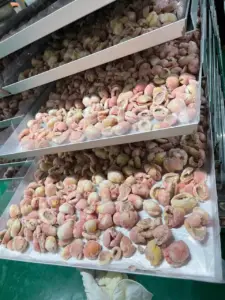
What should you check before buying freeze-dried rambutan in bulk?
Check five things before you pay for a sample: a specification built on water activity ≤0.30, a document set that clears your market, a realistic container load, a written sample-to-bulk process, and a lead time that matches the Vietnamese crop. A supplier who answers all five with numbers is worth sampling. One who answers with adjectives is not.
Few suppliers make freeze-dried rambutan well, and the reason is the fruit. Every aril is peeled and seeded by hand, the flesh carries about 81 g of natural sugar per 100 g once dried, and the main crop arrives in the wettest months of the Vietnamese year. Each of those facts shows up in your warehouse if the supplier gets it wrong. The checklist below is built around them.
Why now. Two 2026 signals point the same way. In the US, lychee sales volume grew 33% year on year (Circana data reported in May 2026), and a 2026 flavour trend report lists lychee among the top emerging flavours; rambutan gives R&D teams that floral, lychee-like note while it is still new on Western shelves. In Vietnam, the 2026 main crop was heavy and farm-gate prices fell through July, while off-season fruit in November traded at roughly three times main-crop levels. A programme contracted before May runs on the sweet, plentiful fruit; spot buying in winter pays the off-season premium.
What does a realistic specification look like?
A workable spec for freeze-dried rambutan reads like this:
| Line | Contract limit | Why it matters to you |
|---|---|---|
| Ingredient | 100% Rambutan | One-word ingredient line, no added sugar, no sulfites |
| Water activity | ≤0.30 | Above it, the sugar softens and pieces fuse into a block |
| Moisture | ≤5.0% | Above it, the core turns chewy |
| Microbiology | TPC ≤10⁴, yeasts & moulds ≤10², E. coli <10 CFU/g, Salmonella ND/25 g | Clears retail and food-service QA |
| Halves: broken and fines | <5% | What you see in the sample is what fills the pouch |
| Pieces | 8–12 mm or 10–15 mm, fines <3–5% | Doses cleanly and keeps chocolate coatings clean |
| Seed cavity and colour | Pale blush to light peach; a thin, edible silky membrane lines the cavity as normal; no woody or hard seed fragments | Your customer bites into a clean, floral 18–22° Brix sweetness, not a bitter shard or a yellowed, over-heated half |
Water activity is the line that separates suppliers. Moisture can pass while aw drifts upward, and on a fruit this sugary, aw decides whether the container opens crisp. A good supplier also tells you the tighter range the facility actually packs at, aw 0.20–0.26, so you can see the buffer protecting you in transit. The full reasoning is in moisture, water activity and microbial limits for freeze-dried rambutan.
The wet-season harvest is where that buffer is won. With outside air at 75–85% RH from May to August, freshly dried aril turns tacky within 15–20 minutes in the open. A capable supplier peels and freezes fruit within 12–24 hours of picking and packs in a cool room held below 50% RH. Ask to see that room.
Then check the price against the fruit. It takes 6–7 kg of peeled aril, roughly 13–17 kg of whole rambutan, to make 1 kg of finished product. A quote far below that raw-material floor is buying wetter product, more fines or lower-Brix fruit. The formula is in how many kilos of fresh rambutan make 1 kg of freeze-dried.
Which documents travel with a container?
Every shipment should carry a commercial invoice, packing list, bill of lading, a third-party lot COA for moisture, aw, TPC, yeasts and moulds, E. coli and Salmonella, a Certificate of Origin Form EUR.1 for the EU and UK (Form CEPA for the UAE), and a phytosanitary certificate. FruitBuys includes the phytosanitary certificate with every shipment as part of its standard export dossier, so port officers and L/C banks never hold a container waiting for one.
Two numbers make the case for getting the file right. Under HS 0813 40 95, the EU duty is 2.4% without preference and 0% with a Form EUR.1. And rambutan is not on the EU’s increased border-check list for Vietnam, fresh or dried. The residue panel, the processing factor of 4.8 and the market-by-market checks are in what freeze-dried rambutan needs to clear US, EU, UK and UAE customs.
Ask every supplier for the facility certificates too. The FruitBuys partner facility holds HACCP, ISO 22000 and BRC (qualified processing facility) certification, with US FDA Facility Registration; Halal certification available on request.
How much fits in a container, and what does it cost per kilo to ship?
The standard export carton is 58 × 28 × 34 cm: 7–8 kg of halves or 9–10 kg of pieces, in soft-vacuumed foil bags with silica gel. Floor-loaded, a 20ft takes about 550 cartons (560 on a full 8 × 10 × 7 layout) and a 40ft HC 1,100–1,120.
Carton weight drives freight. The same 560 cartons carry 3.9 tonnes of halves or 5.6 tonnes of pieces. For cereal, chocolate and bars, switching to pieces stacks two savings: 15–25% lower raw-material cost, because you stop paying for the grading loss of whole domes and can use aromatic Java fruit, plus about 30% less freight per kilo. Rambutan ships in a standard dry container, no reefer, with a six-layer plan and container desiccant strips on hot routes. Loading plans, pallet options and shelf life are in how freeze-dried rambutan should be packed and loaded for export.
Which format to buy depends on what the fruit does in your product: halves for retail snacks, pieces for cereal and chocolate, powder for drinks. See which freeze-dried rambutan format fits your product.
How is sample-to-bulk controlled?
Ask the supplier three questions, and accept only yes:
- Will the pre-shipment sample come from my packed lot, as a composite across production days, in two sealed pouches?
- Is the processing facility named in the contract, with written notice and a new sample approval before any change, and audit access for my QA team?
- Is a retained sample kept from every lot for its full shelf life, under controlled storage?
Those three answers turn “the sample was good, the container wasn’t” into a measurement rather than an argument. The full process is in how to make sure the bulk shipment matches the sample.
What lead time and terms are realistic?
| Item | FruitBuys terms |
|---|---|
| Samples | Prepared in 3–5 working days; express courier 3–5 working days to the US, EU and UK |
| Production | 20–30 days per 20ft after deposit |
| Annual capacity | 100 tonnes |
| OEM / private label | MOQ 500 kg |
| Payment | T/T 40% deposit, 60% before shipment or against copy B/L; L/C at sight |
| Incoterms | FOB, CIF, DDP from Cat Lai Port or Tan Son Nhat Airport |
Timing matters more than terms. Vietnam’s main crop runs May to August at 18–22° Brix; contract before May and your volume runs on main-crop fruit, held as frozen aril and dried to your call-off schedule. Seasons, provinces and varieties are covered in when freeze-dried rambutan is available, and where the fruit comes from. For your own brand, see private-label freeze-dried rambutan from Vietnam, and for label numbers, freeze-dried rambutan nutrition facts.
The 10-point supplier checklist
Send these to every supplier on your shortlist, including us, and compare the answers line by line:
| # | Ask for | A good answer |
|---|---|---|
| 1 | Water activity limit and packing range | ≤0.30 in contract; packs at 0.20–0.26 |
| 2 | Moisture limit | ≤5.0% |
| 3 | Fines and cavity | Halves <5%, pieces <3–5%; no hard seed fragments in a 10-half split (the thin silky membrane is normal) |
| 4 | Raw-material basis | 6–7 kg peeled aril per kg; variety and season named |
| 5 | Lot COA scope | Moisture, aw, TPC, Y&M, E. coli, Salmonella, third-party lab |
| 6 | Surveillance testing | Heavy metals and aflatoxin on periodic batches, report on request |
| 7 | Documents | EUR.1 (EU/UK) or Form CEPA (UAE), phytosanitary certificate, COA, matching lot codes |
| 8 | Container plan | Cartons, kg per carton, tonnes per 20ft and 40ft HC |
| 9 | Sample control | Composite PSS, named facility, retained sample |
| 10 | Timing and crop | Sample and production days, crop calendar, and whether all-year volume runs on main-crop frozen aril |
Should you start with a trial, a 500 kg OEM run or a full container?
Pick the first order by what you need to prove.
- Under a few hundred kilos, needed this week: buy from a local distributor holding stock. A supplier in Vietnam cannot beat a warehouse down the road on speed.
- Trial or LCL bulk, one or two pallets: bulk foil bags of 3.5–5 kg, by air or LCL, for testing your line or a first production run. It ships with the in-house QC log; third-party lab tests are charged at net cost and credited in full against your first container.
- 500 kg OEM private label: retail pouches of 30–100 g under your brand, about 125–250 master cartons and 7–14 m³, shipped LCL.
- 20ft or 40ft HC full container: 3.9–11.2 tonnes, the lowest freight per kilo, a third-party COA on every lot and destination test panels coordinated before stuffing. This is where annual programmes live.
FAQ
What is the minimum order for freeze-dried rambutan?
Trial and LCL bulk orders of one or two pallets are possible; private label starts at 500 kg; a full 20ft carries about 550 cartons.
What water activity should freeze-dried rambutan have?
≤0.30 in the contract. Partner facilities pack at 0.20–0.26.
How long does production take?
20–30 days per 20ft after deposit; samples in 3–5 working days.
What is the EU import duty?
0% with a Form EUR.1 under EVFTA, against 2.4% without preference.
When is the best time to order?
Before May, so your volume runs on the May–August main crop.
Does freeze-dried rambutan need cold-chain shipping?
No. It ships in a standard dry container.
Send your RFQ
Send us your destination, format, volume and timing. We return a specification, sample plan and container plan that answers every line of the checklist above. Full product details are on the freeze-dried rambutan product page, buying powder is covered in what to specify before buying freeze-dried rambutan powder in bulk, and the wider range is in freeze-dried fruit.



