
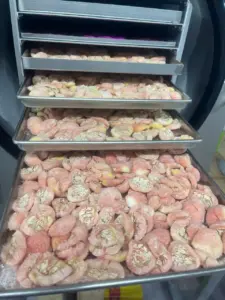
How many kilos of fresh rambutan make 1 kg of freeze-dried?
6–7 kg of peeled, seeded aril makes 1 kg of freeze-dried rambutan at 3–5% moisture. On the farm scale that is roughly 13–17 kg of whole fruit in the main season, because peel and seed are close to half of every rambutan.
That ratio is the floor under every honest quote. Multiply the local aril price by 6–7 before anyone has paid for a dryer, a foil bag or a carton. When a quote lands well below that floor, the difference comes out of the product, and it shows up in your warehouse rather than on the invoice.
Why 6–7 kg of aril, and where does the weight go?
Start with water. Fresh rambutan aril is about 80% water, so evaporation alone takes 4.8 kg of aril down to 1 kg of dry fruit. Nobody runs a rambutan line at 4.8. At FruitBuys partner facilities in the Mekong Delta and Southeast Vietnam, the gap between 4.8 and 6–7 kg breaks down like this:
| Where the weight goes | Share of aril | What happens on the line |
|---|---|---|
| Water removed | ~80% | Leaves as vapour in the freeze-dryer |
| Seeding rejects | 8–12% | Workers push the seed out with a pointed knife. Where the seed holds tight, common in Java fruit and early-season pickings, the aril tears and comes off the halves grade |
| Drip loss | 3–5% | Once the cavity is opened, sweet juice runs onto the tray before freezing |
| Fines at unloading and packing | <5% | Dried aril is brittle as glass; edges crack when it is scraped from steel trays |
Add the three line losses to the water and you arrive at the 6–7 kg every honest rambutan quote is built on.
Why does rambutan cost more to process than mango?
Two reasons, both visible on the production floor.
The first is labour. A skilled worker peeling and seeding by hand turns out 8–12 kg of clean aril per hour. At 6–7 kg per finished kilo, that is roughly 1.2–2 kg of freeze-dried rambutan per working hour, before drying has even started. Mango is sliced; rambutan is opened one fruit at a time.
The second is the dryer. A rambutan half is a hollow dome. It does not lie flat on a tray the way a mango slice or a dragon fruit slice does, so each dryer batch holds 20–30% less fruit by weight. The cycle time and energy are the same; the output is smaller.
Neither cost can be engineered away without changing the product. When a rambutan quote looks like a mango quote, one of these two steps has been cut.
How does the season change yield and eating quality?
The main crop runs May to August. Fruit is full-sized, Brix sits at 18–22°, and about 6.0 kg of aril makes 1 kg of finished product. The dried half comes out thick-walled and crisp, with a full floral sweetness that holds in the finish.
Off-season fruit from December to March, and fruit picked straight after heavy rain, is a different raw material. Brix drops to 15–16°, the aril carries more water and less sugar, and it takes 7.0–7.5 kg of aril to make the same kilo. Because the arils are thinner too, whole fruit per finished kilo climbs to 16–20 kg. The dried half comes out thin, airy and noticeably sharper. The fruit itself costs more too: off-season flowering is forced with tarpaulins and water stress, and in November 2026 off-season Java rambutan traded at about three times its main-crop farm-gate level.
That is the case for booking before May. A full-year programme contracted ahead of the main crop gives you lower raw-material cost per kilo and a thicker, sweeter product in every carton.
How do you check whether a quote is realistic?
Use the ratio as a floor, and fill in the local numbers yourself:
Raw-material floor per kg = peeled aril price per kg × 6–7
Then add hand labour, drying, packing materials, cartons and inland freight. Compare the sum with the quote. A small gap is margin and efficiency. A large gap means the supplier is doing one of four things:
- Shipping wetter product. A lot packed at 7–8% moisture weighs more for the same fruit. Your customer bites into something chewy and leathery instead of a clean snap, and the snack positioning you paid for is gone. The COA and your own aw reading catch it.
- Filling with fines. Broken pieces cost nothing extra and add weight to every bag. Weigh out the fines from the pre-shipment sample.
- Buying low-Brix or off-grade fruit. Underripe or rain-soaked fruit is cheaper at the farm gate and dries to a flat, sour product with a yellow cast.
- Skipping the sorting line. Fewer rejects means more weight out, and more hard seed fragments left in the cavity. Split ten halves and look.
For your landed cost, add ocean freight per kilo from the carton weight, the import duty on your line (0% into the EU with a Form EUR.1; the US and other reference rates are in what freeze-dried rambutan needs to clear US, EU, UK and UAE customs) and your broker’s fees.
This is the check every buyer should run, including on us. A quote that holds up against this formula is one you can build a programme on.
Why can’t the conversion ratio be used for pesticide limits?
Because it measures something else. The 6–7 kg figure includes seeding rejects, drip and fines, none of which concentrates residues. Regulators compare a dried result with a fresh-fruit maximum residue limit using the processing factor, which is based on moisture alone:
Pf = (100 − moisture of dried product) ÷ (100 − moisture of fresh aril)
For freeze-dried rambutan at 4% moisture made from aril at 80% moisture, Pf = 96 ÷ 20 = 4.8. Divide the lab result on the dried product by 4.8 to get the fresh-weight equivalent your QA team compares with the MRL. Dividing by 6–7, or by the whole-fruit figure, would overstate the dilution and understate what the fruit carried. Get this one number right and a lot does not get rejected on paper for residues it never had.
When should you buy pieces or fines instead of halves?
When the shape never reaches your customer. Arils that tear at seeding or crack at unloading have the same 18–22° Brix, the same pale blush colour and the same flavour as whole halves; they simply fail the halves grade. That grading loss is a large part of what you pay for in a halves price.
If the rambutan goes into chocolate centres, granola bars, cereal clusters or milled powder, buy pieces (8–15 mm) or industrial fines instead. You stop paying for a shape you are about to break, and raw-material cost typically comes down 15–25% against halves. Keep halves for retail snack packs and toppings, where the whole dome is what sells the product.
FAQ
How much fresh rambutan do you need for 1 kg of freeze-dried?
About 6.0 kg of peeled, seeded aril in the main season and up to 7.0–7.5 kg off-season. In whole fruit that is 13–17 kg in season and 16–20 kg off-season.
Why is freeze-dried rambutan more expensive than freeze-dried mango or pineapple?
Every fruit is peeled and seeded by hand at 8–12 kg of aril per worker-hour, 15–22% of the aril is lost to seeding rejects, drip and fines, and the hollow halves fill a dryer tray 20–30% lighter than flat slices.
When is the best time to contract?
Before May, so your volume runs on main-crop fruit at 18–22° Brix.
How can I tell if a cheap quote cuts corners?
Check moisture and aw on the COA, weigh the fines in the pre-shipment sample, and split ten halves to look for hard seed fragments in the cavity.
What processing factor should I use for residue results?
About 4.8 for freeze-dried rambutan at 4% moisture: Pf = (100 − 4) ÷ (100 − 80). Divide the dried result by Pf to get the fresh-weight equivalent.
Test your quotes against a real specification
Send us the volume, format and destination you are quoting for. We return a full specification with moisture, aw, fines limit and carton weight, so every quote on your desk can be compared on the same basis. Season planning is in when freeze-dried rambutan is available, format choice in which freeze-dried rambutan format fits your product, product details on the freeze-dried rambutan product page, and the full checklist in what to check before buying freeze-dried rambutan in bulk.



